Category: Data

Data is a source of in-depth reports, visualisations and market analyses that show the real picture of the IT industry and the IT sales channel. These are unique breakdowns on vendors, distributors, integrators and trends.

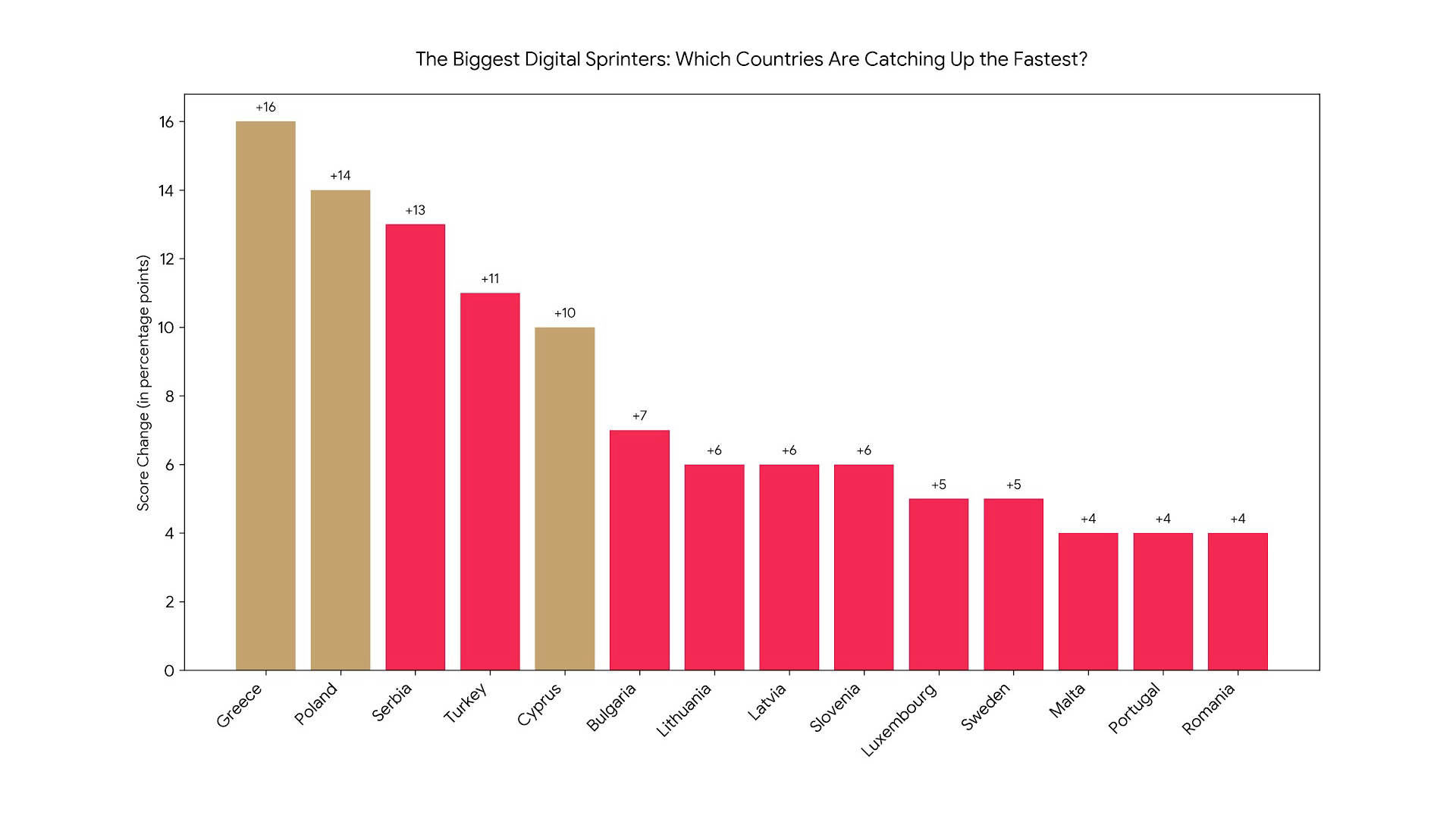
  • Digitisation of public services in Europe: leaders, laggards and the Polish paradox

    Digitisation of public services in Europe: leaders, laggards and the Polish paradox

    Set up in minutes from your smartphone, without a single paper document. Access to all medical records in a few clicks. Settling taxes thanks to forms that the administration has filled out for us.

    This is not a vision of the future, but an everyday reality in the digital vanguard of the European Union. At the same time, in other member states, the same processes can still be a multi-stage, bureaucratic ordeal. This contrast perfectly illustrates the revolution that is the digitalisation of public services – a fundamental change in the relationship between the state, the citizen and the entrepreneur.

    To measure progress in this transformation, the European Commission has been publishing the Digital Economy and Society Index(DESI) since 2014. It is a key analytical tool that assesses countries in four areas: human capital, connectivity, digital integration and digital public services.

    From 2023, the DESI indicators became part of the Road to the Digital Decade programme, setting ambitious 2030 targets for the entire Union, such as 100% availability of key public services online.

    Analysis of DESI data paints a picture of a two-speed Europe. On the one hand, we have a group of leaders who are setting global standards, on the other, a peloton of countries still catching up. Poland occupies a fascinating and contradictory position in this landscape – a country that impresses in some aspects of e-government and lags far behind in others.

    EU leaders: anatomy of a digital success story

    The same group of countries has been at the top of the European digitalisation rankings for years: the Scandinavian countries (Finland, Denmark), the Benelux countries (Netherlands, Luxembourg) and an absolute phenomenon in this field – Estonia. Countries such as Malta and Spain have also joined the top, having made a huge leap in quality in recent years.

    Their success is not a coincidence, but the result of a coherent, long-term strategy based on several pillars.

    Firstly, long-term vision and political will. In these countries, digitalisation is a strategic state priority, pursued regardless of changes in the political scene.

    Secondly, strategic investment. Leaders not only allocate sizable resources, but also make effective use of EU funds such as the Reconstruction and Resilience Facility (RRF).

    Third, a solid foundation. A high level of e-services is inextricably linked to the digital competence of the population and universal access to ultrafast internet – areas in which the Nordic countries are world leaders.

    The most important factor, however, is the culture of trust. Citizens in Scandinavian countries or Estonia trust the state to process their data securely and transparently. This trust is the currency that enables the implementation of advanced services such as digital identity (eID) or centralised medical e-documentation.

    These elements create a ‘flywheel effect’. The successful implementation of one key service builds trust and gets citizens used to interacting with the state online. This, in turn, creates demand for further and more advanced solutions, driving further development.

    In this way, the leaders not only maintain their lead, but actually increase it, making it extremely difficult for the rest of the stakes to catch up with them.

    To understand how this works in practice, just look at some examples:

    • Estonia is a global model of a ‘digital nation’, where 99% of public services are available online. The backbone of the system is X-Road, a secure data exchange platform that implements the “once-only” principle. – a citizen only provides their data to the administration once. Every Estonian has a digital identity card (e-ID) that allows for a legally binding signature, saving everyone an average of five working days per year. The country has even gone a step further by creating e-Residency, a programme that allows entrepreneurs from all over the world to set up and run a company remotely in the EU.
    • Denmark is a champion of user-centred service design. Instead of forcing citizens to navigate a complex structure of offices, Denmark has consolidated services into portals based on ‘life events’. Borger.dk is a one-stop shop for citizens to deal with almost any issue, from taxes to enrolling a child in school, and virk.dk is its counterpart for business.
    • Finland and the Netherlands are examples of pragmatism and innovation. Finland is developing proactive services based on artificial intelligence (AuroraAI programme) to anticipate citizens’ needs at key moments in their lives. The strength of the Netherlands, on the other hand, is its extremely solid foundations – the highest digital competence rates of the population in the EU and the excellent infrastructure on which the entire ecosystem of services centred around the DigiDdigital identity is based.

    The Polish paradox: the leader at the back of the pack

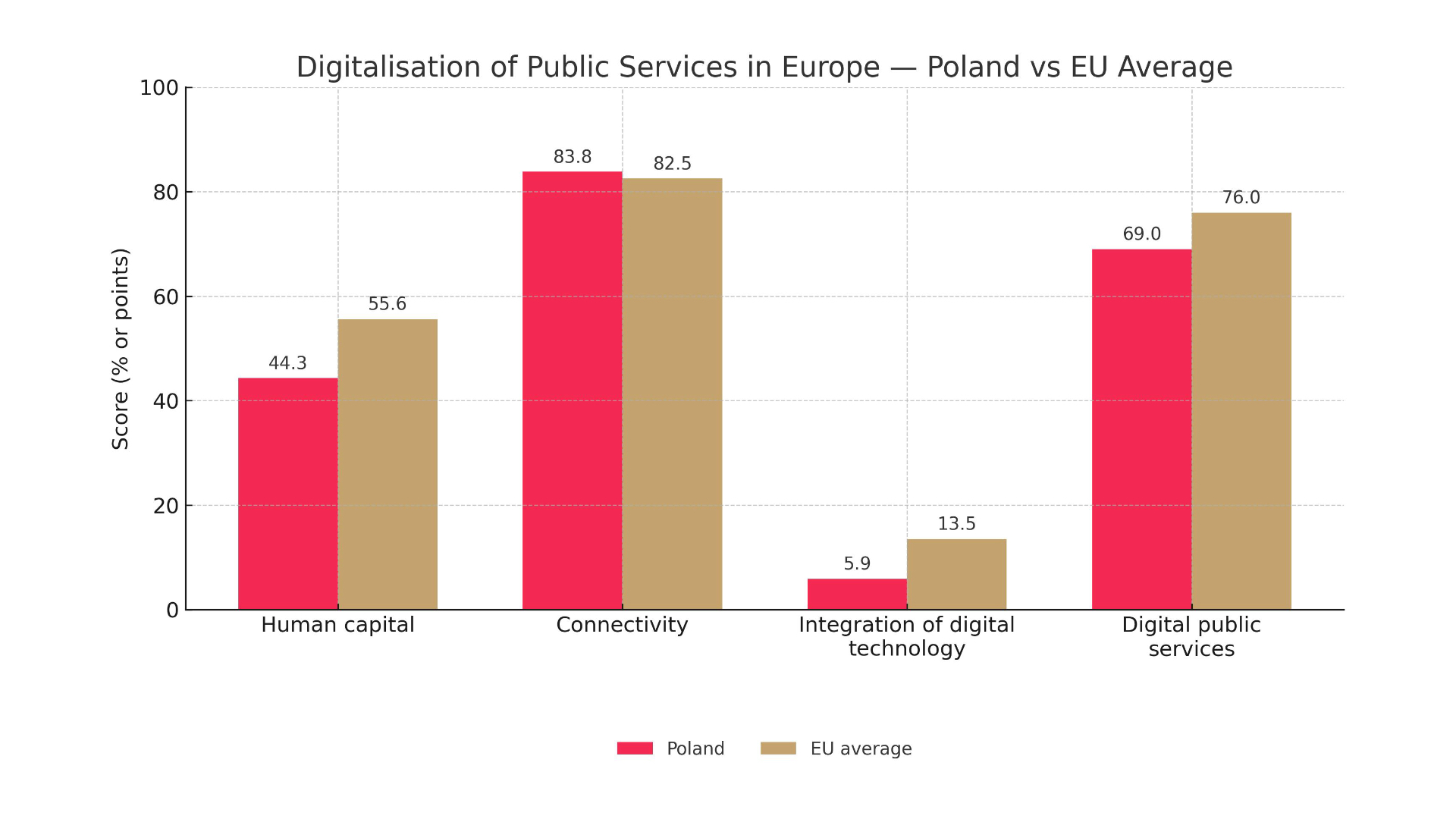
    An analysis of Poland’s position on the digital map of Europe leads to surprising conclusions. In the overall DESI 2022 ranking, Poland ranks at the bottom, taking 24th place out of 27 countries. Our performance in key areas, such as human capital or the integration of digital technologies by companies, is well below the EU average.

    However, there is one bright spot in this bleak picture: digital public services. In this category, Poland not only performs relatively best, but shows one of the highest rates of improvement in the entire EU. In several key indicators, we have even surpassed the European average:

    • Pre-filled forms: as many as 78% of online forms in the Polish administration are pre-filled with data that the state already has (EU average: 68%).
    • Access to medical e-documentation: Thanks to systems such as the Internet Patient Account (IKP), 86% of Poles have access to their medical data online (EU average: 72%).

    These successes are the fruit of the development of platforms such as the gov.pl portal, the mObywatel application or the ZUS Electronic Services Platform. However, behind this impressive facade lies a deeper problem. Despite the fact that we are creating advanced services that are well rated in benchmarks, their actual use by citizens is alarmingly low.

    Only 37% of Poles use e-government, while the average in 16 EU countries exceeds 50% and in Denmark it reaches 73%.

    So we face the risk of a digital ‘Potemkin village’. We have built state-of-the-art e-services that perform brilliantly in technical audits, but they stand on weak foundations – some of the lowest digital literacy rates of the population in the EU. There is a deep gap between accessibility and service adoption. It is this gap that is the biggest challenge for Poland’s digital transformation.

    Strategy 2035: a plan for a digital leap

    In October 2024, the Polish government presented the draft “Digitisation Strategy of Poland until 2035”. – a document that attempts to provide a comprehensive response to the challenges described above. Its ambitions are revolutionary. By 2035, 100% of official matters are to be handled digitally, 20 million Poles are to have a digital identity wallet in the mCitizen application, and the number of ICT specialists is to increase to 1.5 million. PLN 100 billion is to be allocated to realise these goals by 2030.

    More importantly, however, the strategy is holistic. It explicitly states the need to end ‘silos’ in government and combines the development of e-services with powerful investments in the foundations: digital competences (target: 85% of citizens with basic skills), infrastructure and cyber-security.

    This demonstrates the understanding that it is impossible to achieve sustainable success by building more applications without parallel work on the skills and trust of citizens.

    “Strategy 2035” should be seen as an attempt to “set off its own flywheel”. It is a plan for rapid acceleration, which should make it possible not only to catch up, but to realistically close the development gap separating us from European leaders.

    From technology to people

    Europe’s digital transformation is a process that exposes deeper gaps in social capital, trust and long-term planning. Poland, despite impressive progress in the creation of e-services, is still struggling with a fundamental challenge: how to make advanced tools widely used and accessible to all.

    The new digitalisation strategy makes the right diagnosis, shifting the focus from the technology itself to building competence and an integrated ecosystem. Its success will depend on consistency in implementation.

    For the true measure of success will not be the number of new applications, but the percentage of citizens who can use them consciously, safely and effectively. The road from a ‘Potemkin village’ to a fully digital nation is not a technological sprint, but an educational and social marathon.

  • AI adoption in the EU. Ranking of countries from leader to marauder

    AI adoption in the EU. Ranking of countries from leader to marauder

    The artificial intelligence revolution, long heralded in boardrooms and research labs, is finally starting to take shape in the European business landscape.

    The data shows an unprecedented acceleration that suggests that companies on the Old Continent are opening up to new technologies en masse. However, beneath the surface of these impressive figures lies a much more complex and nuanced picture.

    The key question is whether we are witnessing a deep, transformational wave that will lift the entire economy, or rather a concentrated wave that bypasses most businesses

    The latest Eurostat figures provide the starting point for this analysis. In 2024, 13.5% of businesses in the European Union (with 10 or more employees) will be using artificial intelligence technology.

    At first glance, this figure may seem modest, but its true significance is revealed when compared to the previous year. In 2023, the rate was only 8.0%.

    This represents an increase of 5.5 percentage points in just twelve months – a dynamic that has almost doubled the overall level of AI adoption across the Union. Such a sharp jump signals that barriers to entry are falling and companies are seeing increasingly tangible benefits from implementing intelligent systems.

    However, before declaring AI a universal triumph, it is important to look at the other side of the coin. A rate of 13.5% also means that the overwhelming majority, more than 86% of European companies, are still not using AI in their operations.

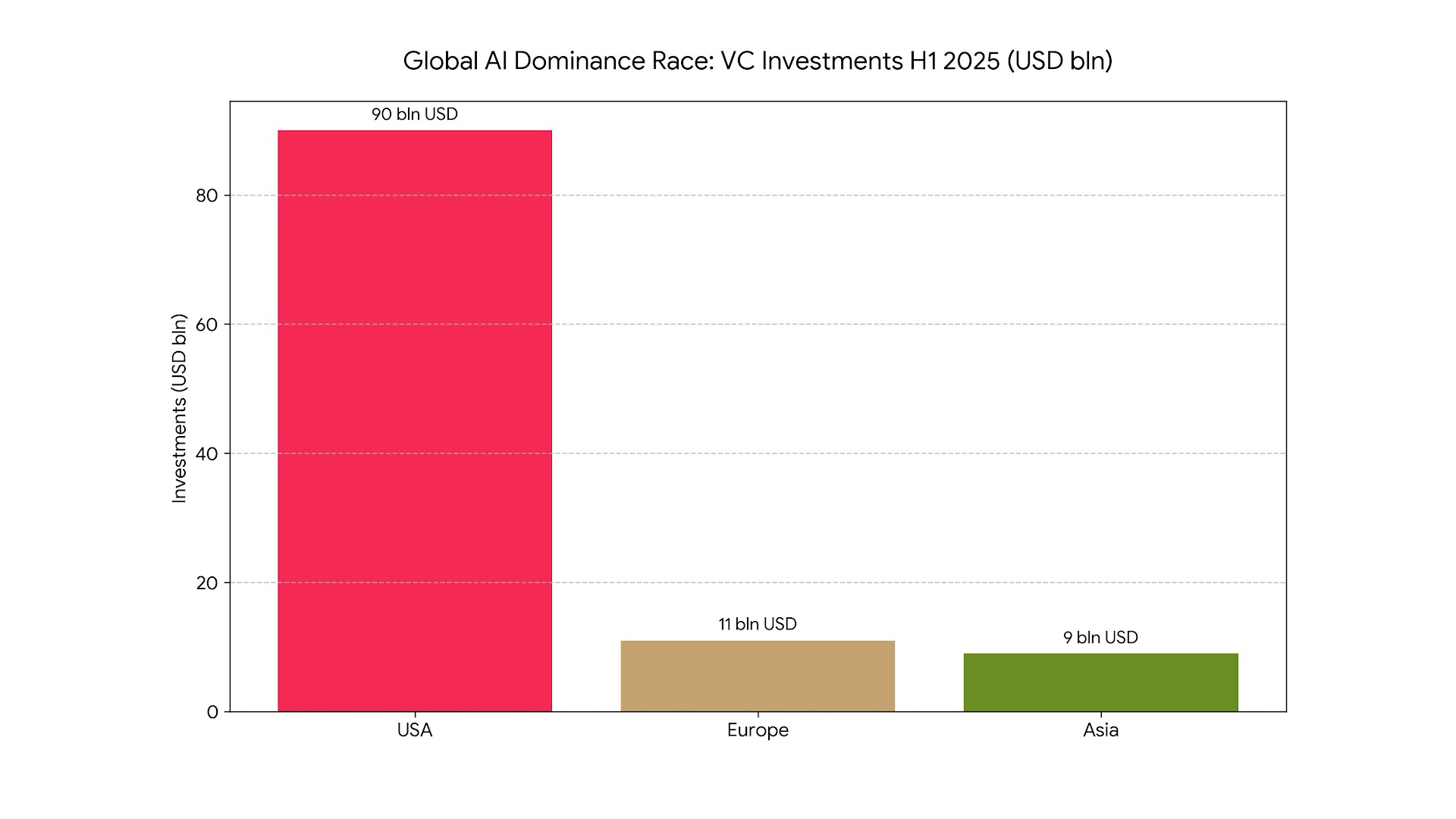
    This shows how far we are from widespread implementation. Moreover, this growth needs to be put in a global context, where Europe is often seen as lagging behind the US and China in terms of both investment and scale of AI deployments.

    This perspective adds urgency to understanding the nature of the current spurt. There is a real risk that Europe, by focusing on regulation, may miss out on the ‘historic wave of wealth creation’ driven by the rapid and widespread deployment of AI in other parts of the world.

    So what is driving this sudden increase? Analysis of the data suggests that this is no coincidence. The surge in adoption between 2023 and 2024 correlates perfectly with the explosion in popularity of generative artificial intelligence, epitomised by ChatGPT, which was released to the general public in late 2022.

    Further data shows that language processing technologies such as text mining and natural language generation have seen the greatest growth. This leads to the conclusion that the current wave of adoption is largely driven by more readily available, often off-the-shelf language applications, rather than the sudden widespread deployment of complex, deeply integrated machine learning systems.

    This is where the ‘hype’ around generative AI is transforming into the first real business applications, lowering the threshold of entry for many companies that previously saw AI as too complex and expensive a technology.

    Europe’s AI map: a continent full of contrasts

    A geographical analysis of artificial intelligence deployments in the European Union reveals a picture of a deeply divided continent. Instead of a united front of technological progress, we see clear clusters of leaders, a group of marauders, and key economies that position themselves in the middle.

    This map of contrasts is key to understanding where AI is already a business reality and where it remains only an aspiration.

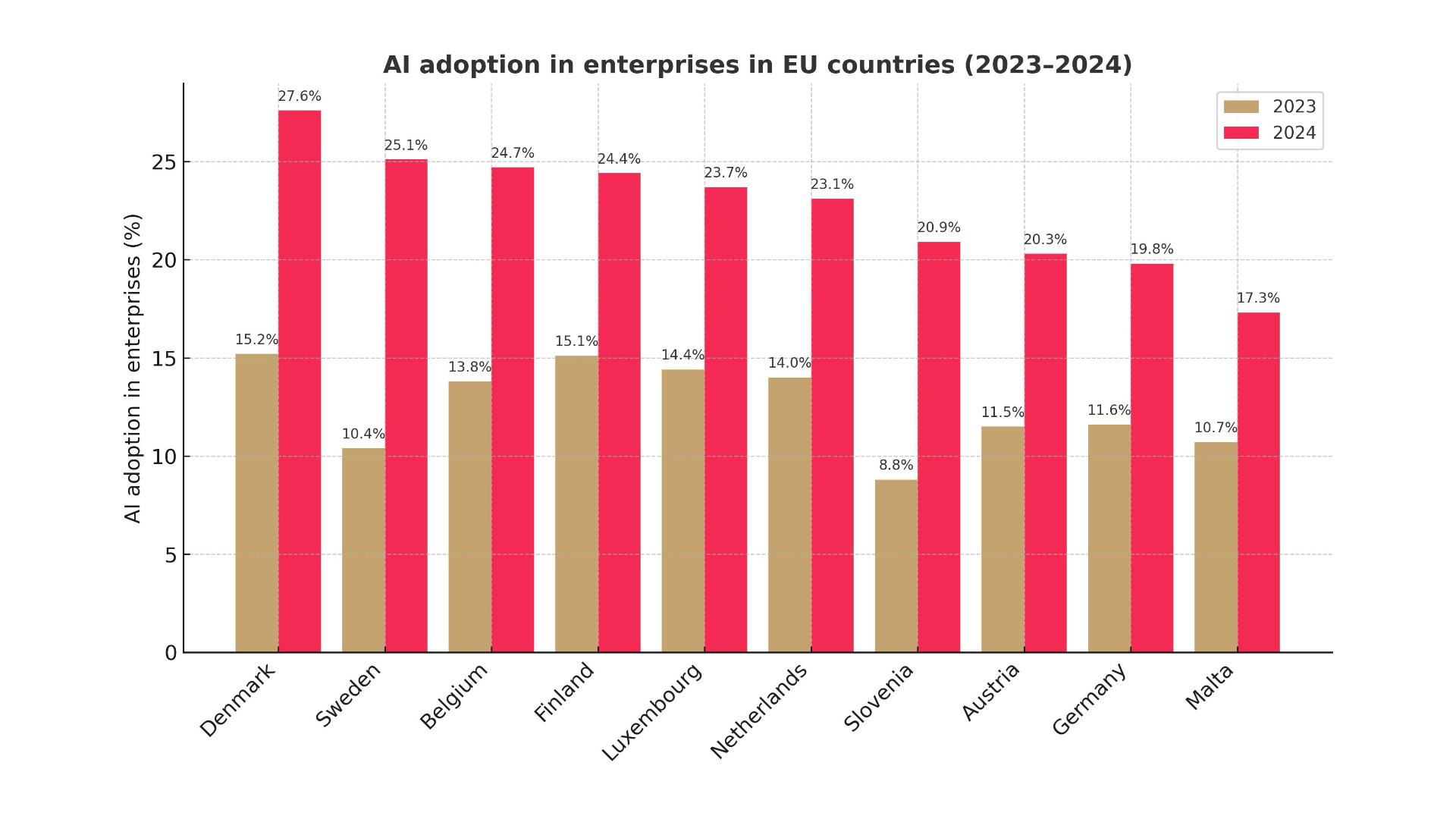
    At the head of the peloton is a clear bloc of Nordic and Benelux countries, which are setting the pace for the rest of the continent. Denmark is the undisputed leader in the EU, with an AI adoption rate of 27.6%.

    This is closely followed by Sweden (25.1%) and Belgium (24.7%). Finland (24.4%) and Luxembourg (23.7%) are also in this top group. It is noteworthy that the rates in these countries are more than double the EU average, demonstrating their digital sophistication and maturity.

    At the other extreme are the countries of Eastern and Southern Europe, where AI adoption is progressing much more slowly. Romania closes the rate with the lowest rate in the entire Union, at just 3.1 per cent.

    The situation is not much better in Poland (5.9%) and Bulgaria (6.5%), which also lag significantly behind the average. This gap between leaders and laggards is not static – it is widening. Growth dynamics show that the leaders are accelerating even further. Sweden recorded the highest annual growth (+14.7 p.p.), closely followed by Denmark (+12.4 p.p.) and Belgium (+10.9 p.p.). At the same time, countries such as Portugal (+0.8 p.p.) and Romania (+1.6 p.p.) are growing at a much slower pace, making the gap to the top ever wider.

    Europe’s largest economies present a more mixed picture. Germany, with a score of 19.8%, ranks well above the EU average. The case of France is surprising.

    Despite being a European leader in the development of advanced AI models (with 3 influential models coming from France in 2024), the adoption rate of AI in companies there is one of the lower ones, at just 9.9%. Spain also scores a modest 11.3%.

    The case of France sheds light on a key paradox: the discrepancy between innovation potential and market implementation. Having strong R&D centres and the capacity to create advanced technologies does not automatically translate into widespread business adoption.

    The low adoption rate in France suggests barriers to the internal market. These could be regulatory obstacles, a risk-averse business culture, or a gap in the skills needed to implement, rather than just create, AI.

    This shows that a thriving innovation ecosystem, consisting of startups and research labs, does not guarantee that the wider business ecosystem, especially small and medium-sized enterprises, will integrate these innovations.

    The path from the laboratory to the production floor is clearly narrowed in this case. There is an important lesson for policymakers: supporting research and development is not enough; a parallel strategy is needed to stimulate demand and facilitate market deployment.

    The great divide: why are large companies overtaking SMEs?

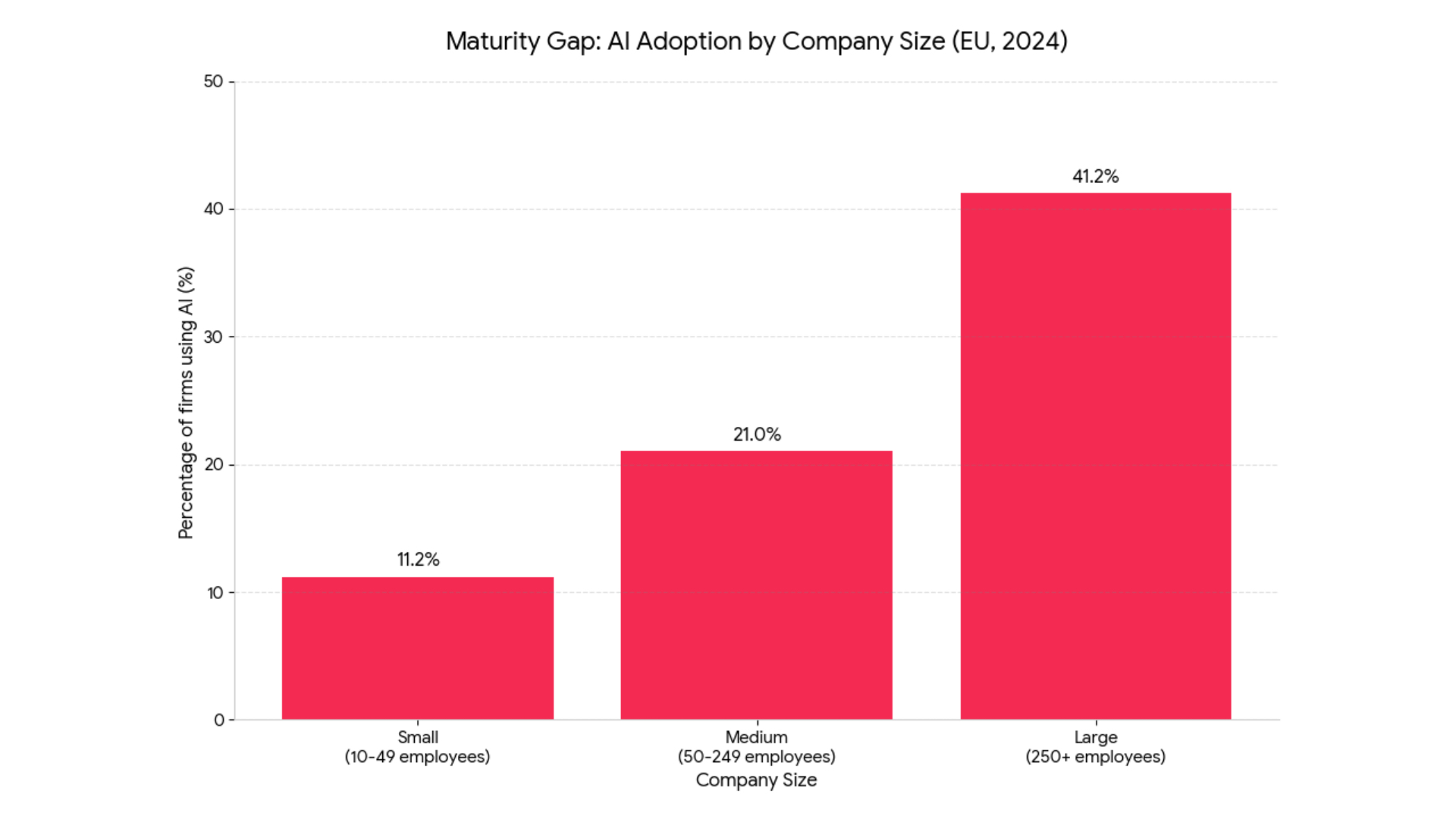
    One of the most striking findings from the data is the huge gap in AI adoption between large corporations and the small and medium-sized enterprise (SME) sector.

    This divergence is so significant that it threatens to create a bipolar economy in Europe, with technological leaders pulling away from the rest of the peloton, exacerbating inequalities in productivity and competitiveness.

    The figures speak for themselves. As many as 41.2% of large companies (with 250 or more employees) are actively using AI technology. This rate drops sharply to 20.9 per cent for medium-sized companies and reaches just 11.2 per cent in small companies (with 10 to 49 employees).

    What’s more, the rate of growth in large companies is also higher – their share of AI adoption has increased by more than 10 percentage points over the past year, further widening the existing gap.

    Eurostat points to three fundamental reasons for this disparity: implementation complexity, economies of scale (larger companies benefit more from automation and optimisation) and cost (large organisations have significantly more capital to invest in new technologies).

    These factors are reinforced by a strategic approach. Companies with a clearly defined and visible AI strategy are twice as likely to achieve AI-driven revenue growth – and the ability to do such strategic planning is much more common in large corporations.

    However, this disparity is not purely financial. Large companies have a key strategic advantage: the vast resources of their own data and the ability to attract rare and expensive AI talent.

    This creates a self-perpetuating cycle, a kind of ‘moat’ separating them from smaller competitors. More data allows them to train better, more effective AI models. These, in turn, generate further data and revenue, allowing the best specialists to be hired.

    Small and medium-sized companies are often outside this virtuous cycle. AI systems, especially those based on machine learning, require huge data sets to operate effectively. Large companies naturally generate and control much more data than SMEs.

    At the same time, a major barrier to adoption is the lack of skills and expertise. The best AI professionals are a limited and expensive resource. Large, recognisable brands with adequate budgets and ambitious projects easily attract this talent, while SMEs find it difficult to compete for them.

    As a result, the AI adoption gap among SMEs is not just a temporary lag, but a structural barrier, rooted in the fundamental requirements of AI technologies (data and talent). Without targeted policy interventions, such as data-sharing initiatives or training programmes for SMEs, this gap is likely to widen, leading to significant productivity gaps across the European economy.

    Sector spotlight: where AI is already an everyday business reality

    Having identified geographical and organisational leaders, the analysis moves to the sectoral level, answering the question: in which industries has AI taken deepest root? The data clearly shows that the AI revolution, at least for the time being, is a phenomenon heavily concentrated in the digital and knowledge-based sectors.

    For many traditional industries, artificial intelligence is still a distant future.

    The undisputed leader is the information and communication (ICT) sector, where as many as 48.7 per cent of companies are actively using AI technologies. This is almost four times the EU average and shows that AI is becoming a business standard in this industry. In second place, at a significant loss, is the professional, scientific and technical activities sector, with a still impressive adoption rate of 30.5%.

    Outside these two leaders, there is a sharp decline. All other sectors of the economy have AI adoption rates below 16%. Traditional industries such as construction show minimal interest, with implementations at just 6.1%.

    This polarisation is directly related to the nature of the industries themselves. The ICT and professional services sectors are inherently data-rich and digitally mature. Applications of AI for data analytics, process automation or content generation are obvious and relatively easy to implement in them.

    The AI adoption map coincides almost perfectly with the digital maturity map. Sectors that have already undergone significant digital transformation provide fertile ground on which AI is now taking root.

    From this, it follows that for traditional industries such as construction or manufacturing, the main challenge may not be AI technology itself, but the more fundamental lack of digitalisation and data infrastructure.

    Effective AI implementation requires a robust data infrastructure, data management skills and digitised business processes. Traditional sectors often lag behind in these basic digital capabilities.

    Therefore, decision-makers and companies in these industries cannot simply ‘implement AI’. They must first address the foundations of digitalisation. The challenge of AI adoption is in many cases symptomatic of a deeper digital maturity gap. Trying to impose AI solutions on companies that do not have a basic data infrastructure is a recipe for failure.

    Beyond the trendy buzzwords: what AI technologies are European companies actually using?

    This section separates the marketing hype from the business reality, looking at which specific AI tools are being deployed in European companies. It turns out that the current boom is overwhelmingly driven by language technologies, reflecting a fundamental shift in the market and the powerful impact of generative artificial intelligence.

    In 2024, the most used AI technology in the EU is text mining, or written language analysis, used by 6.9% of all companies. This is closely followed by natural language generation (NLG), used by 5.4% of companies, and speech recognition (4.8%).

    This is a significant change from 2023, when workflow automation was the most popular technology (3%) and NLG was used by only 2.1% of companies. In one year, the use of text mining and NLG has more than doubled, which is direct evidence of the impact of the AI generative revolution.

    What are companies using these tools for? The main business purpose of AI implementations is marketing and sales (34.1% of companies using AI), followed by the organisation of administrative and management processes (27.5%).

    These applications are ideally suited to the capabilities of language models, which excel at creating marketing content, communicating with customers (chatbots) and summarising information.

    In contrast, more complex applications, such as machine learning for data analytics, are used by a smaller percentage of companies overall, although it is the second most popular technology among large enterprises.

    The dominance of technologies such as text mining and NLG suggests that much of the current wave of adoption represents ‘shallow integration’. These are often standalone tools or APIs incorporated into existing processes – for example, the use of generative AI for marketing text writing.

    This is quite different from ‘deep integration’, which would involve re-engineering a key production process based on a predictive machine learning model. The dominant technologies are language-based and often available as off-the-shelf software.

    The main application areas are support functions such as marketing and administration, rather than key operations in most industries. Deep integration, such as the use of machine learning in manufacturing processes, requires significant data engineering, custom modelling and process redesign, which is much more complex and costly.

    This is borne out by the Accenture report, which shows that in Europe, only 8% of large-scale investments in AI to transform business operations have been implemented at scale, with many companies stuck in the ‘pilot phase’. The conclusion is clear: increasing the adoption rate to 13.5% is real, but it is heavily skewed towards easier-to-implement, shallowly integrated tools. This is a key distinction between hype and reality. While many companies are using AI today, far fewer are fundamentally transformed by it.

    Anatomy of a leader: an in-depth analysis of Denmark’s AI strategy

    To understand what drives success in AI adoption, it is worth taking a closer look at the undisputed leader of the European Union – Denmark. The Danish case study shows that the top ranking is not a coincidence, but the result of a proactive, coherent and well-funded national strategy.

    This case study can serve as a model for other countries seeking to accelerate their digital transformation.

    The result speaks for itself: with a 27.6% adoption rate of AI in companies, Denmark is far ahead of the rest of the EU. Behind this success is the national ‘AI Strategy’, launched in 2019 and strengthened in 2023.

    It is not just a policy document, but a concrete action plan, backed by dedicated funding of €200 million for research and development.

    Denmark’s strategy is based on several key pillars, which together form a coherent innovation-friendly ecosystem:

    • Ethical and human-centred foundation: from the outset, the Danish strategy emphasises the creation of a common ethical framework for AI. It focuses on trust, citizen self-determination and respect for human dignity. This approach builds both social and business trust, reducing one of the key barriers to adoption.
    • Targeting key sectors: rather than dispersing efforts, the strategy identifies priority areas where AI can make the most difference: healthcare, energy, agriculture and transport. This allows for the concentration of resources and the creation of specialised solutions.
    • Support for business, especially SMEs: The strategy includes specific initiatives to support companies. Examples are the Danish Growth Fund investment fund, aimed at companies basing their business model on AI, and the ‘Sprint:Digital’ programme, which helps SMEs with digital transformation.
    • Public sector leadership: One of the main goals is for the public sector to use AI to offer ‘world-class services’. This creates internal demand for innovation, promotes best practice and demonstrates the benefits of the technology.
    • Emphasis on collaboration: The Danish strategy promotes the creation of a collaborative ecosystem, especially with dynamic startups. A similar approach can be seen in another leader, Belgium, where up to 90 per cent of companies see collaboration with startups as crucial to the development of AI.

    Denmark’s success suggests that a proactive, investment-driven national strategy, focused on building a supportive ecosystem, is more effective in driving adoption than a pan-European approach that often puts regulation first.

    While the EU AI Act aims to create a single, trusted market, its complexity can generate uncertainty in the short term and slow down adoption. The Danish model focuses on building capacity and trust from the ground up.

    Denmark has a clear, well-funded and holistic AI strategy ahead of the full implementation of EU legislation. At the same time, some sources point to legal uncertainty and over-regulation as potential barriers to adoption in the wider European context.

    Leadership in AI adoption is therefore no accident. It is the result of a conscious, well-implemented national industrial policy. The Danish case proves that the government can actively shape the market and create an environment for success, not just regulate it. This is a powerful lesson for other EU member states.

    Roadblocks to revolution: barriers holding Europe back

    If the potential of artificial intelligence is so great, why is the adoption rate not reaching 50% or more? The answer lies in a number of barriers that inhibit the wider and deeper integration of AI in the European economy. An analysis of these barriers shows that the biggest challenge is not the technology itself, but the human factor and the regulatory environment.

    • The main barrier: lack of skills. In all the studies and reports, one factor comes to the fore as the biggest barrier: lack of appropriate skills and expertise. In one study from 2024, the importance of this factor increased in the perception of companies compared to the previous year, showing that the problem is growing. It’s not just about hiring data scientists; it’s about having employees who can identify AI use cases, manage implementation projects and work effectively with intelligent systems.
    • Cost and complexity. The high cost of implementation and the complexity of the technology remain significant barriers, especially for SMEs. Failure rates of AI projects are high worldwide (estimated at 30-84%) and are often due to organisational, not just technological, issues.
    • Data problems. Data availability and quality is another major obstacle. Many companies do not have the clean, structured and sufficiently large data sets necessary to train effective AI models.
    • Legal and regulatory uncertainty. While the EU AI Act aims to provide a clear framework, it can also be a source of uncertainty in the short term. Concerns about legal implications, data protection and privacy are cited as significant barriers. Some voices criticise the EU regulatory approach for potentially stifling innovation compared to the more liberal approach in the US.
    • Cultural resistance. A risk-averse culture and conservatism in the approach to business process change are cited as barriers more pronounced in Europe than in the US.

    Europe finds itself in a strategic paradox. Its flagship policy, the AI Act, aims to build long-term trust, which is essential for sustainable technology adoption. Ensuring security and respect for fundamental rights should, in theory, increase trust among companies and the public.

    However, in the short term, compliance burdens and legal ambiguities can act as a brake on innovation and adoption, especially for smaller companies that do not have extensive legal departments.

    Companies point to ‘unclear regulations’ and ‘lack of clarity on legal implications’ as significant barriers. This contrasts with the more market-driven approach of the US, which encourages faster innovation but raises more ethical concerns.

    So Europe is making a strategic choice: it is betting that a foundation of trust will ultimately lead to a more robust and human-centric AI ecosystem. The price for this, however, is lower speed and agility in the short term.

    This is not an unequivocally good or bad approach, but it is a key strategic decision that helps to explain why Europe may appear to be ‘lagging behind’ in raw adoption rates while trying to lead the way in responsible implementation.

    Separating hype from reality – the future of AI in European business

    Analysis of the data on AI adoption in Europe leads to clear, albeit complex, conclusions. The picture that emerges is not a uniform march towards the future, but rather a patchwork of concentrated excellence, dynamic but shallow growth and vast, still untapped potential.

    The leader is the region, not a single country. The true leader of AI adoption in Europe is not a single country, but a regional bloc including the Nordic countries and Benelux. Their success is based on a solid foundation of high digital maturity and proactive, ecosystem-focused national strategies.

    Hype drives real but ‘shallow’ growth. The hype around generative AI is not empty; it has become a direct catalyst for a surge in adoption. However, this is largely ‘shallow’ adoption – focused on readily available language tools used in support functions such as marketing and administration. Deep, transformational integration of AI into key business processes in most companies is still lacking.

    The reality is a two-speed Europe. The European AI landscape is defined by deep divisions: between the digitally advanced North and South and East; between large corporations and the SME sector; and between digital sectors and traditional industries. The benefits of the AI revolution currently accumulate in a small, elite segment of the European economy.

    The main bottleneck is human. Europe’s biggest challenge is not access to technology, but a widespread shortage of AI skills and expertise. Overcoming this talent gap is the most important factor that can unlock wider adoption.
  • Polish software house market: between record exports and internal correction

    Polish software house market: between record exports and internal correction

    For more than a decade, the Polish IT sector has been synonymous with uninterrupted, dynamic growth. It has established itself as the technological heart of Central and Eastern Europe, attracting global investment thanks to its huge talent pool and reputation as a reliable partner in nearshoring and outsourcing projects. The narrative of a ‘golden decade’ for Polish IT, driven by thousands of software houses and skilled developers valued worldwide, has become almost an axiom. However, in the past several months or so, this optimistic picture has begun to crack and the market has started to send deeply contradictory signals that have sown the seeds of uncertainty.

    On the one hand, hard macroeconomic data paints a picture of a sector in peak form. The value of Polish IT services exports is breaking new records, demonstrating extraordinary strength and global competitiveness . Poland sells more IT services abroad than such technological powers as Japan or South Korea, which testifies to the maturity and sophistication of the solutions offered . On the other hand, there are increasingly loud signals from inside the industry about a cooling of the economy. Industry portals and labour market reports report a slowdown in recruitment, job cuts and a general sense of ‘adjustment’ after years of unbridled boom . This clash of two radically different narratives creates a fundamental paradox.

    Are we witnessing the beginning of a stagnation that will end an era of spectacular growth? Or is this just a temporary breathlessness, a natural consequence of the global economic slowdown? Or, as seems most likely, are we seeing something much deeper – a fundamental process of market maturation and restructuring that is separating innovation leaders from companies basing their model on simpler services?

    Market fundamentals: Between impressive scale and growing pressure

    In order to understand the current state of the software house market, it is first necessary to look at its foundations – the number and structure of the companies that make it up. Registration data from the Central Statistical Office (CSO) and the Central Register and Information on Economic Activity (CEIDG) provide key information about the scale and dynamics of this ecosystem.

    The analysis of the Polish IT sector is based on the Polish Classification of Activities (PKD), where the key role is played by Section J, Division 62: ‘Computer programming, consultancy and related activities’ . This category covers a wide range of activities, from code writing (PKD 62.01.Z), to IT consultancy (PKD 62.02.Z), to other information and computer technology services (PKD 62.09.Z). It is these subclasses that largely define the software house ecosystem in Poland.

    Data from the REGON register, maintained by the Central Statistical Office, shows the impressive scale of the market . Industry reports estimate the number of technology companies in Poland at over 60,000, and between 500,000 and even 850,000 people work in the IT sector. This huge number of active entities testifies to the extraordinary density and vitality of the market. It is a landscape dominated by micro, small and medium-sized enterprises, which on the one hand testifies to the low barriers to entry and entrepreneurship, and on the other makes it more susceptible to economic fluctuations.

    However, the sheer size of the market is only one side of the coin. The other, much more dynamic, is hidden in the CEIDG data, which records the fate of sole proprietorships (JDG) – a legal form extremely popular with contract programmers and small IT companies. An analysis of the number of deregistrations and business suspensions sheds light on the pressure this segment of the market has come under. The data from the last few years are clear and point to increasing pressure. In 2022, CEIDG received 9.6% more applications to close a sole proprietorship than the year before. In the first half of the other year analysed, the increase was even more dramatic at nearly 26% year-on-year. These figures are hard evidence that market conditions have become much more difficult for many smaller players.

    The reasons for this phenomenon have to be sought in a combination of macroeconomic and regulatory factors. The global slowdown, high inflation, rising costs of doing business and changes in the legal and tax environment, such as the introduction of the Polish Deal, have hit the smallest entities in particular . However, these figures should be interpreted with caution. The high number of closures and suspensions in CEIDG is not only a symptom of the crisis. It also reflects the nature of the IT industry, which is dominated by project work. The CEIDG system is designed to make it easy to set up, suspend and close a business. For a contractor programmer, closing down a company can simply mean the end of one major project and moving to a contract of employment, and suspending a business is a common tool to manage liquidity in between assignments.

    Global driving force: Exports as a barometer of success

    While data from the domestic market point to increasing pressure, analysis of international trade paints a very different picture. The Polish IT sector has become a real export powerhouse in recent years, and the growth rate of foreign sales is a key argument against the stagnation thesis.

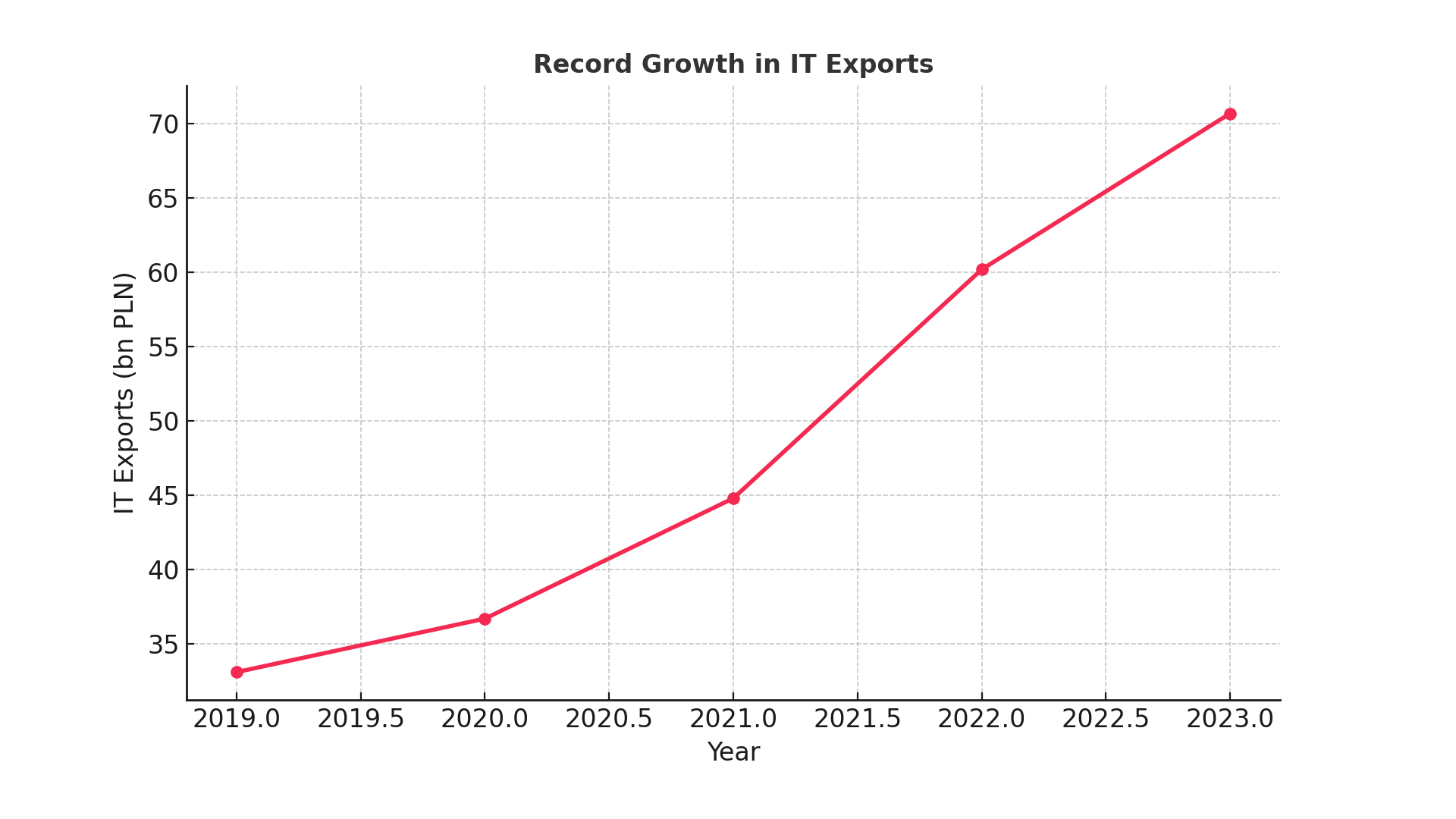
    The figures speak for themselves. The value of Polish exports of services in the ‘telecommunications, IT and information’ category has increased from around PLN 33.1 billion in 2019 to more than PLN 70.7 billion in 2023 . This represents a more than doubling in just four years. Since 2010, exports of IT services have grown at an average annual rate of more than 20%, more than twice as fast as exports of all services in general . As a result, the share of IT services in total Polish services exports has increased from around 5% a decade ago to nearly 13% in 2022 .

    According to data from the Polish Development Fund, based on Eurostat statistics, at the end of 2022 exports of IT services from Poland reached a value of EUR 11.66 billion, generating a significant trade surplus . Importantly, there has not been a single year of decline in this category since 2010, demonstrating the unrelenting demand for Polish digital competencies . This impressive trend fits into the wider European context. Eurostat data shows that telecommunications, computer and information services are one of the fastest-growing export categories for the European Union as a whole, with their share of total services exports (outside the EU) increasing by 7.2 percentage points between 2013 and 2023 .

    This growth is not only quantitative, but above all qualitative. The Polish IT industry is breaking away from the image of a ‘digital assembly plant’, where the main competitive advantage was the lower price of software services. Increasingly, Polish companies are becoming strategic partners for global corporations, providing complex and technologically advanced solutions. Exported services are no longer just simple software development, but also advanced research and development (R&D) projects, strategic IT consulting, cloud services, cyber security and data analytics . This evolution is evidence of Poland moving up the global value chain. The main directions of this expansion are the world’s most demanding markets: the European Union countries (with Germany at the forefront), the United States, the United Kingdom and Switzerland.

    Market reality: the end of the eldorado and a changing of the guard

    The period when recruiters vied for every candidate and companies outdid each other in offering ever higher salaries is over. The last two years have seen a marked cooling and normalisation in the IT job market, which many observers describe as the ‘end of the eldorado’ . Reports from recruitment portals clearly indicate a shift in the balance of power.

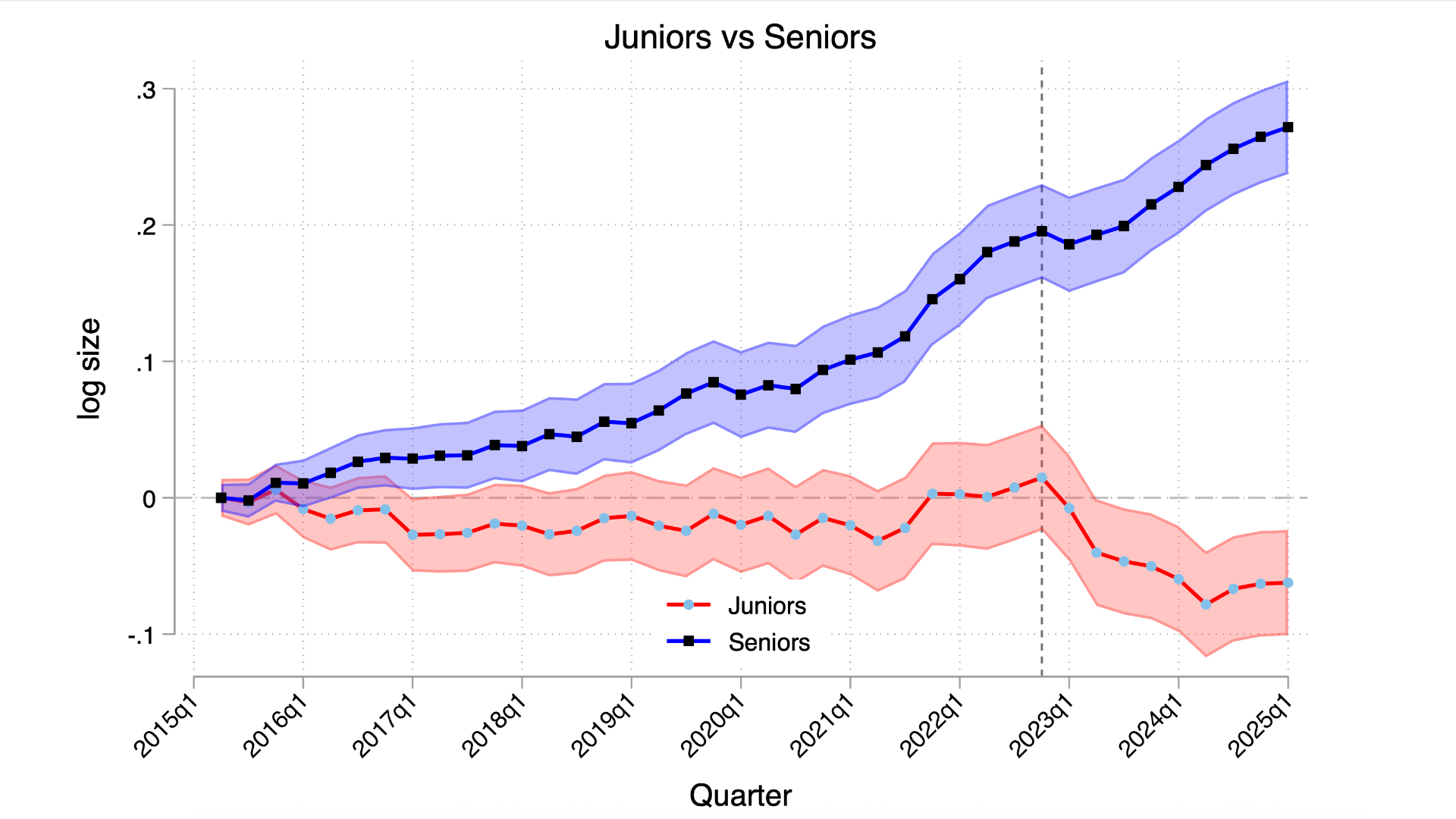
    The number of job offers published has fallen significantly compared to the peak years of 2021-2022 . At the same time, the number of applications per position has increased dramatically, with an average of 44 applications per offer in 2024, compared to 40 the year before . The most noticeable consequence of this change is the drastic reduction in opportunities for juniors. Companies, seeking to optimise costs and minimise risk, prefer to invest in experienced seniors who can deliver business value from day one . This turnaround in the market also comes at a human price – reports indicate increasing levels of stress, job burnout and feelings of job insecurity.

    The cooling in the labour market is a direct consequence of the global economic downturn, which has forced software house clients to review their budgets . Inflation and economic uncertainty have prompted companies around the world to take a more cautious approach to technology investments . Customers, looking to save money, are freezing less critical projects and scrutinising every purchasing decision much more closely . For Polish software houses, this means longer sales cycles and the need to prove return on investment (ROI) at every step. The data from the SoDA report are telling here: small companies (up to 50 people) reduced an average of 26% of their IT specialists in the last year, while in large organisations (more than 300 people) this percentage was 12% . This shows that the market correction is hitting smaller, less stable players hardest.

    New market requirements – Specialisation as the key to survival

    The current market environment acts as a powerful evolutionary filter. In the boom times, demand was so high that almost every company, even those offering uncomplicated outsourcing of programmers (‘body leasing’), could count on orders. Today, the situation is radically different. The market places a premium on specialisation, deep domain knowledge and the ability to deliver complex, measurable business solutions.

    Demand is shifting away from generalist programmers towards experts in niche but rapidly growing fields. An analysis of job vacancies shows that even with an overall decrease in the number of advertisements, areas such as Artificial Intelligence (AI/ML), Cyber Security, Data Analytics (Data & BI) and Cloud Engineering are still seeing increases in demand and offering high salaries . A company that today simply offers ‘Java developers’ is competing in a market that is becoming a commodity, susceptible to price pressure. By contrast, a company that provides ‘certified cyber security experts for the financial sector’ or ‘AI engineers with experience in logistics optimisation’ is selling a unique, high-margin solution.

    This transformation is painful, but in the long term healthy for the sector as a whole. The market correction is not killing the industry, but accelerating its transition from a labour arbitrage-based model to one based on knowledge and innovation. This is a classic symptom of the industry’s transition from a phase of explosive growth to a phase of mature, more sustainable competition.

    Not stagnation, but maturing through correction

    Analysis of the data leads to a clear conclusion. What the Polish software house market is experiencing is not stagnation. It is a complex and multifaceted maturation process that is taking place through a profound, albeit painful, market correction.

    Record exports and internal slowdown are not contradictory phenomena, but two sides of the same coin. Spectacular export success is being driven by leading players who have successfully moved to the next level of technological sophistication. The same process, however, raises the bar for the market as a whole. An internal adjustment, manifested by a slowdown in recruitment and pressure on smaller companies, is a natural consequence of this evolution.

    The “golden decade” of easy, undifferentiated growth is irrevocably over. The future of the Polish IT sector will be shaped by new paradigms:

    • Deep specialisation: Survival and growth will depend on the ability to build unique expertise in niche but strategically important areas. Companies must become experts in specific technologies (AI, cyber security, cloud) or industry verticals (fintech, healthtech, e-commerce).
    • Business maturity: Skills in sales, marketing, financial management and strategy building will become crucial. Software houses need to evolve from technology workshops into mature, efficiently managed businesses .
    • The AI revolution: artificial intelligence is becoming a fundamental tool to be integrated into your own processes to increase efficiency and reduce project delivery times. Companies that ignore this trend risk losing their competitiveness .

    Although the current period is challenging, the outlook for the Polish IT sector remains optimistic. As it goes through this transformation, the industry is becoming stronger, more diverse and resilient to shocks. The adjustment, although painful, is a necessary stage in the evolution that is transforming the Polish IT sector from a regional talent basin into a mature global technology leader capable of competing at the highest global level .

  • IT imports to Poland and exchange rates – How USD/PLN shapes the technology market

    IT imports to Poland and exchange rates – How USD/PLN shapes the technology market

    Imagine the IT director of a large Polish company finalising the budget for a data centre upgrade. At the same time, on the other side of town, a freelance programmer is configuring his dream powerful laptop for work in an online shop.

    Although their goals and the scale of their purchases are radically different, they have one thing in common: they both do not realise that the final amount on the invoice they will have to pay is largely shaped not in Warsaw or Wroclaw, but thousands of kilometres away – by the decisions of currency traders in New York, analysts in London and factory managers in Shenzhen.

    Poland’s dynamic digitalisation and its deep integration into the global economy have made our country a significant consumer of modern technology. However, this appetite for innovation comes at a price.

    Dependence on imported hardware – from servers and disk arrays to computers and components to smartphones – puts the entire Polish IT sector at the mercy of global currency markets. Any fluctuation in the US dollar or euro has a direct impact on companies’ operating costs, investment budgets and, most importantly, the prices we all pay for the technology that drives our economy.

    The anatomy of Polish IT imports: Where is the technology stream coming from?

    In order to understand the specifics of IT imports, it is first necessary to situate them in the overall landscape of Polish foreign trade. Data from the Central Statistical Office (CSO) paints a picture of an economy deeply integrated with international markets.

    In recent years, we have seen dynamic changes in the value of both exports and imports, with the trade balance oscillating between positive and negative values, indicating a high sensitivity to the global economic situation.

    A key piece of this puzzle is the geographical structure. Developed countries, and in particular the European Union, have the largest share of Polish trade, both on the export and import side.

    In total imports, the share of developed countries is around 65%, with EU partners accounting for more than 52%. This dominance is the foundation on which many analyses are based, but in the case of the IT sector it can be misleading, masking the true origins of technology.

    The analysis of IT equipment imports faces some methodological challenges. Publicly available CSO data does not distinguish a precise category covering only ‘computers, servers and components’.

    However, we can use with a high degree of confidence a proxy category that largely captures the scale and trends of this phenomenon. This is SITC section 7: ‘machinery, plant and transport equipment’. The rationale is twofold.

    Firstly, it is the largest single category in the structure of Polish imports, regularly accounting for more than 35% of their total value. Such a high share testifies to the fact that the Polish economy, in its development and modernisation, is strongly dependent on imports of capital goods and advanced technologies, in which IT equipment plays a key role.

    Secondly, it is in this broad category that the vast majority of computer, telecommunications and server equipment imported into Poland is classified.

    The CSO data clearly indicate Poland’s three main import partners. The podium is invariably occupied by Germany, China and the United States. Understanding the role of each of these countries is key to analysing the impact of exchange rates.

    • Germany: Our western neighbour is number one, accounting for around 19.3% of all Polish imports. However, in the context of IT, Germany’s role is primarily that of a giant logistics and distribution centre for the whole of Europe. Much of the equipment we formally import from Germany was not manufactured there. These are goods originating from factories in Asia or designed in the USA, which come to Poland through German ports and warehouses.
    • China: With a share of around 14.4%, China acts as the ‘factory of the world’. It is where the lion’s share of finished consumer products (laptops, smartphones, monitors) and key components come from.
    • United States: The USA’s share of Polish imports is around 5.0%. However, the country’s role is much larger than this figure suggests. The US is a source of intellectual property, designs, advanced software and key high-margin components such as processors and specialised integrated circuits. Significantly, Poland records a significant deficit in trade with the USA, meaning that the value of imports from this direction significantly exceeds the value of exports.

    It is also worth mentioning other important players from Asia, such as South Korea (around 2.9% of imports), which is a powerhouse in memory and display manufacturing, as well as Vietnam and Taiwan, key links in the global semiconductor supply chain.

    Memories, displays, USD components

    A fundamental conclusion emerges from this simple table: although IT equipment arrives in Poland from various geographical directions and transactions with European intermediaries take place in euros, at the very financial basis of this trade is the US dollar.

    Germany’s role as a ‘gateway to Poland’ for technology goods obscures the picture. The base cost of the server that the Polish distributor buys from the German intermediary was calculated on the basis of the price that this intermediary paid to the Chinese factory – and this price was denominated in dollars. The euro transaction is therefore only the last step in a chain whose beginning was denominated in dollars.

    The dollar king, the euro prince: A currency duopoly in the world of technology

    To understand why the USD/PLN exchange rate is so important for IT equipment prices in Poland, it is necessary to grasp the global role of the US currency. The dollar is the default currency of global technology trade for historical and structural reasons.

    The key components at the heart of any modern device – semiconductors, processors, memory bones – are priced and sold in dollars, whether the factory is in Taiwan, South Korea or Malaysia.

    The dollar is the global language of trade in the IT industry. All major global IT spending forecasts, market value analyses and contract valuations are universally quoted in US dollars.

    The euro plays a different, but also important role. It is first and foremost a transaction currency within the single market of the European Union. A Polish importer, buying equipment from a distributor in Germany, the Netherlands or France, will most likely receive an invoice and make payment in euros.

    The EUR/PLN exchange rate therefore has a direct impact on the final cost of such a transaction. However, it must constantly be borne in mind that the price in euros set by the European intermediary is already derived from the price he himself paid for the goods – and this, as we have established, was almost certainly expressed in dollars.

    Understanding the scale of the problem requires a look at historical currency quotations. The National Bank of Poland’s data, publicly available in accessible formats, makes it possible to track these changes.

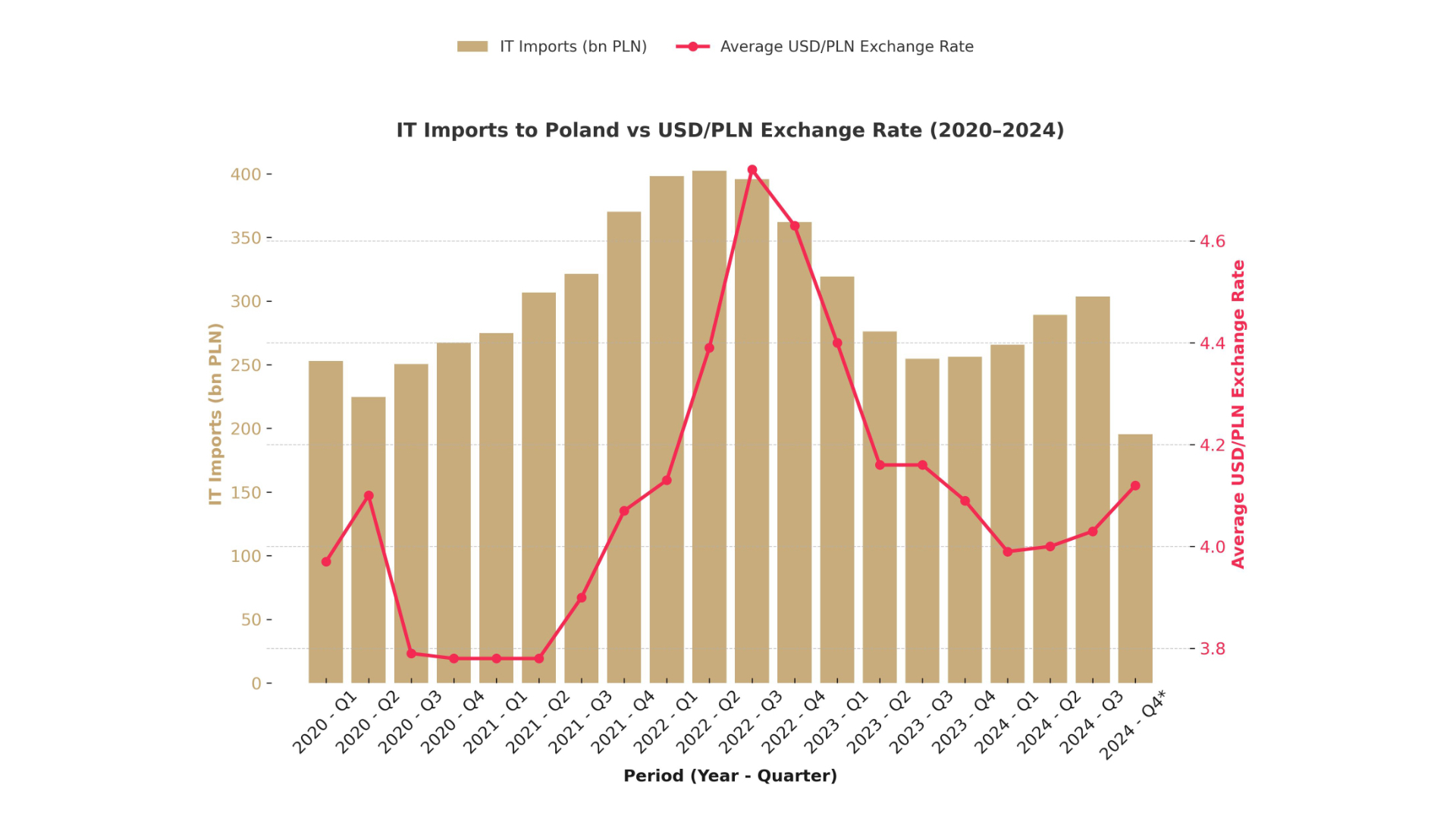
    The USD/PLN and EUR/PLN exchange rate charts of recent years show periods of rapid volatility, often correlated with global events such as pandemics, geopolitical crises or changes in the monetary policies of major central banks. Each peak on the USD/PLN chart is a direct blow to the profitability of importers and a potential price increase for end users.

    This dominance of the dollar creates a direct and often underestimated link between US monetary policy and the budgets of Polish companies. Decisions taken by the US Federal Reserve (Fed) in Washington on interest rates often have a greater and faster impact on equipment prices in Poland than decisions by the European Central Bank or even the National Bank of Poland.

    When the Fed raises interest rates, this usually leads to a strengthening of the dollar on global markets. As a result, the USD/PLN exchange rate rises, meaning that you have to pay more PLN for the same dollar. As a result, the underlying cost of importing all IT equipment rises almost immediately.

    From factory to desk: How do fluctuations translate into shelf price?

    Let’s examine how a change in the exchange rate translates into the price of a laptop that eventually reaches the desk of an employee in Poland.

    • Invoice from the manufacturer (in USD): A Chinese laptop assembly plant invoices a Polish importer for, say, USD 1 million for a container of equipment.
    • Purchase cost for the importer (in PLN): At the time of ordering, the USD/PLN exchange rate is 3.90. The theoretical purchase cost is PLN 3.9 million. However, payment is deferred for 60 days. During this time, as a result of market turbulence, the exchange rate rises to 4.20. The actual cost the importer has to incur to buy dollars and pay the invoice rises to 4.2 million PLN. The difference of PLN 300,000 is a pure cost resulting from the exchange rate change.
    • Distributor margin: The importer adds transport, insurance, customs and its margin to its base purchase cost (PLN 4.2m).
    • Retail price (in PLN including VAT): The equipment reaches the shop, which adds its margin and 23% VAT to the purchase price from the distributor. In this way, the original cost increase is not only passed on, but compounded at each subsequent distribution stage.

    However, this mechanism does not work as a simple automaton. There are several factors that introduce delays. Distributors and retailers sell goods that are physically in their warehouses, purchased weeks or even months earlier, at a completely different rate.

    This buffer acts as a shock absorber. In addition, the Polish electronics market is highly competitive. In the event of an unfavourable exchange rate change, companies may face a dilemma: raise prices and risk losing customers, or take some of the increase on themselves, accepting a temporary reduction in their own margins.

    It would be a mistake to attribute all price movements solely to currency fluctuations. In recent years we have witnessed a ‘perfect storm’ of factors that have overlapped:

    • Disruption in supply chains: Pandemic and geopolitical crises have caused chaos in global logistics, driving up freight costs.
    • Component shortages: The global semiconductor crisis directly affected the cost of manufacturing devices.
    • Inflation and manufacturing costs: Rising energy, raw material and labour costs in Asian production centres are pushing up the base dollar price of equipment.
    • Technological progress: each new generation of equipment is initially more expensive to produce.

    A close observation of the market reveals a regularity: retail prices tend to rise relatively quickly when the zloty weakens, but fall much more slowly when the zloty strengthens.

    This phenomenon, known as ‘price stickiness’, has a business rationale. When the exchange rate is unfavourable, importers need to protect their margins. However, when the zloty strengthens, goods bought at a higher exchange rate are still sitting in warehouses and companies are tempted to maintain higher prices and enjoy higher profitability.

    Behind the scenes of imports: The silent war on currency risk

    No serious importer leaves the fate of their business at the mercy of daily currency quotations. Doing business in such a volatile environment requires active management of exchange rate risk. Importers have a whole arsenal of financial instruments at their disposal to hedge against adverse movements.

    • Forward contracts: This is the most popular tool. The importer agrees with the bank to buy USD 1 million in three months’ time at a predetermined rate, regardless of what the market rate will be at that time. Such a transaction eliminates uncertainty and allows selling prices to be precisely calculated.
    • Currency options: This is a more flexible but also more expensive solution that can be likened to ‘insurance’. The importer buys the right, but not the obligation, to buy the currency at a certain rate. This protects against loss, while allowing you to benefit from successful developments.
    • Online currency exchange platforms: For smaller transactions, specialised platforms offer much more favourable rates and lower transaction costs than traditional banks.

    These strategies, although invisible to the end customer, have a direct impact on them. Through hedging, importers introduce price stability. This is why the price of a laptop in the shop does not change daily with the NBP exchange rate table.

    These actions smooth out market volatility. However, it is important to remember that this certainty comes at a price. Hedging is not free. Banks charge for their services and this ‘insurance cost’ is included in the final price of the product. Consumers, in an indirect way, therefore pay a small premium for price stability.

    Event horizon: Forecasts and strategies for the world of Polish IT

    The analysis clearly shows that the Polish IT market is structurally dependent on imports, with costs inextricably linked to global currency markets. Looking ahead, the trajectory of IT equipment prices in Poland will depend on several key variables.

    Macroeconomic forecasts regarding the monetary policy of the US Federal Reserve, geopolitical stability and the general condition of the Polish economy and the strength of the zloty will play a primary role. Periods of appreciation of the zloty may bring relief to import costs, potentially stimulating investment and lowering prices for consumers.

    In a world where economies are inextricably interconnected, understanding the flow of currency is becoming as crucial for the technology industry as understanding the flow of data. For Poland’s digital economy to grow sustainably, its leaders, professionals and informed consumers need to navigate both realities seamlessly.

  • Two faces of Polish IT – Waves of bankruptcies and the era of giants

    Two faces of Polish IT – Waves of bankruptcies and the era of giants

    For years, the Polish IT sector has been presented as the jewel in the crown of the national economy. It is an engine of innovation, a key exporter of services and a symbol of successful transformation. The data seem to confirm this optimistic picture: the industry accounts for a significant proportion of GDP and forecasts predict further dynamic growth in the value of the market.

    However, beneath the shiny surface of success, a threatening wave is rising that is hitting the foundations of this ecosystem. Thousands of smaller companies and sole traders are facing unprecedented financial pressures and their debts are growing at an alarming rate, reaching hundreds of millions.

    This raises a fundamental question that defines the current moment in the market: how is it possible that a sector that is a national champion simultaneously becomes a graveyard for small businesses? The answer to this paradox is complex and multidimensional.

    We are witnessing the end of the post-pandemic ‘Eldorado’ era – a period in which almost every entity, regardless of scale and efficiency, could count on orders. Today we are entering a new, more brutal phase of market maturity, characterised by ruthless natural selection.

    Landscape after the eldorado: Decline and debt

    The picture of the Polish IT sector, painted by headlines and general economic indicators, often overlooks the murky reality faced by its most fragmented part.

    Analysis of data from public registers and business information bureaus reveals a worrying trend of increasing financial pressures, leading to a wave of business closures, bankruptcies and exponentially increasing debt. This is hard evidence that the golden days are over for many players.

    Although the overall number of active businesses in Poland remains high , data from the Central Register and Information on Economic Activity (CEIDG) show the other, less optimistic side of the coin.

    In recent years, there has been a marked increase in the number of applications to close and suspend sole proprietorships . These figures are a wake-up call, indicating worsening conditions for the smallest entrepreneurs, who are the backbone of the IT sector.

    In addition to de-registrations from CEIDG, which are often quiet disappearances from the market, the number of formal insolvency and restructuring proceedings visible in the National Court Register (KRS) is also increasing.

    Figures from recent years show a steady increase in the number of companies forced to declare bankruptcy. Although these figures apply to the economy as a whole, the IT industry is over-represented in them. According to analyses, the technology sector ranks among the top in terms of the number of bankruptcies and restructurings in the country.

    This is therefore not a picture of the apocalypse, but rather evidence of a painful market correction in which players with weaker business foundations are eliminated after a period of artificially driven demand.

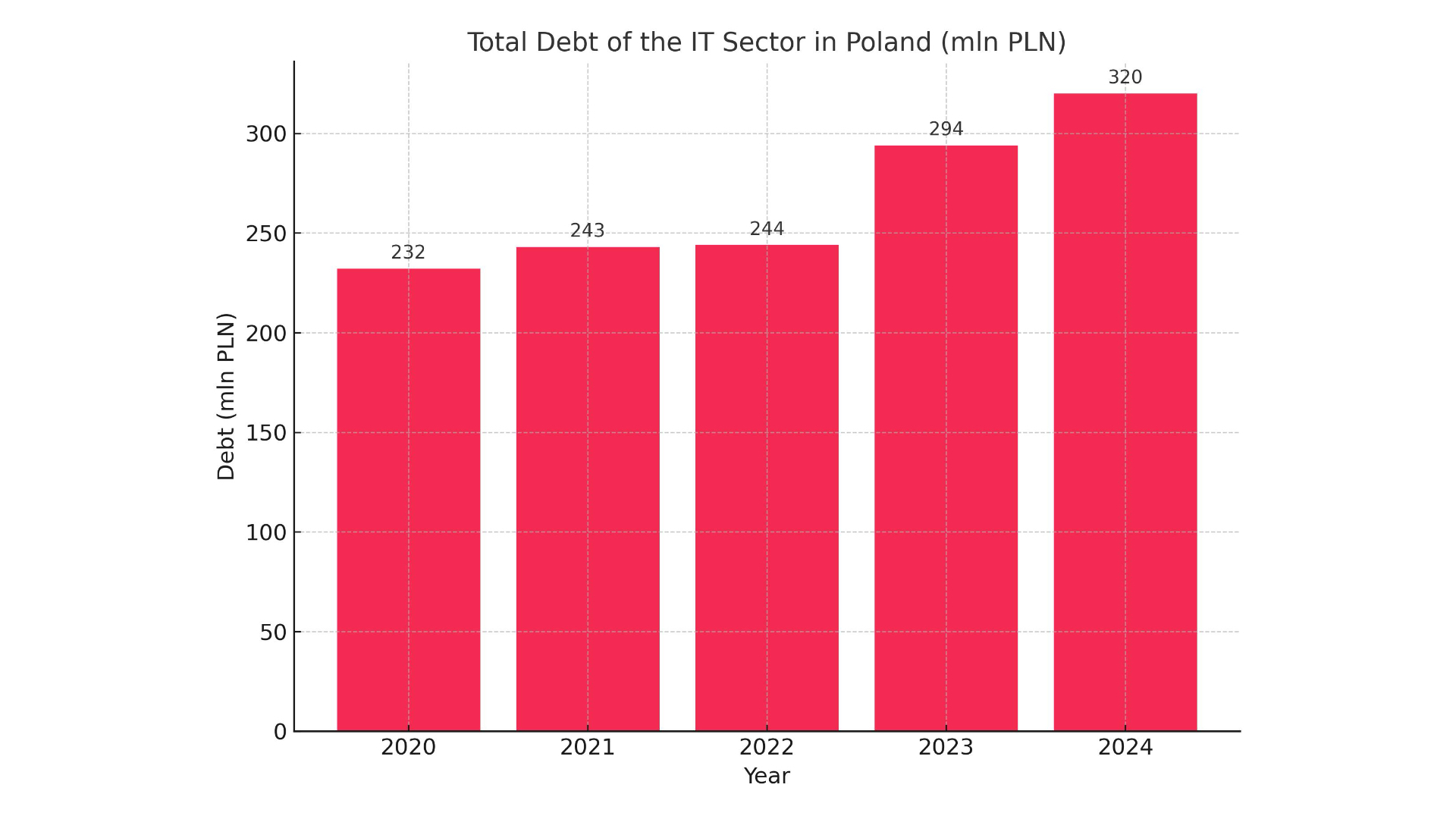
    The most telling indicator of the crisis, however, is the explosion of debt in the industry. Data from the National Debt Register (KRD) is alarming. Over the past two years, the total debt of IT companies has increased significantly, reaching hundreds of millions of PLN . During this time, the number of indebted IT entities has also increased, as has the average debt per company.

    Central to understanding the nature of this crisis is the breakdown of debt into legal forms of activity. This is where the extreme vulnerability of the smallest players becomes apparent. The data shows that sole traders account for a significant proportion of the industry’s total debt.

    This disparity is indicative of the fragility of the self-employment business model, which becomes a financial trap during the downturn .

    The problem is exacerbated by the domino effect caused by payment bottlenecks. The IT industry is not only a debtor, but also a significant creditor. IT companies are waiting to be repaid hundreds of millions of zlotys from their counterparties.

    The main debtors in the IT sector are companies from the retail, construction and transport sectors. This mechanism creates a vicious circle: a large customer delays payment, which deprives a small software house of liquidity, which is consequently unable to settle its own obligations. Small companies, deprived of the financial cushion available to large integrators, become the first victims of this debt spiral .

    Time of the giants: Consolidation and financial dominance

    While thousands of small companies are struggling to survive, at the other end of the market a completely different spectacle is playing out. The biggest players – the mighty systems integrators and distributors – are not only not feeling the crisis, but are actually consolidating their dominance.

    Their financial strength, strategic acquisitions and diversified portfolio allow them to prosper in conditions that are lethal for smaller players. This is the era of the giants, who are actively shaping the new, consolidated landscape of Polish IT.

    The top of the Polish IT market is made up of a relatively small group of companies whose scale of operations puts them in a completely different category from the rest of the industry. We are talking about entities such as the Asseco Poland Group, the Comarch Group, distributors AB and ALSO, or integrators such as Integrated Solutions .

    Their power is best seen in financial data. The revenues of Poland’s largest IT companies exceed the estimated value of the entire IT market in the country, which clearly shows that it is dominated by dozens of entities that control the lion’s share of it, creating a clear financial hierarchy.

    A key element of the growth strategy of these giants is market consolidation through mergers and acquisitions (M&A). Analytical reports clearly indicate that the TMT sector (Technology, Media, Telecommunications) is the most active battleground on the Polish M&A market . P

    ioner and model example of such a strategy is Asseco Poland. For years, the company has consistently built its power by acquiring key players in the market . These historic mergers allowed Asseco not only to leapfrog in scale, but also to diversify its competences and enter new market segments.

    Recent events signal a new, more mature phase of consolidation. The acquisition of Comarch, Poland’s second software giant after Asseco, by a global private equity fund in partnership with the founder’s family, is a landmark deal.

    This is no longer just consolidation within the Polish market. The entry of such a powerful financial player shows that the Polish IT sector has reached a maturity and attractiveness that attracts major international capital. This transaction heralds an acceleration of consolidation processes and even greater pressure on smaller, less efficient competitors.

    In contrast to small companies balancing on the brink of liquidity, large integrators are strongholds of financial stability. An analysis of their financial statements shows not only resilience in the face of a downturn, but often also improved profitability.

    The strength of these companies is also confirmed by investor confidence. The regular and generous dividends attest to their stable financial condition and the boards’ confidence in their positive future prospects.

    The structural advantage of the giants is also due to their evolution. Through years of acquisitions and organic growth, these companies have evolved into diversified technology conglomerates . This diversification is a powerful protective shield.

    A downturn in one area can easily be offset by stable, recurring contract revenues in another sector. This kind of resilience to business cycles can almost never be achieved by a small, specialised company.

    Anatomy of survival: Why do the small fail and the big grow?

    The observed phenomena – the wave of bankruptcies of small companies and the simultaneous growth in the power of integrators – are not a coincidence. They are the logical consequence of fundamental economic forces that operate with redoubled force in times of market correction.

    For smaller players, the current market environment has become a battleground for survival. The post-pandemic boom period is over and the market has returned to more sustainable levels of demand.

    As a result, more players are competing for fewer orders, which inevitably leads to a tougher price battle . At the same time, small companies are particularly sensitive to rising operating costs.

    The salary pressures that dominated the market in previous years have left a lasting mark in the form of high financial expectations of professionals . Small software houses are finding it difficult to compete for talent with the giants.

    Moreover, the structural weakness of small businesses lies in their lack of capital reserves. Dependence on a few key customers and vulnerability to payment bottlenecks mean that even a slight delay in paying an invoice can shake liquidity.

    Finally, the most lucrative and stable revenue streams – multi-year, multi-million dollar contracts from the public sector and large corporations – remain out of their reach due to formal and capital barriers.

    At the same time, the big players use the same market conditions to their advantage. Their fundamental advantage is economies of scale. A large integrator, buying hundreds of software licences or servers, obtains much better pricing terms from manufacturers.

    A diversified portfolio of services and customers acts like an insurance policy, balancing risk . Stable financial performance opens up access to low-cost financing for giants, enabling not only investment in growth but also strategic acquisitions of weakened competitors.

    At the same time, they are able to attract and retain the best professionals, which further strengthens their competitive advantage.

    As a result of these processes, we are witnessing a profound transformation of the market. It is no longer a unified ecosystem, but rather two parallel worlds. The first is the integrator market, characterised by large-scale projects and M&A strategies.

    The second is a fragmented and highly competitive niche market, with thousands of small companies and freelancers competing for smaller assignments. This is not an industry-wide crisis, but a painful but classic stage of economic maturity.

    Consequences and prospects: What does the future hold for Polish IT?

    The processes of polarisation and consolidation we are currently witnessing are not just a temporary anomaly. They are fundamental forces that are reshaping the entire Polish IT ecosystem, with long-term consequences.

    The balance of power is shifting in the labour market. In an environment where cost-cutting dominates, companies have less incentive to invest in training entry-level employees, creating a barrier to entry for juniors.

    Although IT salaries are still at a high level, their explosive growth has slowed down and employers are becoming more demanding. The real value and highest salaries are now offered by the highly specialised fields in which the major players are investing heavily: artificial intelligence, cyber security, data analytics and cloud computing.

    The impact of increasing market concentration on innovation is ambiguous. On the one hand, large corporations have resources for research and development, which can accelerate the commercialisation of innovations.

    On the other hand, the history of technology teaches that revolutionary ideas are often born in small, agile start-ups. Excessive market concentration threatens the emergence of oligopolies that can impede progress . The challenge for Poland will be to maintain a balance between these two forces.

    In the new polarised reality, survival and growth strategies must be redefined. For small companies, hyper-specialisation in a narrow market niche is becoming the only viable growth path. For large integrators, the main challenge will be to maintain the capacity for innovation and agility.

    Looking to the future, the Polish IT market is not shrinking, but evolving into a more mature sector that is integrated into the global economy. The future will be determined by megatrends such as artificial intelligence, ubiquitous digitisation and the growing importance of cyber security.

    Success will depend not so much on swimming with the tide of overall growth, but on precise strategic positioning and operational excellence.

    The analysis of market trends reveals the Polish IT sector at a moment of transformational change. The apparent paradox of simultaneous waves of bankruptcies and the growing dominance of giants turns out to be two sides of the same coin: a painful but inevitable process of market maturation. The golden era of the popandemic boom is irrevocably gone, giving way to a more challenging reality.

    For thousands of small companies, this means a struggle for survival. At the same time, the largest integrators are taking advantage of these conditions to strengthen their position by actively accelerating market consolidation through strategic mergers and acquisitions .

    As a consequence, the Polish IT sector is evolving into a more structured industry integrated with global capital. This transformation, although painful for many, may in the long term lead to a stronger and more internationally competitive sector.

    However, it will be dominated by a few powerful players, with space left for highly specialised, agile niche companies.

    Survival and success in this new reality will require all market players to redefine their existing strategies and adapt to the ruthless laws of a mature economy.

  • Upskilling: Why investing in people is the best engine for digital transformation

    Upskilling: Why investing in people is the best engine for digital transformation

    Modern business is a global digital arms race. Companies around the world are aggressively investing in next-generation technologies – cloud, artificial intelligence(AI) and automation – to gain competitive advantage.

    The scale is staggering: spending on AI alone is expected to exceed $550 billion by 2024 , and the corporate e-learning market is growing exponentially. However, beneath the surface of this technological spurt lies a paradox that acts as a hidden handbrake.

    While companies are allocating huge budgets to the purchase of advanced ‘hardware’, investment in the ‘human operating system’ – i.e. employee competence – is not keeping up.

    The skills gap: the invisible debt you pay every day

    The concept of ‘technology debt’ is well known in the IT world. The skills gap is its organisational equivalent: the invisible debt that a company incurs every day when the skills of its employees no longer keep up with technology.

    This debt accrues interest every day in the form of lost productivity, delayed projects and missed opportunities.

    The scale of the phenomenon is alarming. As many as 92% of jobs today require digital skills, and a third of employees lack even basic digital competence. This is not a problem of the future.

    McKinsey research shows that 87% of managers admit that their companies are already facing a skills gap or expect one in the next five years.

    The cost of inactivity is measurable and enormous. Korn Ferry Group projections indicate that by 2030, the skills gap could cost the global economy $8.5 trillion a year in unrealised revenue.

    In the US alone, the estimated cost over a decade is $2.5 trillion. At an operational level, the lack of skills directly hits productivity. In roles affected by digital transformation, productivity losses can be as high as 20-25% , and in high-tech companies, where expertise is key, skills shortages can reduce productivity per employee by up to 65-75%.

    Director’s dilemma: build or buy talent? the calculus is simple

    Every leader faces a dilemma: ‘buy’ ready-made talent from the market or ‘build’ it internally? Popular belief leans towards recruitment, but the financial data clearly shows that the ‘build’ approach is cheaper and much more effective.

    A cost analysis of the ‘buy-in’ strategy reveals its true price tag. The average cost of hiring a new employee in the technology industry is $23,450.

    For specialised roles, recruitment fees alone can exceed $30,000. Then there’s the time involved – it takes an average of 10 weeks to fill a technology vacancy.

    In contrast, the economics of a talent ‘building’ strategy are much more favourable. The average cost of upskilling an existing employee for an IT position is $15,231, and more than half of companies spend less than $5,000 per person.

    Bersin’s analysis shows that training an internal employee can save up to $116,000 per person over a three-year period compared to external recruitment.

    The strategic benefits are even more compelling. In companies with high internal mobility, employees stay almost twice as long (5.4 years on average compared to 2.9 years). What’s more, 55% of organisations report productivity gains as a direct result of upskilling programmes.

    So the choice is clear: ‘Buying’ is an expensive, risky cycle of recruitment and turnover. “Building” creates a self-perpetuating mechanism of investment, loyalty and growth.

    Measurable return on investment (ROI) in knowledge

    Investment in employee development is not a ‘soft’ HR expense, but one of the most profitable investments. The data clearly shows that the return on investment in upskilling is not only measurable, but extremely high.

    Companies with comprehensive training programmes have 218% higher revenue per employee. Gallup analysis shows that organisations strategically investing in development record 11% higher profitability.

    IBM’s internal research has shown that every $1 invested in online training brings about a $30 return in increased productivity.

    These figures are borne out by specific cases. Telecommunications giant AT&T, faced with outdated competencies in nearly half of its workforce, invested $1 billion in a massive reskilling programme.

    The results were transformational: employee turnover fell and the company was able to fill nearly 50% of new technology positions with internal candidates. Another development programme delivered a 25% increase in revenue over five years.

    The worker at the centre: a new currency in the labour market

    In an era of chronic talent shortages, traditional motivational tools such as salary are no longer sufficient. A powerful new currency has emerged in the labour market: the opportunity for development.

    Employees are no longer passive recipients of training – they actively demand it. As many as 94% of employees say they would stay with a company longer if it invested in their professional development.

    This is one of the most consistent statistics in labour market analyses. Lack of development opportunities is one of the main reasons for resignation.

    This need makes upskilling the most effective retention tool. Companies with strong training programmes enjoy up to 53% lower turnover. Employees who feel their organisation encourages them to learn are 47% less likely to actively seek a new job.

    At the same time, AI is changing the definition of core competencies. As automation takes over routine tasks, uniquely human skills, so-called ‘power skills’, are gaining importance: critical thinking, creativity, emotional intelligence and adaptability.

    Investment in these areas also has tangible benefits – an MIT study found that a training programme focused on soft skills delivered a 250% return on investment.

  • Privacy Tech market: how RODO and AI have created a new billion-dollar industry?

    Privacy Tech market: how RODO and AI have created a new billion-dollar industry?

    We live in an age of fundamental paradox. On the one hand, artificial intelligence, driven by large language models (LLMs), is becoming the lifeblood of modern business, promising unprecedented innovation.

    On the other hand, its insatiable appetite for data clashes head-on with the global privacy rush. This conflict is no longer just a matter of ethics, but a hard regulatory reality that is creating and transforming entire technology markets before our eyes.

    Public sentiment has reached critical mass. Research shows that as much as 86% of the US population expresses growing concern about how their data is being processed, and more than half believe AI will make it harder to protect personal information.

    In response, governments around the world are building a legislative wall. What started with the groundbreaking RODO (GDPR) in Europe has quickly spread globally, creating a dense web of legislation, from the CCPA in California to the LGPD in Brazil.

    Today, more than 137 countries already have national data protection laws, covering almost 80% of the world’s population.

    The stakes in this game are astronomical. Regulators do not hesitate to use their most powerful weapon: financial penalties. The record €1.2 billion fine imposed on Meta for data transfers between the EU and the US or the €746 million fine for Amazon are powerful signals to the market.

    Any such decision is a direct growth stimulus for the ‘Privacy Tech’ sector – a market that has not grown organically out of consumer needs, but has been almost entirely created by legislative action.

    The law does not just regulate technology – it creates it. In this new landscape, a key conclusion emerges: the tool that created the problem – artificial intelligence – is simultaneously becoming the key to solving it.

    We are entering the era of ‘Privacy 2.0’, in which compliance becomes intelligent, proactive and, in retrospect, autonomous.

    From manual work to intelligent automation

    Prior to the era of RODO, privacy management in many organisations was based on manual data mapping, endless spreadsheets and tedious processes for responding to user requests (DSARs).

    The cost of this inefficiency was huge – it was estimated that manually handling a single DSAR request cost an average of more than $1,500. In a world where companies process petabytes of data, such a model was untenable.

    Artificial intelligence (AI) has become the engine that is driving a revolution in this area, transforming privacy management platforms into intelligent command centres. Modern systems are using AI to automate key, once manual processes.

    AI algorithms scan a company’s entire infrastructure, from local servers to the cloud, for personal data, understanding its context and creating a dynamic map in real time. AI models then analyse data flows and access permissions to proactively identify and assess risks, alerting to potential privacy by design violations.

    AI also automates the entire user consent lifecycle and DSAR request fulfilment, reducing processes from weeks to hours.

    The financial impact of this transformation is measurable. Organisations that make extensive use of AI and automation in the security space save an average of $1.76 million in data breach costs compared to companies that do not.

    This is hard evidence of the return on investment of smart privacy management platforms that turn the cost of compliance into operating profit.

    The trust frontier: The world of privacy-enhancing technologies (PETs)

    Automation, however, is only the beginning. The real revolution is taking place at the border of cryptography and advanced mathematics, in the world of Privacy-Enhancing Technologies (PETs).

    It is a set of tools aiming to achieve the ‘holy grail’ of analytics: the ability to extract valuable information from sensitive sets without revealing the data itself.

    One of the key technologies is homomorphic encryption (HE). It allows calculations to be performed on encrypted data, as if the analyst were performing operations on a closed box without seeing its contents.

    Only the owner of the data, who holds the key, can open the box and see the result. The technology, which is being developed by giants such as Microsoft and IBM, is being used in medicine to analyse patient data from multiple hospitals and in finance to detect fraud together.

    Another groundbreaking tool is zero-knowledge proof (ZKP). This is a cryptographic protocol that allows you to prove that you know a certain piece of information without revealing it yourself.

    It’s like being able to prove you are over 21 without showing an ID card with your date of birth and address. ZKP is revolutionising decentralised identity and private financial transactions.

    The problem of analysing data on distributed, private sets is solved by differential privacy and federated learning. Differential privacy involves adding precisely calculated ‘noise’ to a dataset that prevents the identification of a single individual, while preserving overall statistical trends.

    In contrast, federated learning is an approach in which AI models are trained directly on end devices (e.g. smartphones) and only aggregated, anonymised model ‘enhancements’ are sent to a central server, rather than raw user data.

    Giants such as Apple and Google are already using these techniques.

    The deployment of these technologies signals a fundamental shift. Data is no longer an asset whose value lies in exclusive ownership. It is becoming a resource that can be securely shared and collaborated on, unlocking the enormous economic value that was previously trapped in corporate silos. Privacy becomes not a barrier, but a technology that enables innovation.

    The endgame: the dawn of autonomous privacy

    The evolution so far sets out a clear trajectory, the logical culmination of which is a vision of the future in which data protection is managed by autonomous AI systems. A distinction must be made here between automation and autonomy.

    Automation performs defined tasks. Autonomy is the ability of a system to learn, adapt and make decisions on its own to achieve a goal.

    Such a system of the future will be based on the convergence of several technologies. The foundation is autonomous databases that use AI to become self-governing, self-securing and self-repairing.

    This is the basis for a new generation of agent-based AI – systems that can autonomously interact with databases and perform complex tasks to achieve a goal, such as ‘ensure continuous compliance with global regulations’.

    The nervous system is an intelligent data pipeline that filters and edits personal data in real time before it goes to analysis.

    The combination of these elements paints a picture of a future in which an autonomous system will continuously monitor the global legal landscape, automatically translate legal language into enforceable policies and reconfigure data flows across a company’s infrastructure in real time.

    It will also autonomously detect and neutralise potential breaches before they can escalate.

    This technological trajectory leads to the inevitable ‘commoditisation of compliance’, where core tasks will become a universally available service. However, this does not mean the end of the privacy professional’s profession. On the contrary, its role will be transformed – from operational ‘firefighting’ to strategic oversight and ethics management of autonomous systems.

    In this new reality, the key competences will no longer be just interpreting the law, but auditing algorithms and defining operational boundaries for AI agents.

    Privacy 2.0 is not an end in itself. It is the operating system for the future of the digital economy.

  • AI accelerator market: NVIDIA, AMD, Intel – the battle for supremacy

    AI accelerator market: NVIDIA, AMD, Intel – the battle for supremacy

    At North Carolina State University, robotic arms precisely mix chemicals while streams of data flow through systems in real time. This ‘self-powered laboratory’, an AI-powered platform, discovers new materials for clean energy and electronics not in years, but days.

    Collecting data 10 times faster than traditional methods, it observes chemical reactions like a full-length film rather than a single snapshot. This is not science fiction; it is the new reality of scientific discovery.

    This incredible leap is being driven by a new kind of computing engine: specialised AI accelerator chips. These are the ‘silicon brains’ of the revolution. Moore’s law, the old paradigm of doubling computing power in general-purpose systems, has given way to a new law of exponential progress, driven by massive parallel processing.

    The crux of the story, however, is more complex. While AI algorithms are the software of a new scientific era, the physical hardware – the AI chips – has become the fundamental enabler of progress and, paradoxically, also its biggest bottleneck.

    The ability to discover a new life-saving drug or design a more efficient solar cell is today inextricably linked to a hyper-competitive, multi-billion dollar corporate arms race and a fragile geopolitical landscape in which access to these chips is a tool of global power.

    Anatomy of a boom: who is building silicon brains?

    The boom in generative artificial intelligence has created an insatiable demand for computing power. It’s not just chatbots, but foundational models that underpin a new wave of scientific research. This demand has transformed a niche market into a global battlefield for dominance.

    Reigning champion: NVIDIA

    NVIDIA has established itself as a key architect of the AI revolution, as evidenced by its stunning financial results. The data centre division, the heart of the company’s AI business, reported revenues of $41.1bn in a single quarter, up 56% year-on-year.

    This dominance is based on successive generations of powerful architectures such as Hopper and now Blackwell, which are core hardware for technology giants such as Microsoft, Meta and OpenAI .

    An energetic contender: AMD

    AMD is positioning itself not as a distant number two, but as a serious and fast-growing competitor. The company reported record data centre revenue of US$3.5bn in Q3 2024, a massive 122% year-on-year increase, driven by strong adoption of its Instinct series GPU accelerators.

    Significantly, major cloud service providers and companies such as Microsoft and Meta are actively deploying MI300X accelerators from AMD, signalling a desire to have a viable alternative to NVIDIA. The company forecasts that its data centre GPU revenue will exceed US$5bn in 2024.

    The gambit of the historical giant: Intel

    Intel’s situation presents a strategic challenge. Although the company claims that its Gaudi 3 accelerators offer a better price/performance ratio compared to NVIDIA’s H100 , it is struggling to gain market share.

    Intel missed its $500m revenue target for Gaudi in 2024, citing slower-than-expected adoption due to issues with transitioning between product generations and, crucially, challenges with ‘ease of use of the software’.

    Analysis of this data reveals deeper trends. Firstly, the AI hardware market is not just a race for components, but a war of platforms. Intel’s difficulties with software point to the real battlefield: the ecosystem. NVIDIA’s CUDA platform has more than a decade’s head start, creating a deep ‘moat’ of developer tools, libraries and expertise.

    Competitors are not just selling silicon; they need to convince the whole world of science and development to learn a new programming language. Secondly, the AI boom is leading to vertical integration of the data centre.

    Not only does NVIDIA dominate the GPU market, but following its acquisition of networking company Mellanox in 2020, it has also become the leader in Ethernet switches, recording sales growth of 7.5x year-on-year.

    NVIDIA is no longer just selling chips; it is selling a complete, optimised ‘AI factory’ design, creating an even stronger lock-in effect.

    From lab to reality: scientific breakthroughs powered by silicon

    This unprecedented computing power is fueling a revolution in the way we do research, leading to breakthroughs that seemed impossible just a few years ago.

    The medicine of tomorrow

    The traditional drug discovery process, which takes 10 to 15 years, is being dramatically shortened. DeepMind CEO Demis Hassabis predicts that AI will reduce this time to “a matter of months”.

    Isomorphic Labs, a subsidiary of DeepMind, is using AI to model complex biological systems and predict drug-protein interactions. Researchers at Virginia Tech have developed an AI tool called ProRNA3D-single that creates 3D models of protein-RNA interactions – key to understanding viruses and neurological diseases such as Alzheimer’s.

    Moreover, a new tool from Harvard, PDGrapher, goes beyond the ‘one target, one drug’ model. It uses a graph neural network to map the entire complex system of a diseased cell and predicts combinations of therapies that can restore it to health.

    High-resolution climate

    In the past, accurate climate modelling required a supercomputer. Today, AI models such as NeuralGCM from Google can run on a single laptop . This model, trained on decades of weather data, helped predict the arrival of the monsoon in India months in advance, providing key forecasts to 38 million farmers.

    A new AI model from the University of Washington is able to simulate 1,000 years of Earth’s climate in just one day on a single processor – a task that would take a supercomputer 90 days.

    Companies like Google DeepMind (WeatherNext), NVIDIA (Earth-2) and universities like Cambridge (Aardvark Weather) are building fully AI-driven systems that are faster, more efficient and often more accurate than traditional models.

    Alchemy of the 21st century

    As mentioned at the outset, AI is creating autonomous labs that accelerate materials discovery by a factor of ten or more. The paradigm shifts from searching existing materials to generating entirely new ones.

    AI models, such as MatterGen from Microsoft, can design new inorganic materials with desired properties from scratch. This ability to ‘reverse engineer’, where scientists identify a need and AI proposes a solution, has been the holy grail of materials science.

    These examples illustrate a fundamental change in the scientific method itself. The computer has ceased to be merely a tool for analysis; it has become an active participant in the generation of hypotheses. The role of the scientist is evolving into a curator of powerful generative systems.

    This accelerates the discovery cycle exponentially and allows scientists to explore a much larger ‘problem space’ than was ever possible for humans.

    Geopolitical storm and a new division of the world

    As the importance of these silicon brains grows, they are becoming the most valuable strategic resource of the 21st century – the new oil, crucial for economic competitiveness and scientific leadership.

    US strategy: “small garden, high fence”

    The US has implemented a ‘small garden, high fence’ strategy, introducing export controls aimed at slowing China’s ability to develop advanced AI. These restrictions apply not only to the chips themselves (such as NVIDIA’s H100), but also to the hardware required to manufacture them (from companies such as the Dutch ASML).

    This hit the Chinese semiconductor industry in the short term, causing equipment shortages and ‘crippling’ its production capacity.

    China’s determined response

    China’s response has been multi-pronged: massive investment in its domestic semiconductor industry and the use of its own economic leverage by restricting exports of key rare earth elements. The case study is Huawei.

    Despite being crippled by sanctions, the company has developed its own line of AI Ascend chips (910B/C/D), which are now seen as a viable alternative to NVIDA products in China.

    In response, the US government has toughened its stance, declaring that the use of these chips anywhere in the world violates US export controls, escalating the technological divide.

    A study by Oxford University reveals a harsh reality: advanced GPUs are heavily concentrated in just a few countries, mainly in the US and China. The US leads the way in access to state-of-the-art chips, while much of the world is in ‘computing deserts’.

    This situation leads to unintended consequences. US export controls, designed to slow China down, have become an ‘inadvertent accelerator of innovation’ for China, forcing Beijing to build a completely independent technology stack.

    A decade from now, the world may have two completely separate, incompatible AI stacks, fundamentally dividing global research.

    The cloud as the great equivalent?

    There is a powerful counter-argument: cloud computing democratises access to elite AI. Platforms such as Amazon Web Services (AWS), Microsoft Azure and Google Cloud offer AI-as-a-Service (AIaaS), allowing a university or startup to rent the same powerful GPUs that OpenAI uses.

    The cloud giants offer rich ecosystems. AWS provides services such as SageMaker for building models and Bedrock for access to leading foundation models. Google Cloud promotes democratisation with tools such as Vertex AI, designed for minimal complexity.

    Microsoft Azure is tightly integrating AI into its ecosystem through Azure AI Foundry, offering access to more than 1,700 models and running dedicated ‘AI for Science’ research labs.

    However, the promise of access must be set against the harsh reality of cost. Training a state-of-the-art model is prohibitively expensive, with estimates as high as USD 78 million for GPT-4 and USD 191 million for Gemini Ultra. This leads to a ‘two-tier democracy’ in AI research.

    On the one hand, any researcher with a grant can access world-class AI tools. This is a democratisation of application . On the other hand, the ability to train a new large-scale foundational model from scratch remains the exclusive domain of a handful of actors: the cloud providers themselves and their key partners.

    This is the centralisation of creation. The cloud ‘democratises’ AI in the same way that a public library democratises access to books. Anyone can read them, but only a few have the resources to write and publish them.

    A future written in silicon

    The breathtaking pace of scientific discovery in medicine, climatology and materials science is a direct consequence of the massive industrial and geopolitical mobilisation around a single technology: the AI accelerator.

    Progress has become fragile and deeply interdependent. Scientific breakthrough is no longer just a function of a brilliant mind. It now also depends on the quarterly financial reports of NVIDIA and AMD, the trade policies enacted in Washington and Beijing, the stability of the supply chain passing through Taiwan and the pricing models of AWS, Google and Microsoft.

    We have entered an era where the future is literally written in silicon. The great challenges of our time – curing disease, fighting climate change, creating a sustainable future – will be solved with these new tools.

    But who will be able to wield them, and for what purpose, remains the most important and unresolved question of the 21st century. The next great scientific revolution will be televised live, but the rights to broadcast it are currently being negotiated in the boardrooms of corporations and the corridors of global power.

  • Quantum Game of Thrones: who will build the machine that will change the world?

    Quantum Game of Thrones: who will build the machine that will change the world?

    There are moments in the history of technology that redefine the limits of possibility. The mastery of fire, the invention of printing, the digital age – each of these eras was sparked by a fundamental discovery.

    Today we stand on the threshold of another such transformation, which is not simply the evolution of computing power, but the birth of an entirely new paradigm. We are talking about quantum computing.

    The race to build a functional quantum computer is the most important technological and geopolitical duel of the 21st century.

    At stake is the ability to solve problems that are today beyond the reach of the most powerful supercomputers – from designing drugs at the molecular level, to creating revolutionary materials, to breaking almost all modern encryption systems.

    At the heart of this revolution is quantum mechanics, with its principles of superposition and entanglement, which allows a qubit – the quantum equivalent of a bit – to exist in multiple states simultaneously. It is this fundamental difference that gives quantum computers their unimaginable potential.

    The year 2025, declared by the UN as the International Year of Quantum Science and Technology, is a symbolic turning point . We are no longer in the realm of purely theoretical considerations. We have entered the NISQ (Noisy Intermediate-Scale Quantum) era – a time when we have imperfect, ‘noisy’ quantum computers, but which are becoming more powerful every year.

    It is a nascent industry, estimated to be worth US$866 million in 2023 and projected to reach US$4.4 billion by 2028.

    Great quantum families: contenders for the crown

    Three powerful players have emerged on the battlefield for the quantum future: Google, IBM and Microsoft. Each has a different strategy to sit on the technological throne.

    Google: the alchemists of Mountain View

    Google’s strategy focuses on spectacular, breakthrough demonstrations of power. Their latest weapon is the ‘Willow’ processor, but the real breakthrough lies not in the number of qubits, but in the mastery of error correction.

    Google engineers have announced that they are able to maintain the stability of a logical cubit – that is, a set of physical cubits working together to correct errors – for up to an hour.

    This is a monumental leap compared to the microseconds that were the standard not so long ago. Their claim to the throne is based on being the first to push the boundaries of science, as in 2019 when they were the first to announce the achievement of ‘quantum supremacy’.

    IBM: kingdom builders for all

    IBM is playing a very different game. Instead of isolated breakthroughs, they are betting on consistent progress and democratising access to technology. Their roadmap is public and precise, and they plan to make the ‘Nighthawk’ processor available in 2025.

    A key element of their strategy is to integrate quantum computers with classical supercomputers (HPC), creating a hybrid future. The opening of Europe’s first quantum data centre in Germany is a strategic move, bringing quantum resources directly into European industry and academia.

    IBM is not just building a lab experiment; it is creating a business-ready platform accessible through the cloud.

    Microsoft: patient architects in Redmond

    Microsoft took the path of highest risk, but also potentially highest reward. For decades they had invested in research into the mythical ‘topological cubit’, which would be inherently fault-tolerant.

    While waiting for this technology to mature, they built the powerful Azure Quantum ecosystem, designed to be independent of any particular hardware architecture . Their latest breakthrough is a demonstration of 12 entangled logical qubits with an error rate 800 times lower than single physical qubits, achieved in collaboration with Quantinuum.

    The partnership with Atom Computing aims to build “the world’s most powerful quantum machine”, combining their error correction software with promising technology based on neutral atoms .

    The geopolitical great game: the dragon versus the eagle

    The rivalry is moving into the global arena, where it is becoming central to the confrontation between the United States and China. It is a battle for technological hegemony involving billions of dollars of public and private funds.

    The US leads the way when it comes to the dynamism of the startup ecosystem, with 77 quantum technology companies operating there . This innovation is driven by gigantic private investment and the research power of big tech families.

    The federal government also plays a key role by providing significant funding for basic research.

    However, China is playing a long-term, fully state-controlled game. They are catching up with shocking speed. According to a report by the Australian Strategic Policy Institute (ASPI), China is already leading in 57 out of 64 key technologies, including such vital areas as quantum sensors.

    The Middle Kingdom is pursuing a strategy based on gigantic investments in research infrastructure and aims to achieve dominance in the production of mature chips.

    Europe, although a significant player, lags behind the two superpowers in terms of the scale of investment.

    Nevertheless, initiatives such as EuroHPC and the strategic positioning of quantum computers in Poland and Germany are evidence of a coordinated effort to maintain competitiveness.

    Winners’ trophies: industries on the threshold of tomorrow

    Why are governments and corporations investing billions in this technology? The answer lies in the revolutionary applications that await the winners.

    Health service and pharmacy: drug design

    One of the most difficult problems for classical computers is the precise simulation of complex molecules. Quantum computers are naturally predisposed to simulate such systems. Their use can reduce the time needed to discover and develop a new drug by up to 50-70%.

    Pharmaceutical giants such as Roche and Pfizer are actively working with technology companies to prepare for the coming of the quantum era.

    Pfizer’s collaboration with technology company XtalPi, using artificial intelligence as a bridge to full quantum computing, has already reduced the time it takes to calculate the crystal structure of molecules from months to just days.

    Finance: quantum hedge fund

    Financial markets are a world of complex optimisation and risk modelling problems. Quantum algorithms are able to analyse a much larger number of variables and scenarios simultaneously, leading to optimised portfolios and more accurate risk assessment.

    Financial institutions such as JPMorgan and BBVA are already running pilot projects in collaboration with IBM and D-Wave . However, this same power also poses an existential threat. A quantum computer of sufficient scale will be able to crack the encryption algorithms that underpin the security of the entire digital economy.

    This creates an urgent need to implement so-called post-quantum cryptography.

    Materials science and chemistry: engineering the impossible

    The creation of new materials today relies heavily on trial and error. Quantum computers are opening the way to ‘custom material design’, enabling the precise simulation of the quantum properties of substances before they are even produced in the laboratory . This could lead to breakthroughs such as superconductors that work at room temperature or catalysts that make industrial processes radically more energy efficient. Companies such as BASF are deeply involved in research, forming partnerships with startups and academic institutions.

    From supremacy to advantage: the true measure of victory

    Google’s announcement of ‘quantum supremacy’ in 2019 was a milestone, but not a commercial turning point. The problem their computer solved had no practical application . It is therefore crucial to distinguish the terms:

    • Quantum Supremacy (Quantum Supremacy): Proof that a quantum computer can beat a classical one at any task, even a useless one. It is a scientific benchmark, but without direct commercial relevance .
    • Quantum Advantage (Quantum Advantage): The real goal. Means the ability to solve a useful, real-world business problem faster, cheaper or more accurately than any classical computer .
    • Quantum Utility: The pragmatic state we are currently in. It means using today’s imperfect NISQ computers to achieve tangible, though not yet revolutionary, results .

    The change in language itself, moving away from the confrontational term ‘supremacy’ to the more practical terms ‘advantage’ and ‘usability’, is symptomatic of the maturity of the industry as a whole. It marks a shift from pure science to commercial applications.

    The quantum revolution will not come with a bang. It will be a quiet, creeping transformation. The true measure of victory in this game of thrones will not be supremacy, but utility – the number of problems solved and the value created. The time to prepare is not when the throne is won, but now, when the great families are making their first strategic moves. The game has begun.

  • An integrator’s guide to the AI market in Europe: leaders, contenders and ‘green fields’

    An integrator’s guide to the AI market in Europe: leaders, contenders and ‘green fields’

    The year 2023 has gone down in history as the moment when generative artificial intelligence (GenAI) broke through into the mass consciousness. However, for systems integrators and IT directors, once the initial dust has settled, a fundamental question arises: where does the hype translate into real budgets and measurable business value?

    Analysis of recent market data shows that the key to success is not a one-size-fits-all approach, but a nuanced strategy that tailors the offering to the specific level of digital maturity of each economic sector.

    Analysts at the International Data Corporation (IDC) forecast that European spending on AI will reach $144.6 billion by 2028, growing at an annual rate of more than 30%. At the same time, Eurostat figures for 2024 show that overall AI adoption in businesses, although growing, is still only 13.5%.

    This apparent contradiction is in fact the most important market signal: the huge gap between future intentions and the current state of deployments means that a massive order book is forming in the market. The leaders are just the first wave; the main part of the market is only now starting to mobilise its budgets.

    For integrators, the conclusion is clear: the market is not saturated, it is just beginning.

    The great divide: giants versus SMEs, north versus south

    The most important dividing line that defines go-to-market strategies is the gap between large companies and the SME sector. As many as 41.2% of large companies are using AI, compared to only 11.2% of small companies.

    These are two fundamentally different markets. Large corporations are implementing complex, transformational projects, while SMEs are looking for solutions with a lower threshold of entry and a quick return on investment.

    The map of AI adoption in Europe is also not uniform. At the head of the peloton are digitally mature Scandinavian countries such as Denmark (27.6%) and Sweden (25.1%).

    In the middle of the pile are the largest economies such as Germany (14.2%), and at the other end of the spectrum are large but still catching up markets such as Poland (5.9%) and Romania (3.1%). These represent a huge ‘green field’ for core services, related to data preparation and business intelligence implementations.

    The vanguard of data: large-scale monetising sectors

    At the forefront of the AI revolution are sectors that are inherently data-intensive. For integrators, these are the target markets for the most advanced and high-margin projects.

    The Information and Communication (ICT) sector is the undisputed leader, with as many as 48.7% of companies actively using AI. Crucially, for 43.5% of them, the main focus is research and development (R&D).

    These companies are not optimising processes, but creating new products and business models driven by AI. Opportunities for integrators here lie in highly specialised consulting, creating customised machine learning models and implementing MLOps platforms.

    Financial and Professional Services is the second pillar of the vanguard. IDC forecasts indicate that finance will be the largest single sector in terms of AI spending. This group is defined by an absolute focus on measurable return on investment (ROI).

    Specific use cases include advanced analytics for fraud detection, where European banks are doubling the detection rate of compromised cards , and neobank bunq has accelerated the training of its models 100-fold.

    Other applications include hyper-personalisation of products and automation of regulatory compliance processes. Customers in this sector expect robust, secure and regulatory-compliant solutions.

    Emerging contenders: where scale meets opportunity

    In between the vanguard and emerging markets is a group of sectors of huge economic importance that are only now beginning to invest in data on a large scale.

    Retail and E-commerce is the third largest industry in terms of AI spending in Europe. The target is clear: 52.9% of retailers are implementing AI in marketing and sales. The battle for the customer is being won in the field of personalisation.

    The example of a European retailer that increased online sales by 11% in six months by implementing advanced analytics confirms the effectiveness of this strategy.

    For integrators, the sector offers a double opportunity: sophisticated e-commerce players are looking for sophisticated recommendation engines, while more traditional retailers need fundamental projects such as implementing a modern CRM system or building a customer data platform (CDP).

    Manufacturing is a real giant of the European economy. Although the overall adoption rate of AI remains below 16%, it is this sector that accounts for the largest share of value added in the EU (24.1%). Moreover, more than half (51%) of European manufacturers are already implementing AI solutions.

    The key to unlocking this market is predictive maintenance. Companies such as Siemens and Coca-Cola European Partners are already using AI to analyse sensor data to predict machine failures and minimise unplanned downtime.

    “Green fields”: untapped markets for fundamental growth

    At the other extreme of digital maturity are sectors that represent the largest untapped market for integrators able to offer fundamental services.

    Transport and Logistics has a low AI adoption rate (less than 16%), while generating unimaginable amounts of data. The main challenge here is fragmentation and low data quality.

    A case study of a European logistics company revealed that operational data was spread across more than 15 Excel files, making any profitability analysis impossible. For integrators, this is a dream market for services in the ‘data readiness’ category.

    The first step is not to sell a complex AI model, but to implement a central data warehouse and BI tools that address pressing issues such as lack of visibility and control.

    The construction industry shows one of the lowest digital adoption rates (6.1%). Before AI finds widespread use here, the sector needs basic digitalisation, such as the implementation of ERP or CRM systems.

    The sales message should not focus on ‘artificial intelligence’, but on ‘visibility’, ‘control’ and ‘efficiency’ in project management.

    Healthcare is a unique ‘green field’. Although overall adoption figures are low, it is one of the fastest-growing sectors in terms of AI investment, with a projected global growth rate of 44% CAGR.

    The potential is revolutionary: AI-assisted diagnostic imaging, drug discovery and robot-assisted surgery. However, progress is hampered by extreme data privacy requirements and complex regulations.

    This is a market for professionals who can demonstrate deep domain knowledge in medical regulation and data security.

    Compass for the integrator: how to match strategy to market?

    The AI and Big Data market in the EU is not a monolith, but a patchwork of sectors with varying degrees of maturity. Success depends on tailoring the strategy to each of them:

    • Engaging the Vanguard (ICT, Finance): The approach should be consultative and partnership-based. The focus should be on co-creation of innovation, custom development and strategic advice. Key services are MLOps, development of specialised AI models and data governance consultancy.
    • Gaining Pretenders (Trade, Production): A solution-oriented approach is key. Conversations should be based on industry-specific use cases with proven ROI (e.g. predictive maintenance, personalisation). The offering should be hybrid, combining advanced analytics with foundational work.
    • Cultivating Green Fields (Logistics, Construction, Healthcare): Strategy is based on education. Conversations should start with data strategy, not AI. The focus should be on selling core services (cloud migration, data warehousing, BI implementations) that build the foundation for future, more advanced projects.

    Ultimately, the AI and Big Data market in Europe offers huge opportunities, but rewards those who approach it with strategy and understanding. Rather than trying to sell one technology to everyone, the most successful integrators will act as translators – translating the technology’s potential into tangible solutions to business problems, tailored to each client’s unique context and maturity level.

  • IT jobs – AI is not slowing down juniors. It is closing its doors to them

    IT jobs – AI is not slowing down juniors. It is closing its doors to them

    The debate about the impact of artificial intelligence on the labour market is dominated by visions of mass redundancies. However, the latest data from the US market paints a very different and much more worrying picture.

    The real threat to entry-level professionals is not layoff notices, but a silent and invisible barrier – the drastic reduction in recruitment for junior positions. Companies that implement AI are not cleaning up their ranks. They are closing the gates to new recruits, creating a ticking bomb that will threaten the talent market for years to come.

    Quiet revolution: Less recruitment, not more redundancies

    The narrative of robots taking jobs is a media buzzword, but data shows that the reality is more complex. An analysis of nearly 285,000 US companies reveals that organisations actively implementing generative AI are following the path of least resistance.

    Instead of carrying out costly and image-damaging redundancies, they are simply cutting back on hiring new people at the lowest levels.

    The figures are unequivocal. Since the first quarter of 2023, when generative AI became widespread, companies implementing these technologies have seen a 7.7% drop in junior positions compared to companies that do not.

    Crucially, this decline is almost entirely driven by a slowdown in recruitment. AI ‘adopter’ companies hired an average of 3.7 fewer juniors per quarter after Q1 2023 compared to companies not investing in AI.

    What’s more, the departure rate (redundancy and natural turnover) of juniors in the same companies not only did not increase, but actually decreased slightly.

    Companies are therefore not getting rid of current juniors. They simply stop hiring new ones to replace them or fill vacancies. It’s a quiet, ‘invisible’ cutback that doesn’t generate headlines, but over the course of a few years it could dry up the source from which the market draws experienced professionals.

    Why is AI targeting the lowest rung of the ladder?

    To understand this mechanism, it is necessary to look at the nature of junior jobs. Careers in many white-collar jobs start with tasks that researchers describe as ‘intellectually mundane’ – routine but cognitively demanding.

    Examples include debugging code, reviewing legal documents, creating standard reports or responding to repetitive customer queries.

    It is these tasks – structured, pattern-based and information processing-intensive – that are the ideal target for the current generation of AI. Large language models excel at analysing and generating text, finding errors in code or conducting structured conversation.

    In effect, artificial intelligence does not replace the employee as a whole, but automates the core of their daily duties.

    The problem is that these ‘mundane’ tasks were never an end in themselves. They were a fundamental mechanism for learning and gaining experience. It is through debugging hundreds of code snippets that a young programmer acquires intuition and learns good practice.

    By automating these processes, companies are unknowingly automating their own talent development system, which raises a fundamental question: will a manager who has never performed the core tasks be able to effectively manage a team that does, even if with the help of AI?

    Unequal impact: Who loses the most?

    The wave of change brought about by AI is not hitting everyone with equal force. Sectoral and educational analysis shows that there are groups that are particularly vulnerable.

    The largest, almost 40 per cent, decrease in the employment of juniors was in the wholesale and retail sector. Tasks such as routine communication with customers, handling enquiries and processing paperwork were found to be highly susceptible to automation.

    Significantly, finance, manufacturing and professional services also suffered significant declines, confirming that this is not a phenomenon limited to the technology industry.

    Even more surprising are the findings regarding education. The study revealed a clear U-shaped pattern. It turns out that graduates from good but not elite universities (defined as Tier 2 and 3) are the most likely to reduce recruitment.

    Smaller declines affected graduates from universities at the very top (Tier 1) and, interestingly, those at the lower tiers (Tier 4 and 5).

    The logic behind this phenomenon is purely economic. Graduates from the elite are protected by their unique creativity, which is difficult to automate, and their high salaries are a justifiable investment anyway. In contrast, entry-level employees are protected by their low cost – implementing AI can be more expensive than their labour.

    In the ‘death zone’ were graduates from the middle – expensive enough to make their automation viable, yet performing tasks structured enough that AI can handle them well.

    Fortress of talent: Fewer doors, but a faster lift upwards

    However, the analysis also brings a glimmer of hope, at least for those already in the system. It turns out that companies implementing AI, while closing their doors to newcomers, are at the same time taking more care of existing employees. In these companies, the rate of promotions awarded to juniors has increased.

    This can be interpreted in two ways.

    Firstly, AI, which replaces the tasks of beginners, simultaneously becomes a ‘force multiplier’ for more experienced juniors, allowing them to focus on more complex problems and advance faster.

    Secondly, if a company is reducing external recruitment, it needs to rely more on an internal source of talent to fill senior vacancies.

    This creates a new dynamic of the ‘talent fortress’. Companies are raising the walls, making it more difficult to enter from the outside, but investing more heavily in developing those already inside.

    A clear divide is emerging between ‘insiders’, who have found themselves on an accelerated career path, and ‘outsiders’ – graduates for whom the barrier to entry is getting higher.

    Strategic challenge: Where will we get our seniors from in five years’ time?

    The figures presented lead to one fundamental question that should keep business leaders and HR departments awake at night: where will we get experienced professionals from in five years’ time if we cut off the supply of ‘fresh blood’ today?

    This is not a rhetorical question. It is a strategic challenge that requires a fundamental rethink of existing talent management models. The crisis in the market for experienced professionals, which will hit with full force at the end of this decade, is being created here and now.

    Decisions not to recruit juniors, taken en masse between 2023 and 2025, will directly translate into an acute shortage of qualified professionals with 3-5 years’ experience between 2028 and 2030.

    One can predict with a high degree of probability what will happen next. There will be a ‘missing generation’ of professionals on the market. The huge imbalance between supply and demand will trigger an unprecedented war for talent and a hyperinflation of salaries for the few who will have the desired experience.

    Companies that today, in the name of short-term optimisation, forgo investment in their talent pipeline will face a dramatic choice in a few years’ time: either they pay a gigantic premium for experienced employees or they will not be able to meet their business goals.

    This is the ultimate deferred cost of the ‘invisible cuts’ that are taking place before our eyes.

  • Digital arms race in Europe: where can a Polish integrator look for orders in the public sector?

    Digital arms race in Europe: where can a Polish integrator look for orders in the public sector?

    The European public sector is experiencing a transformation on an unprecedented scale. Acting as a global stress test, the pandemic exposed decades of neglect and became a powerful catalyst for change. Today, driven by a stream of funding from EU programmes, digitalisation has ceased to be an option and has become a strategic imperative.

    For Polish IT companies, this opens up a historic opportunity for expansion and lucrative contracts. This is not just another wave of modernisation – it is a real, centrally-funded digital arms race.

    The compass setting the course for these changes is the Digital Decade 2030 programme. In it, the European Commission has set ambitious targets: by the end of the decade, 100% of key public services are to be available online and every EU citizen should have access to a digital identity (e-ID).

    The engine for these investments is the Recovery and Resilience Facility (RRF). Across the Union, we are talking about tens of billions of euros allocated directly to digitisation projects in administration, e-health or e-justice.

    In this dynamic landscape, digital lead markets such as Estonia and Malta would seem to be the intuitive direction. However, the greatest potential for new, large-scale projects lies elsewhere – in countries that can be described as ‘ambitious contenders’.

    These are countries which, starting from a lower base, are dynamically catching up thanks to political determination and funds from the RRF. This is where the Polish integrator has the opportunity to become not just a supplier, but a strategic partner in the national digital transformation.

    Digital Europe map: leaders, stragglers and rising stars

    In order to accurately identify the most promising markets, it is necessary to understand how the digital maturity of government is measured. A key tool is the annual eGovernment Benchmark report, which assesses public services in 35 European countries from the perspective of ‘life events’ such as starting a business or losing a job. It analyses services in terms of their user orientation, transparency, use of key technologies (such as e-ID) and cross-border accessibility.

    The latest 2024 report draws a fascinating picture. The average score for the EU27 countries is 76 out of 100, indicating steady progress. However, the analysis divides the markets into three segments:

    • Digital Leaders (Malta, Estonia, Luxembourg): Extremely mature and saturated markets. Competition is huge here and opportunities lie in highly specialised niche solutions, e.g. using AI or blockchain.
    • Solid Players (Finland, Denmark, Lithuania): Countries with a high level of digitalisation, but still with room for optimisation. Tenders here can be for upgrading existing platforms or improving cross-border services.
    • Ambitious Pretenders (Greece, Poland, Cyprus): This is the most interesting group from the perspective of seeking new large contracts. They are recording the highest growth rates and EU funds are driving large-scale transformation projects there.

    Analysis of the data leads to a fundamental conclusion: there is a clear correlation between a high score in the Key Enablers category and overall digital maturity. Countries at the top of the ranking, such as Malta and Estonia, have advanced and widely used digital identity systems.

    Without secure and convenient e-ID, administrations can only offer simple information services. Therefore, countries with digitisation ambitions but a low score in this category will have to invest in building or upgrading their identity systems first.

    For the Polish integrator, this is a clear signal that tenders for e-ID, e-signature and e-credentialing systems will be an absolute priority in the ‘contender’ markets.

    Beyond the ranking – identification of markets with the highest growth potential

    A static ranking does not tell the whole story. The real value lies in analysing the dynamics of change. It is not the leaders that generate the greatest demand, but the countries that have made the biggest leap in rankings in recent years.

    Greece: the absolute leader in dynamism. In just four years, Greece has improved its ranking by 16 points – the biggest jump in the whole of Europe. The country, which until recently was seen as a digital marauder, is now pursuing an ambitious transformation programme, fuelled by significant funding from the RRF.

    Poland: With an increase of 14 points, Poland is the runner-up for growth in the EU. This proves that our domestic market is also undergoing intensive investment and is an extremely attractive field.

    Cyprus: with an impressive rise of 10 points, Cyprus is another market to watch. Like Greece, starting from a lower base, Cyprus is investing in the fundamentals of the digital state.

    Where does this remarkable dynamic come from? It is the result of a synergy of political will and a powerful financial injection from the EU’s Reconstruction and Resilience Facility (RRF). More importantly, these countries’ investments are not in niche improvements, but in fundamental, large-scale systems, such as the construction of central registries, the implementation of national e-service platforms or the creation of digital identity systems.

    For large IT integrators, these are ideal opportunities to win flagship contracts.

    Poland compared to Europe – the domestic market as a springboard for success

    Poland’s impressive rise in the eGovernment Benchmark ranking proves that great opportunities lie just beyond the threshold. Experience gained on home ground can become the most valuable capital in international expansion.

    Poland’s digital administration is a picture of contrasts. On the one hand, we are a European leader in certain areas, e.g. in terms of online access to medical data. On the other hand, there is still a large gap between central and local administration, and cross-border services need to be improved. These weaknesses are at the same time huge market niches.

    A key driver of the transformation in Poland is the National Recovery Plan (NERP). Out of a total pool of EUR 59.8 billion, as much as 21.3% (around EUR 12.7 billion) has been earmarked for digital purposes. This is a gigantic stream of money that will be invested in cyber security (EUR 532 million), digitisation of administration (EUR 100 million) or digital education (EUR 1.2 billion).

    Polish IT companies should use the domestic market as a testing ground. Every successful project carried out in Poland under the KPO becomes a powerful ‘export ticket’. A Polish company that successfully implements a KPO-funded project gains invaluable know-how.

    It can then offer the same proven solution to a Greek ministry or a Cypriot government agency, arguing that it understands perfectly the specifics of RRF-funded projects. This is a powerful competitive advantage.

    From analysis to contract

    The theoretical analysis materialises in the form of specific public contracts, which can be found on the Tenders Electronic Daily (TED) portal – the official EU platform with free access to thousands of advertisements. Systematic monitoring of the portal is not only a way to find orders, but also a form of market intelligence.

    Here are examples that support these claims:

    • Greece – AI-based innovation: the Greek Ministry of Digitalisation has launched a tender with an estimated value of €19.1 million for the implementation of AI-based solutions in public administration. This is perfect evidence of a ‘technological leap’ – a country catching up with the most advanced technologies right away.
    • Cyprus – Building Data Foundations: A health insurance organisation in Cyprus is looking for a contractor to create, implement and maintain a data warehouse. This is an example of a foundational project that demonstrates the huge demand for building key elements of the data infrastructure.
    • Poland – Cyber Security at Local Level: The tender launched by the Municipality of Lagiewniki to upgrade its cyber security illustrates a market niche at the local government level. Hundreds of similar, smaller tenders create a huge, fragmented market, ideal for medium-sized IT companies.

    Armed with experience and high-calibre specialists, Polish technology companies today have a historic opportunity to become not just contractors, but key architects of this change, building their position on the international stage for years to come.

  • VC investment in Europe 2025: Analysis of trends in AI, HealthTech and GreenTech

    VC investment in Europe 2025: Analysis of trends in AI, HealthTech and GreenTech

    The year 2025 on the European technology scene is a time of apparent contradictions. On the one hand, data points to historically low levels of Venture Capital fundraising, with just €5.2 billion raised in the first half of the year, putting the current year on track for the weakest performance in a decade.

    On the other hand, the same market is witnessing record multi-million dollar funding rounds for selected companies, with valuations of mature companies rising to previously unseen levels. This dichotomy is not a sign of weakness, but of a profound recalibration of the entire ecosystem.

    In 2025, the European technology market is moving from a phase of broad, opportunistic growth to one of strategic depth. Capital, although more difficult to access, is being deployed in a more concentrated and deliberate manner.

    Investors are targeting sectors critical to the continent’s future competitiveness and sovereignty: Artificial Intelligence (AI), Deep Tech, HealthTech and defence technologies. This is a turnaround driven by both the pragmatism of private investors and the conscious industrial policy of public funds.

    The global AI arena: a European gambit in a race dominated by the US

    Data from the first half of 2025 clearly shows that the global AI landscape is dominated by the US. The scale of US dominance is overwhelming.

    In H1 2025, VC investment in the US reached US$91.5bn, compared to US$18bn in Europe and just US$12.9bn in Asia-Pacific. In the area of generative AI, which is attracting the most attention, the gap is even deeper, with US companies accounting for 97% of global deal value in H1 2025.

    There is also a reshuffle in the European backyard. Traditionally, the UK has been the undisputed leader. However, in the second quarter of 2025, Germany, for the first time in more than a decade, overtook the UK in terms of the value of VC funding raised.

    Backed by powerful public investment pledges – President Emmanuel Macron announced a €109 billion plan to develop AI – France is dynamically consolidating its position.

    The inability to compete with the US giants in the extremely capital-intensive foundational ‘model war’ has forced Europe to adopt a more pragmatic strategy. Instead of trying to build their own competitive language models (LLMs) from scratch, European investors and founders are focusing on the so-called ‘application layer’ of AI.

    The approach is to use existing, powerful models to solve specific vertical business problems. Examples of this strategy in action abound. Germany’s Helsing, which raised €600m, is applying AI to battlefield data analysis, becoming a key player in the defence sector.

    UK-based Synthesia, with a US$180m round, dominates the market for generating video for corporate training and marketing.

    Beyond AI hype: a map of the hottest investment sectors

    Although artificial intelligence dominates the headlines, an analysis of capital flows in the first half of 2025 reveals a much more nuanced picture. Investors are diversifying their portfolios, directing significant funds to sectors of fundamental importance to the economy and society.

    H1 2025 figures show a clear changing of the guard. HealthTech (medical technology) became the best-funded sector, raising an impressive €5.7 billion. Deep Tech (deep technology) and B2B SaaS (software as a service for business) followed closely behind, with €5.2bn each.

    FinTech, once the undisputed leader, fell further down the list with €3.7 billion, recording a 20% year-on-year decline. In contrast, GreenTech (also referred to as Climate Tech), despite the global slowdown, remains a key pillar of European investment, attracting USD 5.3 billion (around EUR 4.9 billion) in the first half of the year.

    HealthTech: a new leader driven by demographics and AI

    The growth of the HealthTech sector is indisputable. Europe has seen a 1.65-fold year-on-year increase in funding in this sector, reaching USD 3.3 billion. This boom has solid foundations: Europe’s ageing population and the AI revolution in diagnostics and drug discovery. The mega-rounds for the UK’s Verdiva Bio (USD 410 million) or Sweden’s Neko Health (USD 260 million) are proof of this.

    GreenTech: a resilient pillar in the consolidation phase

    The GreenTech sector is experiencing a period of correction. Funding in H1 2025 fell by around 40-50% compared to the previous year. However, this decline signals a shift from broad market funding to investment in capital-intensive and strategically important Deep Tech.

    Money is flowing to companies working on fusion energy (Proxima Fusion), sustainable aviation fuel (Skynrg) and large-scale battery systems (Green Flexibility).

    FinTech: a mature sector in search of efficiency

    FinTech is entering its maturity phase. The drop in total funding to €3.7bn in H1 2025 is a fact. However, the median round size has increased by 38% over the same period, meaning that capital is concentrated in fewer but more mature and proven companies.

    Cyber security and defence tech: rising stars

    The growth of these two sectors is directly driven by the geopolitical environment. The European cyber security market grew by 13% in H1 2025, stimulated by new regulations and AI threats.

    At the same time, the Aerospace & Defence sector attracted a record €1.5 billion, following growing tensions and EU initiatives to strengthen European defence.

    Public money: how Brussels is building technological sovereignty

    In 2025, the investment landscape in Europe is shaped not only by private capital, but equally by the strategic interventions of public funds.

    With a budget of €95.5bn for 2021-2027, Horizon Europe is the EU’s main vehicle for funding research and innovation, of which around 35% is earmarked for digital transformation.

    The programme focuses on strategic areas such as quantum technologies, graphene, advanced computing and AI, supporting them, among others, through flagship initiatives with a budget of €1 billion each.

    The National Recovery Plans (NRPs), in turn, are an unprecedented injection of money into member state economies. Each country was obliged to allocate at least 20% of the funds to digital and 37% to climate.

    France, for example, is allocating around €8.5 billion to digital transformation, including €1.8 billion for technologies such as cyber security and the cloud. Germany has earmarked more than 52% of its plan for digital transformation (approximately €14.5 billion) , and Italy 25.6% (approximately €49.8 billion).

    These actions show that public funds are not just a form of subsidy, but a tool for a conscious industrial policy. The aim is to build ‘technological sovereignty’ , i.e. making Europe independent of key technologies from the US and China.

    The exit equation: a mature ecosystem seeks liquidity

    In 2025, the European technology ecosystem faces a major challenge: how to deliver return on investment in an environment where traditional capital exit paths are limited.

    The market for initial public offerings (IPOs) remains stagnant, with a dramatic 65% decline from H1 2024. In response, mergers and acquisitions (M&A) are growing rapidly, with H1 2025 in the UK alone seeing the highest number of takeover bids in 15 years.

    Despite the general slowdown, the market is highly polarised. The median pre-money valuation in Europe reached a decade-long peak of €8.6m in June 2025.

    This is indicative of the ‘flight to quality’ phenomenon, in which investors are concentrating capital on the most promising, proven companies. The best indicators of this trend are the largest funding rounds, which perfectly illustrate the key trends: the dominance of AI, the strategic importance of Defense Tech and HealthTech, and the capital intensity of GreenTech.

    Polish growth: Dynamo from Central and Eastern Europe

    In a European VC market landscape characterised by caution, Poland stands out as one of the most dynamically growing ecosystems. The Polish VC market recorded a spectacular 155% year-on-year increase in deal value in the first quarter of 2025, reaching PLN 444 million (approximately EUR 106 million).

    This impressive growth is driven by several fundamental changes indicative of the maturation of the Polish ecosystem:

    • Moving on to later rounds: Almost half (48%) of the deals in Q1 2025 were Series A or later rounds, showing that the Polish market is already capable of not only creating but also scaling innovative companies.
    • Capital internationalisation: As much as 42% of the capital invested in Polish startups in Q1 2025 came from foreign funds, including from the US, Germany and the UK.
    • Flagship successes: The funding round for ElevenLabs, exceeding PLN 700 million and attracting leading US funds such as Andreessen Horowitz (a16z) and Sequoia Capital, is an unprecedented event. As is the investment in Nomagic (approximately PLN 140 million). These transactions definitely put Poland on the global innovation map.

    The analysis of the European technology market in 2025 leads to a clear conclusion: we are facing a more mature, selective and strategically focused market.

    The time of easy money and financing growth at any cost is over. It has been replaced by an era of fewer deals, but bigger, smarter and concentrated in sectors that are fundamental to the continent’s future.

    For investors, the greatest opportunities lie at the intersection of global technology trends (AI in particular) and Europe’s strategic priorities (sovereignty, energy transition, security).

    For the founders, success in the current climate requires more than just innovative technology – investors expect a clear product-market fit and a credible path to profitability.

    The year 2025 is a maturity test for the European technology ecosystem. It is a time when Europe, perhaps out of necessity, learns to invest not only broadly, but above all wisely, building the foundations for its long-term competitiveness on the global stage.

  • From chaos to control: how a FinOps partner builds value and reduces cloud costs

    From chaos to control: how a FinOps partner builds value and reduces cloud costs

    The public cloud was supposed to be a revolution in IT economics. The promise of flexibility, on-demand scalability and a pay-as-you-go model painted a vision of a world where companies only pay for what they need. However, the reality turned out to be much more complicated and, for many organisations, much more expensive.

    Today, for an increasing number of IT and finance directors, the public cloud, rather than being a tool for optimisation, has become synonymous with an uncontrolled budget drain. The figures are alarming.

    According to Flexera’s ‘State of the Cloud’ report, wasteful spending on the public cloud reaches an average of 32%. Globally, this translates into an astronomical amount of more than $225 billion lost in 2024 alone.

    The problem is so acute that managing cloud spend is, for the second year running, the top challenge for companies worldwide, even overtaking security issues.

    The ‘gold rush’ phase and the mass migration to the cloud is over.

    Now the IT industry faces a much tougher challenge: achieving operational excellence and implementing financial governance in this new dynamic environment.

    Anatomy of lost control: why are cloud bills rising?

    In order to effectively manage costs, it is first necessary to understand the fundamental causes of their escalation. This is a confluence of technological, organisational and cultural factors, which together create the ideal conditions for the emergence of ‘cloud debt’.

    • Lack of visibility (The Visibility Gap) is the most fundamental problem. Organisations cannot optimise what they cannot see. As much as 54% of waste in the cloud is directly attributable to a lack of insight into cost structure. Traditional finance departments are presented with a single, aggregate bill that, without specialised tools, is impossible to accurately allocate to specific teams or projects. This leads to companies employing ‘blind’ management strategies, with no idea who is generating the expenditure and why.
    • Cloud Sprawl (Disorder and Resource Proliferation) is another scourge. The ease with which new resources can be deployed without proper oversight is becoming its biggest drawback. This phenomenon, compounded by ‘Shadow IT’ (deploying services without the knowledge of central IT), leads to a chaotic growth of instances and services. In a world where any developer can run a powerful infrastructure, purchasing power has been decentralised, but financial accountability rarely follows.
    • The ‘Lift-and-Shift’ migration trap is often a financial Trojan horse. Moving existing applications from your own data centre to the cloud unchanged is quick, but proves costly in the long run. Applications designed for a static on-premise environment are unable to take advantage of the flexibility of the cloud. They run 24/7, generating costs even when they are idle, which is a simple way to overpay. Thus, companies are moving not only their applications but also old inefficiencies to the cloud.

    A direct consequence of these problems is overprovisioning, i.e. allocating far more resources (computing power, memory) than is actually needed. For fear of performance problems, developers often choose instances ‘over-provisioning’, which is a major source of waste.

    FinOps and the role of the partner: the answer to cost chaos

    In response to the growing financial chaos, a new discipline has been born: FinOps. It is a holistic operational practice and cultural shift that aims to fundamentally change the way an organisation thinks about technology spend.

    The main goal of FinOps is not to save money at all costs, but to maximise the business value from every penny spent in the cloud. It is about finding a smart balance between cost, speed of innovation and quality of service.

    FinOps breaks down traditional silos, creating a bridge between engineering, finance and business teams. However, implementing a successful FinOps practice is a complex undertaking. It requires a unique combination of technical, financial and soft skills.

    Few companies have this set-up within their own ranks, with as many as 64% of organisations reporting staff shortages in the cloud area.

    In this context, the specialised IT partner becomes a strategic consultant and value architect. His or her role is to bridge this competence gap and accelerate the customer journey through the successive stages of FinOps maturity, which can be described in three phases:

    1. Inform: The partner implements tools and processes to ensure full cost transparency. Key here is the establishment of a consistent resource tagging policy that allows every dollar of expenditure to be accurately allocated to the appropriate team or project.
    2. Optimize: Armed with data, the partner moves into action. He or she brings ready-made strategies such as identifying and eliminating waste, ‘rightsizing’ (matching instance size to load) and intelligent commitment management (Reserved Instances/Savings Plans). Effective action in this phase can result in savings of 20-40%.
    3. Operate: This is the most important phase where the partner helps to embed FinOps practices into the day-to-day operations of the organisation, building the client’s internal capacity to manage costs sustainably on its own.

    Optimisation plan in practice: from chaos to control

    Working with a FinOps partner translates into a concrete, structured action plan that takes the organisation from chaos to predictability.

    Step 1: Visibility and Waste Elimination (Quick Wins)

    The process starts with cleaning up the environment. The partner implements consistent resource tagging and scans the environment for ‘zombie resources’ – unused disks, obsolete snapshots or idle load balancers that continue to generate costs. Their elimination results in immediate savings of 5-15% of the total bill.

    Step 2: Optimising Efficiency Gains

    The partner then focuses on efficiency. Rightsizing is key here. By analysing historical data, it identifies oversized resources and recommends reducing them, which can reduce costs by up to 40%. In parallel, automation is implemented that shuts down development and test environments out of hours, which can reduce their cost by up to 60-66%.

    Step 3: Rate Optimisation

    Once the resources are used efficiently, it is time to optimise the price. For workloads of a stable nature, the partner recommends purchasing discount instruments such as Reserved Instances (RI) or Savings Plans (SP). Committing to one or three years of computing power can give discounts of up to 75%. For interrupt-resistant tasks, spot instances are implemented, which offer discounts of up to 90%.

    Step 4: Architectural Optimisation (Strategic Value)

    This is the most advanced stage. The partner, in collaboration with the client’s architects, analyses the applications transferred by the lift-and-shift method. It identifies those whose refactoring towards modern, cloud-based architectures (e.g. serverless, microservices) will yield the greatest return on investment. Although refactoring requires an initial outlay, in the long term it leads to a drastic reduction in operating costs and unlocks the true economic potential of the cloud.

    An investment in FinOps is an investment in the future

    The journey to the cloud that began with the promise of savings has, for many companies, turned into a struggle to control costs. The problem of wastage of more than 30% is not an anomaly, but the new, painful norm.

    Cloud cost management is no longer a one-off IT project. It has become an ongoing, strategic business function. The answer to this challenge is FinOps – a cultural shift that brings financial accountability to the heart of technology operations.

    However, the road to FinOps maturity is long and requires unique, interdisciplinary competences. For most organisations, working with a specialised IT partner is becoming not a luxury, but a strategic accelerator.

    An experienced partner brings knowledge, tools and proven methodologies that enable companies to achieve a measurable return on their cloud investments faster.

    The ultimate goal is sustainable transformation – transforming the cloud from an unpredictable cost centre to an efficient engine that drives innovation and generates real business value.

  • HealthTech leading investment in Poland – analysis of a market that is attracting record capital

    HealthTech leading investment in Poland – analysis of a market that is attracting record capital

    A quiet revolution has been playing out in the landscape of Poland’s technology economy for several years. Devoid of the global publicity that accompanies the biggest tech hubs, the transformation of the HealthTech sector is fundamentally changing the face of national healthcare, while attracting record streams of capital.

    What was a niche for enthusiasts just a decade ago is now becoming one of the hottest and most stable segments of the investment market. Driven by the growing maturity of the ecosystem and digitalisation catalysed by the pandemic, Poland is establishing itself as a leading HealthTech hub in Central and Eastern Europe.

    This thesis is strongly supported by the data. The health sector has consistently held the leading position in terms of the number of Venture Capital (VC) deals in Poland for the past four years, accounting for 15.8% of all funding rounds in 2023.

    This is a sign that investors have not only recognised the potential, but are treating HealthTech as a strategic and volatility-proof area of capital investment. A symbol of the maturity of the market has been the global success of Docplanner (known in Poland as ZnanyLekarz), the first Polish unicorn in this sector, whose valuation has exceeded one billion euros.

    This quiet revolution is gaining momentum, transforming Poland from a technology adopting country to a technology creating and exporting country.

    Capital flows to health in a broad stream

    Analysis of data from the Polish Venture Capital market leaves no illusions – the health sector has become its undisputed leader. Reports from the Polish Development Fund (PFR) and PFR Ventures consistently indicate that HealthTech, MedTech and BioTech startups have attracted the largest number of investment rounds since 2020.

    In 2023 alone, they raked in as much as 15.8 per cent of all transactions in the market, outclassing other popular sectors.

    The scale of this growth is impressive. As recently as 2019, VC funds had funded just 17 projects in the health area. By 2023, this number has risen to nearly 70. This more than fourfold increase in the number of deals has also translated into a huge increase in the value of capital.

    Over the past five years, local and international VC funds have invested approximately PLN 1.3 billion in Polish medical innovations.

    What is particularly telling is that the HealthTech boom is taking place against the backdrop of a global and local VC market downturn. In 2023, the overall value of the Polish VC market shrank by as much as 42% compared to the record year of 2022. In these uncertain times, HealthTech has proven to be an investment ‘safe haven’.

    Its resilience stems from the fact that healthcare is based on fundamental, non-cyclical needs and that structural problems in the system, such as rising costs and staff shortages, create huge potential for technological solutions.

    The development of the market is also supported by institutional initiatives such as the Healthcare Investment Hub created by PFR, which builds bridges between Polish companies and specialised European VC funds .

    An ecosystem built on a foundation of unicorns

    The Polish HealthTech ecosystem has reached a critical mass, counting, according to various estimates, between 100 and over 300 operating medical startups. Geographically, the scene is strongly concentrated in two centres: Warsaw (Masovian Voivodeship) and Wrocław (Lower Silesian Voivodeship), where 50% and 46% of the companies in the sector operate respectively.

    However, the maturity of the market cannot be fully understood without analysing the Docplanner phenomenon. This company, founded in Poland, became the unofficial first VC-backed unicorn in the country’s history.

    Its success, based on a model combining a patient-free appointment booking platform (B2C) with SaaS software for doctors and clinics (B2B), has been a powerful catalyst for the entire ecosystem.

    Docplanner’s global success has proven to international investors that a Polish startup is capable of building a profitable global business. What’s more, the company has trained hundreds of managers and specialists who, having gained unique experience, have gone on to found their own startups or feed the ranks of others, creating a new wave of innovators and business angels.

    As a result, the market has matured, moving from solving ‘first order’ problems (how to make an appointment) to challenges that are much more complex. Today, the ecosystem is diverse, led by companies such as Infermedica, a pioneer in the use of AI for initial symptom assessment, Tomorrow Medical, linking telemedicine to a network of physical PCPs, and StethoMe, developer of a smart stethoscope for home use that uses AI to analyse lung and heart auscultation.

    HealthTech – 3 waves of the technological revolution

    The evolution of the Polish HealthTech market is taking place in three distinct technological phases that build on each other.

    Phase I – Normalising Telemedicine: the COVID-19 pandemic acted as a powerful accelerator. In 2020 alone, as many as 56.8 million teleconsultations were provided in primary care in Poland, accounting for 36.4% of all consultations. At the peak of the pandemic, the proportion of teleconsultations in Poland reached 62%, one of the highest rates in Europe. Remote consultation has ceased to be a curiosity and has become a standard, laying the digital foundation for a further revolution.

    Phase II – The Era of Artificial Intelligence in Diagnostics: As remote communication became the norm, the market began to move from simple video consultations to sophisticated decision support systems. Artificial intelligence (AI) found its way into medical data analysis and the initial assessment of a patient’s condition. An example is the aforementioned Infermedica, whose platform conducts an initial interview with the patient and recommends the most appropriate form of assistance based on an analysis of symptoms.

    Phase III (Future) – Internet of Things (IoT) and Proactive Medicine: the next phase is the Internet of Things (IoT) in medicine, which enables a shift from reactive to proactive and predictive medicine. Wearables and smart sensors can collect data on vital signs in real time, allowing early detection of health problems. Global forecasts indicate a compound annual growth rate (CAGR) for this market of around 21%. For Poland, a stable growth rate of 10.79% per year is forecast, making this segment a very promising growth area.

    Challenges on the horizon: from lab to market

    Despite its dynamic growth, the Polish HealthTech ecosystem faces serious challenges. The most important of these is the so-called “commercialisation gap” – the barrier between the huge scientific potential and its market exploitation.

    Polish universities and research institutes conduct advanced research, but there is still a lack of effective mechanisms to turn scientific discoveries into scalable products, especially in the capital-intensive MedTech and BioTech segments.

    Awareness of these barriers is growing, and with it come initiatives to build bridges between the worlds of science and business.

    Examples include the POLMED Health Hub, a platform that facilitates collaboration between start-ups and mature medical companies, or the MedTech Forum created by the AstraZeneca Group, where scientists can meet entrepreneurs and gain practical business knowledge.

    What does the future hold for Polish healthtech?

    The Polish HealthTech sector has undoubtedly completed the ‘digital spurt’ phase and is entering a period of maturity. “Silent revolution” is getting louder and louder, and its further fate will depend on the ability of the ecosystem to overcome key challenges.

    Future growth will be determined by further capital inflows, success in commercialising advanced technologies (deep-tech) and the effective integration of innovative solutions into the public healthcare system.

    Poland has a unique opportunity to grow from a regional leader in technology adoption to become a significant European centre for the creation and export of medical innovations. If existing barriers can be overcome, the ‘silent revolution’ has every predisposition to become a resounding global success for the Polish economy.

  • Polish FinTech: European leader in payment innovation in numbers

    Polish FinTech: European leader in payment innovation in numbers

    Warsaw rarely features in the global discussion of financial centres. London, Frankfurt or Zurich dominate. Yet it is in Poland, far from the traditional bastions of banking, that a quiet revolution is taking place. A country that is not a global financial capital has built one of the most dynamic and innovative FinTech ecosystems in Europe. This is not a journalistic thesis, but a reality that can be measured and counted.

    Poland’s position as a leader in payment innovation rests on three solid pillars: an astonishingly mature and profitable sector of domestic technology and financial companies, the unprecedented success of the national payment standard BLIK, and the rapid adoption of ‘Buy Now, Pay Later’ (BNPL) services. Analysis of hard data shows how Poland is methodically setting the standard for the entire continent.

    The foundation for success: a healthy and mature ecosystem

    The strength of Poland’s FinTech sector is no accident. It is the result of years of building a deep and, most importantly, financially healthy ecosystem. The data unequivocally points to sustained and dynamic growth. According to the report ‘Map of Polish Fintech‘, the number of companies in the sector has grown from just 167 in 2018 to a record 383 in 2025. This is no longer a handful of promising start-ups, but a fully-formed branch of the digital economy, of which Warsaw is the centre with 45% of companies located in the capital.

    The structure of the market is indicative of its maturity. In addition to agile, small entities employing up to 10 people (31% of companies), there are large, well-established companies with more than 100 employees (30% of companies). The distribution of revenues is similar – as many as 34% of entities are market leaders generating more than PLN 100 million per year.

    However, the most telling indicator that differentiates Poland from many global technology hubs is profitability. In an environment where start-ups often prioritise growth at the expense of profit, Polish FinTech stands on solid foundations. As many as 86% of companies in the sector can boast a profit, while only 14% ended last year in the red. This is evidence of healthy business models that generate real value from the outset. This strong, profitable domestic market has served as an ideal incubator for world-class solutions ready for international expansion.

    BLIK – how Poland has redefined mobile payments

    If the Polish FinTech ecosystem is the foundation, then BLIK is the jewel in its crown. Its success is the result of a globally unique collaboration between competing banks, which created a single, common national standard within the Polish Payments Standard (PSP) company. This strategic decision avoided market fragmentation and gave BLIK access to millions of customers from day one.

    The figures speak for themselves. In the first half of 2025, users completed 1.39 billion transactions with a total value of PLN 207.3 billion . This represents an increase in value of almost a third year-on-year. The active user base reached 19.4 million, growing by 2.5 million in just one year . The scale of operations is huge – on average, Poles make 7.4 million BLIK transactions every day.

    BLIK’s initial strength was e-commerce, where it remains the undisputed leader to this day, accounting for nearly half of all operations. However, the system has evolved into a truly versatile tool. Phone-to-phone (P2P) transfers have become a daily habit for more than 18.7 million registered users. The real revolution, however, has been contactless payments at point-of-sale (POS) terminals, which are recording an astronomical growth rate of 86% year-on-year. This move is transforming BLIK into a direct competitor to the global card giants in the world of physical commerce.

    On a European scale, BLIK is the absolute leader. In 2023, it processed more than 1.7 billion transactions, making it the largest mobile payment system on the continent in terms of volume . Its success is an exemplary example of synergy between the banking and technology sectors, which has become an inspiration for other markets.

    “Buy now, pay later” (BNPL) – the second wave of innovation

    The dynamic development of the ‘Buy Now, Pay Later’ (BNPL) sector is testament to the continued innovation of the Polish market. Poland has not only adapted this global trend, but has become one of the leaders in its implementation. The value of the deferred payment market in Poland is expected to reach USD 1.74 billion in 2025, with forecasts predicting further growth to USD 2.80 billion by 2030.

    Significantly, Polish consumers show exceptional enthusiasm for this form of payment. Already in 2021, the percentage of Poles who used BNPL services (62%) was higher than in Sweden (58%) – a country considered to be the cradle of this type of service . Widespread adoption is progressing – the percentage of users increased from 15% at the end of 2023 to 21% in July 2024 . For e-commerce sellers, BNPL has become a powerful tool that can increase conversions by up to 20%.

    A strategic move that further drives the market is the entry of BLIK with the BLIK Pay Later service. It leverages the huge user base and brand trust to accelerate BNPL adoption on a mass scale. Data shows that the average transaction value of this service (PLN 321) is more than double that of standard BLIK payments (PLN 155), proving that Poles are keen to finance larger purchases in this way .

    Outlook: from local leader to global player

    The success of Polish FinTech is based on the unique synergy of banks and technology companies, a demanding internal market and a strong technology base. In contrast to the confrontational model of Silicon Valley, cooperation dominates in Poland. Banks such as PKO BP, Alior Bank and Santander run their own accelerator programmes, actively implementing solutions created by start-ups .

    Having established itself domestically, international expansion is a natural step. BLIK is already pursuing its strategy, implementing the system in Slovakia and preparing to enter the market in Romania . This is not an isolated case. Polish companies such as Verestro (operating on five continents), Authologic (integrated with sources in nearly 200 countries) or PayU (a global player with Polish roots) have already achieved significant success on the international stage.

    The future of Polish FinTech will be shaped by global trends such as artificial intelligence and embedded finance, but also by new EU regulations and growing competition from global technology giants .

    However, an analysis of the numbers leaves no doubt. A mature, profitable ecosystem, the BLIK phenomenon and the boom in the BNPL market unequivocally confirm that Poland is today one of the most important centres of payment innovation in Europe. It is a leader that not only keeps up with trends, but increasingly sets them.

  • The end of the gold rush: a new era in Polish e-commerce. Analysis and trends 2025

    The end of the gold rush: a new era in Polish e-commerce. Analysis and trends 2025

    The end of the gold rush that drove Polish e-commerce during the pandemic era is now a reality. We are entering a new, much more challenging era – the era of strategists.

    Forecasts indicating that the market will reach £192 billion by 2028 are no longer a promise of easy profits for everyone, but rather a prize pool for the fittest players. The strategic game of profitability, loyalty and technological superiority begins.

    Demanding and impatient: a new portrait of the Polish e-consumer

    The driving force and ultimate judge in the market is the consumer himself. Its evolution dictates the conditions of the game. Online shopping has become a mass phenomenon in Poland – nearly 80% of Internet users do it regularly, which signals a saturation of the market.

    Acquiring a completely new customer is now more difficult and expensive than ever. Therefore, the war is shifting from the acquisition front to the battlefield of retaining and increasing the value of the basket of existing buyers.

    Poles’ virtual shopping baskets are still dominated by fashion, electronics and products from the health and beauty category. However, the true measure of the maturity of the market is the dynamic growth of the e-grocery segment.

    We are increasingly willing to entrust online platforms to carry out our daily grocery shopping, reflecting a growing trust and perception of e-commerce as a fundamental utility.

    The Polish consumer is not only experienced, but also impatient. He expects a shopping process that is seamless, instant and convenient. This need for convenience has shaped two pillars of Polish e-commerce that have become absolute industry standards: BLIK payments and parcel machine delivery.

    BLIK, used by around 70 per cent of online shoppers, and parcel machines, chosen by nearly 85 per cent of shoppers, are today’s market ‘must-haves’. Any player who does not offer these options is already putting himself in a losing position at the start.

    This ‘convenience infrastructure’ levels the playing field in a sense, forcing the giants to compete not only on logistics, but above all on price, quality of service and user experience.

    Arena of titans: Allegro’s stronghold vs. the global offensive

    The Polish e-commerce scene is a battlefield dominated by the fortified national hegemon, Allegro. With a market share estimated at around 35%, the company is no longer just a trading platform, but a complex ecosystem designed to keep both buyers and sellers with it.

    The pillars of this defensive strategy are the Allegro Smart! loyalty programme, which offers free delivery, and the Allegro Pay deferred payment system. For sellers, Allegro is building an ever-widening range of fulfillment services, creating an environment that is difficult and unprofitable to abandon.

    However, Allegro ‘s stronghold is under constant pressure from global contenders, each employing a different strategy. Amazon is pursuing a ‘slow cook the frog’ strategy in Poland.

    Its debut did not cause an earthquake, but the US giant has been patiently building its position around the Prime ecosystem, combining free delivery with access to streaming services. Its strength is its global scale and almost infinite range.

    From a completely different angle, platforms such as Temu and Shein are attacking. They are not trying to become a ‘better Allegro’. They represent a disruptive force, based on a social commerce model and ultra-low prices. They are creating a new market for low-cost, impulse purchases, where the very process of browsing the offers becomes a form of entertainment.

    The war for Polish e-commerce is therefore not being fought on a single front. We observe a fragmentation of the market according to the customer’s ‘shopping mission’. On Allegro he enters for a specific, planned product, expecting trust and speed. On Amazon – in search of a niche product.

    On Temu – for entertainment and to catch a bargain. The biggest threat to the leader is therefore not one powerful rival, but the dispersion of consumer attention and budgets between many specialised players.

    The technological arms race: AI and automation

    In an environment where prices and product ranges can be easily copied, technology is becoming the ultimate battleground. Investment in artificial intelligence (AI) and automation is no longer an option – it has become a survival imperative.

    AI is revolutionising the way we interact with customers, enabling hyper-personalisation on an unprecedented scale. We are talking about dynamically generated homepages that show different products to each user, or predictive marketing, offering a product to a customer before he or she starts looking for it.

    Equally important is the role of intelligent chatbots, capable of solving complex problems and offering 24/7 support.

    At the same time, consumer expectations of same- or next-day delivery are making logistics the backbone of e-commerce. Operational agility is impossible without deep automation.

    In modern logistics centres, fleets of autonomous robots sort and prepare goods for shipment, while advanced algorithms optimise couriers’ routes in real time.

    The common denominator of these technologies is data – the new currency of e-commerce. The ability to collect, integrate and analyse information from dozens of different sources gives giants such as Allegro and Amazon a huge advantage. This creates a deep technology divide that will drive further market consolidation.

    Who will win the war for the Polish customer?

    We have entered an era in which victory will not belong to the biggest or cheapest company, but to the smartest one. The future of Polish e-commerce depends on mastering three key areas:

    • A deep understanding of the customer: Moving from segmentation to individualisation and understanding the context of each ‘buying mission’.
    • Operational excellence: The ability to deliver on the promise of immediate delivery profitably.
    • Intelligent integration of technology: Using data and AI as the central nervous system of the entire organisation.

    The market has matured and the rules of the game have become mercilessly clear. A chess game with the highest stakes is about to begin, in which only the best strategists will survive.

  • Billions from exports: the financial powerhouse of Polish gamedev on the WSE

    Billions from exports: the financial powerhouse of Polish gamedev on the WSE

    Poland’ s games industry has undergone a transformation over the past two decades from a ‘marginalised success story’ to a globally recognised innovation hub, which today ranks alongside powerhouses such as Finland, Japan and the United States.

    Games developed on the Vistula have become a key element of the country’s international soft power, promoting its culture and technological proficiency around the world.

    The foundations of this success lie in the unique historical circumstances – the political transition, the accession to the EU which attracted investment, and the early dominance of personal computers which forced the development of deep technical competence.

    Scale of success: a decade of exponential growth

    The figures best illustrate the dynamics of Polish gamedev. In 2022, the industry generated revenues of €1.286 billion (approximately PLN 6.04 billion), an 11 per cent year-on-year increase.

    This is the culmination of a long-term trend – in just five years, the sector’s total revenues have increased by an incredible 250%.

    This trajectory was not without its challenges. There was an 8 per cent decline in 2021, but this was a predictable correction after an unprecedented digital entertainment boom in pandemic 2020.

    The ability to return to growth quickly in 2022 proves that the market’s foundations are sound and its development stable. Nevertheless, in terms of total revenue, Poland is still behind Europe’s largest markets such as the UK, France, Germany and the Nordic countries, which is an interesting paradox in the context of the size of the workforce.

    Global reach: an export phenomenon

    At the heart of the Polish games sector is its almost complete orientation towards foreign markets. As much as 96-97% of revenue comes from exports, making games one of Poland’s most successful cultural and economic products on the international stage.

    The geographical structure of these exports is diversified and demonstrates strategic maturity. Sales are evenly distributed across three key regions: North America, Europe and Asia, which together account for 75% to 90% of total sales.

    North America, with the US in the lead, remains the most important single market.

    Europe (UK, Germany, France) is the second pillar of sales.

    Asia (China, Japan, South Korea) is the third prospective area of expansion.

    Importantly, Polish studios not only create games, but also understand global markets. Polish horror movies are successful in Japan, while strategy games and simulators are hugely popular in Germany and South Korea.

    The technological underpinning of this reach is digital distribution, accounting for more than 85% of sales and allowing even small studios to compete on the global stage.

    Driving force: the fastest-growing talent centre in Europe

    Behind the financial performance is the most important resource – human capital. In 2023, the sector will employ more than 15,200 people in some 494 studios, placing Poland among the top three largest gamedev labour markets in Europe, alongside the UK and France. What’s more, the employment growth rate is estimated to be the fastest on the continent.

    At the same time, the ecosystem is extremely diverse. Alongside giants like CD Projekt RED, its strength is the dense network of smaller players – as many as 78% of the studios are teams of less than 25 employees, which is a forge for innovation and human resources.

    The workforce is also becoming increasingly international and diverse: 24-25% are women (one of the highest rates in the world) and more than 14.5% are foreigners, mainly from Ukraine.

    However, the picture of the ’employee market’ is not without its shadows. The industry is still struggling with the phenomenon of ‘crunch’ – periods of intense overtime work. Although 81% of companies officially condemn it, as many as 27% of employees have experienced it in 2023, with a worrying 70% admitting to working excessive hours.

    This discrepancy between declarations and reality points to deep-rooted cultural challenges that a mature industry must address.

    The price of talent: salaries in Polish gamedev

    The high demand for specialists translates into salaries well above the national average. In May 2024, the median gross earnings in the industry were around PLN 12 000, while the national average oscillated around PLN 8 000. However, earnings are highly variable.

    An analysis of the median total cost to the employer shows that the highest paid are production specialists (PLN 15,000) and programming specialists (PLN 13,900), with design (PLN 10,500) and graphic designers (PLN 10,300) in the middle of the pack.

    The key drivers of salaries are location and company size. Warsaw is the salary capital, with the median over 20% higher than in the rest of the country. Employees at the largest studios earn on average more than 45% more than their colleagues in small teams.

    The gender pay gap remains a complex issue. The median for men is PLN 12,000 and for women PLN 10,000. Surprisingly, the largest gap, 27 per cent, is in the graphics department – the same department that is the most feminised.

    This suggests the existence of more complex, systemic barriers that go beyond the mere representation of women in teams.

    Stock exchange: financial leaders

    The maturity of the Polish games sector is reflected by its strong presence on the Warsaw Stock Exchange. An analysis of three key companies reveals the strategic diversity of the ecosystem.

    • CD Projekt: Global flagship and titan of the AAA segment. Focuses on games with huge budgets, such as The Witcher and Cyberpunk. In 2024, the Group will reach PLN 985 million in revenue and PLN 470 million in net profit, with a market capitalisation of around PLN 26 billion.
    • 11 bit studios: An innovator in the AA segment, creating games with a deep message (This War of Mine, Frostpunk) that ensure a long sales cycle. In 2024, the company recorded PLN 140.5m in revenue and PLN 6.9m in net profit, with a capitalisation of around PLN 445m.
    • PlayWay: Unique business model, operating like an incubator. Diversifies risk by funding dozens of low-budget games per year, hoping for a few viral hits (Car Mechanic Simulator, House Flipper). This model brought in PLN 302.9m in revenue and as much as PLN 206.6m in net profit in 2024, with a capitalisation of around PLN 1.76bn.

    The success of such strategically different companies is the strongest evidence of the maturity and resilience of the Polish games market.

    The Polish games industry has entered a phase of maturity as a global player. Spectacular growth, export dominance, status as a European talent centre and strategic diversity on the WSE are the pillars of its strength. However, maintaining this position will require facing new challenges.

    The global games market, soon to exceed $200 billion, presents huge opportunities. At the same time, there are challenges on the horizon: global consolidation and the risk of loss of independence , growing pressure from the capital market to deliver profits on a regular basis, the need to continuously feed the market with new talent through the education system, and paying off the ‘cultural debt’ – eliminating the crunch and closing the wage gap.

    The next chapter in the history of Polish gamedev will be defined by how the industry copes with the complexities of global leadership. The challenge will no longer be just to make great games, but to sustainably scale the business and build a sustainable, ethical work culture.

    This will determine whether Poland will consolidate its position not only as a manufacturing powerhouse, but also as a sustainable and influential centre of global digital culture.

  • Everything as a Service (XaaS): Market maturity and profitability analysis in the partner channel

    Everything as a Service (XaaS): Market maturity and profitability analysis in the partner channel

    The global IT market is undergoing a transformation that is shaking its foundations. The model where technology was bought like a product in a one-off investment (CapEx) is being systematically displaced by the Everything as a Service (XaaS) paradigm.

    From software (SaaS) to infrastructure (IaaS) to hardware(DaaS), almost every technology feature today is available as a subscription, billed as an operating expense (OpEx).

    This is not a fad, but a strategic shift driven by fundamentally different customer expectations, who instead of asset ownership, are looking for flexibility, scalability and real business results.

    The scale of the phenomenon is impressive. Global forecasts indicate a compound annual growth rate (CAGR) for the XaaS market in excess of 20%, and it is expected to grow from around US$610 billion in 2025 to nearly US$3.7 trillion by 2034.

    However, the key to understanding this trend is to set it in the wider context of the subscription economy. Research shows that there are already 3.9 subscriptions per statistical Pole, and this model is popular even among older generations.

    Everyday experiences with services such as Netflix and Spotify normalise the idea of paying for access rather than ownership. This habit is seeping into the B2B world, where decision-makers, who are privately owned consumers, are becoming much more open to paying for ongoing value rather than a one-off purchase.

    In this new landscape, the Polish IT partner channel faces its biggest challenge in a decade.

    Mature market, new rules of the game

    The Polish IT market is no longer just a follower of global trends – it has become an active participant in them, reaching a significant level of maturity. According to analyses by PMR Market Experts, the value of the Polish cloud computing market reached PLN 4.7 billion in 2024 and is expected to exceed PLN 13 billion by 2030.

    IDC Poland data confirms this dynamic, valuing the public cloud segment alone at USD 2 billion in 2023 and forecasting annual growth of 25%.

    These figures are reflected in adoption rates. In 2023, already 55.7% of Polish enterprises were using cloud services, which for the first time ever puts Poland above the EU average.

    In the large enterprise segment, adoption is almost universal, reaching 95%. A key catalyst for this shift has been the strategic investment by global hyperscalers – Google, AWS and Microsoft – in local data centres.

    They neutralised the main barriers to adoption, such as concerns about data sovereignty or regulatory compliance, giving Polish companies the ‘green light’ to accelerate migration.

    However, an analysis of the structure of this growth reveals a deeper trend. Although Software-as-a-Service (SaaS) still dominates, accounting for nearly 70% of the market, Platform-as-a-Service (PaaS) is growing much faster than Infrastructure-as-a-Service (IaaS).

    This signals that the market is moving from simple lift-and-shift migrations (moving existing machines to the cloud) towards developing and upgrading applications directly in the cloud environment. Companies are no longer asking ‘if’ but ‘how’ to use the cloud to build competitive advantage, especially in the context of the rapid development of AI.

    It is in services centred around PaaS – such as DevOps, data analytics or the implementation of AI/ML solutions – that the future and greatest value for the partner channel lies.

    Device-as-a-Service: a barometer of change

    A prime example of the expansion of the ‘as a service’ model beyond the software world is the growing popularity of Device-as-a-Service (DaaS). For years seen as a niche curiosity, DaaS is finally gaining real momentum.

    Research shows strong interest in Poland: as many as 56% of large companies and 44% of medium-sized ones are considering renting hardware as an alternative to buying. The global market is expected to grow fivefold by 2030, demonstrating the strength of this trend.

    The real value of DaaS, however, lies not in the leasing itself, but in the comprehensive service model, covering the full lifecycle of the device: from implementation, management and support to safe decommissioning and recycling.

    In the era of hybrid working, this is becoming a key operational solution. Importantly, the narrative around DaaS has evolved. Initially, the model was promoted mainly through the lens of financial benefits (replacing CapEx with OpEx).

    Today, strategic arguments are coming to the fore. Manufacturers such as Lenovo, Dell and HP emphasise aspects of sustainability, the circular economy and improving the employee experience (Employee Experience). This positions DaaS as the answer to the key challenges of boards of directors, not just finance departments.

    Partner parallax: the painful truth about transformation

    The transition to the XaaS model is a revolution for the Polish partner channel that exposes fundamental problems. The research organisation TSIA has accurately diagnosed the key phenomena.

    The first is ‘Partner Parallax’ – a situation in which the supplier perceives the transformation as smooth and logical, while for the partner it appears as a scenario fraught with reduced revenues, higher costs and huge business risks.

    This discrepancy is reflected in hard data. “The Partner Performance Gap”, also identified by TSIA, shows that revenue from XaaS solution sales made through the channel is on average 40 percentage points lower than for direct sales.

    This figure brutally quantifies the financial pain of transformation. The traditional integrator business model, based on large, one-off deals, simply does not work in a subscription world. The value of the initial transaction is many times lower and the profit is realised gradually.

    This creates the phenomenon of the ‘valley of cash flow death’, which, for many companies operating on already tight margins (median EBITDA in IT services is around 13%), can be critical.

    In this new reality, the traditional role of ‘reseller’ is losing its raison d’être. To survive, the partner must evolve into a ‘solution aggregator’ and ‘managed service provider’. True profitability lies not in reselling subscriptions, but in building your own unique and high-margin cyclical services around them.

    The profit does not come from the Microsoft 365 licence, but from the fee for its advanced management, configuration of security policies or user support. Partners who do not understand this will struggle to survive.

    A strategic compass for times of transition

    The analysis of the XaaS market leads to clear conclusions: transformation is inevitable, and ignoring it is a straight path to marginalisation. For Polish IT partners who want not only to survive, but come out of this revolution strengthened, four strategic directions will be key:

    • Specialise or perish. The era of generalists is coming to an end. The future belongs to partners with deep, specialised knowledge – whether in the area of fast-growing PaaS or in specific industry verticals such as finance or manufacturing.
    • Build your own high-margin services. This is the most important recommendation. Long-term profitability lies in building your own portfolio of managed services that create real value for the client and secure your partner’s margin.
    • Solve the business model problem. Before a company invests in new technology, it has to grapple with its financial model. This means renegotiating incentive systems with suppliers and securing financing to survive the transition period.
    • Adopt a ‘Customer Success’ mentality. The aim is no longer to ‘close the deal’, but to ‘manage customer success throughout the customer lifecycle’. This requires the development of new competencies, proactive guidance and constant monitoring of whether the customer is realising the full potential of the service purchased.

    The transformation towards ‘Everything as a Service’ is undoubtedly the toughest test facing the Polish partner channel. It will be a period of increased competition and inevitable consolidation.

    However, for those who manage to redesign their business models around repeatable value and customer success, the reward will be a business that is much more predictable, resilient to economic fluctuations and, most importantly, ultimately much more valuable.

  • War for the CRM throne: Can new players like ServiceNow threaten Salesforce’s dominance?

    War for the CRM throne: Can new players like ServiceNow threaten Salesforce’s dominance?

    The customer relationship management(CRM) software market is a strategic battleground, valued at more than $80 billion in 2024, making it the largest enterprise software category.

    At the head of this empire for more than a decade has been Salesforce, the undisputed leader, which analysts at IDC have crowned king of the market for the twelfth consecutive year. The platform is used by more than 150,000 companies, including around 90 per cent of Fortune 500 corporations, and its market share is greater than that of its four largest competitors combined.

    However, even the most powerful kingdoms are not forever. Although Salesforce’s revenues continue to grow, its percentage market share has started to decline slightly – from 21.7% in 2023 to 20.7% in 2024. This subtle but significant signal shows that the strategic landscape is changing.

    The resurgence of an ecosystem giant in the form of Microsoft, the emergence of a disruptor from another domain such as ServiceNow, and the relentless pressure of the AI revolution are creating the biggest challenge to the Salesforce hegemony in years. Are we witnessing the beginning of the end of the Salesforce era, or merely temporary turbulence?

    Anatomy of domination: how Salesforce built its empire

    Understanding today’s challenges requires an analysis of the foundations of Salesforce’s power. Its dominance is the result of a consistent strategy based on three pillars:

    • Cloud pioneering: As one of the first players to bet on the Software-as-a-Service (SaaS) model, Salesforce gained a huge advantage by eliminating the need for customers to invest in costly infrastructure
    • An unparalleled ecosystem (AppExchange): the creation of AppExchange was a strategic masterstroke. By enabling thousands of developers to create their own extensions, Salesforce built a self-perpetuating economy around its platform that made the system extremely ‘sticky’ – difficult and expensive to abandon.
    • Growth through acquisitions: Acquisitions such as Tableau ($15.7bn) and Slack ($27.7bn) were not just technology purchases, but strategic moves to take control of key areas: data analytics and corporate communications.

    In the face of new threats, Salesforce is investing billions in the development of its Einstein AI platform, as evidenced by its recent $14bn acquisition of Convergence AI, a company specialising in customer behaviour prediction.

    However, it is the strategy that has been the source of Salesforce’s strength – aggressive acquisitions – that may prove to be its Achilles’ heel. It has led to a powerful but architecturally inconsistent portfolio.

    Instead of a single, unified platform, Salesforce offers a collection of interconnected ‘clouds’, creating fundamental challenges around data unification – a key prerequisite for successful AI implementation.

    The giant’s awakening: Microsoft Dynamics 365 and the power of the ecosystem

    Microsoft has been seen as one of many contenders over the years, but its recent moves make it the most serious rival to Salesforce. Microsoft’s strategy is not to win in a direct comparison of CRM functions.

    Instead, the company is aiming to make Dynamics 365 the natural choice for the millions of businesses already in its ecosystem.

    The key is seamless, native integration with Microsoft 365, Teams, Power BI and the Azure cloud. Central to this strategy is Copilot, the intelligence layer that permeates all Microsoft applications.

    Copilot in Outlook analyses the content of the email and automatically suggests the creation of a new sales opportunity in Dynamics 365. In Teams, it generates a summary of the meeting, which immediately goes into the CRM. This deep, contextual integration creates a productivity loop that Salesforce cannot easily copy.

    What’s more, Microsoft actively competes with a lower total cost of ownership (TCO) and flexibility. Case studies of companies that have switched from Salesforce to Dynamics 365 often highlight a 30-60% reduction in unnecessary customisation and a significant acceleration in reporting cycles.

    For IT directors grappling with application chaos, Microsoft’s proposition – the consolidation of vendors into a single, cohesive ecosystem – is extremely tempting.

    An attack from another field: ServiceNow and the workflow revolution

    ServiceNow’s entry into the CRM market is one of the most exciting developments in the industry in years. The company is not trying to compete with Salesforce on its terms. Instead, it is proposing a fundamentally different approach. Traditional CRMs are ‘systems of record’ (SOS).

    ServiceNow positions itself as a ‘system of action’ (system of action) that aims to orchestrate and automate activities across the company to deliver on the promise made to the customer.

    At the heart of ServiceNow’s competitive advantage is its architecture. Unlike Salesforce, ServiceNow has grown organically from the start, based on the philosophy of ‘one platform, one data model, one architecture’.This approach eliminates integration complexity and creates an ideal environment for artificial intelligence.

    ServiceNow’s unique positioning stems from its roots in IT service management (ITSM). The company transfers its expertise in automating complex, internal processes to customer-facing processes such as customer service management (CSM) and field service management (FSM).

    This strategy is particularly attractive to industries with complex after-sales processes, such as telecommunications and financial services. ServiceNow is trying to change the rules of the game, arguing that the real value lies not in the sale itself, but in delivering on the promise made to the customer.

    The old guard on the defensive: the position of Oracle and SAP

    While the battle is being fought at the forefront, market veterans Oracle and SAP are fighting their own battle to defend their territories. Oracle’s strategy is based on lower TCO and offering a fully integrated suite of front-office (CX/CRM) and back-office (ERP, HCM) applications.

    This is attractive to companies already entrenched in the Oracle ecosystem, as evidenced by the ‘Leader’ position in Gartner’s Magic Quadrant.

    SAP’s approach is similar and focuses on leveraging the giant S/4HANA ERP customer base. The SAP CX value proposition lies in the promise of seamless, native integration with key financial and logistics data residing at the heart of the enterprise.

    For an existing SAP customer, choosing an integrated CRM from the same supplier is often the path of least resistance.

    The future of the kingdom

    The battle for the CRM throne is no longer just about functionality. The future will be decided by the clash of fundamentally different technological philosophies.

    An analysis of the major players’ strategies reveals three key axes of competition: platform versus application, embedded AI versus AI as a layer, and the central role of data.

    Given these trends, three likely scenarios can be outlined for the coming years:

    • Erosion of the Status Quo: Salesforce maintains its leadership position, but its market share continues to slowly decline. Microsoft consolidates in second position and ServiceNow is gaining a significant niche in industries with complex service processes.
    • Power duopoly: Microsoft’s ecosystem advantage proves decisive. The company is significantly closing the gap with Salesforce, creating a clear two-horse race
    • The New Triumvirate: ServiceNow’s workflow-focused approach has been so successful that it is redefining parts of the market, making the company a third, undisputed top-level player.

    The final verdict? The title of ‘best CRM’ is no longer universal. The optimal choice depends on a company’s strategic centre of gravity.

    If you prioritise best-in-class, sales-focused customer engagement, backed by the world’s largest app ecosystem, Salesforce remains the default leader.

    If the aim is to maximise productivity across the organisation and leverage existing Microsoft technology investments, Dynamics 365 offers a powerful, integrated and often more cost-effective proposition.

    If your business model is based on complex, multi-departmental service and after-sales support processes, ServiceNow presents a fundamentally different and potentially much more effective approach.

    The final piece of advice for decision-makers is: don’t evaluate CRM platforms solely on the basis of their functions today. Analyse their fundamental architectural philosophy and its alignment with your company’s long-term strategy in the areas of data, AI and automation. In this new era, it is these foundations that will determine future success.

  • The low-code/no-code revolution. These industries are taking the lead

    The low-code/no-code revolution. These industries are taking the lead

    Low-Code/No-Code(LCNC) has evolved from a niche trend into a driving force of digital transformation. Market forecasts are clear: the global LCNC platform market, valued at just over $10 billion in 2019, is expected to explode to a value of up to $187 billion by 2030.

    This leap is being driven by a growing demand for business agility, a chronic shortage of IT talent and the democratisation of technology. LCNC platforms, using visual drag-and-drop interfaces and pre-built components, allow applications to be developed up to 90% faster than traditional methods.

    However, adoption of this revolutionary technology has not been uniform. Specific sectors, driven by market pressures and optimisation opportunities unique to them, are emerging as clear leaders.

    The surge in popularity of LCNCs is a response to several key challenges in modern business. Firstly, the digital transformation imperative is colliding with a talent shortage. Demand for new applications is growing at a rate five times faster than IT departments can deliver them, with 82% of companies reporting difficulty in sourcing developers.

    LCNC is becoming a key tool to reduce the burden on IT departments and eliminate the growing backlog of projects.

    Secondly, there is a democratisation of technology. LCNC platforms, especially the no-code ones, are putting tools into the hands of non-technical business users, transforming them into so-called ‘citizen developers’.

    This phenomenon is gaining massive scale – Gartner predicts that by 2026, up to 80% of LCNC tool users will come from outside formal IT structures. Already, nearly 60% of all custom applications are created outside of IT departments, fundamentally redefining the software development landscape.

    While LCNC is applicable across the economy, some industries are adopting these solutions more quickly and successfully, driven by specific needs.

    The financial sector operates under the constant pressure of complex regulation and dynamic competition from agile FinTech start-ups.

    Key motivators for LCNC adoption here are risk management, compliance and dramatically reduced time-to-market for new products.

    Financial institutions are using LCNC to rapidly create and modify applications to support processes such as Know Your Customer (KYC) and anti-money laundering (AML). They are also building integrated systems to manage the customer lifecycle, from digital onboarding to personalised portals with new services.

    The effects are measurable: banks report a significant increase in engagement after implementing mobile apps built in low-code in just six weeks, and in insurance, automation of policy pricing is a key benefit for 60% of LCNC users.

    In the manufacturing sector, the goal is the ‘smart factory’. LCNC is becoming a key tool to maximise operational efficiency, modernise ageing systems (legacy systems) and increase supply chain transparency.

    Companies are developing real-time machine monitoring applications to optimise production and respond quickly to breakdowns. In one documented case, the implementation of such a system increased productivity by 20%.

    Instead of costly replacement of old MES or ERP systems, manufacturers are using LCNC to build modern applications that integrate with existing infrastructure, extending its functionality.

    Logistics is an industry defined by complex processes, where efficiency and accuracy determine profitability. LCNC is used here to automate manual tasks, reduce operational costs and improve coordination in the supply chain.

    Typical applications include warehouse inventory management applications, real-time tracking systems and self-service portals for customers and partners. Digitisation of documentation, such as waybills, eliminates paper-based processes and reduces errors.

    One logistics company that implemented LCNC’s delivery monitoring tools reported a 30% reduction in customer waiting times.

    HR departments are reaching out to LCNC to improve the employee experience (employee experience) and automate repetitive administrative tasks, freeing up time for strategic talent management.

    The most common application is the automation of the onboarding process – from setting up accounts in systems, to IT notification, to the assignment of deployment tasks. Other examples include self-service portals for leave management or chatbots answering employees’ most common questions.

    The benefits are measurable: companies using automation in HR report a 36% reduction in problems in the onboarding process and an 18% increase in new employee productivity.

    The evolution of LCNC is entering a new phase, defined by deep integration with artificial intelligence (AI). Leading platforms are embedding intelligent assistants (so-called copilots) into their environments to support developers, and generative AI allows application components to be created using natural language commands.

    As many as 85% of businesses say that the combination of AI and low-code allows them to innovate faster.

    The technology is also becoming the foundation for the concept of the ‘composable enterprise’ – an organisation built from interchangeable, modular application components that can be quickly reconfigured in response to market changes.

    The Low-Code/No-Code revolution is no longer just a promise – it is a reality that is changing the rules of the game in key economic sectors.

    Adoption leaders are the industries with the biggest challenges: finance seeking agility in a regulatory world, manufacturing seeking maximum operational efficiency, logistics struggling for transparency and HR focused on automation and employee experience.

    The common denominator for success is treating LCNC not as a tool, but as a strategic organisational change. It is a shift from a centralised IT model to a decentralised culture of innovation, where technology becomes accessible to everyone.

    Combined with the growing power of artificial intelligence, LCNC is becoming not only a way to develop applications faster, but an engine for continuous improvement across the organisation.