Category: Channel

The IT sales channel is a hub for VARs, MSPs, integrators and distributors operating in the ecosystems of major vendors.

  • How Zebra Technologies has been building a global partner ecosystem for a decade

    How Zebra Technologies has been building a global partner ecosystem for a decade

    In the technology industry, ten years is a whole era. Zebra Technologies is just celebrating the anniversary of its PartnerConnect programme, which provides a good opportunity to look at how the business collaboration model has evolved in the digital age. What started in 2016 as an attempt to integrate dispersed partners is today a powerful network of more than 10,000 players worldwide, from resellers to innovative software developers.

    From the beginning, the programme has relied on a channel-first strategy, i.e. growth through the success of its partners. Throughout this decade, Zebra has not only delivered hardware, but built the framework for the entire ecosystem, introducing specialisations in areas such as RFID, vision systems and AI-based automation. The success of this strategy is confirmed not only by the numbers, but also by industry accolades.

    Today, in IT, a product alone, even the best, is not enough. Real value is created where technology meets industry-specific expertise – whether in logistics or healthcare. Zebra understood that it could not solve every customer problem on the front line alone. Instead, it created a platform that allows partners to overbuild their own high-margin services on the foundation of their technology.

    Greg Williams, VP Channel EMEA w Zebra Technologies Corporation

    “Partners play a key role in how we solve problems and deliver value to our customers by offering solutions that digitise, automate and deploy intelligence into frontline operations,” says Greg Williams, VP Channel EMEA at Zebra Technologies Corporation. “The PartnerConnect programme reinforces our channel-first strategy and the development of an ecosystem that meets the needs of today’s customers and AI-driven transformation.”

    When choosing technology providers, it is worth paying attention to whether they offer only tools or an entire environment to support data development and integration. It seems reasonable to look for partners that invest in long-term relationships and specialisations, as these are the ones that guarantee that the implemented solution will not get old after one season. It is also worth considering a greater focus on solutions that provide real-time data insights, as these, combined with the right software, build a real competitive advantage in the modern market. A good direction is to bet on ecosystems that promote the exchange of competencies – working with a specialised integrator often yields better results than trying to implement universal solutions on your own.

  • Samsung goes all the way and wants to block trade union strikes

    Samsung goes all the way and wants to block trade union strikes

    Samsung Electronics, the cornerstone of the global semiconductor market, has embarked on a new path of confrontation with its workers. The giant has asked the court to block the actions of its unions, which the company describes as illegal. The move is an attempt to secure production continuity at a time when global demand for artificial intelligence chips is reaching critical levels.

    The crux of the dispute centres around the 18-day strike planned for May and the methods of pressure used by the social side. While the unions accuse management of ‘declaring war’ and violating the constitutional right to protest, Samsung’s management argues that their legal intervention does not strike at the very idea of a strike, but is intended to prevent radical forms of expression, such as the occupation of production lines. For a company that has just reported an eightfold increase in operating profit to 57.2 trillion won, every day of downtime at the Pyeongtaek complex means losses running into billions of dollars.

    The workers’ frustration is deeply rooted in economic and image reasons. The market success of rival SK Hynix and the growing disparity in bonus schemes has led the workforce to demand the removal of salary caps and a closer link between bonuses and real company profits. Samsung’s record financial performance has become the unionists’ strongest argument in the negotiations, giving them the feeling that the company has capital that it is unwilling to share fairly.

    From a business perspective, the escalation of this conflict comes at the worst possible time. The global data centre infrastructure, driven by the AI arms race, is extremely sensitive to any fluctuation in the supply of DRAM and NAND. The possible paralysis of half the capacity in Pyeongtaek would instantly translate into bottlenecks, hitting sectors from automotive to consumer electronics.

    Samsung needs to act to avoid downtime and maintain growth levels, but pulling up the strings on the conflict with its employees seems a short-sighted move, given that tensions have been ongoing for several months. The company does not seem to have any idea how to resolve the conflict beyond maintaining the status quo, and the consequences, such as the occupation of production lines, could realistically affect the business. It could come to the point where the Korean giant not only has to go along with the unions, but also gifts a market ace to its competitors by being forced to halt production.

  • Pawel Pisarczyk resigns as president of Atende Industries

    Pawel Pisarczyk resigns as president of Atende Industries

    Pawel Pisarczyk’s decision to step down as CEO of Atende Industries, announced on 16 April 2026, is a move that reflects the growing importance of deep technology (deep-tech) in the architecture of modern business. Pisarczyk, who has been the technological visionary of the Atende group for many years, is moving to the company’s Supervisory Board in order to fully focus his energies on the development of Phoenix Systems.

    Key to this change is Phoenix-RTOS, a proprietary real-time operating system that is becoming the foundation for a new generation of critical systems. The project is now entering a key phase of scaling, finding applications in sectors with the highest level of complexity: from modern unmanned vehicles to smart energy to space systems.

    For Atende Industries, a leading provider of Smart Grid and IoT solutions, this change marks a natural evolution. The company today has a mature product portfolio that allows for a smooth operational succession. Pisarczyk’s presence on the Supervisory Board will ensure the continuation of the technological vision, while freeing up his engineering potential to work on a solution that has the potential to become a standard in next-generation devices.

    This move should be interpreted as a mature specialisation strategy. While Atende Industries focuses on implementing advanced systems for industry, Phoenix Systems under Pisarczyk has the ambition to become the ‘intellectual heart’ of European hardware.

  • 4 new organisations in PIIT

    4 new organisations in PIIT

    Four new companies representing various complementary market areas are joining the Polish Chamber of Information Technology and Telecommunications(PIIT). Joining the Chamber’s members are: Autopay S.A., Aether Mariusz Busiło, InPay S.A. and the Agora Group.

    The addition of new companies is not only an expansion of membership, but also a confirmation of PIIT’s growing role as a collaboration platform for the entire technology ecosystem.

    – The addition of such diverse and technologically advanced organisations is the best proof of the dynamic development of both the Chamber and the entire ICT sector in Poland. The new members strengthen us in terms of competence and show how broad and increasingly integrated the areas of IT, telecommunications, finance and media are today,’ notes Andrzej Dulka, President of the Polish Chamber of Information Technology and Telecommunications.

    The new members represent a broad spectrum of expertise and experience, reflecting the trends in today’s digital economy. Their activities include payment infrastructure, cyber security and regulation, blockchain technology and the media sector, among others. This is another important step in strengthening the Chamber’s position as a collaboration platform for technology and telecoms companies.

    Payment infrastructure for the digital economy

    Autopay S.A. is a Polish fintech founded in 1999 in Sopot, which has been developing payment technology for business and end users for more than 25 years. The company builds a modern infrastructure for recurring, automatic and embedded payments in everyday shopping and service processes, supporting the development of the digital economy in a model that combines user convenience with the requirements of scale, security and system integration.

    The nature of the company’s business and its role in the development of the digital payments market is highlighted by Wojciech Murawski, CCO of Autopay S.A.: – Autopay is an interesting example of a Polish technology company that combines software, fintech and integration competences with real business scale and the ability to innovate at the intersection of payments, data, identification, AI and user experience. It is at such intersections – between infrastructure, regulation, security, telecommunications, AI and technology commercialisation – that the most valuable competitive advantages of the entire ICT sector will emerge today.

    Today, Autopay processes more than one billion transactions a year, supports more than 50,000 merchants and operates in eight European markets. The company’s portfolio includes online payments, account-to-account solutions, services for the mobility market, verification technologies and biometric innovations, including HandGo, a palm scan-based shopping system. Autopay’s solutions support e-commerce, media, financial services, insurance, mobility and broad digital services, among others. An important application area for Autopay technology is also the telecommunications sector and broader digital services based on subscription models, top-ups, bill payments and recurring payments. The company’s expertise in recurring payments, embedded payments and the handling of digital goods also makes Autopay a natural fit with the development of modern telco models.

    From an ICT market perspective, Autopay is growing as an infrastructure company, designing technologies that work reliably in the background of business processes and facilitate the scaling of digital services.

    Blockchain software and digital asset infrastructure

    InPay S.A. is a specialised software provider for the financial sector, focusing on solutions based on blockchain technology, payment infrastructure and systems for the digital asset market. The company carries out projects for entities developing modern financial services, supporting them in designing and building secure, scalable and regulatory-compliant technology solutions. InPay combines advanced software competence with a practical understanding of the regulatory requirements specific to the financial market and the crypto-asset sector. The company has experience in developing systems that require a high level of security, reliability and integration with existing financial infrastructure.

    InPay also uses artificial intelligence-based tools in its software development and production process, both in the area of development process optimisation and business process analysis.

    Lech Wilczyński, CEO of InPay S.A., refers to the importance of membership and the direction of the company’s development: – We regard joining the Polish Chamber of Information Technology and Telecommunications as an important step in the development of InPay and a natural extension of our activity in the area of financial technology. As a software provider specialising in blockchain solutions and infrastructure for the digital asset market, we want to actively participate in the industry dialogue and share our experience in building secure and modern systems for the financial sector.

    Media, technology and digital transformation of content

    Agora Group is the largest media group in Poland, present on the market since 1989, listed on the Warsaw Stock Exchange since 1999. Its key businesses include Helios S.A., NEXT FILM, radio activity under the banner of Grupa Eurozet (including Radio ZET and Radio TOK FM), AMS, “Gazeta Wyborcza” and Gazeta.pl with thematic websites. The Group is also active in publishing through the Agora Publishing House, and its activities cover a wide range of media – from press and Internet, through radio, to cinema and outdoor advertising.

    – Joining the Polish Chamber of Information Technology and Telecommunications is an important step for us in building cooperation between the media and new technology sectors. As a media-technology company, we want to actively participate in the debate about the future of the digital market and the conditions for the development of innovation. It is particularly important for us to strengthen the role of independent media, which is one of the foundations of a democratic society. We believe that cooperation within the PIIT will allow us to jointly work towards solutions that foster quality information, responsible technology development and the creation of value for society and the economy,” notes Paweł Czajkowski, Director of Legal and Public Policy.

    Legal advice for technology and cyber security

    Aether Mariusz Busiło is a legal advisor specialising in the areas of telecommunications, digital services, new technologies, cyber security and compliance. The firm offers over 25 years of experience at the intersection of law, technology and regulation, gained on both the regulatory and business sides. The range of services includes support with new service launches, contract negotiations, regulatory compliance and training delivery. Specialisation includes telecommunications, digital services and new technologies,
    including business intelligence and artificial intelligence.

    The firm also provides cyber security advice – from preparing organisations for incidents, communicating with regulators and providing legal support in the area of RODO and KSC. It offers practical support in implementing regulations such as DORA, NIS2/KSC, the Data Act and the AI Act.

    From an advisory practice perspective, the importance of these competences is emphasised by Mariusz Busiło: – The firm offers more than 25 years of experience at the intersection of law, technology and regulation, gained on both the regulatory and business sides. It supports organisations in the secure implementation of modern technologies, regulatory risk management and effective response to cyber security incidents.


  • Jacek Przybylski new General Director of Cisco in Poland

    Jacek Przybylski new General Director of Cisco in Poland

    Cisco, the networking infrastructure and cyber security giant, has made a strategic change at the top of its Polish structures. Jacek Przybylski, previously leader of the company’s Krakow centre and director of the Customer Experience area in EMEA, has taken over as general manager in Poland. This change comes at a critical time when the local market is shifting its centre of gravity from simple digitalisation towards advanced ecosystems based on artificial intelligence.

    Przybylski’s appointment is no coincidence and is part of Cisco’s broader strategy, which emphasises the synergy between professional services and security. The succession from Przemyslaw Kania, who was promoted to regional structures, suggests a continuation of steady growth, but with a new operational focus. Przybylski brings to the role a unique perspective built on 16 years’ experience at Atos, where he specialised in managed services and process optimisation. This proficiency in ‘delivery’ will be key as Polish companies increasingly look not just for hardware, but for comprehensive support in scaling AI technologies.

    New leadership means a partner that understands the European (EMEA) services market and is able to translate global innovation into the local realities of Poland’s dynamic economy. Pär Holgersson of Cisco EMEA North points to customer and partner relationships as a priority. Combining the engineering background of the Bydgoszcz University of Technology with the business acumen of HEC Paris, Przybylski seems ideally positioned to navigate this new and challenging technology landscape.

  • Zbigniew Mądry new CEO of AB Group

    Zbigniew Mądry new CEO of AB Group

    After almost 36 years of building its position as the largest distributor of electronic equipment in the CEE region, AB Group founder Andrzej Przybylo is handing over the reins. Zbigniew Mądry, hitherto Vice President for Operations, has been appointed the new President of the Management Board.

    The supervisory board’s decision is not a market surprise. The new CEO has been with the company continuously since 1992. For decades, as chief operating architect, he co-founded the company, expanding its influence in the markets of Poland, the Czech Republic and Slovakia. Alongside him, Grzegorz Ochędzan, the long-standing CFO, remains on the new board.

    Change comes at a crucial time for the technology industry. AB Group, now ranked among the top five European and top 15 global IT distributors, is posting record results. The handover coincides with a new business cycle driven by global megatrends.

    Company authorities will need to skilfully discount the growing demand for hardware infrastructure associated with the artificial intelligence revolution, the accelerated digital transformation of the economy and increased investment in cyber security. An additional and strong growth driver remains the efficient handling of lucrative public tenders.

    The current condition of the Wrocław group allows it to finance further growth while generously rewarding shareholders. The board has proposed a record dividend of £6.45 per share for the 2024/2025 financial year, an impressive 115 per cent year-on-year increase.

    The proposal has received a favourable opinion from the supervisory board and awaits final approval at the general meeting scheduled for 26 March this year. It is this event that will formally inaugurate the new term of the company’s authorities.

  • Tomasz Stachlewski new CTO of Comarch. Strategic transfer from AWS

    Tomasz Stachlewski new CTO of Comarch. Strategic transfer from AWS

    The appointment of Tomasz Stachlewski as Chief Technology Officer at Comarch is one of the most significant transfers on the Polish technology market in 2026. The transition of a manager who for the past decade has been co-creating the structures of Amazon Web Services (AWS) signals a fundamental change in the company’s product strategy. Comarch, with a portfolio of solutions developed for more than three decades, faces the challenge of fully modernising its technological foundations in an era dominated by cloud solutions and artificial intelligence.

    Stachlewski assumes responsibility for technology strategy and product development across the company’s key platforms. His main task is to transform ERP systems towards cloud-native architectures and integrate them with advanced AI mechanisms. The operational scale is significant – the new CTO will head an engineering organisation of around 800 specialists. For a company with Comarch’s profile, the success of this transformation depends on a skilful combination of the stability of enterprise-class systems and the flexibility that Stachlewski honed while managing technology teams in Germany and Central and Eastern Europe for AWS.

    Stachlewski’s experience at AWS, where he most recently oversaw teams of architects and customer success managers as director of technology in Germany, is crucial to Comarch’s market position. The business software industry is moving away from a static tools model towards intelligent automation. The new CTO brings globally proven operational patterns. His mission goes beyond pure architecture; it includes the evolution of manufacturing practices across the group to allow Comarch to compete more effectively with global SaaS players.

    The support Stachlewski mentioned in the context of the company’s board of directors suggests that the change process has full acceptance at the highest level of decision-making. This is crucial, as modernising such an extensive product ecosystem often requires painful decisions about technology debt and development priorities.

    “The company is now entering a new phase of growth and transformation, and I’m glad to be joining the team at this moment. I’m looking forward to the work ahead and to building new things together with the teams at Comarch. It’s a great moment to be joining the company.” – Stachlewski wrote in a post on LinkedIn.

  • RAM and SSD prices are going up. Is this the end of cheap upgrades?

    RAM and SSD prices are going up. Is this the end of cheap upgrades?

    Building or upgrading a company’s infrastructure has ceased to be a routine operational task and has become a test for IT budgets. According to a recent report by guenstiger.de, which analysed more than 28,000 products between November 2025 and January 2026, RAM prices and the PC component market have entered a phase of steep price increases that we have not seen in years.

    Memory at the price of gold

    The biggest shock has affected the operating memory segment. The prices of modern DDR5 modules have doubled in just three months, calling into question the profitability of a massive hardware swap to the latest standards. However, the problem is not limited to technical innovations. The older but still widely used DDR4 architecture has become 46 per cent more expensive, and even the already niche DDR3 modules have seen an increase of almost a third.

    Experts point out that the culprit is not increased demand from end users, but a structural shift in supply chains. Driven by the arms race in the area of artificial intelligence, technology giants are buying up huge stocks of high-performance memory for their data centres. Chip manufacturers, reacting to these lucrative orders, have shifted production lines, drastically reducing supply in the consumer and business markets.

    More than just RAM

    The knock-on effect is evident across the hardware ecosystem. SSDs have become 25 per cent more expensive on average, which directly translates into higher costs for server and workstation builds. Even components such as graphics cards and motherboards are seeing double-digit increases, generating differences running into thousands of euros with larger fleet orders.

    It is interesting to note, however, that off-the-shelf device segments such as notebooks, smartphones and tablets have so far shown great resilience to this turbulence, maintaining stable price levels. This suggests that OEMs have long-term contracts in place to protect them from sudden market fluctuations, which may be prompting companies to purchase off-the-shelf solutions rather than configuring systems themselves.

    A strategy for difficult times

    Torben Mallwitz, chief technology officer at guenstiger.de, warns that a quick return to low prices is unlikely. AI data centres will continue to absorb the lion’s share of global production. In the current business climate, postponing investment in the hope of a correction could be counterproductive.

  • IT partner in 2026: Why is the partner channel generating $2 trillion in SME sector spend?

    IT partner in 2026: Why is the partner channel generating $2 trillion in SME sector spend?

    Paradoxically, it is not algorithms but trusted human capital that is becoming the most valuable asset of smaller business. The SME sector is increasingly shifting its budgets towards specialised partners, looking to them not only as suppliers, but above all as architects of survival. In 2026, as much as 79% of IT spending in the SME sector flows through the hands of commercial partners. In regions such as EMEA or Latin America, this figure is even higher than 80%.

    This is no coincidence, but proof that relationship and local trust are becoming the hardest currency in business.

    Partner as ‘external brain’ of the operation

    For a small or medium-sized company, technology is rarely an end in itself – it is a tool for survival and growth. At the current rate of innovation, managing the technology stack alone is becoming an insurmountable barrier for SMEs. The difference between the market average (66.7% spend by partners) and the SME sector (79%) shows that the smaller the scale of the business, the greater the need for a trusted guide.

    The IT partner in 2026 has become the de facto ‘external technology director’ . Companies with between 100 and 499 employees, which account for as much as 42% of spend in their segment, are not looking for products on the shelves of digital giants. They are looking for someone who will take responsibility for consultancy, implementation and, most importantly, ongoing operational support.

    The end of the dictatorship of “boxed” solutions

    The SME market in 2026 has developed a defence mechanism against technological chaos. Although this sector’s spending is growing more slowly than the broader enterprise market, its structure is becoming increasingly consolidated around external advisors. While the largest corporations are pumping billions directly into hyperscale data centres, smaller companies have almost completely handed over the reins to local partners.

    This change is not a coincidence, but a pragmatic calculation. The medium-sized company is not looking for access to raw computing power, but a ready continuity of processes. In EMEA, where partners control as much as 82% of spending, technology has become a service whose stability must be vouched for by a specific individual, not the anonymous rules and regulations of a global provider

    Managed services: A new standard for security and peace of mind

    Omdia’s data analysis sheds light on a fascinating trend: the dynamic growth of managed services, which is expected to reach $251 billion at 9.7% growth. This signals a profound mental shift in business. Entrepreneurs have realised that a one-off implementation is only the beginning.

    Technology in the hands of smaller companies has become a test of character and trust. While the market giants are tempted by direct access to powerful infrastructure, the SME sector in 2026 is massively opting for the intermediation of local partners, seeing them not only as suppliers, but above all as guarantors of operational peace of mind. The eighty per cent dominance of the partner model is clear evidence that it is the personal relationship that is becoming the most effective fuse for business growth.

    Cloud and connectivity – foundations built by intermediaries

    Although cloud computing is associated with giants such as AWS, Microsoft and Google, partners are the ones ‘bringing it under the roof’ of medium-sized companies. The predicted 22.3% growth in cloud infrastructure services is largely due to integrators who can carry out a secure migration without paralysing the customer’s current operations.

    A similar mechanism is observed in the area of Unified Communications (UC). Since 9 out of 10 UC platforms are purchased through partners, this means that the key for the business is not the chat application itself, but its integration with sales processes, customer service and ERP systems. The partner is the architect here, making the individual building blocks from different suppliers start to form a coherent whole.

    cloud

    Regional dependency

    Geographical data confirms that reliance on the partner channel is a global trend and resilient to cultural differences. From Asia (81%) to Latin America (86%), the SME sector needs local support. Even in North America, where direct sales models are historically the strongest, up to 73% of budgets go through partners.

    The battle for the SME market is not taking place in the data centres of the hyperscalers, but in the relationships built by thousands of local IT companies. They are the ‘last mile’ of digitalisation, without which the global technology revolution would be bogged down by configuration problems and lack of technical support.

    Pragmatism instead of fascination

    An interesting phenomenon is the evolution of approaches to artificial intelligence. Although half of SME companies are already using AI tools, the time for hobbyist testing of chatbots is over. In 2026, AI has become an invisible component of analytics and compliance, and its implementation depends almost entirely on the competence of the IT partner. It is up to them to decide whether the technology will save money or merely increase the client’s technology debt.

    The real strength of the partner channel lies in its flexibility. While global providers standardise their offering to the limit, the IT partner adapts it to local legal and operational realities. It is this ‘last mile’ of implementation that generates the lion’s share of the $2 trillion that the SME sector puts on the table.

    The renaissance of relationships

    The addressable market for partners serving SMEs is expected to be worth as much as $1.87 trillion in 2026. This is evidence of a renaissance in professional advisory services, making it clear that the role of the partner as a trusted advisor is becoming more important than ever. Channel partners have won this battle because they are the only ones offering something that cannot be bought in a subscription model: personal accountability for the business outcome. For the SME sector, which cannot afford downtime and failed experiments, the professional IT partner has become the most important fuse for growth.

    Finally, it is worth adding that, according to Omdia data, the SME sector, with a budget of $2.38 trillion, will capture nearly 40% of the IT pie in 2026, creating a powerful space for partners to build business value.

  • Action S.A. opens the year with double-digit growth

    Action S.A. opens the year with double-digit growth

    According to the latest current report, the Action group generated revenues of PLN 258 million in January 2026, a solid 11.2 per cent increase compared to the same period last year.

    For investors and analysts who follow the technology trading sector, these figures are more than just a seasonal blip. January, traditionally regarded as the month of the ‘post-Christmas slowdown’, has become a proving ground for Action to demonstrate operational prowess. However, the key to understanding the company’s current health is not turnover per se, but margin management discipline.

    The management highlighted that the group’s margin remains consistently high at around 8%. In a distribution business characterised by historically low spreads, such a result demonstrates effective portfolio diversification. Action has been consistently moving away from its role as a simple hardware broker to a value-added distributor (VAD) and a strong player in the e-commerce and private label segments.

    Maintaining an eight per cent margin on double-digit sales growth suggests that the company is effectively managing its supply chain and optimising operating costs, while avoiding aggressive price wars that could hollow out its financial foundations. This margin-first approach allows the group to build a safe buffer in the face of a volatile economy and currency fluctuations that directly affect the price of imported electronics.

    Looking at January’s results, Action is positioning itself as an entity that can scale the business without sacrificing profitability. Against the backdrop of global trends, where e-commerce giants are putting increasing pressure on distributors’ margins, the Warsaw-based company seems to have developed a unique niche. Investors will now be on the lookout to see if this momentum continues in the coming quarters, which could define 2026 as a time of further expansion and market consolidation.

  • Microsoft Poland bets on veterans. Strategic castling in the shadow of the race for AI

    Microsoft Poland bets on veterans. Strategic castling in the shadow of the race for AI

    Microsoft’s Polish division is making a move that suggests a need for stability and deep knowledge of the local ecosystem. The appointments of Ilona Tomaszewska and Tomasz Wilecki, announced at the beginning of 2026, are not so much a personnel revolution as a precise regrouping of forces in key areas for the Redmond giant: partner network and public administration.

    The decision to give Ilona Tomaszewska the role of Partner Channel Director (EPS Lead) is a signal to the market that Microsoft intends to monetise its investment in cloud infrastructure through an army of intermediaries. Tomaszewska, with 16 years of experience at the company, is taking the helm of a network of 7,500 partners at a critical time. In the era of the ‘AI era’, the technology itself is becoming a commodity; the real margin lies in implementation and consultancy. Her experience in the public sector can prove invaluable in aligning partner offerings under the stringent regulatory requirements that currently define the pace of innovation adoption in Poland.

    Tomasz Wilecki’s return to the public sector after eight years in other divisions, including most recently as sales leader for AI solutions, is indicative of Microsoft’s priorities in its relationship with the state. The Polish administration faces the challenge of implementing artificial intelligence in a secure way, and Wilecki is to be the guarantor of this process. His appointment combines technological competence with the ability to navigate complex public structures. For Microsoft, this sector is a strategic bastion – not only because of the scale of procurement, but also as a testing ground for sovereign cloud solutions.

    Both appointments share a common denominator: loyalty and internal promotion. In a time of geopolitical and regulatory uncertainty (AI Act), Microsoft is betting on proven leaders who can translate global corporate strategy into the specific realities of the Vistula market. This is a safe, but also very pragmatic move. Instead of looking for ‘fresh blood’ externally, the company is opting for the relational capital that Tomaszewska and Wilecki have built up over decades. In the context of the competition with Google Cloud and AWS for dominance in the Polish cloud, it is these relationships that could prove to be a decisive asset.

  • Polish tech-retail under the magnifying glass: What does the OCC’s raid on distribution giants mean?

    Polish tech-retail under the magnifying glass: What does the OCC’s raid on distribution giants mean?

    There is a chill in the Polish technology and consumer electronics retail sector that has nothing to do with the seasonal weather. The Office of Competition and Consumer Protection(UOKiK) has made a decisive move, conducting searches at the headquarters of key players: listed giants AB and Action, GT Group distributor Tomaszek and white goods manufacturer Beko. The scale of the operation, conducted assisted by the police, suggests that the regulator is not just looking for minor misconduct, but is tracking systemic price collusion.

    For market observers, the entry of controllers into AB S.A. – a leader in the CEE region with revenues of almost PLN 15 billion – is a signal that the proceedings strike at the very heart of the supply chain. If the suspicions of horizontal and vertical agreements are confirmed, we will witness one of the largest antitrust trials in this part of Europe. UOKiK president Tomasz Chróstny points to the potentially wide reach of the collusion, which could involve not only wholesalers but also the largest electromarket chains.

    From a business perspective, the stakes are gigantic. The IT and consumer electronics/appliances distribution system is based on low margins and huge volumes. Any interference in the free market by artificially maintaining prices or dividing spheres of influence hits consumers’ wallets directly, but above all destroys fair competition between smaller players. For the companies involved, the risk is twofold: financial and reputational. Fines of up to 10% of annual turnover can drastically shake the liquidity of even such large entities, and the personal liability of managers (up to PLN 2 million) casts a shadow over the corporate governance (ESG) of the companies listed on the WSE.

    The secured hard drives and documentation are currently being analysed. Proceedings are ongoing “in the case”, which gives companies room to cooperate, but the stock market reaction of investors is rarely balanced in the face of legal uncertainty. If the evidence proves solid, the Polish electronics market is in for a painful adjustment in trading standards. In the world of modern retail, where pricing algorithms are increasingly replacing traditional negotiations, the line between optimisation and collusion is becoming a priority battleground for regulators.

  • Accumulation on the IT market. AB Group gears up for more expensive hardware and EU billions

    Accumulation on the IT market. AB Group gears up for more expensive hardware and EU billions

    For the largest IT distributors in the Central European region, a moment of testing is coming. After a period of stabilising supply chains, the market is once again entering a phase of turbulence which, paradoxically, may prove extremely profitable for players such as AB Group. The company’s vice-president and COO, Zbigniew Mądry, paints a picture of a market where the confluence of three factors – component shortages, the AI boom and the unlocking of KPO funds – will create upward pressure on prices and sales volumes in the coming quarters.

    A key signal for the business is the return of RAM and SSD availability issues. Management estimates that current capacity covers only 70 per cent of global demand. In distribution logic, this means inevitable overnight price increases for IT equipment and a forced acceleration of purchases by corporate customers looking to escape increases. This phenomenon coincides with a rapid recovery in the public sector. Figures for the third quarter of 2025 show a leap of 61 per cent year-on-year increase in the number of tenders announced. The public procurement market is clearly waking up from its lethargy, stimulated by the need to spend NIP funds, the lion’s share of which must be settled in 2026.

    The short-term outlook is supported by macroeconomic forecasts. Gartner predicts that IT spending in Europe will increase by more than 10 per cent in 2026, which is significantly higher than the global average. Importantly, the structure of the Polish economy is changing – the IT sector’s share of GDP is expected to increase from the current 4.5 per cent to nearly 9.5 per cent in 2029. The driving force remains spending on cyber-security (average annual growth of over 12 per cent) and AI technologies, where the cumulative annual growth rate by 2033 is expected to be as high as 30 per cent.

    AB Group’s financial position seems prepared for this scenario. Although the last financial year ended with a flat net result of nearly PLN 174 million on revenues of PLN 14.9 billion, the company maintains a high level of cash (over PLN 135 million). CFO Grzegorz Ochędzan emphasises financial stability, which, with rising inventory financing costs, can be a key competitive advantage. CEO Andrzej Przybyło suggests outright that the current stock market valuation does not reflect this potential, pointing to the disparity between the share price and the fundamental value of the company in the face of upcoming

  • Asbis closes a difficult year on a strong note. Slovakia and new iPhones drive the rebound

    Asbis closes a difficult year on a strong note. Slovakia and new iPhones drive the rebound

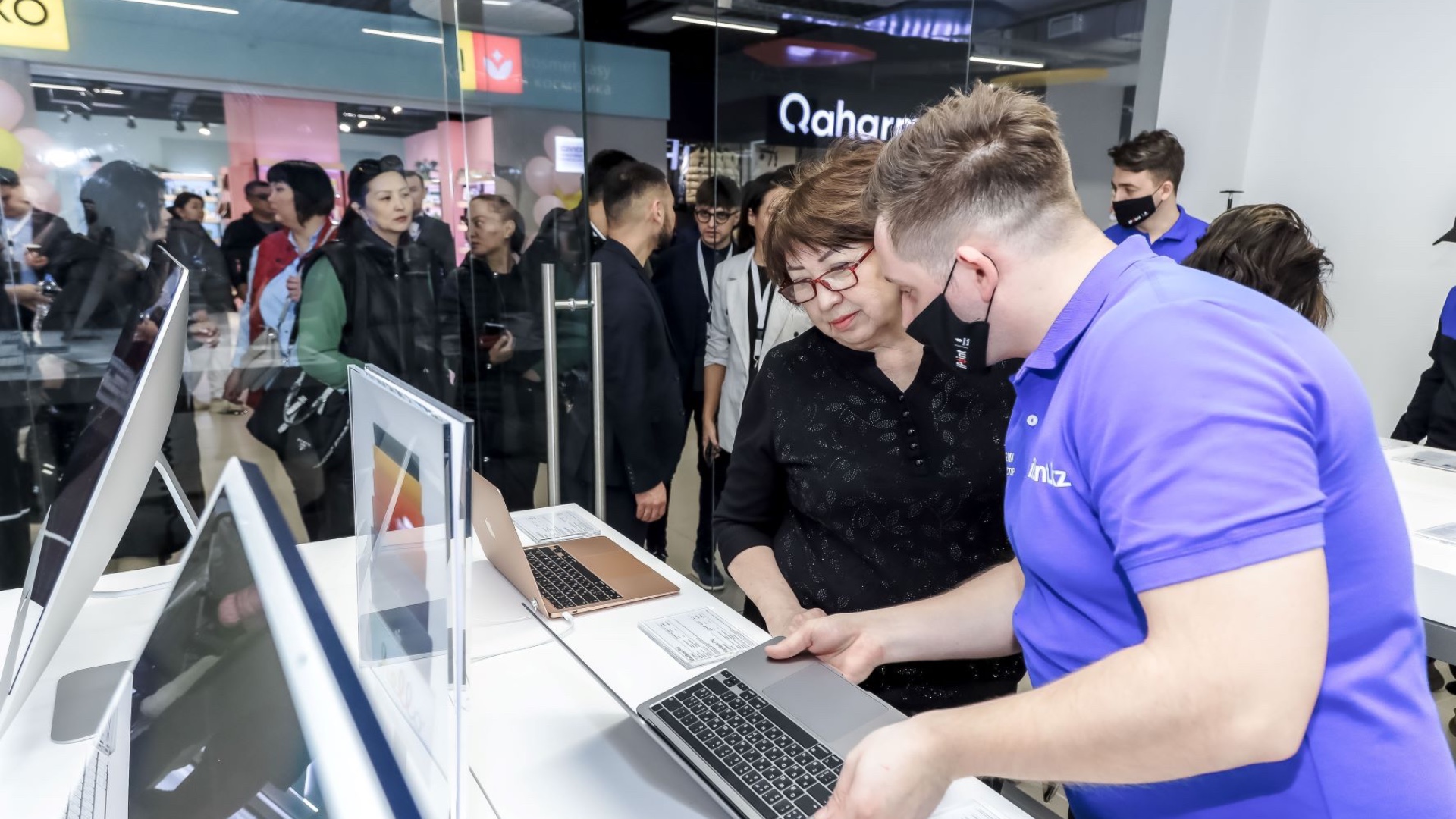
    Despite a year full of geopolitical and economic challenges, Asbis ended 2024 with a result that may herald a change in market sentiment. The mWIG40 index-listed IT equipment distributor generated estimated consolidated revenues of USD 383 million in December. This represents a year-on-year increase of 17 per cent and represents the company’s best monthly sales performance in the past year.

    The key to December’s success, however, was not even growth in all markets, but the completion of specific major projects. Slovakia stood out in particular, where Asbis almost doubled sales thanks to the finalisation of significant contracts. Poland and the United Arab Emirates were equally solid, with double-digit growth, confirming their role as stable pillars in the group’s portfolio.

    From a technological perspective, however, the most interesting signal is coming from Kazakhstan. After months of stagnation, this market has started to show positive trends, which CEO Serhei Kostevitch links directly to the launch of new Apple smartphone models. This may suggest that demand for consumer electronics in the EMEA region is beginning to recover, driven by hardware innovation.

    For investors, the December report proves that Asbis’ geographic diversification strategy is still working, cushioning local downturns with prosperity in other regions. Although the whole of 2024 required management to ‘put out fires’, the end of the year provides a solid foundation for an optimistic entry into 2025.

  • Heading to California: ASBIS makes its US debut with the largest Bang & Olufsen showroom

    Heading to California: ASBIS makes its US debut with the largest Bang & Olufsen showroom

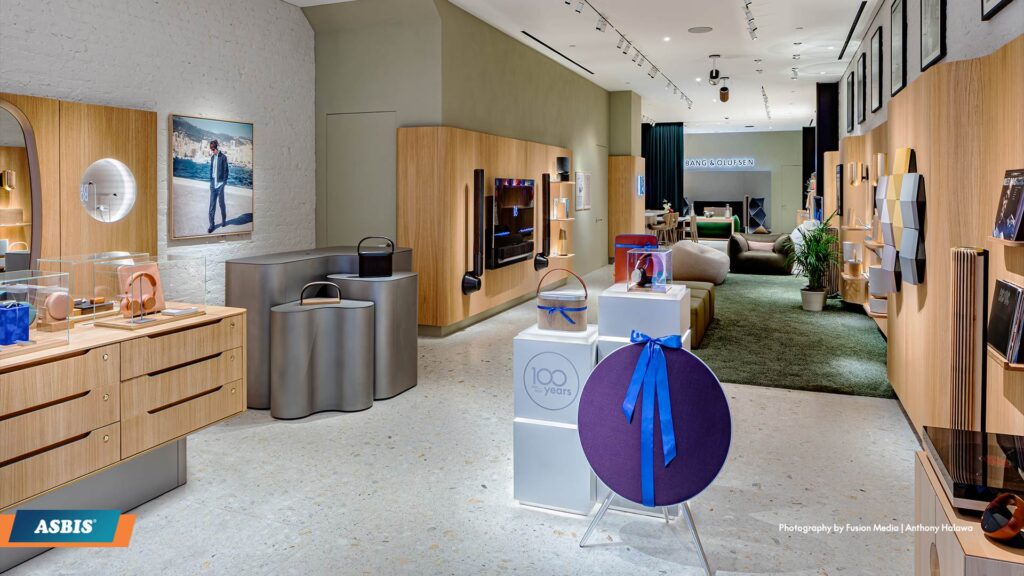
    ASBIS Group, hitherto primarily associated with its strong position as a value-added distributor (VAD) in the markets of Europe, the Middle East and Africa, is making a strategic turn overseas. The company has officially made its debut in the US retail market with the opening of the world’s largest flagship Bang & Olufsen brand store in San Francisco.

    The decision to locate a facility in California is no coincidence and is part of the Group’s broader geographic diversification plan. While ASBIS has built its strength on ICT and IoT distribution in the EMEA region, the entry into the US signals an appetite for higher-margin markets and stabilised demand for luxury goods. The operation is the responsibility of the ASBC subsidiary, which is steadily expanding its retail portfolio. It currently manages a network of 41 outlets in 12 countries, combining sales of Apple products (under the Apple Premium Reseller format) with exclusive audio equipment.

    ASBIS BO US San Francisco2 s
    source: Asbis

    The new showroom in San Francisco is to act as a showcase for both brands, combining Danish minimalism with the distributor’s technological know-how. Serhei Kostevitch, CEO of ASBIS Group, emphasises that the US is a natural environment for premium products, and the current opening is just a bridgehead for wider expansion. The roadmap for the coming years is already outlined – further showrooms are planned to open in the first half of 2026 in key locations of the technology business: Los Angeles and Palo Alto.

    The move should be read as an attempt to become independent of economic fluctuations in emerging markets, where ASBIS has traditionally generated most of its revenue. Choosing Bang & Olufsen as a partner in this expansion seems a safe bet, given the eight jointly operated showrooms in countries as diverse as Italy, South Africa and Georgia. The success in California could become proof for ASBIS that their business model is also scalable in the world’s most competitive retail market.

  • Cyber-Paradox: Why does the exponential increase in cyber attacks not translate 1:1 into security industry revenues?

    Cyber-Paradox: Why does the exponential increase in cyber attacks not translate 1:1 into security industry revenues?

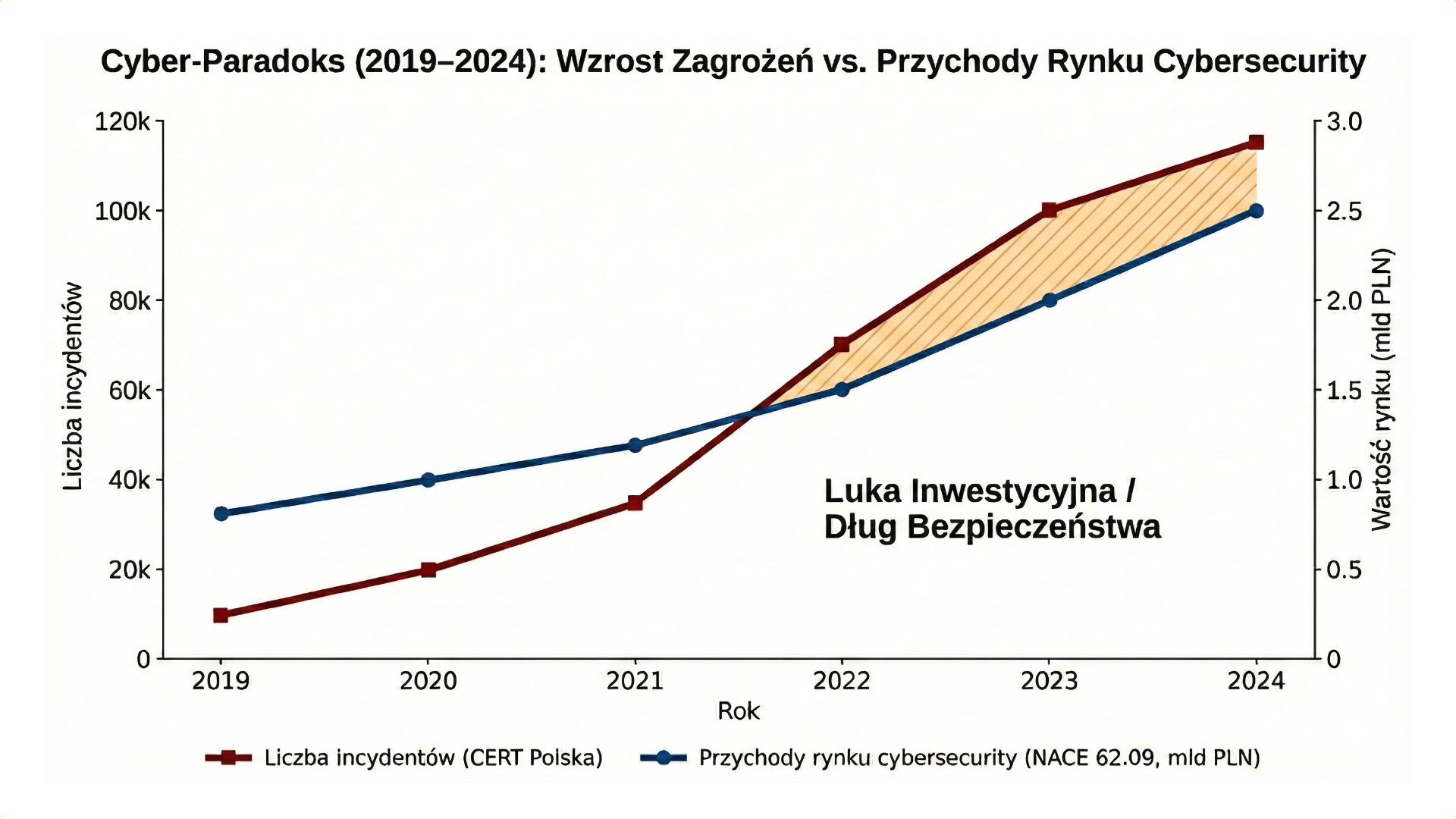
    Does fear really sell? Analysis of data from 2019-2024 debunks a popular myth in the industry. Although the number of cyber security incidents in Poland increased by more than 1,500% during this period, the market for security services and solutions grew by “only” around 120%. Where is the reason for this gap and why does the SME sector still remain a ‘no-man’s land’ for integrators?

    For years, the commercial narrative of the IT industry has been dominated by a simple logic: the more threats, the more customers spend on protection. The market reality of the last five years, however, shows that this correlation is much weaker than it might seem. There is an unprecedented asymmetry – while the threat curve is climbing exponentially, the revenue curve of technology providers is growing at a linear rate, stable but far from explosive.

    Battle landscape: Escalation of 1,500 per cent

    To understand the scale of the disparity, we need to look at hard data on the ‘supply’ of threats. Statistics from CERT Polska (NASK) over the last five years paint a picture of a digital battlefield that has been completely transformed.

    Back in 2019, considered the last year of the ‘old era’, CERT Polska recorded 6,484 security incidents. Even then, there was talk of records. However, the real shock came in 2020 and the pandemic, when the number topped 10,000. This was just the beginning.
    The following years have had a snowball effect. In 2021, nearly 30,000 incidents were recorded, and 2023 closed with more than 80,000 recorded incidents. Preliminary estimates and communications for 2024 show a further dramatic increase, with the number of incidents exceeding 100,000 (an average of 300 per day).

    The mathematics are inexorable: in five years, the volume of successful attacks and incidents has increased by nearly 1500%. If the market had reacted directly in proportion, the cybersecurity industry should be the largest sector of the digital economy today. However, this is not the case.

    Market: Solid growth, but no euphoria

    Juxtaposing these figures with the financial performance of the cybersecurity sector reveals a fundamental ‘divergence’ (decoupling). According to analyses by the research company PMR, the value of the cyber security market in Poland in 2018 was PLN 1.14 billion. Forecasts for 2024 oscillated around PLN 2.5-3 billion.

    This means that at the same time as the number of attacks has increased fifteenfold, the market has grown by around 120-140%. This is a very good result compared to other IT branches, but it clearly shows that the elasticity of demand for security is low. Each additional thousand attacks generates a relatively small increase in new budgets.

    Eurostat data (NACE classification 62.09) and the services price indices (PPI) confirm this trend – there is a steady increase in turnover, but there is no question of a jump to match the scale of the risks.

    Diagnosis: Why are SMEs not buying security?

    The key to solving this conundrum is the structure of the Polish economy. While the banking sector and large corporations (Enterprise) invest adequately for the risk, the SME sector – which is the backbone of the economy – lags behind. This phenomenon can be called the ‘investment gap’.

    1. financial barrier and microbudgets

    The average annual expenditure on cyber security in SME companies is only PLN 24,000. When juxtaposed with the cost of modern SIEM, EDR or specialist salaries, this amount is a drop in the ocean of needs. It allows the purchase of basic licences, but not to build real resilience.

    2. awareness vs. practice

    ESET and Dagma’s 2024 research is alarming: as many as 41% of Polish companies do not even use anti-virus software. Despite the fact that 87% of companies consider digitalisation to be crucial and 88% have experienced an incident in the last 5 years, a ‘somehow it will be done’ attitude still persists.

    3 Technology debt and Shadow IT

    Many companies migrate to the cloud (SaaS), mistakenly assuming that security is included in the price of an office suite subscription. These expenses are often not classified as ‘cybersecurity’, which understates the market statistics, but also puts to sleep the vigilance of businesses that do not invest in additional layers of protection (backup, training).

    What really drives the market?

    Analysis of the data leads to the conclusion that the number of attacks is not the main driver of sales. Polish companies are reactive rather than preventive. The real ‘engine’ of spending growth is two other factors:

    • Paralysing Incident(Ransomware): Only an attack that encrypts data and stops production opens the board’s portfolio. Minor incidents (spam, phishing) are ignored.
    • Regulation (Compliance): The spike in reported incidents in 2020 coincided with the implementation of the KSC Act. The market is now waiting for the effect of the NIS2 directive. It is the threat of administrative penalties (up to 2% of turnover), not hackers, that will force thousands of entities to make real investments between 2025 and 2026.

    The future belongs to companies that will offer security as a scalable service (Managed Security Services), taking the burden of hiring expensive experts off the customer’s shoulders, and to those that combine technology with legal support for NIS2 requirements in their offerings. This is the only way to bridge the gap between the growing graph of attacks and the flat graph of spending.

  • HP warns: DDR5 prices will rise by 200%. How the PC market will cope with the supply crisis

    HP warns: DDR5 prices will rise by 200%. How the PC market will cope with the supply crisis

    Every one of us has seen it in the grocery shop. Your favourite chocolate bar, which used to weigh 100 grams, suddenly weighs 90, even though the price on the shelf has not budged. However, the phenomenon of shrinkflation – i.e. a hidden increase in price by making a product smaller – is no longer the domain of the FMCG market alone. Everything seems to indicate that the coming spring will bring us a technological version of this trend. This time, however, it will not be sweets that are being slimmed down, but the configurations of our laptops and workstations.

    Over the years, the IT industry has accustomed us to a comfortable trend: each successive generation of hardware has offered more computing power and memory for the same (or less) money. Moore’s Law and economies of scale worked in favour of the end customer. This mechanism is just now coming to a halt. The reason is the rapid turbulence in the RAM market, where prices for DDR5 modules have shot up by 100 and, in extreme cases, even 200 per cent in recent weeks. This is an upheaval that cannot be swept under the carpet, and its effects will be felt sooner than we think.

    The era of safe stocks is over

    Until now, the PC market has been somewhat impregnated against these increases. The big players, such as HP, had massive stockpiles that acted as a safety buffer, cushioning spikes in component prices from suppliers. As a result, distributors’ price lists remained relatively stable, even though the component exchanges were at fever pitch.

    However, this protective period is coming to an end. Enrique Lores, CEO of HP, leaves no illusions in his market forecasts. He is signalling clearly that the giant’s accumulated stocks are likely to run out by next spring. This is a key moment for the entire sales channel. When the warehouses empty, manufacturers will have to go out into the market and buy components at new, drastically higher rates.

    For the reseller and integrator, this means one thing: current pricing is a relic of the past that will only last for another quarter, maybe two. Then there will be a painful collision with the new BOM (Bill of Materials) cost.

    Less RAM or a higher invoice

    This brings us to the crux of the problem, namely the aforementioned shrinkflation. Hardware manufacturers are well aware that the market – especially in the entry-level and SME segments – is extremely price-sensitive. Raising the price of an entry-level office laptop by 15-20% can drastically suppress demand.

    What strategy will the industry adopt? According to predictions coming from the HP camp, in order to maintain certain price points, manufacturers will be forced to cut specifications. In practice, this could mean that a model that was offered with 16 GB of RAM as standard this year will only have 8 GB on board at the same price next year.

    Devices with a ‘decent’ amount of memory will not disappear, but will inevitably move into the premium category. The customer will have a choice: accept inferior performance on an old budget or dig deeper into their pockets.

    While in the case of powerful workstations for engineers or graphic designers, companies are likely to ‘swallow this sour apple’ – because there performance is business-critical – in the case of bulk orders for offices or schools, we can expect a return to configurations that until recently we considered the bare minimum, not to say relic.

    Why is it so expensive? The invisible AI tax

    One might ask: why is memory getting more expensive just now, when the PC market is still licking its wounds after the post-pandemic slowdown? The short answer is Artificial Intelligence.

    The PC industry has become somewhat hostage to the AI revolution. Memory manufacturers such as Micron and Samsung are acting rationally. Seeing the tech giants’ insatiable appetite for servers to train language models, they are redirecting their production capacity to the manufacture of HBM (High Bandwidth Memory). It is these dice that are essential to the operation of AI accelerators and it is these that are currently generating the highest margins.

    The problem is that a semiconductor factory is not a bakery – you cannot change the product range or add a new production line overnight. New factories take years to build and cost billions of dollars. So, since the production lines are busy producing expensive memory for AI servers, there is not enough room to produce ‘ordinary’ RAM for laptops.

    We are dealing with a classic domino effect. DDR4 production has been largely extinguished (which has already driven up its prices), and DDR5 supply is not keeping up with demand, as HBM takes priority. As a result, when we buy an ordinary laptop for Excel, we pay a kind of ‘tax’ that funds the construction of Meta or Google data centres, powered by thousands of Nvidia Blackwell processors.

    The market abhors a vacuum and the economic calculus is inexorable. In 2026, AI will not only change the way we work, it will also have a real impact on the hardware we use to do that work. There are many indications that the coming spring in the hardware industry will be extremely expensive.

  • West looks East: Is CEE becoming Europe’s new IT logistics hub?

    West looks East: Is CEE becoming Europe’s new IT logistics hub?

    The upheaval in global supply chains from 2020-2024 has forced the tech giants to redefine their strategies. In this new dispensation, Central and Eastern Europe (CEE) is no longer merely a ‘cheaper alternative’ to Germany. Thanks to a combination of advanced warehousing infrastructure, growing manufacturing competence and strategic location, the region is emerging as a key distribution hub for the IT and electronics sector. What does this mean for the Polish IT industry?

    End of the “Just-in-Time” era, beginning of the “Just-in-Case” era

    Until a decade ago, the model was simple: electronics produced in Asia sailed by container ship to the ports of Rotterdam or Hamburg, and from there they were sent to distribution centres in Western Europe. The CEE region played a peripheral role. Today, this model is becoming a thing of the past. The pandemic, the blockades of the Suez Canal and the war in Ukraine have exposed the fragility of long supply chains. The corporate response is nearshoring – moving production and logistics closer to markets.

    The data is clear: around half of the companies operating in Europe have started to decentralise their supply chain, and CEE is the main beneficiary of this trend. It is no longer just about cheap labour. It is about resilience. For an IT distributor, not having goods on the shelf during the ‘peak season’ (Q4) means measurable losses. Warehousing goods in Poland or the Czech Republic, from where it takes a few hours to get to Berlin, has become a safety net for Western European business.

    Hard data: Poland the warehouse of Europe

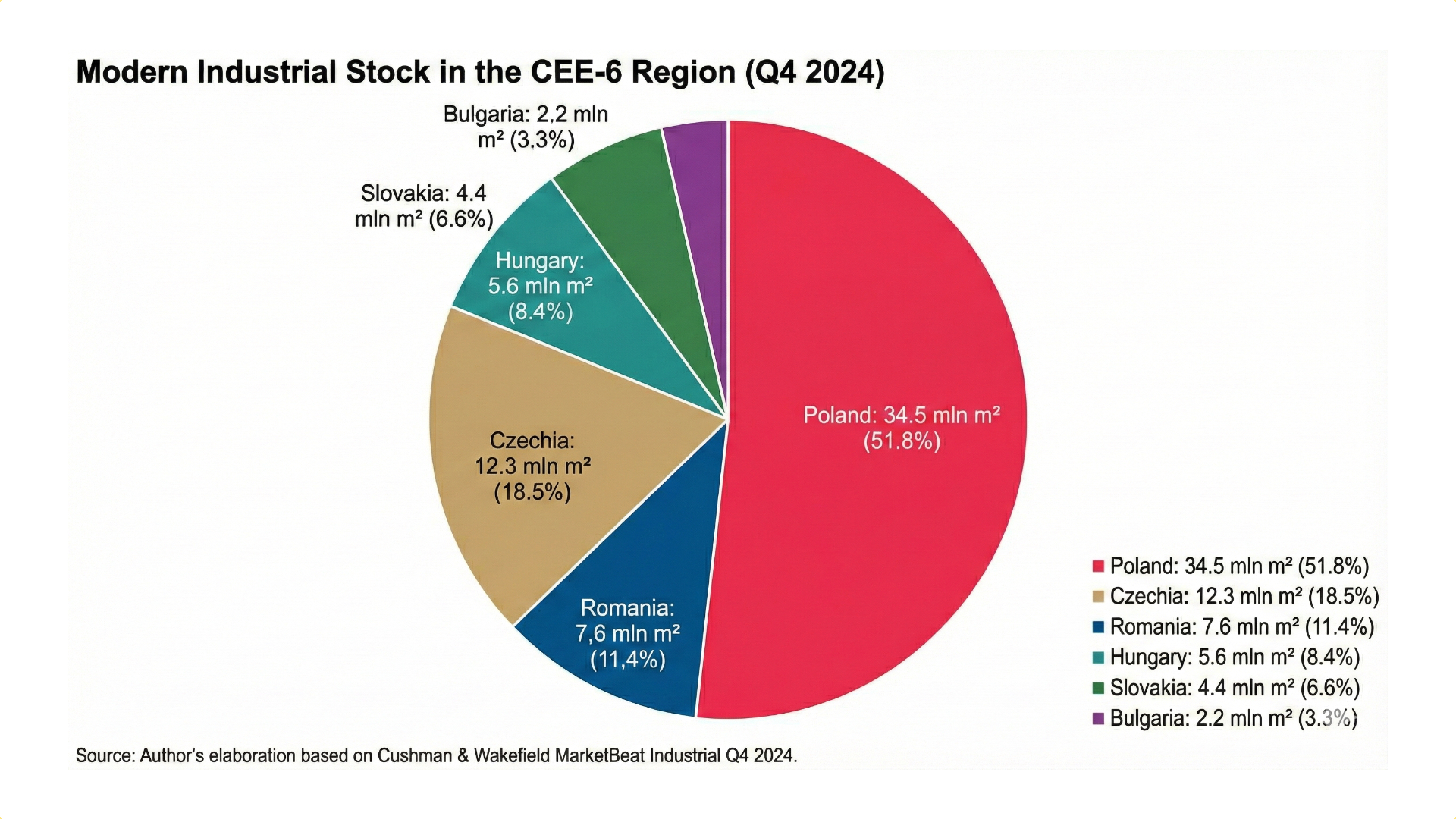
    Poland has grown into the undisputed logistics leader in the region, with 2024 figures confirming its dominance over many Western markets. In the first half of 2024, Poland recorded the highest warehouse rental volume in Europe, even overtaking the German market.

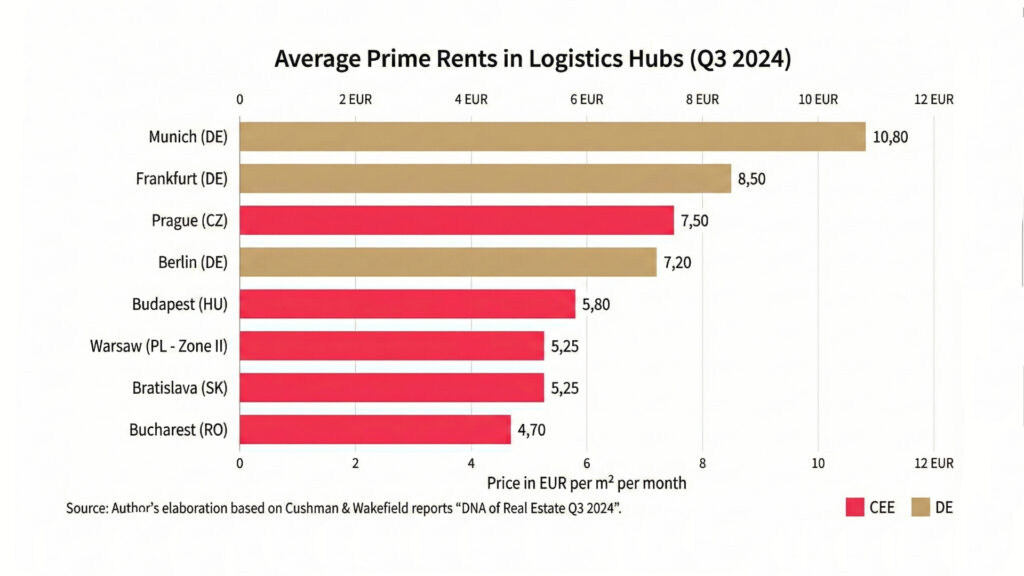
    Cost arbitrage remains a key factor for the IT industry, operating on low distribution margins. An analysis of prime rents in Q3 2024 shows a gap between CEE and the West:

    • Munich: approx. EUR 10.80/m²
    • Warsaw (surroundings): approx. EUR 5.25/m².
    • Bucharest: approx. EUR 4.70/m².
    czynsz eng

    For a company from the SME sector or a large electronics distributor (such as TD Synnex or Ingram Micro), maintaining a distribution centre near Wrocław or Poznań is nearly half as expensive as in Germany, while maintaining the A-class standard. Moreover, modern warehouses in CEE are often younger and better adapted to automation and ESG requirements (BREEAM/LEED certificates) than older facilities in the West.

    Not just a warehouse, but a factory

    The myth of CEE as exclusively an ‘assembler’ collides with the data on high-tech exports. Hungary, the Czech Republic and Poland have transformed themselves from technology importers to net exporters.

    • Hungary has become a regional powerhouse in electronics manufacturing, with exports of electrical and electronic equipment accounting for more than 23% of total exports there.
    • Lenovo in Hungary: The Üllő plant is an example of what nearshoring looks like in practice. This plant has already produced more than 1.5 million servers and workstations, serving the EMEA markets (Europe, Middle East, Africa). Reducing delivery times to customers in Europe from several weeks (shipping from China) to a few days is a competitive advantage that cannot be ignored.

    In the case of Poland, exports of high-tech products have approached USD 30 billion. Poland plays a key role in so-called fulfilment for e-commerce. Giants such as Amazon and Zalando have located their centres in Poland not only because of costs, but because of the possibility of servicing the entire German and Scandinavian market from here. More than 34% of the demand for warehouses in Poland in 2024 will be generated by the e-commerce and retail sector, which is directly correlated to the sale of electronics.

    Risks: Lessons from Intel and labour market challenges

    However, the image of the region as the ‘Promised Land’ has its cracks. The loudest echo in the industry was the suspension (and de facto cancellation in its current form) of Intel’s investment near Wrocław in the Semiconductor Integration and Testing Facility. This decision, resulting from the corporation’s global financial problems, shows that basing a development strategy on a single giant investor can sometimes be risky. Nonetheless, the logistics sector has ‘absorbed’ the news without breaking down. The land prepared for Intel’s investment remains an attractive asset and demand from other players is not waning.

    For Polish IT SMEs, the labour market is becoming a challenge. Although labour costs in Poland are still 2-3 times lower than in Germany , the availability of skilled workers is decreasing. The answer is automation. Implementing systems such as AutoStore or AMR robots in warehouses (as Zalando or Ingram Micro are doing, for example) is becoming a necessity rather than a gadget. This is an opportunity for Polish IT system integrators who can offer these solutions to logistics.

    Polish IT SMEs do not need to build their own warehouses. The CEE region offers the most modern fulfilment infrastructure in Europe. The use of logistics operators (3PLs) in Poland makes it possible to compete with Western companies on delivery times, with a lower cost base.

    • Supplier diversification: Proximity to factories in Hungary (Lenovo, Samsung) or the Czech Republic (Foxconn) means that Polish distributors and resellers can rely on shorter supply chains. It is worth reviewing contracts and looking for manufacturing partners within the CEE region, rather than relying solely on imports from Asia.
    • Investment in technology: As logistics in CEE is moving towards automation, IT companies should focus on providing solutions to support this trend: from WMS (Warehouse Management Systems), to IoT for shipment monitoring, to cyber security for industrial infrastructure.

    Is CEE the new IT logistics hub for Europe? The answer is yes, but in a new formula. We will not replace Rotterdam as a port of entry, but we have become a ‘buffer warehouse and last mile factory’ for Europe. Poland (distribution), Hungary (manufacturing) and the Czech Republic (high-tech) form a complementary ecosystem. For the IT industry, this means more stable supply and lower operating costs. The winners will be those who understand that logistics in 2025 is not just about pallet transport, but about data and time management – and in this, the CEE region is starting to win over Western competitors.

  • Action S.A. summarises Q3 2025: E-commerce shot up. Shipping growth of 34%

    Action S.A. summarises Q3 2025: E-commerce shot up. Shipping growth of 34%

    Action S.A. closed the third quarter of 2025 with revenues of nearly PLN 745 million, confirming that its sustainable growth strategy is yielding tangible results in a still challenging macroeconomic environment. The distributor generated nearly PLN 9 million in net profit during the period, maintaining a margin at a safe level of 8.41 per cent. These results shed light on the company’s broader transformation, which is increasingly balancing between classic distribution and its role as a provider of advanced services.

    A key driver in recent months has been the B2C e-commerce segment. The scale of operations in this area has increased significantly, as evidenced by the volume of shipments handled – more than 1.07 million items, which is 34 per cent better than in the same period last year. However, Action is not limiting itself to the role of a passive retail intermediary. The company is consistently developing overseas sales channels and strengthening its B2B offering, which allows it to diversify its revenue streams and become independent of fluctuations in the local consumer market.

    An important element of the report is the evolution of the business model towards value-added services. As part of the #ACTIONTechSolutions initiative, the distributor is increasingly bold in its role as an implementation partner for corporate and institutional customers. Offering end-to-end enterprise solutions is a strategic retreat from low-margin volume distribution. Slawomir Harazin, Vice President of the Management Board, points out that building sustainable advantages is based on innovations, which the company first tests on its own body.

    “We know that modern business is about creating sustainable advantages based on innovative solutions that we ourselves implement in our organisation. Thanks to the experience we have gained and the systems we develop, we become a reliable partner for other entities. We are convinced that this approach allows us not only to support the development of our customers, but also to consistently strengthen the Company’s position on the market,” – adds Sławomir Harazin, Vice President of the Management Board of ACTION S.A.

    On the operational side, Action is focusing on cost optimisation by finalising the implementation of a new ERP system and tools based on artificial intelligence. Piotr Bielinski, CEO, emphasises that the company is choosing the ‘small steps’ method instead of sudden leaps. This approach aims not only to improve efficiency on an ongoing basis, but above all to prepare the ground for future scaling of the business. Investment in technology serves a dual purpose here: it streamlines internal processes and builds credibility in the eyes of business partners looking for proven solutions in the age of digital transformation.

    “Our approach is based on systematic, deliberate growth – we choose small steps rather than sudden leaps. Current work and activities are strengthening the base for future growth. At the same time, we are optimising costs and preparing for the implementation of new systems to work even more strongly in our favour in the future. In the B2C e-commerce segment we are consistently pursuing growth,” says Piotr Bielinski, CEO of ACTION S.A.

    Selected financial data of GK ACTION S.A. for Q3 2025.

    thousand PLN20252024 change
    Sales revenue744 698 627 489 18,68%
    Gross profit/loss on sales62 61450 32824,41%
    Margin %8,41%8,02%0,39%
    Net profit8 9946 16545,89%
  • Customer contact avoidance. Why AI in B2B sales is a lifesaver in 2026

    Customer contact avoidance. Why AI in B2B sales is a lifesaver in 2026

    The traditional ‘relationship’ model in the IT industry is shaking in its foundations. Today’s buyers are armed with knowledge, sceptical and… increasingly preferring not to speak to a supplier representative at all. Gartner’s Robert Blaisdell warns: by 2026, strategies based on ‘number of contacts’ will no longer work. The question is: how can sales directors (CSOs) use AI to ensure that their teams are no longer seen as intrusive and become trusted advisors?

    Just a decade ago, there was a simple rule of thumb in the affiliate channel and B2B sales: the more phone calls and emails you made, the more deals you closed. Today, this statistic is no longer defensible. With the dynamic evolution of the sales market, leaders (CSOs – Chief Sales Officers) are facing an unprecedented challenge. Productivity pressures are increasing, costs need to be cut and customers are becoming increasingly elusive.

    Experts in the Gartner Sales Practice make it clear: the path to success in 2026 is not through ‘more of the same’. It requires a fundamental remodelling of Go-to-Market (GTM) strategy and an understanding that artificial intelligence in the hands of the sales person is not to be used to generate spam, but to build precision.

    The paradox of the “Rep-Free Experience”

    The most important trend keeping sales directors awake at night is the change in buyer preferences. The business customer, especially in the technology sector, is moving towards a so-called rep-free experience.

    Why does this happen? Blaisdell points out an interesting paradox. Buyers today have access to an almost unlimited supply of information online. In theory, they are brilliantly educated before the first conversation. In practice, however – the information is often fragmented, contradictory or unreliable. This gives rise to deep scepticism. The customer avoids contact with the salesman not because he does not need help, but because he does not believe that the salesman will add value beyond what he has already ‘Googled’ himself.

    This is where the skills gap and opportunity for modern sales organisations opens up.

    No more “spamming”, time for precision

    Many IT leaders fall into the trap of treating AI as a tool to increase volume. If AI can write 100 emails in a minute, why not send them? This is a mistake. Customers are sensitive to generic messages and mass communication.

    According to Gartner’s predictions for 2026, the key to success will be a shift away from volume-based activities to relevance. A sales-focused AI strategy must serve hyper-personalisation.

    Instead of implementing AI as a ‘technological novelty’ (or, as it is sometimes referred to, ‘technological nonsense’ with no results), CSOs need to define clear business objectives. AI should act as an analytical partner that prompts the sales person:

    When exactly is the client looking for a solution?

    • What specific problem is it trying to solve?
    • What information (content) will make us credible in his eyes?
    • Building trust in the age of algorithms

    To break through the wall of scepticism, organisations need to rebuild their GTM operations. Since customers avoid contact until they are sure of a decision, the role of the salesperson – supported by AI – is to provide them with the ‘ammunition’ to make that decision.

    It is about providing credible, targeted information that addresses specific buyer concerns. This requires close collaboration between Sales – Marketing – IT. Sales executives need to sit down at the table with technology leaders and create a roadmap where AI realistically improves productivity, not just adds another tool to log in.

    Sales manager: The forgotten link

    When implementing these changes, the human factor cannot be forgotten. Blaisdell points out that an often overlooked piece of the puzzle is **sales managers**. In an AI-enabled world, their role needs to evolve from ‘performance supervisor’ to ‘performance enhancer’.

    Companies are investing crores in tools for serial salespeople, neglecting middle management. Meanwhile, it is managers who need support, role clarity and tools to coach their teams based on data from AI systems. Without a strong, digitally competent manager, even the best algorithm will not translate into revenue growth.

    3 steps for the Chief Sales Officer (CSO) for 2026

    Based on Gartner’s findings, IT sales leaders should focus on three pillars:

    1. sales-focused AI: Deploy technologies only if they have a clear translation into commercial outcome and real productivity, not for the sake of innovation.

    2 Align with the ‘Rep-Free’ client: Change tactics from a mass attack to precise, data-driven trust-building. Be where the customer is looking for insights before they make a bid.

    3. Supporting Managers: Invest in developing managers to be able to use the potential of AI to coach and improve the effectiveness of the whole team.

    The year 2026 will not be the year of the battle between man and machine. The teams that will win will be those where the machine does the dirty analytical work, allowing humans to do what they still do best – build trust in a world full of digital noise.

  • The end of the ‘sell and forget’ era. How the subscription economy is quietly redefining the IT channel

    The end of the ‘sell and forget’ era. How the subscription economy is quietly redefining the IT channel

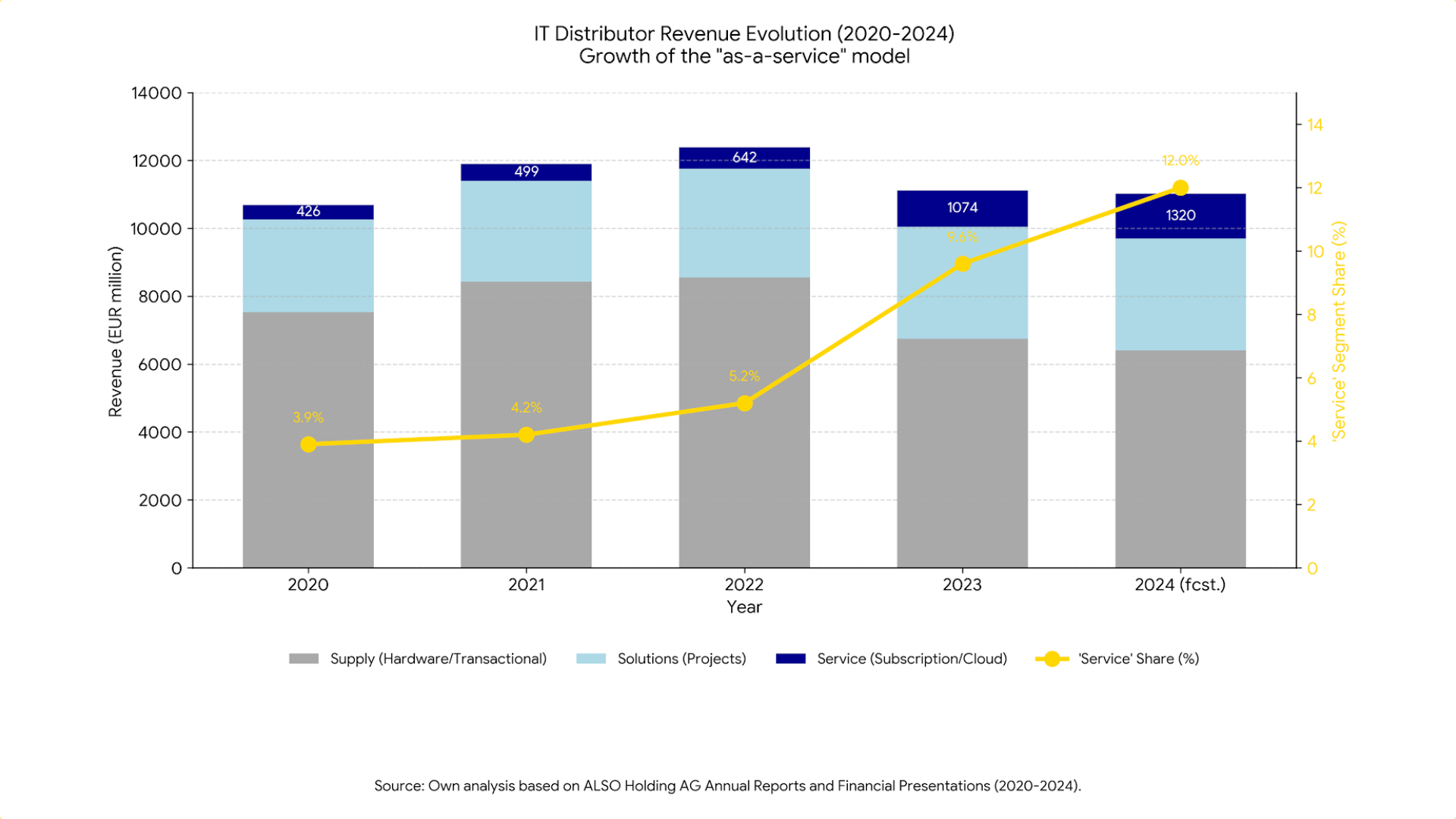
    Nominal revenue growth in the IT industry is no longer the only determinant of success. Between 2023 and 2025, we are seeing a fundamental change in Poland and Europe: money in the distribution and partner channel is changing its nature. Instead of one-off cash shots (transactions), the market is shifting towards streams (subscriptions). For distributors this is an accounting challenge, for resellers a painful foray through the ‘valley of death’ in cash flow, but for those who survive, the reward is company valuations that are up to three times higher.

    The transformation from CapEx (capital expenditure) to OpEx (operating costs) is no longer just the domain of SaaS start-ups, but a hard reality for the traditional sales channel – from distribution giants to local MSP integrators (Managed Service Providers).

    Invisible turnover: lessons from the global giants

    To understand what is happening in Poland, you need to look at the performance of global leaders who are setting trends. The traditional ‘Revenue’ line in financial statements has become confusing in the cloud era. Why? Because subscription sales (e.g. Microsoft 365, AWS, Cyber-as-a-Service) are often accounted for on a ‘net’ agency model – the distributor only shows its margin, not the full invoice value.

    This is perfectly illustrated by TD SYNNEX’s Q3 results for fiscal 2025. Reported revenues amounted to USD 15.7 billion (+6.6% year-on-year), but so-called Gross Billings (the real value of technology sold) reached a staggering USD 22.7 billion, increasing by 12.1%.

    This difference – amounting to $7 billion in a single quarter – is the ‘invisible’ mass of turnover coming from cloud services and subscriptions in a standard P&L account. For the Polish market, the lesson here is clear: if your revenues are stagnant, but the number of supported licences and service contracts is growing, then your business is actually growing faster than the simple P&L calculation shows.

    Poland specific: Infrastructure ready, people not

    The growth dynamics of the as-a-Service model in Poland has a unique, local drive. It is the gap between infrastructure and competence. On the one hand, Poland has a fibre optic infrastructure above the EU average, which is a technological highway for cloud services. On the other hand, Poland’s basic digital skills rate is only 44.3% (compared to the EU average of 55.6%).

    For the partner channel (Resellers/MSPs), this is an ideal situation. Polish SMEs have the connectivity to use the cloud, but do not have the people to manage it. This forces outsourcing. According to PMR forecasts, the cloud market in Poland was expected to grow by 24% in 2024, reaching a value of PLN 4.8 billion. Importantly, Polish companies are still at the ‘Cloud 1.0’ stage (mail, storage), while the adoption of advanced services (AI, analytics) is only 3.7% compared to 8% in the EU. This shows a gigantic potential for upselling in the coming years.

    AB S.A. and the run to the front

    In Poland’s backyard, this transformation is perfectly illustrated by the AB S.A. Group. In the 2023/2024 financial year, the group’s revenues amounted to PLN 14.7 billion (a slight decrease reported by exchange rate differences), but profitability is key. The profit margin on sales reached a record level of 4.1%.

    This is evidence of a shift in product mix. AB S.A. is shifting the weight of the business from simple ‘box shifting’ to VAD (Value Added Distribution) – advanced server solutions, cyber security and cloud. The company has reduced its net financial debt by three quarters, building a powerful financial cushion. In a subscription model, where payments are staggered, it is the strong balance sheet and low-cost financing that become the distributor’s main competitive advantage over smaller players.

    YearNon-recurring revenues (Hardware/perpetual licences)Recurring revenues (Subscriptions/MSP/Cloud)Trend commentary
    202180%20%Dominance of the transactional model (traditional reseller).
    202365%35%Post-pandemic acceleration, cloud growth (PMR data).
    202455%45%‘Gross Billings’ effect – growth in managed services and security.
    2025 (Forecast)45%55%Point of intersection (AI, DaaS, NIS2).

    The holy grail: own IP and repeatability

    At the other end of the market are companies that have already completed the transformation. Asseco Poland reported in 2024 that as much as 79% of revenue (approximately PLN 13.5 billion) comes from its own software and services.1 Such a revenue structure, based on licences, maintenance and subscriptions, is the goal pursued by the modern IT channel. It ensures predictability and resilience to economic fluctuations, as can be seen from the steady growth of Asseco’s net profit (+8% year-on-year).

    MSP and the ‘Valley of Death’: why suffer?

    For smaller IT companies (integrators, resellers), moving to a subscription model involves the risk of the so-called ‘Valley of Death’ in cash flow (Cash Flow J-Curve). Instead of a one-off invoice for PLN 50,000 for the implementation, the company receives, for example, PLN 2,000 per month. This means a drastic drop in cash inflow in the first year, even though the customer value (LTV) is higher in a three-year perspective.

    So why do companies decide to take this step? The answer lies in the valuation of the business.

    • A traditional IT company (break-fix/non-recurring sales model) is valued in the market at 2.6x – 4.8x EBITDA.
    • A mature MSP with a high proportion of recurring revenue (Recurring Revenue) achieves multipliers of 8x – 10x EBITDA, and even more for large-scale platforms.

    Investors pay a ‘peace of mind premium’ – a predictable revenue stream is worth far more than a one-off sales shot, even a high one.

    Forecast: What will drive the market in 2025?

    The data points to three catalysts for service share growth in 2025:

    1. AI PCs and the end of Windows 10: PC fleet replacement (predicted by AB S.A. and IDC) is an opportunity to sell hardware in a DaaS (Device-as-a-Service) model with AI management services.
    2. Cyber Security (NIS2): EU directive will force thousands of companies in Poland to professionalise security. SMEs cannot afford their own SOC (Security Operations Centre), so they will buy security as a subscription service from MSPs.
    3. Platformisation of distribution: Tools such as Ingram Micro Xvantage or AB S.A.’s cloud platforms automate the subscription renewal process, making revenue more ‘sticky’ and cheaper to handle.

    The Polish IT industry is at a turning point. Although, by volume, hardware sales still account for a large proportion of turnover (as can be seen from distributors’ results), margins and enterprise value are migrating towards recurring services. Analysis of the data shows unequivocally: whoever does not have a significant share of recurring revenues on their balance sheet in 2025 will lose relevance and market value, no matter how much nominal turnover they generate.