Tag: IT industry

  • IT market in CEE: Poland vs. Czech Republic, Hungary, Romania. Analysis

    IT market in CEE: Poland vs. Czech Republic, Hungary, Romania. Analysis

    Central and Eastern Europe (CEE) has long ceased to be seen as an ’emerging’ technology market. Today, it is a globally established, dynamic and competitive centre of innovation, whose IT services and R&D market is growing four to five times faster than the global average.

    At the heart of this technological renaissance are four key players, a kind of ‘Visegrad+ Technology’: Poland, the Czech Republic, Hungary and Romania. Each of these countries brings a unique profile to the regional jigsaw: Poland appears as a regional hegemon in terms of scale, the Czech Republic as a stable industrial and technological centre, Hungary as a magnet for foreign direct investment and specialised expertise, and Romania as a ‘digital contender’ with the highest growth rate.

    CEE technology arena

    To understand the dynamics of competition in the region, it is first necessary to assess the fundamental economic context, comparing the scale, structure and importance of IT markets in each of the four countries. It is these indicators that determine who are the biggest players and where the epicentre of growth lies.

    Scale and dynamics of the market: measuring the forces

    Market size is a fundamental indicator of strength. In this respect, Poland is the undisputed leader in the region, although different sources give slightly different estimates, reflecting the complexity and dynamics of the sector. According to PMR data, the value of the Polish IT market in 2023 was PLN 66.3 billion (approx. EUR 15.4 billion), with a forecast of growth to PLN 74 billion (approx. EUR 17.2 billion) by 2025. IDC Poland analysts, on the other hand, estimate this value even higher – at PLN 80.3 billion (approx. EUR 18.6 billion) in 2023. Regardless of the methodology adopted, the scale of the Polish market significantly exceeds its neighbours.

    The Czech ICT (information and communication technology) market presents the picture of a mature and stable powerhouse. Its revenues are forecast to reach EUR 24.3 billion by 2026, with a steady annual growth rate of 2.1%. This indicates a less volatile, well-established market. The Hungarian ICT market is more difficult to assess conclusively due to disparate data. Mordor Intelligence estimates its value at an impressive USD 35.17 billion in 2025, with a projected annual growth rate (CAGR) of 11.41% until 2030. Other sources quote a more conservative figure of €5bn for 2024. This discrepancy suggests that the higher estimate covers a wide range of telecoms services and hardware sales, driven by large corporations. The Hungarian e-commerce segment alone reached HUF 1,920 billion (approximately EUR 4.9 billion) in 2024.

    Romania presents the most dynamic picture. Its digital economy is expected to reach a value of EUR 52 billion by 2030. The IT services export market, valued at EUR 24.9 billion in 2023, is expected to grow to EUR 44.8 billion by 2028, representing an impressive CAGR of 9.1%. This is the fastest growth trajectory in the group analysed, positioning Romania as a top contender for regional momentum.

    This dichotomy between scale and speed of growth creates a strategic tension. Poland, as the largest market, offers stability, a mature and diverse ecosystem, which is attractive to large corporations looking for space for R&D centres. On the other hand, Romania, with its near double-digit growth, is a magnet for venture capital funds and companies looking for rapid expansion, willing to accept the risks associated with a less mature market. The choice between these countries is therefore not a simple decision, but depends on the investor’s appetite for risk and its growth strategy.

    The powerhouse that drives GDP: More than the service sector

    The importance of the IT sector for national economies is best reflected in its share of Gross Domestic Product. In Poland, it is an impressive 8%, reflecting the deep integration of technology into the overall economy and its key role as a driving force. Romania also boasts a high figure at 6.6%. Surprisingly, Hungary has the lowest share at 4.3%. Although precise data for the Czech Republic is lacking for IT alone, the context is the powerful automotive industry, generating 10% of GDP, indicating strong links between the technology sector and industry.

    These figures, juxtaposed with overall wealth levels, show that technology is a key tool for convergence. Poland and Romania, with GDP per capita (in purchasing power parity) at 79% of the EU average, are chasing the Czech Republic (92%). The IT sector is undoubtedly one of the main accelerators of this process.

    Market Architecture: What’s hiding under the hood?

    The internal structure of the IT markets in each country reveals their unique specialisations and strategic directions.

    Poland: We are seeing a clear bifurcation of the market. The hardware segment is stabilising after a pandemic boom, while software and services are going from strength to strength, reaching a value of PLN 30.5bn (€7.1bn) in 2023. Cloud services are a key driver, with the market growing by 25% year-on-year to reach US$2bn.

    Czech Republic: The market is strongly determined by a powerful industrial base, especially the automotive and electrical engineering sectors. This generates a huge demand for embedded systems, industrial automation and advanced enterprise IT solutions. The country is also a hub for international R&D centres such as Microsoft, IBM and Oracle.

    Hungary: the market is characterised by an exceptionally high level of high-tech adoption by businesses. The cloud adoption rate is 37.1% (slightly below the EU average) and data analytics as high as 53.2%, which is well above the EU average (33.2%). This indicates a mature and demanding corporate customer base. The largest segment of the ICT market is telecommunications services, accounting for more than 41% of the total.

    Romania: the market is largely export-oriented, especially in the area of software development services. Despite the government’s strong emphasis on the digitalisation of small and medium-sized enterprises, its level (27%) still lags far behind the EU average (57.7%), which paradoxically creates a huge potential for growth in the internal market.

    An analysis of the structure of markets reveals an interesting phenomenon in Hungary. On the one hand, companies there show above-average maturity in the adoption of advanced technologies such as data analytics.

    On the other hand, the contribution of the overall IT sector to GDP is the lowest in the group. This apparent contradiction suggests that technological advancement is concentrated in a narrow group of large, often foreign corporations (e.g. from the automotive sector), rather than being a widespread phenomenon driven by a broad domestic IT industry.

    This indicates a ‘top-heavy’ market with potentially fewer opportunities for local SMEs compared to Poland, where the domestic IT sector is a much larger economic force.

    The human capital equation: talent, skills and remuneration

    In an industry dominated by a ‘war for talent’, it is human capital that is the most valuable asset and the ultimate determinant of competitiveness. The analysis moves from macroeconomic numbers to the practical realities of building and maintaining technology teams.

    Talent resource: A deep but challenging resource

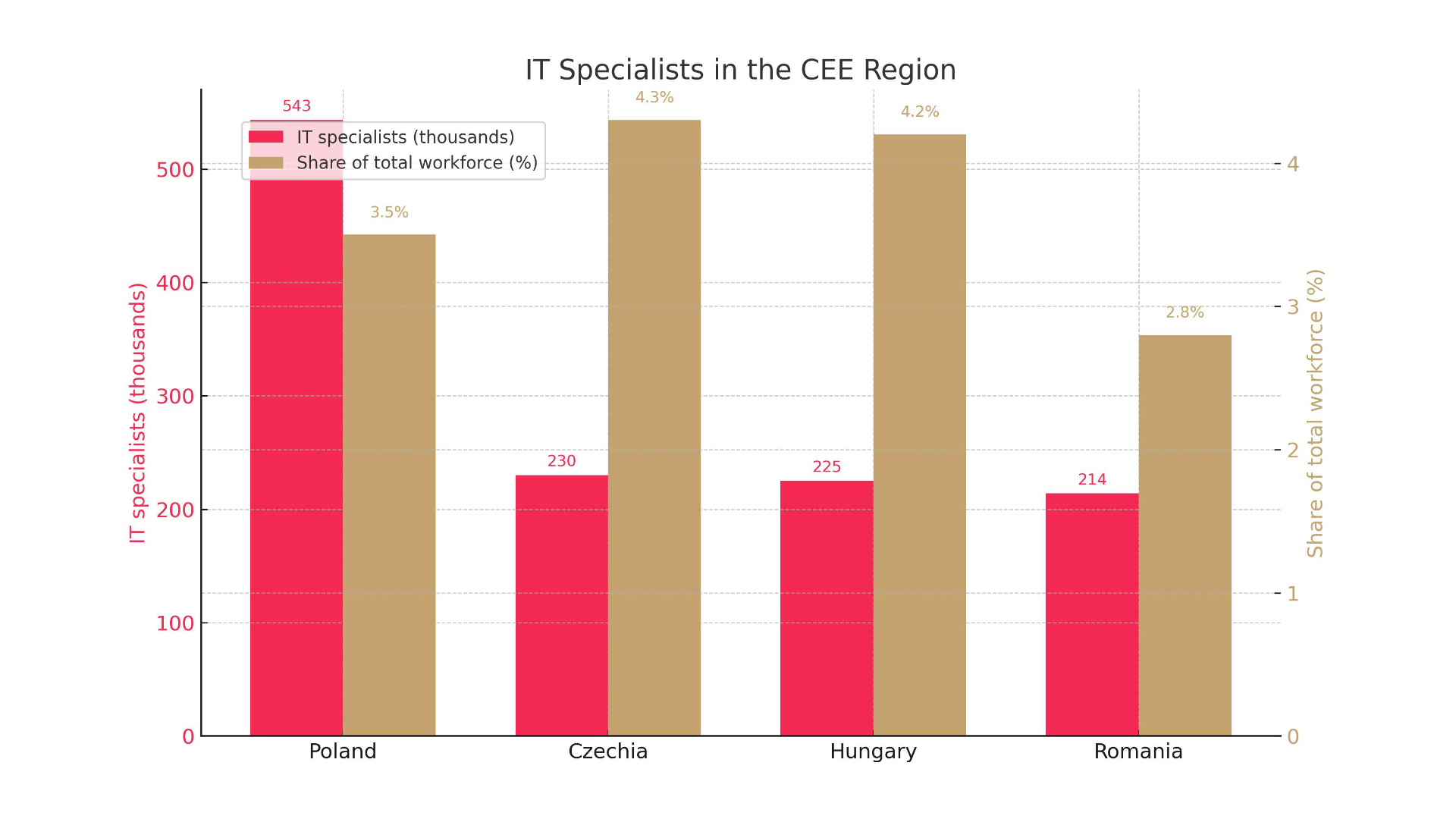
    Poland: a giant with a skills gap: Poland has by far the largest talent pool, estimated at between 493,000 and over 586,000 professionals. This is a powerful asset, but the country is struggling with a significant skills gap. IT professionals account for 3.5% of the total workforce, which is lower than the EU average (4.5%). It is estimated that Poland lacks as many as 147,000 experts to reach the EU average.

    Czech Republic: Hub of specialists: the Czech Republic has a solid base of nearly 230,000 ICT experts, representing 4.3% of the workforce – a figure close to the EU average. Renowned technical universities provide a steady flow of graduates, although they have to compete for talent with the powerful industrial sector.

    Hungary: Stability and qualifications: In Hungary, the share of ICT professionals in employment is 4.2%, also close to the EU average. However, the annual growth rate of these professionals (2.4%) is slower than in the EU (4.3%) , suggesting a stable but less rapidly growing talent pool.

    Romania: The density paradox: Romania has a large and highly valued talent pool of between 202,000 and 226,000 professionals. The country boasts the highest number of certified IT professionals per capita in Europe. Paradoxically, their share of the total workforce is the lowest in the group at just 2.8%. In addition, Romania faces a ‘brain drain’ problem, which poses a serious challenge to keeping top talent in the country.

    This talent flow dynamic is fundamental to long-term development. The phenomenon of ‘brain drain’ in Romania stands in contrast to the ‘brain inflow’ in Poland, which is becoming an attractive place to work for professionals from other countries, including Ukraine.

    An economy that loses talent often exports junior and mid-level professionals, which undermines its ability to create complex, high-margin products locally. In contrast, a country attracting talent can accelerate its march up the value chain by importing experienced experts.

    This indicates that the Polish ecosystem may mature faster, while the Romanian ecosystem, if not reversed, may remain more focused on the provision of outsourcing services.

    Map of Wages: Clash of the four capitals

    Salaries are a key competitive factor in the talent market. A comparison of rates in the region’s main technology hubs reveals significant differences.

    Warsaw bonus: Polish salaries are among the highest in the region. A senior programmer on a B2B contract in Kraków or Warsaw can expect a salary in excess of PLN 26,000 net per month (around EUR 6,000). Even on an employment contract, senior salaries exceed PLN 12,000 net (around EUR 2,800).

    Prague competitiveness: Czech salaries are also very high. The typical range for IT professionals is between CZK 43,130 (approximately EUR 1,730) and CZK 122,874 (approximately EUR 4,930) per month. The best-paid roles, such as Data Scientist, can bring in an annual income of CZK 1.2 million (approximately EUR 48,150). The average annual salary for a software engineer is around EUR 55,600.

    Budapest’s value proposition: Hungarian salaries offer a better cost/quality ratio. The average salary for an IT specialist is around EUR 1,800 per month , while a software engineer in Budapest earns an average of EUR 40,400 per year. This makes Hungary much more affordable to build a team than Poland or the Czech Republic.

    Rising costs in Bucharest: Romanian wages are rising fast, but still offer a cost advantage. The average salary in the technology industry is EUR 3,402 net per month. The general range for IT is between RON 4,647 (approximately EUR 930) and RON 16,879 (approximately EUR 3,390) per month. However, these rates are further bumped up by the total exemption from income tax up to a certain threshold, which significantly increases the net salary.

    The prevalence and high rates of B2B contracts in Poland are not just a billing method, but symptomatic of a mature, highly competitive senior talent market. This model gives maximum flexibility and earning potential to the best professionals, but at the same time creates instability for employers and leads to a more transactional relationship with employees.

    In contrast, the dominance of traditional employment contracts in Hungary and the Czech Republic (83.5% and 67% in IT respectively) suggests a more stable, corporate labour market. This means that companies in Poland need to adopt a different HR strategy, focusing on offering attractive projects and top salaries, while in the Czech Republic and Hungary more emphasis can be placed on long-term career paths and company culture.

    A list of coveted expertise: Who’s on top?

    Across the region, there is a huge demand for specialists in areas such as artificial intelligence and machine learning (AI/ML), data analytics (Data & BI), cyber security and DevOps. It is these roles that are the highest paid.

    However, each country also has its niches in which it has achieved a leadership position. Poland is a global powerhouse in the production of computer games (gamedev), with giants such as CD Projekt RED at the forefront. The industry generates more than EUR 500 million in revenue, creating an ecosystem of talent in game design, programming and graphics that is unique in the region.

    Romania is rapidly developing its own gamedev scene, attracting global players such as Amazon Games, which has opened a new studio in Bucharest. The country is also strong in the Fintech sector, with the capital generating 77% of the industry’s turnover in the country.

    The Czech technology scene fits perfectly with the needs of its industry base, targeting areas such as cyber security (Avast originated from here) and enterprise software. Hungary, on the other hand, with its high adoption rate of cloud and data analytics by corporations, generates a strong demand for data architects, cloud engineers and enterprise systems specialists such as SAP.

    The innovation frontier: start-ups, outsourcing and investment

    The future of any technology market depends on its ability to innovate, attract capital and integrate into the global ecosystem. This section examines the dynamics that are shaping tomorrow’s technology scene in Central and Eastern Europe.

    The vibrant Venturelands: The startup race

    Poland: Leader in terms of volume: Poland boasts the largest startup ecosystem in the group, with more than 1,251 companies. Warsaw is the dominant hub. The ecosystem is mature enough to have released nearly a third of all unicorns (companies with a valuation of more than USD 1 billion) in the CEE region. Funding, however, remains a challenge, with as many as 56% of startups reporting difficulties in obtaining it.

    Czech Republic: An effective rival: Despite its smaller scale, the Czech ecosystem is highly rated, ranking 3rd in Eastern Europe, ahead of Poland. It is famous for startups in the areas of SaaS, Fintech and Healthtech and is the cradle of global success stories such as Avast and unicorns such as Rohlik and Productboard. A key challenge is the perceived lack of a sufficient number of high-quality projects by investors.

    Hungary: a stagnant giant? Hungary has established companies such as Prezi and LogMeIn, but has struggled to maintain momentum in recent years. Total investment has stagnated at around EUR 54 million. Recently, however, there has been an upturn in the segment of early-stage AI-based startups, which could herald a rebound.

    Romania: The unicorn factory: The Romanian ecosystem has been defined by the spectacular success of UiPath, the global leader in process automation (South Africa). This event has put the country on the map for international investors. The AI scene is particularly active, with large funding rounds for companies such as FintechOS. The ecosystem is heavily concentrated in Bucharest.

    The success of UiPath has had a profound secondary impact on the entire Romanian ecosystem. Not only has it created a generation of experienced, wealthy angel investors and serial entrepreneurs (the so-called ‘UiPath mafia’), but it has also acted as a global proof of principle, reducing the perceived risk of investing in Romania in the eyes of international VC funds. This explains the impressive funding rounds for companies such as FintechOS and the general revival around the Romanian scene, which might otherwise seem disproportionate to the size of the market. This ‘unicorn effect’ is a powerful accelerator that allows the ecosystem to perform well above its nominal weight.

    Global background: Strategic partner, not cheap labour

    The entire CEE region is a leading global destination for IT outsourcing. Clients are increasingly shifting their focus from cost optimisation to access to high-end skills, innovation and cultural proximity. The regional talent pool exceeds 1.75 million engineers.

    A stable business environment is a key asset. In the Doing Business 2020 ranking, Poland (40th), the Czech Republic (41st), Hungary (52nd) and Romania (55th) offer predictable conditions, an advantage over other global outsourcing hubs.

    Poland is often recognised as a leader in IT competitiveness in the region thanks to its huge talent pool, business climate and strong exports. It is a major hub for the R&D centres of global giants such as Google and Microsoft.

    The Czech Republic ranks among the top five countries in terms of the attractiveness of outsourcing, renowned for its high quality services and data security.

    Hungary and Romania are attracting investors with their correspondingly low 9 per cent corporate income tax and tax exemptions for programmers, which, combined with a large talent pool, creates a powerful value proposition.

    The strong presence of international R&D centres and outsourcing companies in Poland and the Czech Republic is not just a service industry; it is a key incubator for the country’s startup ecosystem. These centres train local talent to global standards, introduce them to global business practices and create a network of professionals who eventually leave to start their own product companies. A programmer working for five years in Google ‘s Warsaw office learns product management, scaling and international sales at a level not available in most local companies. Such a specialist, armed with unique skills, contacts and an understanding of the needs of the global market, is much more likely to succeed. In this way, the outsourcing sector is not a separate entity, but a fundamental pillar that feeds and accelerates the development of the domestic product and startup economy.

    The role of the state: Catalysts for growth

    The governments of all four countries actively support the technology sector through a variety of initiatives, including tax incentives, funding programmes and startup visas. Key policies, such as Romania’s income tax exemption for software developers or Hungary’s low CIT rate , are important competitive advantages. Poland and the Czech Republic are effectively using EU funds and national development agencies (such as PFR Ventures and CzechInvest) to fuel their innovation ecosystems.

    Verdict: Poland’s position and the way forward

    A synthesis of the data presented makes it possible to formulate a clear verdict on Poland’s position compared to regional rivals and to outline strategic perspectives for the entire region.

    Regional SWOT analysis: Comparative scorecard

    Poland:

    • Strengths: Largest market and talent pool, diverse ecosystem (gamedev, enterprise), strong startup scene.
    • Weaknesses: Significant talent gap, increasing wage pressure, high competition.
    • Opportunities: Inflow of talent from abroad, opportunity to move up the value chain to more complex products.
    • Threats: Loss of cost competitiveness to Romania/Hungary, market saturation in some areas.

    Czech Republic:

    • Strengths: Stable, mature market, highly qualified professionals, strong integration with industry, excellent business environment.
    • Weaknesses: Smaller talent pool, slower growth, higher costs than some neighbours.
    • Opportunities: Leverage the industrial base for innovation within Industry 4.0, become a hub for high-margin R&D centres.
    • Threats: Competition for talent with powerful manufacturing sector, risk of stagnation.

    Hungary:

    • Strengths: Favourable tax environment, high adoption of advanced technologies in companies, strong value proposition.
    • Weaknesses: Stagnation in startup funding, slower growth of talent pool, less dynamic ecosystem.
    • Opportunities: Potential to become a specialised hub for AI and data science solutions for corporations, attracting cost-oriented FDI.
    • Threats: Lagging behind regional leaders in startup innovation, political uncertainty affecting investor confidence.

    Romania:

    • Strengths: Top growth rate, high talent density, significant cost advantages, ‘unicorn effect’ after UiPath success.
    • Weaknesses: Brain drain, less developed domestic market, infrastructure gaps outside major hubs.
    • Opportunities: huge potential in the digitalisation of the country’s SMEs, becoming the gamedev hub of South East Europe.
    • Threats: Talent retention, risk of overheating the economy, dependence on export markets.

    Poland’s position in the CEE arena: Heavyweight champion under pressure

    Poland remains the undisputed leader of the CEE technology scene in terms of scale, talent numbers and diversity of the ecosystem. The size of its market and depth of specialisation, especially in gamedev and enterprise software, are unrivalled.

    However, leadership comes at a price. Poland faces challenges typical of a mature market: intense wage competition that undermines its cost advantage, and a critical skills gap that could stifle future growth. Poland is no longer the ‘low-cost’ option; it is the ‘scale’ option.

    While Poland is leading the way, the competition is not sleeping. Romania challenges it in terms of growth and dynamism, the Czech Republic in terms of stability and specialised quality, and Hungary in terms of cost efficiency for corporate investments.

    Collective strength: The future is regional

    The future of the CEE technology scene will not depend on which country ‘wins’, but on how the region as a whole handles the transformation from a cost-driven outsourcing destination to a value-driven innovation partner. Poland, as the largest player, has a key role to play in leading this change, but its success is inextricably linked to the health and dynamism of its neighbours.


  • Conflict in the Middle East and electronics prices: What lies ahead for the IT industry in 2026?

    Conflict in the Middle East and electronics prices: What lies ahead for the IT industry in 2026?

    The armed conflict involving Iran, the United States and Israel sheds new light on a fundamental paradox of modernity: the world’s most advanced technologies are being held hostage to resource extraction processes whose logistics rely on the stability of regions that have for decades been described as powder kegs.

    Fundamental to the current unrest in the high-tech industry has been the issue of the availability of helium, a noble gas whose role in the process of semiconductor lithography cannot be overestimated. While the public associates helium with entertainment applications or medical MRI equipment, for chipmakers it is an essential coolant and a medium for maintaining thermal stability in the most precise manufacturing equipment. The fact that nearly thirty-eight per cent of the world’s production of this raw material is concentrated in Qatar creates a dangerous tipping point in the global supply chain. QatarEnergy’s decision to declare a state of force majeure, prompted by attacks on refining infrastructure, is a wake-up call for the entire silicon ecosystem. Halting operations at natural gas processing plants means not only a shortage of fuel, but more importantly an interruption in the supply of petrochemical components, without which modern electronics cannot function.

    However, the problem goes far beyond helium alone. Market analyses show the industry’s deep dependence on fourteen other critical materials from the Middle East, including bromine and specialised process gases. In the semiconductor sector, where purity standards are measured at the nanoscale, switching suppliers is not a simple logistical operation. It is a process of months of validation and rigorous quality testing, violations of which could destroy entire production runs worth hundreds of millions of dollars. In the face of protracted conflict, the flexibility of giants such as TSMC, Samsung and GlobalFoundry is being put to its toughest test since the global pandemic, with the current crisis being far more structural and unpredictable.

    The geopolitical Gordian knot remains the Strait of Hormuz. A key artery for global energy trade, this narrow maritime isthmus also acts as a fuse for global digital transformation. The blockade or significant obstruction of shipping in this body of water is hitting the cost of the energy required to power giant server farms and the price of polymers used in the manufacture of computer components with a ricochet. The observed increase in energy prices is therefore not just a transport issue, but a direct operating cost for any company operating a SaaS model or cloud infrastructure provider. The disruption to supply in this region is forcing a shift away from the previous dogma of just-in-time logistics management to costly strategic stock-building strategies, which will inevitably impact the operating margins of the technology sector.

    This situation is particularly acute in the context of the unprecedented demand for computing power generated by the development of artificial intelligence. The industry is in ticks: on the one hand, demand for advanced computing units is growing exponentially, while on the other hand, production capacity is encountering a raw material glass ceiling. The risk of technological involution is becoming real and may manifest itself not only in delays in the release of new generations of processors, but above all in the forced cannibalisation of resources. Sectors such as automotive or industrial automation may be forced to compete for the same limited chip resources with technology giants, leading to drastic price increases for end devices and stifling digitalisation in less profitable industries.

    Undisrupted globalisation, in which access to technology was guaranteed by efficient market mechanisms, is a thing of the past. It is now giving way to an era of strategic resilience. The stability of the Middle East has become a key element of technological security for any business using digital working tools. The current crisis shows that the future of artificial intelligence and global connectivity depends on the permeability of sea lanes and the political stability of raw material exporting countries, which are often forgotten in the daily pursuit of innovation.

    Managing an organisation in 2026 therefore requires not only proficiency in anticipating market trends, but also a deep understanding of the physical map of the world. The cost of technology ceases to be a function of the progress of miniaturisation and becomes a product of the security price of physical assets. In this new reality, the winners will be those who can integrate geopolitical risk analysis with technology planning, understanding that the blue gas in Qatar’s tanks has a direct impact on the fluidity of a mobile app in Europe or the agility of an ERP system in North America. The Middle East is now becoming the catalyst for a major shift in the way the world thinks about technology: no longer as an unlimited resource, but as a precious asset whose foundations are extremely vulnerable to shocks.

    Further developments between Tehran and Washington will determine whether the current perturbations turn out to be merely a short-term shock or the beginning of a profound reconfiguration of the global technological order. The illusion of the autonomy of the digital world from the problems of the physical world has finally been dispelled. It is therefore worth keeping a close eye not only on the stock market quotations of technology companies, but also on the movements of ships in the Gulf, as this is where the source code for next year’s IT sector margins is currently being written.

  • Huawei and the dream of Strasbourg. A state-of-the-art plant in France may never get off the ground

    Huawei and the dream of Strasbourg. A state-of-the-art plant in France may never get off the ground

    Just twenty kilometres north of Strasbourg stands a state-of-the-art industrial complex, completed in September. It was supposed to bustle with life as Huawei‘s first European factory, symbolising a €200 million investment and the promise of 500 jobs. Instead, the corridors are silent and the 52,000 square metre facility has become a monument to the changing geopolitics and caution of the Old Continent.

    According to sources close to the matter, the Chinese tech giant is holding off on launching production and is considering a complete change of plans, including the sale of property. The decision is a direct result of cooling relations between Europe and China and slower-than-expected deployment of 5G technology. Local officials confirm that the plant has already been visited by other industry groups and that the Grand Est region has cancelled a previously agreed grant of €800,000 due to a lack of clarity about the future of the project.

    Huawei
    Source: Unsplash

    The situation in France reflects a wider trend in Europe, where governments are increasingly emphasising the need for ‘digital sovereignty’. While Paris continues to declare its openness to Chinese investment, the telecoms sector has been placed under a de facto national security umbrella. An even clearer signal is coming from Berlin. German Chancellor Friedrich Merz has toughened his course towards Beijing, setting up an expert commission to review trade policy. Germany has announced not only the replacement of Huawei components in key 5G network components next year, but also a ban on Chinese technology in the upcoming 6G standard.

    Although Huawei still holds an estimated 35% to 40% share of the European market for installed 4G and 5G equipment, the growth momentum in this segment has slowed. Jean-Luc Beylat of Systematic Paris-Region notes that the company’s ambitions have collided with a barrier of security concerns. As a result, instead of fighting for the infrastructure market in an unfavourable regulatory environment, Huawei is starting to prioritise other areas of the business. The company is seeing a strong revenue rebound from smartphone sales and smart driving technology, suggesting a strategic turnaround and allocation of resources where politics is not such a tight barrier.

  • Hardware casualties of artificial intelligence. Why will PC and server prices shoot up?

    Hardware casualties of artificial intelligence. Why will PC and server prices shoot up?

    The world of technology today is looking in one direction, mesmerised by the promises made to us by artificial intelligence. However, behind the scenes of this media and stock market spectacle, there is a brutal battle for resources that could have far-reaching consequences for the entire partner channel. Experts are warning ever louder: the colossal infrastructure needed to ‘feed’ insatiable AI models is beginning to cannibalise the traditional IT market. In the name of global dominance by technology giants, is the professional and consumer customer sector facing a supply crunch and a drastic price increase?

    The technology industry has entered what many observers describe as a ‘journey of no return’. The decision that the coming decades will be dominated by artificial intelligence has been made at the highest strategic levels in Silicon Valley, and there is no turning back from it. The problem is that at the current stage of development, the beneficiaries of this revolution are mainly the technology providers themselves and the marketing departments of the corporations that are building the narrative of success.

    Apart from the big players, few yet see the promised massive business benefits that would justify such a gigantic outlay. Nevertheless, the ‘snowball’ effect is working – the ball is rolling faster and faster and continues to feed on itself, consuming capital and resources at a rate the IT market has not seen in years.

    Infrastructure at its limits

    A key issue that rarely breaks through to the consciousness of the average business user is the physicality of AI. AI is not an ethereal entity in the cloud – it’s thousands of tonnes of silicon, steel and copper. It is hectares of data centres that consume as much energy as a medium-sized country.

    We are currently facing a situation where the consumer electronics market has a large-scale problem. The colossal infrastructure required to power language and generative models needs to be prioritised. As a result, there is an unbridled battle for global control of these technologies and the resources required to maintain them. Technology giants are reserving capacity and energy for years ahead.

    For the traditional IT ecosystem – from hosting providers to integrators to enterprise IT departments – this means risking being pushed to the margins. If the priority of factories and data centres becomes servicing hyperscale AI projects, infrastructure availability for the ‘rest of the world’ can become, and is slowly becoming, a luxury.

    Memories: Silicon gold and looming shortages

    The most tangible evidence that the market is losing its balance is the news coming from the computer memory sector (DRAM and NAND). This is where the greatest risk to the distribution channel is currently concentrated.

    Training and operating AI models requires specific, expensive and difficult-to-manufacture High Bandwidth Memory (HBM). Manufacturers, seeing the gigantic margins and insatiable demand from AI accelerator developers, are shifting their production lines to this range. However, this is at the expense of standard DDR memory or NAND flash dice used in laptops, workstations and typical servers.

    Market signals emerged last week that predict a worrying future. Due to a shortage of supply and rising manufacturing costs, the consumer and professional customer segment could face steep price increases and problems with commodity availability. The threat of a collapse of this segment is real – if the supply of memory is sucked up by AI servers, PC and consumer electronics manufacturers will have to either drastically increase prices or reduce production.

    Dot-com 2.0 bubble or the foundation of a new era?

    Observing this race, it is impossible to escape questions about its economic basis. The strategies of the biggest stock market players are now one-way: all resources are directed towards AI. Satisfying investors, who demand that companies put ‘more eggs in one basket’, has become the overriding objective, often obscuring common-sense diversification.

    Analysts are increasingly bold in their thesis that we are inside a speculative bubble reminiscent of the famous ‘dot-com boom’ at the turn of the century. The stock market valuations of technology companies are rising in isolation from their traditional performance, driven only by the promise of future AI dominance. Some even argue that this bubble will sooner or later explode as ‘Punkt.com 2.0’. If the monetisation of AI does not come fast enough to cover the gigantic infrastructure costs (CAPEX), the correction could be painful for the entire industry – not just the leaders of the race.

    For resellers, distributors and system integrators, the current situation is a wake-up call. The market to which we have become accustomed – relatively stable prices and high component availability – is entering a phase of turbulence.

    The technology industry has put everything on the line. And while AI will undoubtedly change the world, the bill for this change – in the form of more expensive equipment and more difficult access to technology – will be paid by all of us before we even have time to feel the real benefits of this revolution.

  • Project Stargate and 40% of the world’s resources. How AI giants are draining the memory market

    Project Stargate and 40% of the world’s resources. How AI giants are draining the memory market

    We all marvel at the possibilities of generative artificial intelligence, analysing its impact on the labour market or data security. However, we look less often at the bill this progress is footing for the hardware industry. This is not about subscriptions to language models, but about drastic changes to the physical supply chain. As OpenAI and Microsoft talk about a $500 billion investment, the component market is holding its breath. Giant data centres are becoming a ‘black hole’ absorbing the world’s silicon resources, and we – as an industry and as consumers – must prepare for the painful consequences of this.

    For months, analysts and distributors had been warning of rising memory prices. However, reality proved to be more brutal than forecasts. The increases have been faster and steeper, and this is only the beginning of a trend that will define the IT market for years to come. We are dealing with the classic effect of the cannibalisation of the consumer market by the Enterprise market, driven by the insatiable appetite for artificial intelligence.

    The ‘Stargate’ effect – the scale that changes everything

    To understand why RAM or SSD prices are skyrocketing, one needs to look at the scale of investment in AI infrastructure. The ‘Stargate’ project, led by OpenAI, is emblematic of this transformation. This is not just another server room. It is a half-trillion-dollar venture to provide computing power for future generations of AI models .

    The numbers behind this project are downright abstract for the average hardware supplier. We are talking about contracts with giants such as Samsung and SK Hynix, which amount to deliveries of 900,000 silicon wafers per month.

    What does this mean in practice? It is estimated that the completion of just this one contract could reduce the global supply of DRAM by 40%. If one project consumes almost half of global production, that leaves a much smaller slice of the pie for the rest of the market – from smartphone manufacturers to the automotive industry to the PC market. The fight for resources becomes fierce, and in economics, scarcity always means one thing: an increase in price.

    HBM is the new gold (and the nail in the coffin of cheap DDR5)

    The situation is exacerbated by the fact that the memory manufacturers – the so-called Big Three (Samsung, SK Hynix, Micron) – are acting rationally. Production lines are not made of rubber and capacity is finite. Faced with the gigantic demand for HBM (High Bandwidth Memory) server memory and RDIMM modules, which are essential for AI training and offer much higher margins, manufacturers are massively shifting their factories.

    The production of standard DDR5 modules, used in laptops and desktops, is receding into the background. It is a less profitable segment and is now treated as secondary. The effects are already visible in the financial reports. Micron, one of the key players, has already announced that it has sold off its HBM memory production capacity until 2026.

    For the partner channel and end customers, this sends a clear signal: there will be less stock. DRAM contract prices have recently increased by 171%. By comparison, this is a jump higher than that of many investment assets, including gold, considered a safe haven in uncertain times. Memory has become a luxury commodity.

    Domino effect – it’s not just PCs that are getting hit

    It is a mistake to think that the problem only affects those assembling new PCs. Memory is the ‘bloodstream’ of the entire technology ecosystem. The same silicon wafers and the same factories are needed to produce NAND Flash memory (SSDs, memory cards), VRAM for graphics cards or components for consoles.

    • GPU market: here the situation is twinned. While sales of consumer graphics cards remain at a relatively low level, the data centre accelerator segment is recording growth rates of 145%. NVIDIA and other manufacturers prioritise the hyperscalers (customers like Google, Meta, Microsoft) because that’s where the money is. The consumer market gets the ‘leftovers’ from the Lord’s table.
    • Consoles and Gaming: Analysts are predicting that the Steam Machine will cost significantly more than originally expected. What’s more, Microsoft is considering raising the price of Xbox consoles. The reason? Rising component costs, which can no longer be taken “at face value”.

    Landscape after the battle – forget cheap shopping

    Is there a chance of rapid improvement? Unfortunately, the indicators do not point to it. Artificial intelligence, by its very nature, learns and improves continuously. This means it is an insatiable technology – its resource requirements (energy, water for cooling and silicon) will grow exponentially rather than linearly.

    It will take the industry years to adapt global supply chains to such a sudden jump in demand. Building new factories is a lengthy and expensive process. Therefore, a scenario in which prices return to normal in 2026 seems optimistic, not to say naive.

    If consumers or businesses are planning their hardware purchases, hoping for ‘big discounts’ during Black Friday in 2025, they may be sorely disappointed. Base prices for products are likely to be so high that even promotional discounts will not bring them down to the levels we remember before the AI boom era.

    We are at a turning point. “AI tax” has become a reality that we need to factor into IT budgets. For resellers, integrators and purchasing departments, the conclusion from the market analysis is one: the days of cheap hardware are over.

    Postponing the upgrade of infrastructure or the purchase of a fleet of laptops in anticipation of price drops is currently a highly risky strategy. The availability of components for the consumer segment is threatened by the prioritisation of AI giants. In this arms race, the average computer user unfortunately stands on the losing end, with his or her wallet becoming an unwitting sponsor of the technological revolution.

  • West looks East: Is CEE becoming Europe’s new IT logistics hub?

    West looks East: Is CEE becoming Europe’s new IT logistics hub?

    The upheaval in global supply chains from 2020-2024 has forced the tech giants to redefine their strategies. In this new dispensation, Central and Eastern Europe (CEE) is no longer merely a ‘cheaper alternative’ to Germany. Thanks to a combination of advanced warehousing infrastructure, growing manufacturing competence and strategic location, the region is emerging as a key distribution hub for the IT and electronics sector. What does this mean for the Polish IT industry?

    End of the “Just-in-Time” era, beginning of the “Just-in-Case” era

    Until a decade ago, the model was simple: electronics produced in Asia sailed by container ship to the ports of Rotterdam or Hamburg, and from there they were sent to distribution centres in Western Europe. The CEE region played a peripheral role. Today, this model is becoming a thing of the past. The pandemic, the blockades of the Suez Canal and the war in Ukraine have exposed the fragility of long supply chains. The corporate response is nearshoring – moving production and logistics closer to markets.

    The data is clear: around half of the companies operating in Europe have started to decentralise their supply chain, and CEE is the main beneficiary of this trend. It is no longer just about cheap labour. It is about resilience. For an IT distributor, not having goods on the shelf during the ‘peak season’ (Q4) means measurable losses. Warehousing goods in Poland or the Czech Republic, from where it takes a few hours to get to Berlin, has become a safety net for Western European business.

    Hard data: Poland the warehouse of Europe

    Poland has grown into the undisputed logistics leader in the region, with 2024 figures confirming its dominance over many Western markets. In the first half of 2024, Poland recorded the highest warehouse rental volume in Europe, even overtaking the German market.

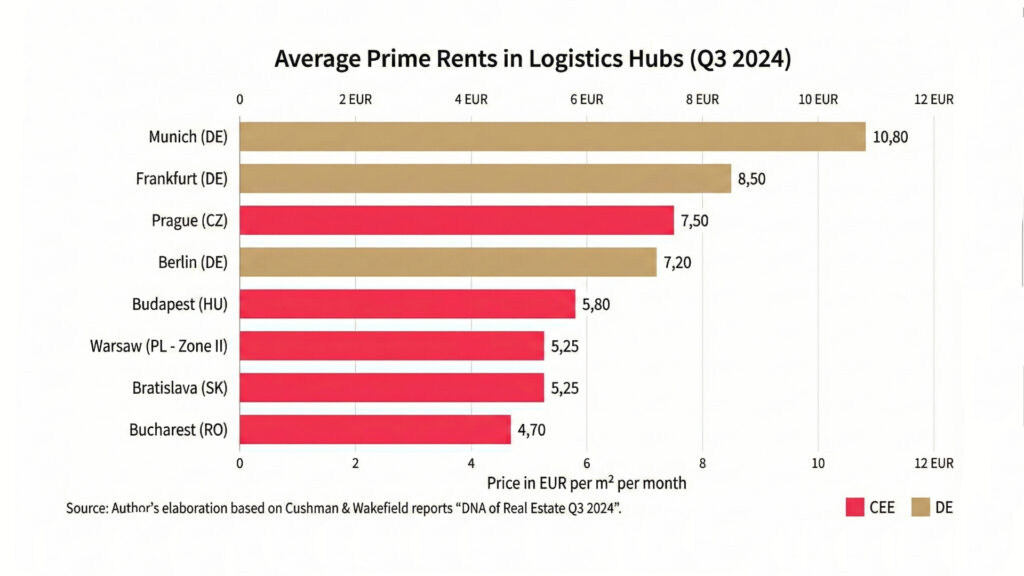
    Cost arbitrage remains a key factor for the IT industry, operating on low distribution margins. An analysis of prime rents in Q3 2024 shows a gap between CEE and the West:

    • Munich: approx. EUR 10.80/m²
    • Warsaw (surroundings): approx. EUR 5.25/m².
    • Bucharest: approx. EUR 4.70/m².
    czynsz eng

    For a company from the SME sector or a large electronics distributor (such as TD Synnex or Ingram Micro), maintaining a distribution centre near Wrocław or Poznań is nearly half as expensive as in Germany, while maintaining the A-class standard. Moreover, modern warehouses in CEE are often younger and better adapted to automation and ESG requirements (BREEAM/LEED certificates) than older facilities in the West.

    Not just a warehouse, but a factory

    The myth of CEE as exclusively an ‘assembler’ collides with the data on high-tech exports. Hungary, the Czech Republic and Poland have transformed themselves from technology importers to net exporters.

    • Hungary has become a regional powerhouse in electronics manufacturing, with exports of electrical and electronic equipment accounting for more than 23% of total exports there.
    • Lenovo in Hungary: The Üllő plant is an example of what nearshoring looks like in practice. This plant has already produced more than 1.5 million servers and workstations, serving the EMEA markets (Europe, Middle East, Africa). Reducing delivery times to customers in Europe from several weeks (shipping from China) to a few days is a competitive advantage that cannot be ignored.

    In the case of Poland, exports of high-tech products have approached USD 30 billion. Poland plays a key role in so-called fulfilment for e-commerce. Giants such as Amazon and Zalando have located their centres in Poland not only because of costs, but because of the possibility of servicing the entire German and Scandinavian market from here. More than 34% of the demand for warehouses in Poland in 2024 will be generated by the e-commerce and retail sector, which is directly correlated to the sale of electronics.

    Risks: Lessons from Intel and labour market challenges

    However, the image of the region as the ‘Promised Land’ has its cracks. The loudest echo in the industry was the suspension (and de facto cancellation in its current form) of Intel’s investment near Wrocław in the Semiconductor Integration and Testing Facility. This decision, resulting from the corporation’s global financial problems, shows that basing a development strategy on a single giant investor can sometimes be risky. Nonetheless, the logistics sector has ‘absorbed’ the news without breaking down. The land prepared for Intel’s investment remains an attractive asset and demand from other players is not waning.

    For Polish IT SMEs, the labour market is becoming a challenge. Although labour costs in Poland are still 2-3 times lower than in Germany , the availability of skilled workers is decreasing. The answer is automation. Implementing systems such as AutoStore or AMR robots in warehouses (as Zalando or Ingram Micro are doing, for example) is becoming a necessity rather than a gadget. This is an opportunity for Polish IT system integrators who can offer these solutions to logistics.

    Polish IT SMEs do not need to build their own warehouses. The CEE region offers the most modern fulfilment infrastructure in Europe. The use of logistics operators (3PLs) in Poland makes it possible to compete with Western companies on delivery times, with a lower cost base.

    • Supplier diversification: Proximity to factories in Hungary (Lenovo, Samsung) or the Czech Republic (Foxconn) means that Polish distributors and resellers can rely on shorter supply chains. It is worth reviewing contracts and looking for manufacturing partners within the CEE region, rather than relying solely on imports from Asia.
    • Investment in technology: As logistics in CEE is moving towards automation, IT companies should focus on providing solutions to support this trend: from WMS (Warehouse Management Systems), to IoT for shipment monitoring, to cyber security for industrial infrastructure.

    Is CEE the new IT logistics hub for Europe? The answer is yes, but in a new formula. We will not replace Rotterdam as a port of entry, but we have become a ‘buffer warehouse and last mile factory’ for Europe. Poland (distribution), Hungary (manufacturing) and the Czech Republic (high-tech) form a complementary ecosystem. For the IT industry, this means more stable supply and lower operating costs. The winners will be those who understand that logistics in 2025 is not just about pallet transport, but about data and time management – and in this, the CEE region is starting to win over Western competitors.

  • Customer contact avoidance. Why AI in B2B sales is a lifesaver in 2026

    Customer contact avoidance. Why AI in B2B sales is a lifesaver in 2026

    The traditional ‘relationship’ model in the IT industry is shaking in its foundations. Today’s buyers are armed with knowledge, sceptical and… increasingly preferring not to speak to a supplier representative at all. Gartner’s Robert Blaisdell warns: by 2026, strategies based on ‘number of contacts’ will no longer work. The question is: how can sales directors (CSOs) use AI to ensure that their teams are no longer seen as intrusive and become trusted advisors?

    Just a decade ago, there was a simple rule of thumb in the affiliate channel and B2B sales: the more phone calls and emails you made, the more deals you closed. Today, this statistic is no longer defensible. With the dynamic evolution of the sales market, leaders (CSOs – Chief Sales Officers) are facing an unprecedented challenge. Productivity pressures are increasing, costs need to be cut and customers are becoming increasingly elusive.

    Experts in the Gartner Sales Practice make it clear: the path to success in 2026 is not through ‘more of the same’. It requires a fundamental remodelling of Go-to-Market (GTM) strategy and an understanding that artificial intelligence in the hands of the sales person is not to be used to generate spam, but to build precision.

    The paradox of the “Rep-Free Experience”

    The most important trend keeping sales directors awake at night is the change in buyer preferences. The business customer, especially in the technology sector, is moving towards a so-called rep-free experience.

    Why does this happen? Blaisdell points out an interesting paradox. Buyers today have access to an almost unlimited supply of information online. In theory, they are brilliantly educated before the first conversation. In practice, however – the information is often fragmented, contradictory or unreliable. This gives rise to deep scepticism. The customer avoids contact with the salesman not because he does not need help, but because he does not believe that the salesman will add value beyond what he has already ‘Googled’ himself.

    This is where the skills gap and opportunity for modern sales organisations opens up.

    No more “spamming”, time for precision

    Many IT leaders fall into the trap of treating AI as a tool to increase volume. If AI can write 100 emails in a minute, why not send them? This is a mistake. Customers are sensitive to generic messages and mass communication.

    According to Gartner’s predictions for 2026, the key to success will be a shift away from volume-based activities to relevance. A sales-focused AI strategy must serve hyper-personalisation.

    Instead of implementing AI as a ‘technological novelty’ (or, as it is sometimes referred to, ‘technological nonsense’ with no results), CSOs need to define clear business objectives. AI should act as an analytical partner that prompts the sales person:

    When exactly is the client looking for a solution?

    • What specific problem is it trying to solve?
    • What information (content) will make us credible in his eyes?
    • Building trust in the age of algorithms

    To break through the wall of scepticism, organisations need to rebuild their GTM operations. Since customers avoid contact until they are sure of a decision, the role of the salesperson – supported by AI – is to provide them with the ‘ammunition’ to make that decision.

    It is about providing credible, targeted information that addresses specific buyer concerns. This requires close collaboration between Sales – Marketing – IT. Sales executives need to sit down at the table with technology leaders and create a roadmap where AI realistically improves productivity, not just adds another tool to log in.

    Sales manager: The forgotten link

    When implementing these changes, the human factor cannot be forgotten. Blaisdell points out that an often overlooked piece of the puzzle is **sales managers**. In an AI-enabled world, their role needs to evolve from ‘performance supervisor’ to ‘performance enhancer’.

    Companies are investing crores in tools for serial salespeople, neglecting middle management. Meanwhile, it is managers who need support, role clarity and tools to coach their teams based on data from AI systems. Without a strong, digitally competent manager, even the best algorithm will not translate into revenue growth.

    3 steps for the Chief Sales Officer (CSO) for 2026

    Based on Gartner’s findings, IT sales leaders should focus on three pillars:

    1. sales-focused AI: Deploy technologies only if they have a clear translation into commercial outcome and real productivity, not for the sake of innovation.

    2 Align with the ‘Rep-Free’ client: Change tactics from a mass attack to precise, data-driven trust-building. Be where the customer is looking for insights before they make a bid.

    3. Supporting Managers: Invest in developing managers to be able to use the potential of AI to coach and improve the effectiveness of the whole team.

    The year 2026 will not be the year of the battle between man and machine. The teams that will win will be those where the machine does the dirty analytical work, allowing humans to do what they still do best – build trust in a world full of digital noise.

  • The end of the ‘sell and forget’ era. How the subscription economy is quietly redefining the IT channel

    The end of the ‘sell and forget’ era. How the subscription economy is quietly redefining the IT channel

    Nominal revenue growth in the IT industry is no longer the only determinant of success. Between 2023 and 2025, we are seeing a fundamental change in Poland and Europe: money in the distribution and partner channel is changing its nature. Instead of one-off cash shots (transactions), the market is shifting towards streams (subscriptions). For distributors this is an accounting challenge, for resellers a painful foray through the ‘valley of death’ in cash flow, but for those who survive, the reward is company valuations that are up to three times higher.

    The transformation from CapEx (capital expenditure) to OpEx (operating costs) is no longer just the domain of SaaS start-ups, but a hard reality for the traditional sales channel – from distribution giants to local MSP integrators (Managed Service Providers).

    Invisible turnover: lessons from the global giants

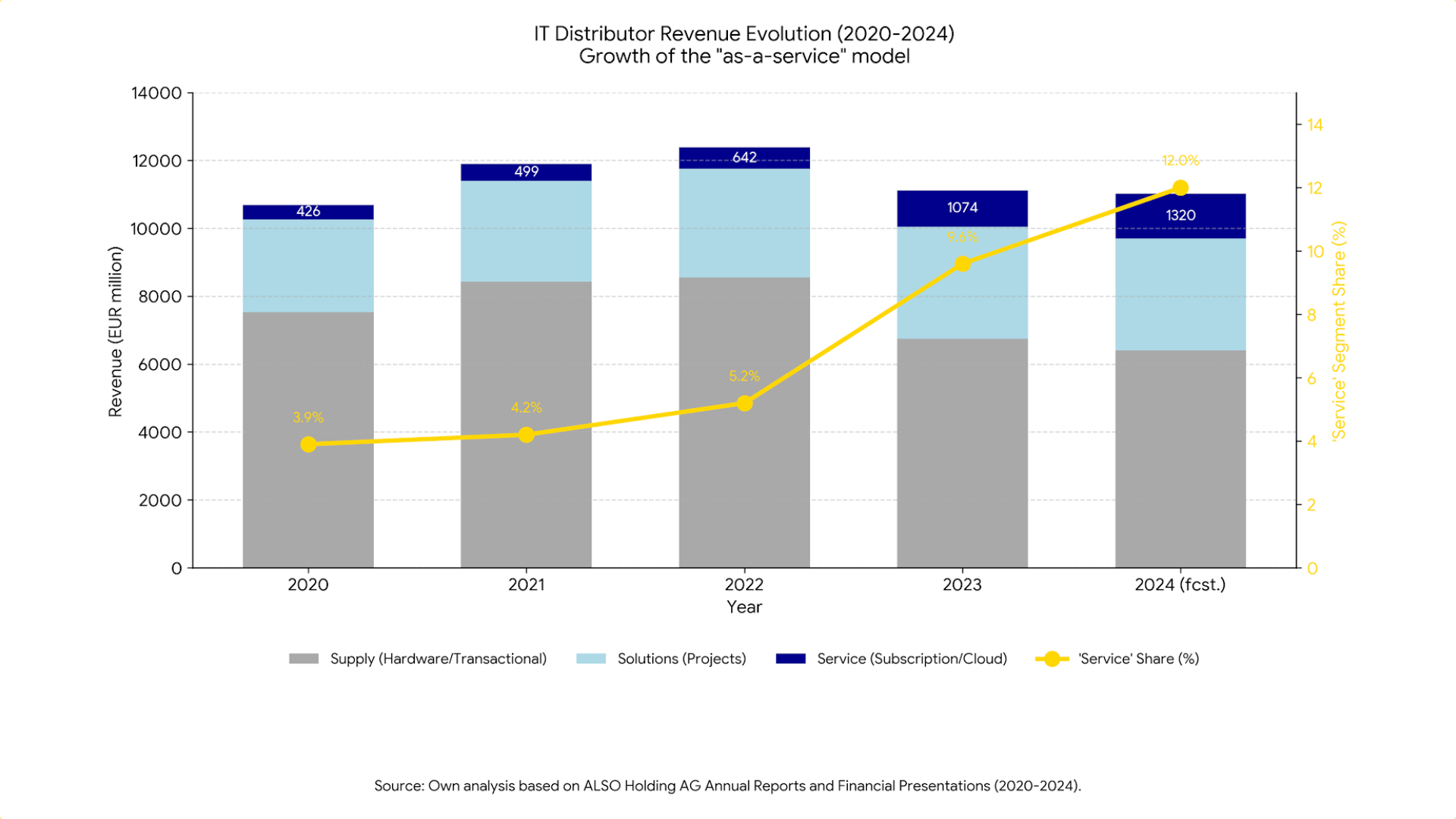
    To understand what is happening in Poland, you need to look at the performance of global leaders who are setting trends. The traditional ‘Revenue’ line in financial statements has become confusing in the cloud era. Why? Because subscription sales (e.g. Microsoft 365, AWS, Cyber-as-a-Service) are often accounted for on a ‘net’ agency model – the distributor only shows its margin, not the full invoice value.

    This is perfectly illustrated by TD SYNNEX’s Q3 results for fiscal 2025. Reported revenues amounted to USD 15.7 billion (+6.6% year-on-year), but so-called Gross Billings (the real value of technology sold) reached a staggering USD 22.7 billion, increasing by 12.1%.

    This difference – amounting to $7 billion in a single quarter – is the ‘invisible’ mass of turnover coming from cloud services and subscriptions in a standard P&L account. For the Polish market, the lesson here is clear: if your revenues are stagnant, but the number of supported licences and service contracts is growing, then your business is actually growing faster than the simple P&L calculation shows.

    Poland specific: Infrastructure ready, people not

    The growth dynamics of the as-a-Service model in Poland has a unique, local drive. It is the gap between infrastructure and competence. On the one hand, Poland has a fibre optic infrastructure above the EU average, which is a technological highway for cloud services. On the other hand, Poland’s basic digital skills rate is only 44.3% (compared to the EU average of 55.6%).

    For the partner channel (Resellers/MSPs), this is an ideal situation. Polish SMEs have the connectivity to use the cloud, but do not have the people to manage it. This forces outsourcing. According to PMR forecasts, the cloud market in Poland was expected to grow by 24% in 2024, reaching a value of PLN 4.8 billion. Importantly, Polish companies are still at the ‘Cloud 1.0’ stage (mail, storage), while the adoption of advanced services (AI, analytics) is only 3.7% compared to 8% in the EU. This shows a gigantic potential for upselling in the coming years.

    AB S.A. and the run to the front

    In Poland’s backyard, this transformation is perfectly illustrated by the AB S.A. Group. In the 2023/2024 financial year, the group’s revenues amounted to PLN 14.7 billion (a slight decrease reported by exchange rate differences), but profitability is key. The profit margin on sales reached a record level of 4.1%.

    This is evidence of a shift in product mix. AB S.A. is shifting the weight of the business from simple ‘box shifting’ to VAD (Value Added Distribution) – advanced server solutions, cyber security and cloud. The company has reduced its net financial debt by three quarters, building a powerful financial cushion. In a subscription model, where payments are staggered, it is the strong balance sheet and low-cost financing that become the distributor’s main competitive advantage over smaller players.

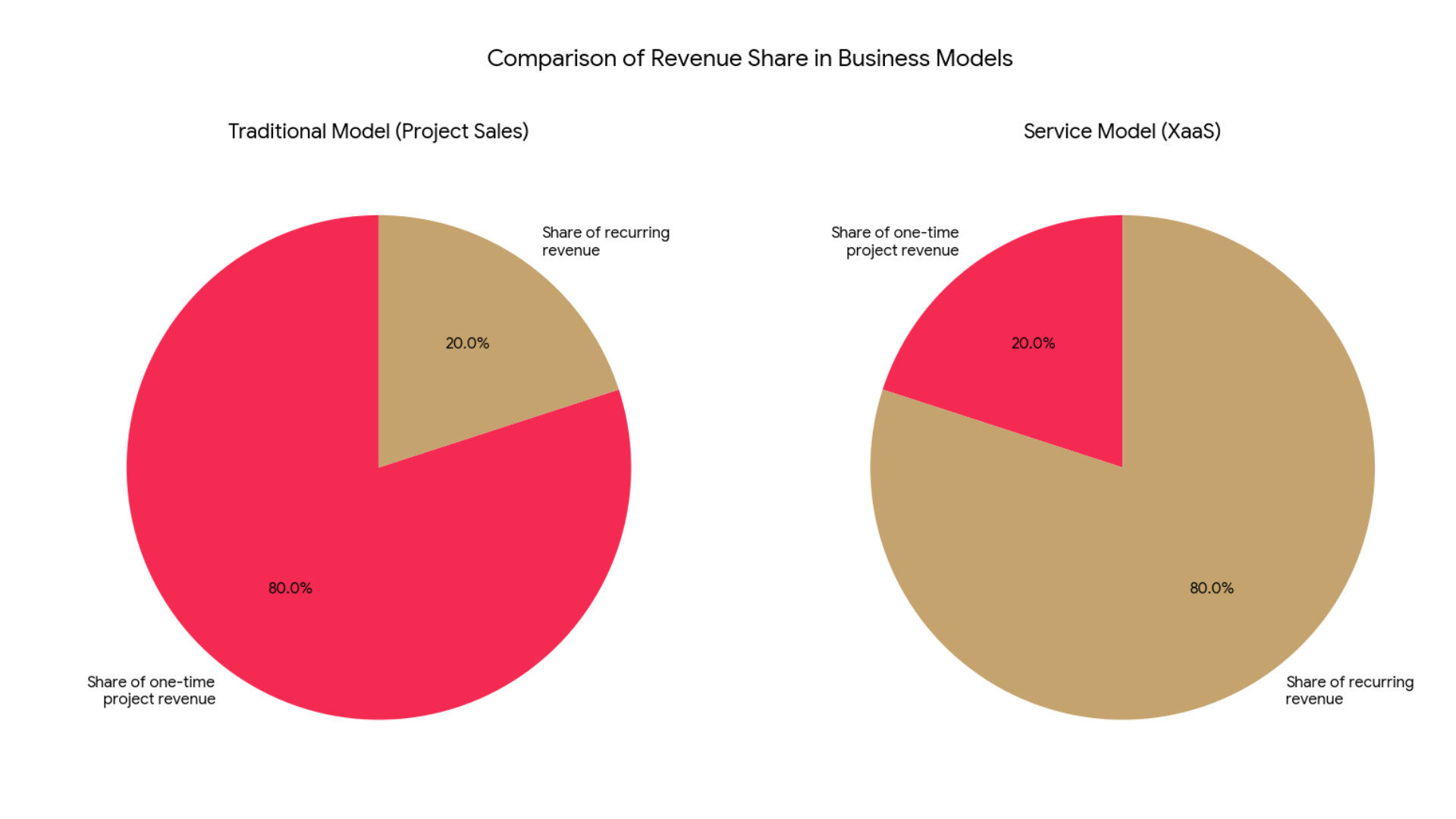
    YearNon-recurring revenues (Hardware/perpetual licences)Recurring revenues (Subscriptions/MSP/Cloud)Trend commentary
    202180%20%Dominance of the transactional model (traditional reseller).
    202365%35%Post-pandemic acceleration, cloud growth (PMR data).
    202455%45%‘Gross Billings’ effect – growth in managed services and security.
    2025 (Forecast)45%55%Point of intersection (AI, DaaS, NIS2).

    The holy grail: own IP and repeatability

    At the other end of the market are companies that have already completed the transformation. Asseco Poland reported in 2024 that as much as 79% of revenue (approximately PLN 13.5 billion) comes from its own software and services.1 Such a revenue structure, based on licences, maintenance and subscriptions, is the goal pursued by the modern IT channel. It ensures predictability and resilience to economic fluctuations, as can be seen from the steady growth of Asseco’s net profit (+8% year-on-year).

    MSP and the ‘Valley of Death’: why suffer?

    For smaller IT companies (integrators, resellers), moving to a subscription model involves the risk of the so-called ‘Valley of Death’ in cash flow (Cash Flow J-Curve). Instead of a one-off invoice for PLN 50,000 for the implementation, the company receives, for example, PLN 2,000 per month. This means a drastic drop in cash inflow in the first year, even though the customer value (LTV) is higher in a three-year perspective.

    So why do companies decide to take this step? The answer lies in the valuation of the business.

    • A traditional IT company (break-fix/non-recurring sales model) is valued in the market at 2.6x – 4.8x EBITDA.
    • A mature MSP with a high proportion of recurring revenue (Recurring Revenue) achieves multipliers of 8x – 10x EBITDA, and even more for large-scale platforms.

    Investors pay a ‘peace of mind premium’ – a predictable revenue stream is worth far more than a one-off sales shot, even a high one.

    Forecast: What will drive the market in 2025?

    The data points to three catalysts for service share growth in 2025:

    1. AI PCs and the end of Windows 10: PC fleet replacement (predicted by AB S.A. and IDC) is an opportunity to sell hardware in a DaaS (Device-as-a-Service) model with AI management services.
    2. Cyber Security (NIS2): EU directive will force thousands of companies in Poland to professionalise security. SMEs cannot afford their own SOC (Security Operations Centre), so they will buy security as a subscription service from MSPs.
    3. Platformisation of distribution: Tools such as Ingram Micro Xvantage or AB S.A.’s cloud platforms automate the subscription renewal process, making revenue more ‘sticky’ and cheaper to handle.

    The Polish IT industry is at a turning point. Although, by volume, hardware sales still account for a large proportion of turnover (as can be seen from distributors’ results), margins and enterprise value are migrating towards recurring services. Analysis of the data shows unequivocally: whoever does not have a significant share of recurring revenues on their balance sheet in 2025 will lose relevance and market value, no matter how much nominal turnover they generate.

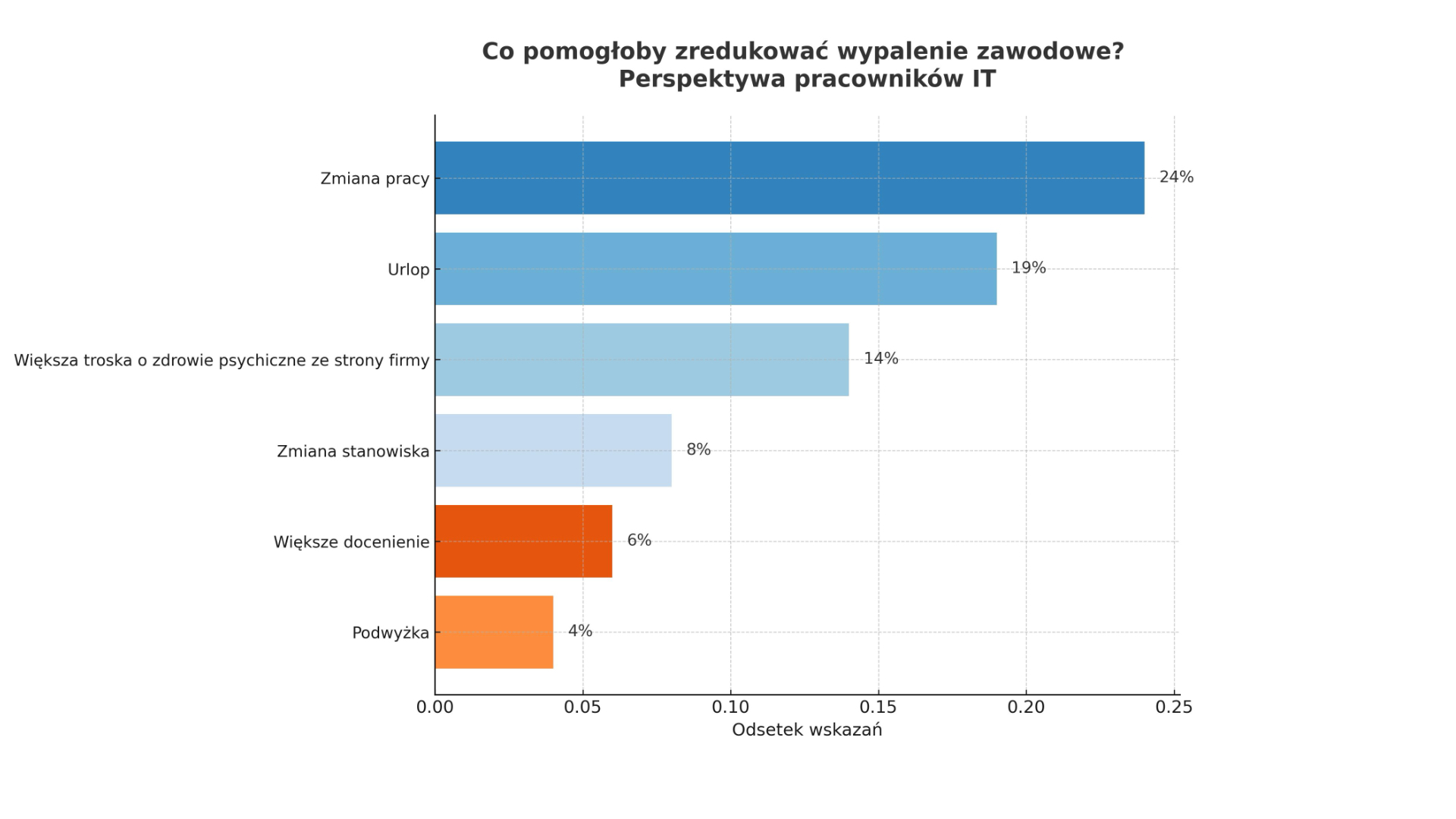
  • Professional burnout in IT. How to combat it? – Risk analysis for key specialisations

    Professional burnout in IT. How to combat it? – Risk analysis for key specialisations

    Professional burnout in the tech industry has ceased to be a taboo subject and has become a systemic crisis that threatens the foundations of innovation and the stability of the entire sector. It is no longer a matter of individual fatigue, but a silent epidemic of alarming proportions.

    The research is clear: almost three-quarters (73%) of developers have experienced burnout at some point in their career. Earlier studies, such as the 2021 Haystack Analytics report, indicated an even higher percentage, reaching 83%.

    The problem is just as acute in the Polish market, where symptoms of burnout affect as many as 70% of IT workers to varying degrees, with up to 42.1% of respondents at high risk.

    When such a vast majority of the population experiences a negative phenomenon, it ceases to be an individual problem and becomes a systemic challenge. This normalisation leads to a vicious circle: new employees perceive burnout as ‘buying in’ to the industry, and companies may under-invest in prevention.

    To add weight to this discussion, it should be noted that occupational burnout has been officially recognised by the World Health Organisation (WHO) and included in the ICD-11 International Classification of Diseases as an occupational syndrome.

    Anatomy of burnout: The 3 dimensions of crisis

    To effectively address burnout, it is essential to understand its nature. The WHO defines it as ‘a syndrome resulting from chronic workplace stress that has not been effectively managed’. It is a phenomenon closely related to the work context.

    The most influential model describing this syndrome, the Maslach Burnout Inventory (MBI), distinguishes three fundamental dimensions.

    1. Emotional exhaustion: This is the central element of the syndrome, characterised by a feeling of complete depletion of energy resources. In the IT context, it manifests itself with thoughts such as: “I’m exhausted at the mere thought of starting another sprint” or “The morning status meeting is sucking all the energy out of me for the rest of the day”. It’s a sense of emptiness that doesn’t go away after the weekend.
    2. Cynicism and depersonalisation: This dimension describes a growing mental distance from work, accompanied by a negative or cynical attitude. In the IT world, cynicism can sound like: “Why make the effort and write clean code when this feature will be removed in six months anyway?”. Depersonalisation is treating colleagues and customers as anonymous objects, leading to a loss of empathy.
    3. Reduced sense of professional efficacy: The third pillar is a sense of lack of competence and personal achievement. The employee begins to evaluate his or her effectiveness negatively and feels that his or her contribution does not matter. In the IT industry, where progress is crucial, this dimension is particularly painful and can take the form of imposter syndrome, where even experienced technical leaders feel they are underperforming.

    These three dimensions form a vicious circle. Usually it all starts with emotional exhaustion. To cope with it, the individual develops cynicism as a defence mechanism. However, this detachment leads to a decline in the quality of work, which becomes fuel for the third dimension: a reduced sense of efficacy.

    The employee now has objective evidence that he is ‘failing’, which in turn exacerbates his exhaustion, closing a destructive cycle.

    Battlefield analysis: risk factors in key IT roles

    Each speciality has a unique ‘risk profile’ that shapes the day-to-day experience of professionals.

    DevOps and SRE: engineers on constant call

    DevOps and SRE specialists are the backbone of modern systems, but the role comes with a huge workload. The main stressor is the 24/7 work culture and ubiquitous on-call duties that blur the boundaries between work and personal life.

    Another factor is the enormous complexity and fragmentation of tools – engineers manage an ‘endless jigsaw’ of technologies such as Terraform, Kubernetes and Jenkins. Added to this is the constant context switching, which can reduce productivity by up to 40%.

    The burnout mechanism here is driven by chronic stress resulting from hyper-sensitivity and cognitive overload.

    Cyber security: watchdogs on constant alert

    Cyber security professionals operate in an environment with zero tolerance for error. A unique stressor is so-called ‘alert fatigue’ – fatigue caused by a constant barrage of alerts, most of which are false alarms.

    The pressure is immense, as one mistake can lead to catastrophic losses. The situation is exacerbated by a global shortage of staff, meaning that existing teams are permanently overstretched.

    This creates a sense of asymmetrical struggle: the defenders need to secure everything and the attackers need only one success. Burnout here is the result of operating in a long-term ‘fight or flight’ mode.

    Project manager: conductor of an orchestra of chaos

    PMs function at the intersection of different interests: the team, the client and management. The main source of stress is managing multiple projects at the same time, with more than half (52%) of PMs managing between two and five projects at once.

    Equally taxing is emotional labour, i.e. absorbing frustrations and managing expectations. The constant need to make decisions leads to decision fatigue (decision fatigue).

    The key element here is the disconnect between the enormous responsibility and the limited control over budgets, resources or changing requirements.

    Developer (Frontend/Backend): between creativity and technological debt

    The role of a software developer is saturated with unique stressors. One is the constant learning curve in the face of rapidly evolving technologies. But the strongest demotivator is the sense of wasted effort when weeks of work on functionality are rejected by the product department.

    Added to this is the high cognitive load associated with working on a complex legacy code. The burnout mechanism is fuelled by the frustration of feeling that the work is more about fighting the system than creating real value.

    QA / Tester: the quality guardian at the end of the chain

    The role of the quality specialist is often underestimated, yet under enormous pressure. The biggest stressor is the position at the very end of the software development cycle. Any delays accumulate, drastically reducing the time for testing.

    The role also suffers from a sense of undervaluation – the tester’s work remains ‘invisible’ as long as everything works, but when a bug makes its way into production, the QA department is most often blamed. Burnout in this role is the result of a toxic mix of high pressure, huge responsibility and low recognition.

    The common denominator for the roles most at risk of burnout is a fundamental imbalance between responsibility and control. The DevOps engineer is responsible for the stability of the system, but does not always have control over the quality of the code being deployed.

    The Project Manager is responsible for the delivery of the project, but does not fully control the resources. The tester is responsible for quality but has no control over the schedule. This discord is one of the most powerful chronic stressors in the workplace.

    How do you build resilience against burnout?

    Combating burnout requires a two-pronged approach: strengthening individual resilience and, more importantly, fundamental organisational change.

    • Conscious boundary-setting: It’s more than ‘work-life balance’. It’s about actively managing your own energy, scheduling blocks for deep work and regular digital detoxes. In doing so, it is important to remember that although 70% of developers code at weekends for pleasure, this can lead to blurred boundaries and prevent full recovery.
    • Managing cognitive load: Methods such as the Pomodoro Technique or the conscious reduction of context switching can reduce daily overload.
    • Normalising seeking support: Open communication with a supervisor and the use of psychological support are signs of maturity, not weakness.
    • Build a culture of psychological safety: An environment must be created where employees can talk openly about problems without fear of punishment. Leaders need to model healthy behaviour – taking leave and respecting working hours.
    • Process and tool optimisation: Investments in simplifying the tool chain (DevOps), automating testing (QA) and systematically reducing technical debt (Developers) are direct attacks on sources of stress.
    • Ensuring a balance between responsibility and control: The level of responsibility must go hand in hand with an appropriate level of autonomy and control over one’s own work. Regular feedback helps to correct any imbalances.
    • Actively promote regeneration: Companies should realistically encourage the use of holidays (and not contact employees during them) and offer flexible working arrangements.

    Professional burnout is a signal that legacy working models in IT have reached their limits. It is time to stop treating employees’ mental health as a cost and start seeing it as a key investment in the most important resource the technology industry has: human talent, creativity and a passion to create.

  • Is the IT industry getting older? Age structure of ICT professionals in Poland and the EU

    Is the IT industry getting older? Age structure of ICT professionals in Poland and the EU

    In the business narrative, the technology industry is synonymous with youth, dynamism and a constant influx of new talent. The common perception of the IT sector as the domain of people under 30 is so strong that the question of its ageing sounds almost like heresy. However, the latest Eurostat data sheds a whole new light on this picture, revealing a fundamental paradox that has direct implications for Polish companies, especially in the SME sector.

    Analysis of data from the last decade (2014-2024) brings a surprising conclusion: the European IT sector as a whole is not ageing at all. On the contrary, it shows remarkable demographic stability. In 2024, the share of ICT (information and communication technology) professionals aged 35 and over across the European Union was 62.8%. A decade earlier, the figure was marginally higher at 62.9%. However, this almost zero change (-0.1 percentage points) is not a sign of stagnation, but of a dynamic equilibrium.

    This stability is the result of two powerful forces clashing. On the one hand, the ICT industry is growing at a rate unmatched by the rest of the economy. Between 2014 and 2024, the number of ICT professionals employed in the EU increased by as much as 62.2%, while total employment in the EU grew by only 10.6%. Such massive growth generates a constant demand for new staff, met mainly by graduates, which naturally rejuvenates the sector. On the other hand, the powerful base of professionals hired a decade or two ago is naturally maturing, moving into older age groups. At an EU-wide level, these two trends are almost perfectly balanced. The IT sector in Europe is therefore a mature market – where almost two-thirds of the workforce is over 35 – but thanks to expansion, as a whole, it is not ageing.

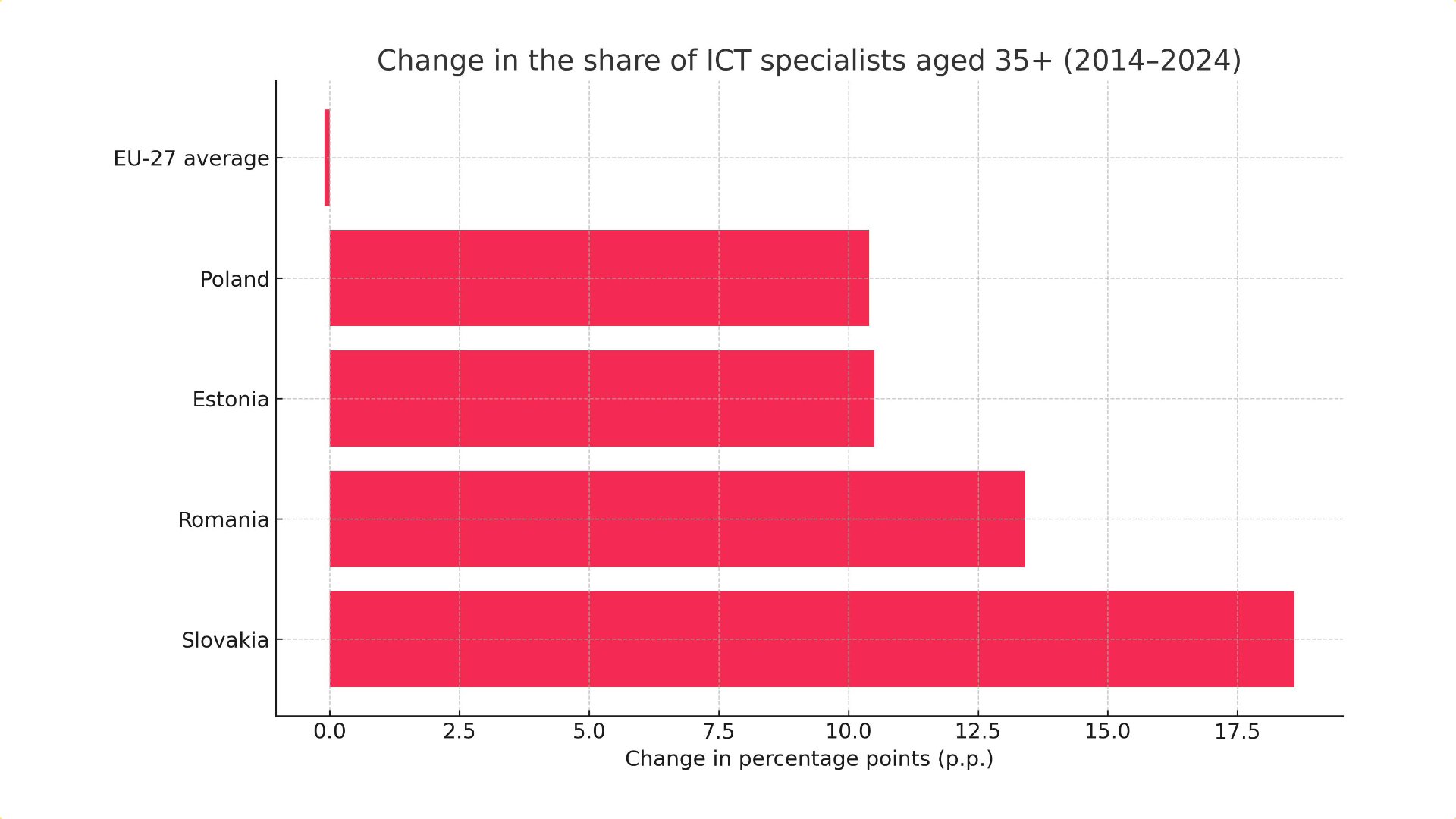
    However, this pan-European balance masks ‘contrasting national trends’, and Poland is one of the clearest examples of this divergence. While the share of ICT professionals aged 35+ declined in the EU, in Poland it increased by as much as 10.4 percentage points over the same period. This places Poland among the top countries with the fastest maturing technology workforce, alongside Slovakia (+18.6 p.p.) or Romania (+13.4 p.p.).

    This does not mean that the Polish sector is ‘old’, but that it is maturing at a rapid pace. There are several factors behind this phenomenon. Firstly, it is the effect of the maturing of the market. The generations that fed into the industry en masse during the recruitment boom of the 2000s and 2010s are now collectively crossing the threshold of 35 and 45 years of age. Secondly, this trend is reinforced by the overall unfavourable demographic situation in the country. Poland is an ageing society at a rapid pace , which translates into a shrinking pool of young talent across the labour market. Finally, the market itself has started to favour experience – the observed slowdown in the recruitment of juniors goes hand in hand with a growing demand for experts, including in the context of the development of AI.

    As a result, the Polish IT sector is losing its former ‘youth’ advantage. The age structure of the industry, visualised in the form of a pyramid, would show a clear ‘convexity’ in the 25-34 and 35-44 age cohorts, which contrasts with the much older and flatter structure of the total workforce in the Polish economy.

    For Polish SME companies, this rapid demographic shift creates a fundamental conflict: a clash between cultural stereotypes and market reality. The organisational culture of many technology companies, both globally and in Poland, is steeped in ageism, or age discrimination. Stereotypes perceiving older workers as “less adaptable” or “unwilling to learn” are still common. Polish studies show glaring disparities: candidates aged 28 receive twice as many invitations to interviews as people over 50, with identical qualifications.

    With demographics forcing a reliance on older staff, this cultural ageism is becoming a strategic mistake. Companies that continue to use platitudes about a ‘young, dynamic team’ in their recruitment communications , are actively scaring away the largest and most experienced talent pool in the market. In an era when more than half of EU businesses report difficulty filling ICT vacancies , this is a business barrier that raises recruitment costs and increases turnover.

    Adapting to this new reality requires SMEs to immediately revise their strategy. Competing for a growing pool of experienced experts cannot be based on salary alone. It becomes necessary to implement conscious Age Management strategies. This means focusing on critical areas for a mature workforce. Firstly, on the strategic transfer of knowledge. Experienced specialists (50+) are often the “first generation” of Polish IT, possessing invaluable knowledge of key systems. Their departure without a succession plan, e.g. through mentoring or workshops, means an irrevocable loss of critical ‘know-how’. Secondly, SMEs can gain an advantage by offering values valued by seniors: employment stability , real flexibility and attention to work-life balance.

    Redefining development and upskilling is becoming equally important. Investing in the development of a senior looks different to that of a junior. It is no longer just about learning a new framework, but about developing competences that multiply the value of their experience. Companies need to create formal technical development paths (e.g. Staff/Principal Engineer) that allow for promotion and salary increases without moving to a managerial path. This is a development towards technical leadership , systems architecture and taking full responsibility for a product area.

    Finally, this internal strategy must be reflected in the company’s external communication, i.e. in its Employer Branding. It is time to audit recruitment language and eliminate ageist language from it. Instead, communications should consciously showcase and celebrate experienced employees as mentors and innovation leaders.

    The question “is the IT industry ageing?” has a complex answer: in Europe – no, in Poland – yes, and rapidly. The Polish IT sector has ceased to be a “young industry” and has become a mature market. The competitiveness of SMEs in the coming decade will not depend on the ability to attract the youngest, but on the ability to strategically retain, effectively develop and fully utilise the potential of the growing number of professionals over 35. The greatest competitive advantage will be gained by those companies that are the first to abandon stereotypes and adapt their culture to the demographic reality.

  • Selling the cloud: From technical features to business benefits

    Selling the cloud: From technical features to business benefits

    The Polish IT industry is at the epicentre of a revolution. Cloud computing has ceased to be a technological novelty and has become the foundation of modern business. The Polish cloud computing market, whose value in 2023 reached PLN 3.9 billion, is forecast to approach PLN 13 billion by 2029. This is no longer a trend – it is a new reality. For B2B marketers, this means one thing: the rules of the game have changed. Success no longer depends on selling technology, but on strategic advice.

    Communication in the language of benefits, not technology

    The key to a successful sale is to understand that the decision to migrate to the cloud is rarely purely technical. It is a business move, driven by specific needs and equally specific concerns. Companies opt for the cloud because they are concerned about data security, want the flexibility of remote working, or want to turn a one-off, huge investment in hardware (CAPEX) into predictable operational costs (OPEX).

    At the same time, decision-makers are afraid of losing control over costs and lacking the internal competence to manage the new environment. It is this paradox – a strong need for change while fearing it – that defines the role of the modern salesman. His job is not to sell a product, but to allay fears. He or she becomes a de-risking agent who guides the customer through the transformation process, providing peace of mind and a sense of security.

    Selling solutions, not functions

    The biggest IT sales mistake is reciting technical specifications. The business customer is not buying ‘elastic scalability’ or ‘georedundant disaster recovery’. He is buying concrete results. Instead of talking about technical features, it is worth painting pictures of business benefits in the customer’s mind.

    Selling this is not about offering scalability, but about guaranteeing that a customer’s online shop will never fail during peak Black Friday sales, maximising their profits. Rather than offering disaster recovery, it is more effective to present this as an insurance policy for the business, ensuring business continuity even in the event of an office fire. Instead of explaining the OPEX model, it is useful to show that the client can stop freezing hundreds of thousands in servers and use the money saved for marketing or product development, paying for IT like electricity. It is this translation from the language of technology to the language of value that builds trust and closes the sale.

    Turning objections into arguments

    Even the best conversation will encounter objections. This is not a failure, but an invitation to a deeper discussion. The most common of these – “it’s too expensive”. – rarely means an actual lack of budget. It is a signal that the customer has not yet seen enough value. Instead of defending the price, the conversation can be shifted to another track. It is worth asking how much each hour of downtime of a key system costs him during peak season. The key is to make the customer aware of the cost of inaction. In this way, price ceases to be an expense and becomes an investment in stability and revenue.

    The same is true for security concerns. Rather than inundating the customer with a list of certificates, it is effective to explain the concept of ‘shared responsibility’. Presenting this as a partnership, where the supplier builds a fortress with state-of-the-art security systems and the customer manages who has the keys to each chamber, gives a sense of control and builds trust much more effectively than technical jargon.

    Playing for loyalty in a world of subscriptions

    In traditional sales, signing a contract completed the process. In the subscription model that dominates the cloud, this is only the beginning. The financial success of the provider is inextricably linked to the business success of the customer. Therefore, sales is evolving towards a Customer Success philosophy, i.e. proactively ensuring that the customer achieves their goals with the solution.

    As experts point out, in this model, up-selling and cross-selling cease to be aggressive techniques and become a natural part of the partnership relationship. When you can see that a customer is successful, it’s the perfect time to offer them the next step. If he has successfully migrated his applications to virtual machines, perhaps he is ready for containerisation, which will further accelerate his development processes.

  • Partner network integrator – the new standard for competitiveness in IT

    Partner network integrator – the new standard for competitiveness in IT

    A scenario that a decade ago might have been considered a sign of weakness is today becoming a market standard. A medium-sized IT integrator faces the prospect of a lucrative contract that exceeds its internal competence resources. Instead of opting out, the company turns to partners within a formal network. The result? The project is won and the client receives a solution that could not be delivered by a single entity. This is a sign of the times in a market whose value is growing at a dizzying pace.

    The role of the IT systems integrator has undergone a fundamental transformation. Corporate customers are no longer just looking for hardware and software suppliers. They expect strategic partners who not only support, but actively guide their digitalisation process. This trend, identified, among others, in research by the analyst firm Lünendonk, is driving demand for advanced and comprehensive IT services.

    This is borne out by hard data. Analysts at Gartner forecast that global spending on IT services will reach nearly $1.7 trillion in 2025, continuing its rapid growth in the years to come. This is a huge and attractive market, but it is becoming increasingly difficult to enter it with a full range of offerings, especially for small and medium-sized companies that cannot afford to build all their niche specialisations internally.

    In this new reality, traditional fierce competition, especially between like-minded companies, is beginning to give way to cooperative models. The solution is becoming associations and networks of integrators, which are evolving from loose interest groups into strategic alliances. Their aim is not only to survive, but above all to successfully compete for the largest contracts.

    The main benefit of such cooperation is synergy. Companies gain access to a wider market, to the unique competences of other partners, and to preferential terms with suppliers and distributors. The pooling of resources allows the implementation of complex, multi-phase projects, and the transfer of knowledge and experience within the network increases the competitiveness of each member. Support in technical, legal or marketing issues is an added value that allows you to focus on your core business activities.

    Key to the success of such platforms is a culture based on trust and the elimination of internal competitive pressure. Rather than competing, network members act as one organism, exchanging knowledge and experience on an equal basis. Informal communication and peer relationships build an environment where innovation and out-of-the-box solutions are easier to come by. Importantly, the best networks take care to preserve the independence of their members, avoiding the creation of centralised structures, such as joint purchasing departments. Instead, they negotiate favourable framework agreements from which everyone can benefit on their own terms.

    Membership of an elite network, however, is not given to everyone. It is a model based on reciprocity – ‘give and take’. These organisations place specific requirements on candidates, expecting not only a willingness to compromise, but above all an active contribution to the community. Criteria often include proven financial stability and a certain minimum volume of turnover in the IT industry, reaching, for example, €2.5 million per year. This is a selection mechanism to ensure that only reliable and committed partners are brought into the network.

    The ‘lone wolf’ model, which builds all competences on its own, is becoming a relic of the past in the face of increasing technological complexity and market pressures. The future belongs to ecosystems in which the strength of a single company is measured not only by its internal potential, but above all by the quality of its partner network. This is a strategic shift that redefines the rules of the game on the Polish and global IT market.

  • Polish software house market: between record exports and internal correction

    Polish software house market: between record exports and internal correction

    For more than a decade, the Polish IT sector has been synonymous with uninterrupted, dynamic growth. It has established itself as the technological heart of Central and Eastern Europe, attracting global investment thanks to its huge talent pool and reputation as a reliable partner in nearshoring and outsourcing projects. The narrative of a ‘golden decade’ for Polish IT, driven by thousands of software houses and skilled developers valued worldwide, has become almost an axiom. However, in the past several months or so, this optimistic picture has begun to crack and the market has started to send deeply contradictory signals that have sown the seeds of uncertainty.

    On the one hand, hard macroeconomic data paints a picture of a sector in peak form. The value of Polish IT services exports is breaking new records, demonstrating extraordinary strength and global competitiveness . Poland sells more IT services abroad than such technological powers as Japan or South Korea, which testifies to the maturity and sophistication of the solutions offered . On the other hand, there are increasingly loud signals from inside the industry about a cooling of the economy. Industry portals and labour market reports report a slowdown in recruitment, job cuts and a general sense of ‘adjustment’ after years of unbridled boom . This clash of two radically different narratives creates a fundamental paradox.

    Are we witnessing the beginning of a stagnation that will end an era of spectacular growth? Or is this just a temporary breathlessness, a natural consequence of the global economic slowdown? Or, as seems most likely, are we seeing something much deeper – a fundamental process of market maturation and restructuring that is separating innovation leaders from companies basing their model on simpler services?

    Market fundamentals: Between impressive scale and growing pressure

    In order to understand the current state of the software house market, it is first necessary to look at its foundations – the number and structure of the companies that make it up. Registration data from the Central Statistical Office (CSO) and the Central Register and Information on Economic Activity (CEIDG) provide key information about the scale and dynamics of this ecosystem.

    The analysis of the Polish IT sector is based on the Polish Classification of Activities (PKD), where the key role is played by Section J, Division 62: ‘Computer programming, consultancy and related activities’ . This category covers a wide range of activities, from code writing (PKD 62.01.Z), to IT consultancy (PKD 62.02.Z), to other information and computer technology services (PKD 62.09.Z). It is these subclasses that largely define the software house ecosystem in Poland.

    Data from the REGON register, maintained by the Central Statistical Office, shows the impressive scale of the market . Industry reports estimate the number of technology companies in Poland at over 60,000, and between 500,000 and even 850,000 people work in the IT sector. This huge number of active entities testifies to the extraordinary density and vitality of the market. It is a landscape dominated by micro, small and medium-sized enterprises, which on the one hand testifies to the low barriers to entry and entrepreneurship, and on the other makes it more susceptible to economic fluctuations.

    However, the sheer size of the market is only one side of the coin. The other, much more dynamic, is hidden in the CEIDG data, which records the fate of sole proprietorships (JDG) – a legal form extremely popular with contract programmers and small IT companies. An analysis of the number of deregistrations and business suspensions sheds light on the pressure this segment of the market has come under. The data from the last few years are clear and point to increasing pressure. In 2022, CEIDG received 9.6% more applications to close a sole proprietorship than the year before. In the first half of the other year analysed, the increase was even more dramatic at nearly 26% year-on-year. These figures are hard evidence that market conditions have become much more difficult for many smaller players.

    The reasons for this phenomenon have to be sought in a combination of macroeconomic and regulatory factors. The global slowdown, high inflation, rising costs of doing business and changes in the legal and tax environment, such as the introduction of the Polish Deal, have hit the smallest entities in particular . However, these figures should be interpreted with caution. The high number of closures and suspensions in CEIDG is not only a symptom of the crisis. It also reflects the nature of the IT industry, which is dominated by project work. The CEIDG system is designed to make it easy to set up, suspend and close a business. For a contractor programmer, closing down a company can simply mean the end of one major project and moving to a contract of employment, and suspending a business is a common tool to manage liquidity in between assignments.

    Global driving force: Exports as a barometer of success

    While data from the domestic market point to increasing pressure, analysis of international trade paints a very different picture. The Polish IT sector has become a real export powerhouse in recent years, and the growth rate of foreign sales is a key argument against the stagnation thesis.

    The figures speak for themselves. The value of Polish exports of services in the ‘telecommunications, IT and information’ category has increased from around PLN 33.1 billion in 2019 to more than PLN 70.7 billion in 2023 . This represents a more than doubling in just four years. Since 2010, exports of IT services have grown at an average annual rate of more than 20%, more than twice as fast as exports of all services in general . As a result, the share of IT services in total Polish services exports has increased from around 5% a decade ago to nearly 13% in 2022 .

    According to data from the Polish Development Fund, based on Eurostat statistics, at the end of 2022 exports of IT services from Poland reached a value of EUR 11.66 billion, generating a significant trade surplus . Importantly, there has not been a single year of decline in this category since 2010, demonstrating the unrelenting demand for Polish digital competencies . This impressive trend fits into the wider European context. Eurostat data shows that telecommunications, computer and information services are one of the fastest-growing export categories for the European Union as a whole, with their share of total services exports (outside the EU) increasing by 7.2 percentage points between 2013 and 2023 .

    This growth is not only quantitative, but above all qualitative. The Polish IT industry is breaking away from the image of a ‘digital assembly plant’, where the main competitive advantage was the lower price of software services. Increasingly, Polish companies are becoming strategic partners for global corporations, providing complex and technologically advanced solutions. Exported services are no longer just simple software development, but also advanced research and development (R&D) projects, strategic IT consulting, cloud services, cyber security and data analytics . This evolution is evidence of Poland moving up the global value chain. The main directions of this expansion are the world’s most demanding markets: the European Union countries (with Germany at the forefront), the United States, the United Kingdom and Switzerland.

    Market reality: the end of the eldorado and a changing of the guard

    The period when recruiters vied for every candidate and companies outdid each other in offering ever higher salaries is over. The last two years have seen a marked cooling and normalisation in the IT job market, which many observers describe as the ‘end of the eldorado’ . Reports from recruitment portals clearly indicate a shift in the balance of power.

    The number of job offers published has fallen significantly compared to the peak years of 2021-2022 . At the same time, the number of applications per position has increased dramatically, with an average of 44 applications per offer in 2024, compared to 40 the year before . The most noticeable consequence of this change is the drastic reduction in opportunities for juniors. Companies, seeking to optimise costs and minimise risk, prefer to invest in experienced seniors who can deliver business value from day one . This turnaround in the market also comes at a human price – reports indicate increasing levels of stress, job burnout and feelings of job insecurity.

    The cooling in the labour market is a direct consequence of the global economic downturn, which has forced software house clients to review their budgets . Inflation and economic uncertainty have prompted companies around the world to take a more cautious approach to technology investments . Customers, looking to save money, are freezing less critical projects and scrutinising every purchasing decision much more closely . For Polish software houses, this means longer sales cycles and the need to prove return on investment (ROI) at every step. The data from the SoDA report are telling here: small companies (up to 50 people) reduced an average of 26% of their IT specialists in the last year, while in large organisations (more than 300 people) this percentage was 12% . This shows that the market correction is hitting smaller, less stable players hardest.

    New market requirements – Specialisation as the key to survival

    The current market environment acts as a powerful evolutionary filter. In the boom times, demand was so high that almost every company, even those offering uncomplicated outsourcing of programmers (‘body leasing’), could count on orders. Today, the situation is radically different. The market places a premium on specialisation, deep domain knowledge and the ability to deliver complex, measurable business solutions.

    Demand is shifting away from generalist programmers towards experts in niche but rapidly growing fields. An analysis of job vacancies shows that even with an overall decrease in the number of advertisements, areas such as Artificial Intelligence (AI/ML), Cyber Security, Data Analytics (Data & BI) and Cloud Engineering are still seeing increases in demand and offering high salaries . A company that today simply offers ‘Java developers’ is competing in a market that is becoming a commodity, susceptible to price pressure. By contrast, a company that provides ‘certified cyber security experts for the financial sector’ or ‘AI engineers with experience in logistics optimisation’ is selling a unique, high-margin solution.

    This transformation is painful, but in the long term healthy for the sector as a whole. The market correction is not killing the industry, but accelerating its transition from a labour arbitrage-based model to one based on knowledge and innovation. This is a classic symptom of the industry’s transition from a phase of explosive growth to a phase of mature, more sustainable competition.

    Not stagnation, but maturing through correction

    Analysis of the data leads to a clear conclusion. What the Polish software house market is experiencing is not stagnation. It is a complex and multifaceted maturation process that is taking place through a profound, albeit painful, market correction.

    Record exports and internal slowdown are not contradictory phenomena, but two sides of the same coin. Spectacular export success is being driven by leading players who have successfully moved to the next level of technological sophistication. The same process, however, raises the bar for the market as a whole. An internal adjustment, manifested by a slowdown in recruitment and pressure on smaller companies, is a natural consequence of this evolution.

    The “golden decade” of easy, undifferentiated growth is irrevocably over. The future of the Polish IT sector will be shaped by new paradigms:

    • Deep specialisation: Survival and growth will depend on the ability to build unique expertise in niche but strategically important areas. Companies must become experts in specific technologies (AI, cyber security, cloud) or industry verticals (fintech, healthtech, e-commerce).
    • Business maturity: Skills in sales, marketing, financial management and strategy building will become crucial. Software houses need to evolve from technology workshops into mature, efficiently managed businesses .
    • The AI revolution: artificial intelligence is becoming a fundamental tool to be integrated into your own processes to increase efficiency and reduce project delivery times. Companies that ignore this trend risk losing their competitiveness .

    Although the current period is challenging, the outlook for the Polish IT sector remains optimistic. As it goes through this transformation, the industry is becoming stronger, more diverse and resilient to shocks. The adjustment, although painful, is a necessary stage in the evolution that is transforming the Polish IT sector from a regional talent basin into a mature global technology leader capable of competing at the highest global level .

  • IT imports to Poland and exchange rates – How USD/PLN shapes the technology market

    IT imports to Poland and exchange rates – How USD/PLN shapes the technology market

    Imagine the IT director of a large Polish company finalising the budget for a data centre upgrade. At the same time, on the other side of town, a freelance programmer is configuring his dream powerful laptop for work in an online shop.

    Although their goals and the scale of their purchases are radically different, they have one thing in common: they both do not realise that the final amount on the invoice they will have to pay is largely shaped not in Warsaw or Wroclaw, but thousands of kilometres away – by the decisions of currency traders in New York, analysts in London and factory managers in Shenzhen.

    Poland’s dynamic digitalisation and its deep integration into the global economy have made our country a significant consumer of modern technology. However, this appetite for innovation comes at a price.

    Dependence on imported hardware – from servers and disk arrays to computers and components to smartphones – puts the entire Polish IT sector at the mercy of global currency markets. Any fluctuation in the US dollar or euro has a direct impact on companies’ operating costs, investment budgets and, most importantly, the prices we all pay for the technology that drives our economy.

    The anatomy of Polish IT imports: Where is the technology stream coming from?

    In order to understand the specifics of IT imports, it is first necessary to situate them in the overall landscape of Polish foreign trade. Data from the Central Statistical Office (CSO) paints a picture of an economy deeply integrated with international markets.

    In recent years, we have seen dynamic changes in the value of both exports and imports, with the trade balance oscillating between positive and negative values, indicating a high sensitivity to the global economic situation.

    A key piece of this puzzle is the geographical structure. Developed countries, and in particular the European Union, have the largest share of Polish trade, both on the export and import side.

    In total imports, the share of developed countries is around 65%, with EU partners accounting for more than 52%. This dominance is the foundation on which many analyses are based, but in the case of the IT sector it can be misleading, masking the true origins of technology.

    The analysis of IT equipment imports faces some methodological challenges. Publicly available CSO data does not distinguish a precise category covering only ‘computers, servers and components’.

    However, we can use with a high degree of confidence a proxy category that largely captures the scale and trends of this phenomenon. This is SITC section 7: ‘machinery, plant and transport equipment’. The rationale is twofold.

    Firstly, it is the largest single category in the structure of Polish imports, regularly accounting for more than 35% of their total value. Such a high share testifies to the fact that the Polish economy, in its development and modernisation, is strongly dependent on imports of capital goods and advanced technologies, in which IT equipment plays a key role.

    Secondly, it is in this broad category that the vast majority of computer, telecommunications and server equipment imported into Poland is classified.

    The CSO data clearly indicate Poland’s three main import partners. The podium is invariably occupied by Germany, China and the United States. Understanding the role of each of these countries is key to analysing the impact of exchange rates.

    • Germany: Our western neighbour is number one, accounting for around 19.3% of all Polish imports. However, in the context of IT, Germany’s role is primarily that of a giant logistics and distribution centre for the whole of Europe. Much of the equipment we formally import from Germany was not manufactured there. These are goods originating from factories in Asia or designed in the USA, which come to Poland through German ports and warehouses.
    • China: With a share of around 14.4%, China acts as the ‘factory of the world’. It is where the lion’s share of finished consumer products (laptops, smartphones, monitors) and key components come from.
    • United States: The USA’s share of Polish imports is around 5.0%. However, the country’s role is much larger than this figure suggests. The US is a source of intellectual property, designs, advanced software and key high-margin components such as processors and specialised integrated circuits. Significantly, Poland records a significant deficit in trade with the USA, meaning that the value of imports from this direction significantly exceeds the value of exports.

    It is also worth mentioning other important players from Asia, such as South Korea (around 2.9% of imports), which is a powerhouse in memory and display manufacturing, as well as Vietnam and Taiwan, key links in the global semiconductor supply chain.

    Memories, displays, USD components

    A fundamental conclusion emerges from this simple table: although IT equipment arrives in Poland from various geographical directions and transactions with European intermediaries take place in euros, at the very financial basis of this trade is the US dollar.

    Germany’s role as a ‘gateway to Poland’ for technology goods obscures the picture. The base cost of the server that the Polish distributor buys from the German intermediary was calculated on the basis of the price that this intermediary paid to the Chinese factory – and this price was denominated in dollars. The euro transaction is therefore only the last step in a chain whose beginning was denominated in dollars.

    The dollar king, the euro prince: A currency duopoly in the world of technology

    To understand why the USD/PLN exchange rate is so important for IT equipment prices in Poland, it is necessary to grasp the global role of the US currency. The dollar is the default currency of global technology trade for historical and structural reasons.

    The key components at the heart of any modern device – semiconductors, processors, memory bones – are priced and sold in dollars, whether the factory is in Taiwan, South Korea or Malaysia.

    The dollar is the global language of trade in the IT industry. All major global IT spending forecasts, market value analyses and contract valuations are universally quoted in US dollars.

    The euro plays a different, but also important role. It is first and foremost a transaction currency within the single market of the European Union. A Polish importer, buying equipment from a distributor in Germany, the Netherlands or France, will most likely receive an invoice and make payment in euros.

    The EUR/PLN exchange rate therefore has a direct impact on the final cost of such a transaction. However, it must constantly be borne in mind that the price in euros set by the European intermediary is already derived from the price he himself paid for the goods – and this, as we have established, was almost certainly expressed in dollars.

    Understanding the scale of the problem requires a look at historical currency quotations. The National Bank of Poland’s data, publicly available in accessible formats, makes it possible to track these changes.

    The USD/PLN and EUR/PLN exchange rate charts of recent years show periods of rapid volatility, often correlated with global events such as pandemics, geopolitical crises or changes in the monetary policies of major central banks. Each peak on the USD/PLN chart is a direct blow to the profitability of importers and a potential price increase for end users.

    This dominance of the dollar creates a direct and often underestimated link between US monetary policy and the budgets of Polish companies. Decisions taken by the US Federal Reserve (Fed) in Washington on interest rates often have a greater and faster impact on equipment prices in Poland than decisions by the European Central Bank or even the National Bank of Poland.

    When the Fed raises interest rates, this usually leads to a strengthening of the dollar on global markets. As a result, the USD/PLN exchange rate rises, meaning that you have to pay more PLN for the same dollar. As a result, the underlying cost of importing all IT equipment rises almost immediately.

    From factory to desk: How do fluctuations translate into shelf price?

    Let’s examine how a change in the exchange rate translates into the price of a laptop that eventually reaches the desk of an employee in Poland.

    • Invoice from the manufacturer (in USD): A Chinese laptop assembly plant invoices a Polish importer for, say, USD 1 million for a container of equipment.
    • Purchase cost for the importer (in PLN): At the time of ordering, the USD/PLN exchange rate is 3.90. The theoretical purchase cost is PLN 3.9 million. However, payment is deferred for 60 days. During this time, as a result of market turbulence, the exchange rate rises to 4.20. The actual cost the importer has to incur to buy dollars and pay the invoice rises to 4.2 million PLN. The difference of PLN 300,000 is a pure cost resulting from the exchange rate change.
    • Distributor margin: The importer adds transport, insurance, customs and its margin to its base purchase cost (PLN 4.2m).
    • Retail price (in PLN including VAT): The equipment reaches the shop, which adds its margin and 23% VAT to the purchase price from the distributor. In this way, the original cost increase is not only passed on, but compounded at each subsequent distribution stage.

    However, this mechanism does not work as a simple automaton. There are several factors that introduce delays. Distributors and retailers sell goods that are physically in their warehouses, purchased weeks or even months earlier, at a completely different rate.

    This buffer acts as a shock absorber. In addition, the Polish electronics market is highly competitive. In the event of an unfavourable exchange rate change, companies may face a dilemma: raise prices and risk losing customers, or take some of the increase on themselves, accepting a temporary reduction in their own margins.

    It would be a mistake to attribute all price movements solely to currency fluctuations. In recent years we have witnessed a ‘perfect storm’ of factors that have overlapped:

    • Disruption in supply chains: Pandemic and geopolitical crises have caused chaos in global logistics, driving up freight costs.
    • Component shortages: The global semiconductor crisis directly affected the cost of manufacturing devices.
    • Inflation and manufacturing costs: Rising energy, raw material and labour costs in Asian production centres are pushing up the base dollar price of equipment.
    • Technological progress: each new generation of equipment is initially more expensive to produce.

    A close observation of the market reveals a regularity: retail prices tend to rise relatively quickly when the zloty weakens, but fall much more slowly when the zloty strengthens.

    This phenomenon, known as ‘price stickiness’, has a business rationale. When the exchange rate is unfavourable, importers need to protect their margins. However, when the zloty strengthens, goods bought at a higher exchange rate are still sitting in warehouses and companies are tempted to maintain higher prices and enjoy higher profitability.

    Behind the scenes of imports: The silent war on currency risk

    No serious importer leaves the fate of their business at the mercy of daily currency quotations. Doing business in such a volatile environment requires active management of exchange rate risk. Importers have a whole arsenal of financial instruments at their disposal to hedge against adverse movements.

    • Forward contracts: This is the most popular tool. The importer agrees with the bank to buy USD 1 million in three months’ time at a predetermined rate, regardless of what the market rate will be at that time. Such a transaction eliminates uncertainty and allows selling prices to be precisely calculated.
    • Currency options: This is a more flexible but also more expensive solution that can be likened to ‘insurance’. The importer buys the right, but not the obligation, to buy the currency at a certain rate. This protects against loss, while allowing you to benefit from successful developments.
    • Online currency exchange platforms: For smaller transactions, specialised platforms offer much more favourable rates and lower transaction costs than traditional banks.

    These strategies, although invisible to the end customer, have a direct impact on them. Through hedging, importers introduce price stability. This is why the price of a laptop in the shop does not change daily with the NBP exchange rate table.

    These actions smooth out market volatility. However, it is important to remember that this certainty comes at a price. Hedging is not free. Banks charge for their services and this ‘insurance cost’ is included in the final price of the product. Consumers, in an indirect way, therefore pay a small premium for price stability.

    Event horizon: Forecasts and strategies for the world of Polish IT

    The analysis clearly shows that the Polish IT market is structurally dependent on imports, with costs inextricably linked to global currency markets. Looking ahead, the trajectory of IT equipment prices in Poland will depend on several key variables.

    Macroeconomic forecasts regarding the monetary policy of the US Federal Reserve, geopolitical stability and the general condition of the Polish economy and the strength of the zloty will play a primary role. Periods of appreciation of the zloty may bring relief to import costs, potentially stimulating investment and lowering prices for consumers.

    In a world where economies are inextricably interconnected, understanding the flow of currency is becoming as crucial for the technology industry as understanding the flow of data. For Poland’s digital economy to grow sustainably, its leaders, professionals and informed consumers need to navigate both realities seamlessly.

  • AI will shake up the IT industry more strongly than others. What does this mean for professionals?

    AI will shake up the IT industry more strongly than others. What does this mean for professionals?

    Just a few months ago, generative artificial intelligence was a technological curiosity, a topic for coffee conversations and after-hours experimentation. Today, it is a powerful tool that has become a permanent part of the business landscape and is revolutionising the way we work.

    Behind the media hype around language models, however, is a fundamental question that everyone in the IT industry is asking themselves: “How will artificial intelligence affect my career?”. Indeed Platform’s latest report sheds new light on this question, providing concrete answers and identifying the IT sector as the epicentre of the changes to come.

    Is this a cause for concern or an unprecedented opportunity?

    Analysts from Indeed Hiring Lab conducted an in-depth analysis of more than 2,800 job skills to assess their vulnerability to the impact of generative AI. The conclusions are unequivocal and should come as no surprise to anyone in the industry – technology is changing itself first and foremost.

    It is IT people, who will feel this transformation most strongly. The results of the research paint a stark picture of the scale of this phenomenon. It turns out that more than half of all job-related skills in the technology sector are highly exposed to the transformation.

    When we look at the competences with the highest potential for near-total change, we see that almost three out of five of them are strictly technological skills. This trend affects developers the hardest, as the competences mentioned in a staggering 82% of developer job offers are among the group most susceptible to deep change.

    However, before anyone starts spinning science-fiction visions, it is worth quoting a key counterpoint from the report. The analysts point out that less than 1% of all skills surveyed are rated as fully replaceable.

    It is not a revolution that will wipe us out of the job market, but a profound evolution that will redefine roles in IT.

    Why is it that IT has found itself in the eye of the cyclone? The answer lies in the nature of the work. Generative AI, contrary to appearances, is not a creative entity, but an extremely sophisticated tool for recognising and replicating patterns in huge data sets.

    It excels wherever there are clear rules, logic and structured information. The work of a programmer is a perfect example of this. Programming languages are based on strict syntax and precise rules.

    Processes such as writing standardised code, refactoring, finding bugs or creating unit tests are largely repetitive in nature. These are tasks in which GenAI already demonstrates superhuman efficiency.

    Tools such as GitHub Copilot have ceased to be a novelty and have become a daily support for millions of developers around the world. GenAI is simply another, more powerful step along the same path.

    Now that we know what is changing and why, it is time to ask the most important question: what does all this mean for you? First and foremost, it signals that the role of the IT specialist is evolving. Skills that were valued just five years ago may soon become secondary.

    The ability to write simple, repetitive code or manually sift through tests will increasingly be delegated to machines. However, this does not mean that the demand for experts is declining. On the contrary, the demand for higher-level competences is growing.

    AI becomes our personal assistant, a coding partner that frees up our time and potential, allowing us to focus on what humans are irreplaceable at.

    The new role of the specialist requires a shift in emphasis from being a doer to being a strategist and architect. Professional value will depend less and less on the ability to write line-by-line code and more and more on the ability to design robust, scalable systems, deeply understand business objectives and select the right technologies to solve real-world problems.

    This strategic shift naturally entails an increase in the importance of soft skills. Effective communication with the team and the customer, a creative approach to the obstacles encountered and the empathy to translate human needs into the language of technology is a domain where AI will not be able to compete with humans for a long time to come.

    At the same time, mastering cooperation with artificial intelligence itself becomes a practical requirement. It must be treated as an extremely capable but initiativeless assistant, which means learning to formulate commands precisely, so-called ‘prompt engineering’.

    Ultimately, in this new working model, it is the human expert who remains in the key role of verifier and curator. The ability to critically assess the results generated by the machine, catch subtle errors and take full responsibility for the final product becomes absolutely fundamental.

    The Indeed report is not a prediction of the professional apocalypse. Rather, it is a roadmap of the changes to come and a valuable guide for anyone who wants to consciously shape their career. Transformation in IT is inevitable and will be more profound than in any other sector.

    However, this does not mean the end of work for professionals, but rather the beginning of an exciting new era. The question we need to ask ourselves is not “will AI take my job?”, but “how can I use AI to make my work more creative, valuable and effective?”.

    The future belongs to those who will stop seeing AI as a threat and start treating it as the most powerful tool in their arsenal. It is time to start learning it.

  • Oracle’s big game on AI: Potential and risk under Moody’s magnifying glass

    Oracle’s big game on AI: Potential and risk under Moody’s magnifying glass

    Contracts worth $300 billion to take Oracle ‘s cloud business to a new level have caught the attention of analysts. While the company is celebrating the prospect of huge revenues, ratings agency Moody’s is pointing out the risks that may lurk behind this ambitious plan. Despite the concerns, no decision has been made to change the Austin-based giant’s rating for now.

    Cloud power and one key customer

    Oracle recently announced that it expects revenues from its flagship Oracle Cloud Infrastructure (OCI) service to exceed half a trillion dollars. As reported by The Wall Street Journal, a significant portion of this amount is expected to come from a single, albeit gigantic, contract – a deal with OpenAI for the use of computing power over a period of about five years.

    This move is expected to catapult Oracle to the forefront of infrastructure providers for generative artificial intelligence.

    However, Moody’s analysts, without naming clients, analyse these reports with caution. In their note, they emphasise the “huge potential” inherent in these deals, but at the same time recall the risks that already prompted the agency to change Oracle’s credit rating outlook from stable to negative in July.

    Risks hidden in volume

    Moody’s main concern is counterparty risk. The agency points out that Oracle’s AI business model is based on huge commitments from a very small number of companies. Such heavy reliance on one or a few key players is risky.

    Analysts have likened Oracle’s construction of data centres to one of the world’s largest project finance projects, where the stability of revenue from a single customer is crucial to the success of the entire investment.

    Another aspect is the financial health of the company itself. Moody’s forecasts that Oracle’s debt will grow faster than its operating profit (EBITDA) in the near term. This could lead to a high leverage ratio of 4x before profits from new contracts start to exceed costs.

    Moreover, analysts expect free cash flow to remain negative for quite some time before the investment starts to pay off.

    Oracle is entering the world of big artificial intelligence with tremendous momentum, but its apuesta is fraught with significant financial risk. The company’s current rating of Baa2, at the lower end of the investment grade scale, along with a negative outlook, suggests that financial markets will be watching the giant’s every next step closely.

  • The IT industry doesn’t need more leads. It needs better

    The IT industry doesn’t need more leads. It needs better

    For years, a sales lead was regarded as a valuable resource in the IT industry – regardless of quality, customer buying stage or context. More contacts meant more sales potential, and channel partners hoped that, given enough scale, some of them could be turned into contracts.

    Today, this model is backfiring. More and more companies in the channel are beginning to loudly question the wisdom of bulk lead acquisition, pointing to low conversion and the rising costs of handling ‘blind’ contacts.

    Instead of numbers, quality is becoming more and more important. It is no longer a question of how many potential customers end up in a partner’s system, but how they are vetted, matched and prepared for a sales call.

    Such a change in attitude does not happen overnight, but is clearly emerging as a new standard in mature partnerships.

    From leads to costs

    Many integrators and VARs are now signalling that up to 80-90% of the leads they receive from manufacturers do not translate into real sales opportunities.

    Added to this is the issue of repetition and lack of alignment. One partner serving the public sector gets a contact from a retail customer, another – specialised in the cloud – gets a lead on an on-premise solution.

    As a result, the contact not only fails to lead to a sale, but consumes the time of the sales and technical teams trying to figure out whether the subject is even promising. Presales becomes unprofitable and confidence in leads from head office is severely damaged.

    Which leads make sense?

    In response to these challenges, partners are beginning to formulate their own expectations of lead quality. In practice, this means greater selectivity – not every contact is accepted, and many partners are putting in place internal qualification systems that filter leads before they reach the merchant.

    Contextual information is at a premium: what interested the customer, what stage of decision-making they are in, whether they have spoken to another partner or vendor before.

    Elements such as industry and technology fit, budget potential and the client’s real willingness to talk also matter. These types of leads do not have to be numerous – what matters for experienced partner companies is their predictability, not their scale.

    Another interesting phenomenon is the change in rhetoric. There is less and less talk of ‘leads to be passed on’ and more talk of ‘sales opportunities to be worked with’. This shift in emphasis reflects well the expectation that vendors will engage not only in generating contacts, but also in qualifying them, planning their activities and supporting them in driving the sales process.

    How are producers responding?

    From the manufacturers’ perspective, the shift from mass lead generation to precision channel sales support means that existing practices need to be reviewed.

    Companies that invest in the channel are increasingly seeing teams specialising in lead scoring, purchase intent analytics and account-based marketing campaigns.

    It is not just about finding the customer, but about providing the partner with a contact that realistically fits their profile and competences.

    Some vendors go a step further – creating joint ‘ideal customer’ (ICP) profiles with their partners, setting rules for the transfer of leads or offering the possibility of joint marketing activities, the goal of which is not the number of clicks, but the closure of a specific project.

    Examples of activities also include the use of CRM data and predictive tools that analyse previous campaigns, measure contact activity and suggest which leads have the greatest potential.

    This makes the process more transparent and partners do not feel like they have to ‘dig through’ random contact lists.

    Quality as a shared risk – and shared gain

    Changing the approach to leads is not just a matter of partner convenience. It’s also a way to increase the efficiency of the entire channel – from customer acquisition costs to sales cycle times to retention rates.

    Fewer leads but better quality means less operational effort, greater end-customer satisfaction and more predictable revenue.

    In this context, it is clear that the role of the vendor is changing – from a sender of leads to a contributor to the pipeline. This shift could prove crucial to the future of the channel.

    At a time when B2B customers are making purchasing decisions increasingly on their own, partners need not so much ‘contacts from the market’ as complete pictures of the context in which the customer operates.

  • Organisational culture in an IT company – what leaders do, not HR

    Organisational culture in an IT company – what leaders do, not HR

    Trust, responsibility, openness – these are words that are used in all cases in technology companies. They appear on onboarding slides, in internal communications, in presentations to vendors and in job advertisements. But if you ask employees whether they actually see them on a daily basis, the answer is sometimes different.

    In many partner organisations, organisational culture remains a statement. Meanwhile, in practice, something completely different matters: the decisions that leaders make. And not the ones written down in strategy, but the everyday, often unnoticed ones. It is these that build trust or undermine it without saying a word.

    What culture isn’t – and why this can be seen in IT channels

    In partner channel companies – integrators, MSPs, VARs or distributors – the pace of business is high, the complexity of projects is high and teams are often dispersed. This is an environment where organisational culture cannot be something declarative.

    She needs to operate operationally. When this is missing, there is decision-making chaos, inconsistent communication and the phenomenon of ‘formal rules and informal practices’, which begins to break down the team from the inside.

    Leaders often believe that culture is something that needs to be described and communicated – preferably once, properly, in a joint meeting. But the organisation does not remember the presentation.

    The organisation observes everyday life. If the values announced on Monday diverge from the decisions made on Wednesday, the team instantly draws conclusions. Often other than the expected ones.

    How culture is really shaped – in the leader’s decision-making practice

    In reality, culture is not created top-down. It is shaped from the bottom up – through repetition. When an employee sees that an initiative ends in a reprimand, he does not come up with a proposal again. When he observes that mistakes are hidden or punished, he stops admitting failure. And if he sees that promotion depends not on competence but on loyalty, he begins to adapt his behaviour not to expectations but to policy.

    Trust and responsibility – the most frequently repeated buzzwords in IT company culture – are not the result of training. They come from the daily experience of working in a given environment. When a leader says he cares about the team’s autonomy, but approves decisions at every stage of the project, the team learns that autonomy is a fiction.

    When it talks about transparency and then key changes are announced by surprise, it is difficult to expect openness in the other direction.

    Trust is not an emotion. It is the result of consistency

    In partner organisations, trust is not only relational, but also very practical. Sales teams need to trust marketing and presales, and delivery needs to trust project teams and the client. If this doesn’t work, everything goes awry.

    Communication becomes defensive, delegation of responsibility occurs and decisions are delayed for fear of error.

    Trust does not arise because someone has announced it. It arises when people see that an organisation operates according to predictable rules. That mistakes can be reported without fear of consequences. That decisions are made on the basis of facts, not emotions. That a leader sticks to what he or she declares – even when it is difficult.

    In companies where trust is high, teams act faster and take more initiative. Where it is lacking, everything needs to be clarified, consulted, approved and – often – confirmed by email “just in case”.

    Culture is built through decisions, not narratives

    Some partner organisations build a consistent culture not through big programmes, but through very concrete actions. An MSP company that holds a joint problem analysis meeting after every major incident shows that failure is part of the process, not a reason to avoid responsibility.

    An integrator who allows junior staff to lead a pilot project themselves not only builds commitment but also teaches confidence in their own decisions.

    A distributor whose management publicly asks for feedback on the changes made is not only listening, but modelling the behaviour that is then evident in the sales teams.

    These are not employer branding campaigns. These are not organisational culture certificates. These are actions that show people that values are not just words on the wall, but something that realistically affects their daily work.

    The leader as owner of cultural micro-decisions

    Organisational culture is not created in the communication layer. It is created at the operational layer – where decisions are made about promotions, reactions to mistakes, the distribution of responsibility or how meetings are conducted.

    It is the leader – regardless of the level in the structure – who owns this daily life. He can shape it coherently or disperse it haphazardly. He or she can build a climate in which people know what to expect, or an environment in which everyone acts ‘by feel’.

  • Vendor or advisor? The IT partner and its role in 2025

    Vendor or advisor? The IT partner and its role in 2025

    Not so long ago, good functionality and an attractive price were enough to close sales in the IT channel. Today, this no longer works. Customers are better informed, analyse the available options more often, involve more people in the purchasing process and make decisions more carefully. In this set-up, resellers need to go beyond the pattern of presenting the product and sending offers. Effectiveness now depends on the partner’s ability to guide the customer through the decision-making process – not just the sales process.

    Customer-side decisions are increasingly complex

    In B2B IT sales, it is increasingly rare to deal with a single decision maker. The process often involves several departments – IT, finance, security, operations and also compliance. Each participant has different expectations, different levels of knowledge and different evaluation criteria.

    This not only results in a longer procurement process, but also a greater risk of deadlock. Instead of a quick decision, organisations struggle with lack of consensus, unclear project scope and fear of risk. A partner that limits itself to providing a bid is reduced to the role of contractor – and loses influence over the final selection.

    The customer does not need a product salesman

    Much of the buying process is carried out by customers themselves – analysing data, comparing solutions and consulting other companies. When it comes to contacting a reseller, customers are already at an advanced stage of thinking about implementation, although they are often not yet clear on exactly what they want to buy and why.

    At this point, the client is not expecting another technical specification or product brochure. He needs help in understanding how a particular solution fits into his situation, what results it will deliver and how to minimise the risks associated with implementation. It is this stage that determines whether the partner becomes an advisor – or just one of many options being compared.

    The role of the decision advisor – how to put it into practice?

    Resellers who successfully adapt to the new reality start by talking about the customer’s context: their challenges, internal barriers and business goals. Only then do they move on to technology. This order allows them to better tailor their offering, but above all – to justify its value.

    Another element is support in the preparation of internal decisions on the client side. Resellers can help with ROI analysis, preparing materials for the CFO, assessing risks from a security or regulatory compliance perspective. These are real purchasing barriers that often block a project – and which a partner can help break down.

    So it’s not about selling a solution. It is about facilitating the customer’s decision to implement – and giving them the arguments that will convince the rest of the organisation.

    Value instead of discount, process instead of pressure

    Partners who support the decision-making process are less likely to have to compete on price. A customer who feels looked after and understands the value proposition is less sensitive to discounting. What’s more – a better-guided process translates into higher sales effectiveness, a shorter decision cycle and greater customer loyalty.

    This is a fundamental change. Not so long ago, sales in the IT channel were based mainly on product availability and the strength of the relationship. Today, what matters is the ability to guide the customer through a difficult, multi-stage decision-making process. In this context, consultancy competences – knowledge of purchasing processes, communication with different groups of decision-makers, the ability to translate technology into the language of effects – become crucial.

    New partner advantage: decision support

    In a world where technology is becoming increasingly standardised and offerings are difficult to differentiate at the level of specification, the advantage is not gained by whoever has the best product, but by whoever helps the customer best make sense of its implementation.

    It’s a change that requires investment – in people, in pre-sales tools, in training in communication and needs analysis. But it’s also a direction that offers more stable margins, longer relationships and a higher quality of collaboration.

    A partner who wants to sell effectively today should not only be able to explain ‘what’ he or she is selling – but above all: why the customer should make a decision right now, with him or her and in this direction.

  • Everything as a Service (XaaS): Market maturity and profitability analysis in the partner channel

    Everything as a Service (XaaS): Market maturity and profitability analysis in the partner channel

    The global IT market is undergoing a transformation that is shaking its foundations. The model where technology was bought like a product in a one-off investment (CapEx) is being systematically displaced by the Everything as a Service (XaaS) paradigm.

    From software (SaaS) to infrastructure (IaaS) to hardware(DaaS), almost every technology feature today is available as a subscription, billed as an operating expense (OpEx).

    This is not a fad, but a strategic shift driven by fundamentally different customer expectations, who instead of asset ownership, are looking for flexibility, scalability and real business results.

    The scale of the phenomenon is impressive. Global forecasts indicate a compound annual growth rate (CAGR) for the XaaS market in excess of 20%, and it is expected to grow from around US$610 billion in 2025 to nearly US$3.7 trillion by 2034.

    However, the key to understanding this trend is to set it in the wider context of the subscription economy. Research shows that there are already 3.9 subscriptions per statistical Pole, and this model is popular even among older generations.

    Everyday experiences with services such as Netflix and Spotify normalise the idea of paying for access rather than ownership. This habit is seeping into the B2B world, where decision-makers, who are privately owned consumers, are becoming much more open to paying for ongoing value rather than a one-off purchase.

    In this new landscape, the Polish IT partner channel faces its biggest challenge in a decade.

    Mature market, new rules of the game

    The Polish IT market is no longer just a follower of global trends – it has become an active participant in them, reaching a significant level of maturity. According to analyses by PMR Market Experts, the value of the Polish cloud computing market reached PLN 4.7 billion in 2024 and is expected to exceed PLN 13 billion by 2030.

    IDC Poland data confirms this dynamic, valuing the public cloud segment alone at USD 2 billion in 2023 and forecasting annual growth of 25%.

    These figures are reflected in adoption rates. In 2023, already 55.7% of Polish enterprises were using cloud services, which for the first time ever puts Poland above the EU average.

    In the large enterprise segment, adoption is almost universal, reaching 95%. A key catalyst for this shift has been the strategic investment by global hyperscalers – Google, AWS and Microsoft – in local data centres.

    They neutralised the main barriers to adoption, such as concerns about data sovereignty or regulatory compliance, giving Polish companies the ‘green light’ to accelerate migration.

    However, an analysis of the structure of this growth reveals a deeper trend. Although Software-as-a-Service (SaaS) still dominates, accounting for nearly 70% of the market, Platform-as-a-Service (PaaS) is growing much faster than Infrastructure-as-a-Service (IaaS).

    This signals that the market is moving from simple lift-and-shift migrations (moving existing machines to the cloud) towards developing and upgrading applications directly in the cloud environment. Companies are no longer asking ‘if’ but ‘how’ to use the cloud to build competitive advantage, especially in the context of the rapid development of AI.

    It is in services centred around PaaS – such as DevOps, data analytics or the implementation of AI/ML solutions – that the future and greatest value for the partner channel lies.

    Device-as-a-Service: a barometer of change

    A prime example of the expansion of the ‘as a service’ model beyond the software world is the growing popularity of Device-as-a-Service (DaaS). For years seen as a niche curiosity, DaaS is finally gaining real momentum.

    Research shows strong interest in Poland: as many as 56% of large companies and 44% of medium-sized ones are considering renting hardware as an alternative to buying. The global market is expected to grow fivefold by 2030, demonstrating the strength of this trend.

    The real value of DaaS, however, lies not in the leasing itself, but in the comprehensive service model, covering the full lifecycle of the device: from implementation, management and support to safe decommissioning and recycling.

    In the era of hybrid working, this is becoming a key operational solution. Importantly, the narrative around DaaS has evolved. Initially, the model was promoted mainly through the lens of financial benefits (replacing CapEx with OpEx).

    Today, strategic arguments are coming to the fore. Manufacturers such as Lenovo, Dell and HP emphasise aspects of sustainability, the circular economy and improving the employee experience (Employee Experience). This positions DaaS as the answer to the key challenges of boards of directors, not just finance departments.

    Partner parallax: the painful truth about transformation

    The transition to the XaaS model is a revolution for the Polish partner channel that exposes fundamental problems. The research organisation TSIA has accurately diagnosed the key phenomena.

    The first is ‘Partner Parallax’ – a situation in which the supplier perceives the transformation as smooth and logical, while for the partner it appears as a scenario fraught with reduced revenues, higher costs and huge business risks.

    This discrepancy is reflected in hard data. “The Partner Performance Gap”, also identified by TSIA, shows that revenue from XaaS solution sales made through the channel is on average 40 percentage points lower than for direct sales.

    This figure brutally quantifies the financial pain of transformation. The traditional integrator business model, based on large, one-off deals, simply does not work in a subscription world. The value of the initial transaction is many times lower and the profit is realised gradually.

    This creates the phenomenon of the ‘valley of cash flow death’, which, for many companies operating on already tight margins (median EBITDA in IT services is around 13%), can be critical.

    In this new reality, the traditional role of ‘reseller’ is losing its raison d’être. To survive, the partner must evolve into a ‘solution aggregator’ and ‘managed service provider’. True profitability lies not in reselling subscriptions, but in building your own unique and high-margin cyclical services around them.

    The profit does not come from the Microsoft 365 licence, but from the fee for its advanced management, configuration of security policies or user support. Partners who do not understand this will struggle to survive.

    A strategic compass for times of transition

    The analysis of the XaaS market leads to clear conclusions: transformation is inevitable, and ignoring it is a straight path to marginalisation. For Polish IT partners who want not only to survive, but come out of this revolution strengthened, four strategic directions will be key:

    • Specialise or perish. The era of generalists is coming to an end. The future belongs to partners with deep, specialised knowledge – whether in the area of fast-growing PaaS or in specific industry verticals such as finance or manufacturing.
    • Build your own high-margin services. This is the most important recommendation. Long-term profitability lies in building your own portfolio of managed services that create real value for the client and secure your partner’s margin.
    • Solve the business model problem. Before a company invests in new technology, it has to grapple with its financial model. This means renegotiating incentive systems with suppliers and securing financing to survive the transition period.
    • Adopt a ‘Customer Success’ mentality. The aim is no longer to ‘close the deal’, but to ‘manage customer success throughout the customer lifecycle’. This requires the development of new competencies, proactive guidance and constant monitoring of whether the customer is realising the full potential of the service purchased.

    The transformation towards ‘Everything as a Service’ is undoubtedly the toughest test facing the Polish partner channel. It will be a period of increased competition and inevitable consolidation.

    However, for those who manage to redesign their business models around repeatable value and customer success, the reward will be a business that is much more predictable, resilient to economic fluctuations and, most importantly, ultimately much more valuable.

  • Is your team still learning? Stalled development not visible in CRM

    Is your team still learning? Stalled development not visible in CRM

    At first glance, everything is working. The team is delivering sales targets, implementations are completed and calendars are filling up with meetings. But beneath the surface, there is a growing problem that no dashboard shows: the team stops learning.

    It does not happen suddenly. The process is quiet, gradual, often imperceptible. We stop hearing questions in meetings. Feedback goes into a vacuum.

    The same people solve the same problems in the same way. Change creates resistance, not curiosity. And leaders begin to feel that the team is performing – but not growing.

    In the IT channel, where the operational pace is high and projects are complex, a lack of learning is a strategic risk.

    A company that does not develop a team starts to regress – even if it is temporarily growing.

    Why the team stops learning

    Contrary to appearances, it is not a lack of willingness on the part of people. In most cases, the problem is not motivation, but a lack of space. When calendars are filled from morning to evening, there is no time for reflection. And without reflection, there is no learning.

    In many partner companies, leaders unknowingly block team development.

    They are often the experts themselves, who have the answer to every question. When every decision ends with the sentence “let’s do it like last time”, there is no space for experimentation. If an initiative is met with criticism or disregard, it stops.

    Another factor is an excessive focus on operational efficiency.

    When only the quarterly result counts, any activity that does not directly translate into a sales target is considered a waste of time.

    In such an environment, rehearsals, tests, conversations about failures – all seem like a ‘luxury’ that no one can afford.

    And yet it is the failures that are the fuel for learning. A team where nothing ever goes wrong often doesn’t experiment. It works according to plan – even if the plan is from the previous decade.

    What can a leader do to unlock this

    Building a learning culture doesn’t start with a training budget. It starts with a decision that there is room for thinking in this company. And that a leader doesn’t need to know all the answers, but can ask questions that trigger reflection.

    The first step is to change your own behaviour. Instead of giving immediate answers, it is worth starting with: “And how would you solve this?”. Such questions show that it is not just about performance, but about developing competence.

    Another element is to protect the learning space. It is not about designating whole days for training.

    Sometimes an hour a week dedicated to analysing a specific project situation, discussing a mistake together, sharing experiences after implementation is enough. The most important thing is that such time is not put aside ‘for later’.

    It is also worth communicating clearly that non-obvious questions and attempts at new approaches are welcome. And set an example. Talk about what is being taught. To admit when they don’t know something. Share not only successes but also moments of doubt.

    What a team that learns looks like

    Learning teams are recognised not by how often they go to training, but by how they operate on a day-to-day basis. In such teams, feedback comes naturally – not as a mandatory agenda item, but as part of the conversation. Feedback is not seen as a threat, but as a help.

    Team members try their hand at different tasks. Role rotation – even short-term – teaches them to think contextually rather than just operationally. Instead of being locked into their section of responsibility, they understand the whole process.

    After every major project there is a moment for reflection. What worked? What would we have done differently? What is one thing we can improve on before next time? This doesn’t require big meetings or presentations. It is enough that the team knows that such a conversation is important.

    The most thriving teams are those that have permission to take the initiative – and the realisation that not everything has to work the first time.

    Human development, or just numbers?

    In an age of automation, AI and ever-increasing customer expectations, it is not certificates or systems that determine the advantage of an IT partner. What decides is a team that can learn. Not just from books, but from daily work, from conversations, from mistakes.