For decades, the European economy has been based on a paradigm of maximum openness, often at the expense of its own industrial base. Today, we are witnessing a historic turnaround. The regulations proposed by Brussels – from tougher cyber security standards to the ‘Buy European’ (Industrial Accelerator Act) – are not just a defensive response to global turmoil, but above all an ambitious plan to reclaim Europe’s role as a technological leader. Beijing’s vehement opposition, which has taken the form of diplomatic warnings in recent days, is the best evidence that the European Union has finally begun to define its national interests effectively.
Power diplomacy: Brussels begins to speak with one voice
China’s Ministry of Commerce and diplomats in Beijing accuse the EU of ‘double standards’ and violating free trade rules. But from an analytical perspective, what Beijing calls discrimination, for European business is a levelling of the playing field. For years, Chinese giants have benefited from subsidies and a protected internal market, expanding in Europe on terms that were unattainable for EU companies in China.
China’ s current diplomatic offensive – letters to the European Commission and lobbying in capitals – confirms that the EU’s de-risking strategy has real leverage. The EU is ceasing to be merely a market and is becoming a standard-setter, which in the long term will ensure greater predictability and operational stability within the community.
Cyber security as a foundation for trust
A key pillar of the new strategy is the elimination of components from ‘high-risk’ suppliers in critical sectors. China is calling for these definitions to be removed, seeing them as a barrier to companies like Huawei. However, technological sovereignty is not a luxury but a cornerstone of national security, especially in times as geopolitically unstable as the present.
From a market perspective, this process is stimulating a new wave of innovation within the EU:
Support for homegrown integrators: Reducing the share of non-trusted suppliers opens up space for European companies such as Ericsson and Nokia, as well as the growing Open RAN sector.
Integrity by design: European safety standards are becoming a global quality certificate, which could become a new export asset for EU technology.
Industrial Accelerator Act: A new era for European innovation
The ‘Buy European’ law is not an act of protectionism, but a strategy to build a healthy industrial ecosystem. Using public procurement to promote local manufacturing and low-carbon standards is a mechanism that aims to:
Stimulating the energy transition: Promoting goods with a low carbon footprint forces global suppliers to innovate, while giving a technological edge to European manufacturers.
Protection of intellectual property: Beijing’s opposition to technology transfer legislation shows that the EU is effectively safeguarding its most valuable assets against uncontrolled leakage of know-how.
The introduction of a requirement for EU-produced content in public contracts is not a barrier, but an invitation to real investment on the continent. Companies that choose to build factories and research centres in Europe will gain stable and preferential access to one of the world’s largest markets.
Investment in stability
Although China is threatening ‘countermeasures’, the analysis of economic interdependence indicates that both sides have too much at stake to bring about a full-blown rupture of relations. For business, the following conclusions are key:
Reshoring and Nearshoring: building industrial sovereignty in the EU will shorten supply chains, drastically reducing the geopolitical risks that have destabilised production in recent years.
Growth of the local R&D sector: The need to replace some imported technologies with our own solutions will force an increase in R&D spending, which will raise the competitiveness of the European IT sector within a decade.
New partnerships: Diversifying suppliers (e.g. towards India or Vietnam) in response to Chinese restrictions will make European companies more resilient to economic blackmail.
Empowerment through sovereignty
Building the ‘Digital Fortress of the EU’ is in fact building the foundations for a modern, independent and competitive economy. Transitional tensions with Beijing are the natural result of correcting long-standing imbalances. For European entrepreneurs, Brussels’ current course means a return to the highest stakes game – not as sub-suppliers, but as technology owners and standard setters.
Strategic autonomy does not mean isolation, but the right to choose partners on their own terms. In the long term, it is this assertiveness that will make Europe a more attractive and credible place to do business, where innovation goes hand in hand with security and values.
US diplomacy is entering a new phase of offensive against Chinese artificial intelligence leaders. The State Department has issued global guidelines to its outposts, ordering them to warn foreign governments about the practices of companies such as DeepSeek, Moonshot AI and MiniMax. The crux of the dispute is no longer just access to processors, but the process of so-called distillation, which Washington explicitly calls the theft of American technological thought.
From a business perspective, distillation is a tempting shortcut. It allows smaller, cheaper-to-operate models to be trained on the results generated by powerful systems such as those from OpenAI. For Chinese startups, it’s a way to erode the US advantage at a fraction of the research cost. However, according to the US administration, this process not only copies intellectual architecture, but is done without authorisation, hitting Silicon Valley’s commercial foundations.
DeepSeek’s situation is key here. The startup, which recently electrified the market with its V3 model, has just unveiled the V4 version, optimised for Huawei hardware. This is a clear signal of building an independent ecosystem that challenges the hegemony of Nvidia and Microsoft. While DeepSeek has consistently denied using synthetic data from OpenAI, US lawmakers have received reports suggesting the opposite: deliberately replicating the behaviour of models in order to clone them.
Washington alerts that ‘distilled’ models often lack built-in fuses and controls, making them unpredictable for corporate use. At the same time, many Western institutions are already banning the use of DeepSeek tools, citing data privacy concerns.
The timing of this escalation is no coincidence. The escalation in rhetoric comes just weeks before President Donald Trump’s planned visit to Beijing. The dispute over AI intellectual property becomes a bargaining chip in a broader technology war, which, after a brief period of relaxation, is again gaining momentum. The choice of AI model supplier is ceasing to be a purely technical decision and is becoming a statement in a growing geopolitical conflict.
DeepSeek, the Chinese startup that destabilised the AI market last year with its low-cost models, has just made a move of a strictly strategic nature. The release of a familiarisation version of the V4 model demonstrates that the Chinese AI ecosystem is preparing for a permanent disconnect from Western infrastructure.
A key differentiator of V4 is its strict optimisation for the Huawei Ascend processor architecture. While the Hangzhou-based startup has historically based its success on Nvidia chips, the current turn to domestic solutions is a response to growing regulatory pressure from Washington. Huawei has confirmed that the entire Ascend ‘super node’ product line already supports the new DeepSeek architecture, suggesting deep integration at the hardware-software level to minimise performance losses from not having access to the latest H100 or Blackwell units.
In terms of content, V4 Pro positions itself at the top of the world. According to the manufacturer, the model outperforms other open-source solutions in general knowledge tests, second only to the closed model Gemini-Pro-3.1 from Google. The strategy of providing a flash and preview version allows the company to collect real-time feedback data, which is essential for calibrating parameters prior to final deployment.
The market reaction to the launch was immediate and painful for competitors. The stock market listing of rivals such as Zhipu AI and MiniMax saw significant declines, confirming DeepSeek’s dominant position in China’s open-source sector. At the same time, the company finds itself at the centre of a geopolitical cyclone. The White House openly accuses Beijing Labs of systemic intellectual property theft, and DeepSeek itself faces allegations of misuse of data from its OpenAI and Anthropic models.
For investors, however, DeepSeek remains one of the most promising assets in Asia. The company, controlled by High-Flyer Capital Management, is aiming for a valuation in excess of $20 billion. Interest in taking a stake from giants such as Alibaba and Tencent suggests that Chinese Big Tech sees DeepSeek not just as a technology provider, but as the foundation of a national technology stack.
Artificial intelligence AD 2026 resembles a brilliant polymath who defends his PhD in quantum physics on Monday only to fail a shoelace tying test on Tuesday. According to Stanford University’s latest Artificial Index Report 2026, we have reached a point where algorithms have not only caught up, but overtaken human experts in science and multimodal reasoning. This is no longer evolution; it is a digital blitzkrieg, with the industrial sector producing more than 90 per cent of the leading models and four out of five people at universities treating AI like a third hemisphere brain.
However, this brilliant picture has a crack in it, which researchers call the ‘jagged frontier’ (jagged frontier). It is a fascinating paradox: a model that solves Olympic mathematics tasks without flinching capitulates before the … the dial of an analogue watch. The example of the Gemini Deep Think, which only reads the time correctly 50.1% of the time, is as comical as it is sobering.
We are used to thinking of progress as a rising, smooth line. The Stanford report brutally verifies this belief. It shows a technology with almost godlike analytical capabilities, which at the same time stumbles over thresholds that a kindergartner passes effortlessly. This means that we are implementing systems that are at once superhumanly clever and painfully naive. The core competency in IT is no longer ‘implementing AI’ per se, but precisely mapping those invisible cliffs where the machine’s logic ends and its digital myopia begins.
Peaks of possibility: When an algorithm puts a scientist to shame
When you look at the hard data from the SWE Bench-Verified test, you get the impression that developers should slowly consider changing their profession to goose farming. A score jumping from 60% to 100% in just twelve months is a complete takeover of the sandbox where humans ruled until recently. AI is now reaching doctoral level in the sciences and crushing the mathematical competition, becoming the analytical partner we have been dreaming of for decades.
The problem arises, however, when that same digital titan has to look at the wall. Literally. The aforementioned case of Gemini Deep Think and its 50.1 per cent efficiency in reading an analogue clock is a manifestation of the jagged frontier – a phenomenon in which the limit of an algorithm’s capabilities is not a continuous line, but a jagged boundary. The machine reasoning is multi-modal, operating on abstractions we don’t grasp, while stumbling over simple perceptual mechanisms we have mastered at the age of six.
The same is true of AI agents. Their effectiveness in operational tasks in the OSWorld environment has increased spectacularly – from a niche 12% to an impressive 66%. This sounds like a success, until you realise that in business practice this means an error in one in three attempts. In the structured world of corporate systems, a margin of error of 33% is not ‘progress’, but a massive operational risk.
This erraticity makes AI like a brilliant pianist who can play the most difficult Liszt sonata, but doesn’t always hit the keys when he is supposed to perform ‘There’s a kitten on a hurdle’. It is this unpredictability, not a lack of computing power, that is the biggest challenge for IT system architects today. We need to learn how to manage technology that is both omniscient and …. disarmingly inattentive.
The wall you can’t see: Gemini and the unfortunate watch
The implementation of artificial intelligence in organisations has reached a staggering 88% in 2026. In the business world, this is a result that is close to a plebiscite for breathing room – almost everyone is doing it, because no one wants to stay in a digital stasis. However, this massive flight to the front is taking place to the accompaniment of a worrying grinding of the brakes, or rather a chronic lack of them. The Stanford report sounds the alarm: responsible AI is not advancing at the same pace as its raw capabilities.
In the last year, the number of documented AI incidents has risen to 362, up from 233 the year before, which should give policymakers pause for thought. These are no longer theoretical mistakes in sterile labs, but real stumbling blocks at the interface between technology and market. To make matters worse, engineers are facing an innovative paragraph 22: safety versus precision. Research shows that attempts to ‘tame’ models and put ethical muzzles on them often result in a decline in their effectiveness. We want AI to be safe, but when it becomes too cautious, it stops delivering the brilliant results we hired it for.
It’s a classic technology stalemate. Almost all the makers of top models are keen to brag about their performance records, but when it comes to reporting on liability tests, there is suddenly a significant silence in the industry. The IT sector is speeding towards the horizon in a car with seatbelts still in the conceptual stage.
Business on the brink: 88% adoption and no brakes
The geopolitical chessboard of AI in 2026 resembles a game in which the incumbent grandmaster, the US, is starting to glance nervously at the clock – and not just because Gemini is having trouble reading it. Although US dollars are still flowing in a broad stream, the technological advantage over China has almost completely melted away. Worse still, the most valuable ammunition in this race – human genius – is beginning to evaporate from Silicon Valley.
The dramatic 89 per cent drop in the number of AI researchers moving to the US since 2017 (with as much as 80 per cent of this occurring in the last year!) is a painful side-effect of migration policy and the rising cost of H-1B visas. While the US is betting on massive data centres, China is taking the lead in patents, industrial robotics and the number of scientific publications. New dots are also shining on the innovation map: South Korea dominates in patent density, and Singapore and the United Arab Emirates are becoming the training grounds for the world’s fastest technology adoption, leaving the giants behind.
The open source movement, which effectively democratises access to AI, and the issue of public trust play a key role in this new split. There is a gigantic gap here: 73% of experts see AI as having a bright future, but only 23% of the public share this enthusiasm. Those regions that can tame this fear will win. The European model of regulation, although often criticised for being slow, builds a foundation of trust that is dramatically lacking in the US – with record low levels of faith in government.
The conclusion? Success in AI is no longer just about having the most powerful model, but about navigating the geopolitical and human fabric in which that model operates. AI is a new form of national sovereignty – and one that is not built on silicon alone, but above all on open doors for talent and wise, trustworthy law.
While Silicon Valley’s attention is focused almost exclusively on the most advanced lithographic processes, a picture of new pragmatic dominance is emerging in Shanghai. This year’s Semicon China 2026 confirmed what analysts have long suspected: the global hunger for AI infrastructure is not only accelerating the development of state-of-the-art computing units, but is triggering a surge in demand for components that China can produce best and cheapest.
Jerry Zhang of VAT notes that the industry’s momentum this year is ‘coming faster than expected’. This is not just a matter of commercial optimism, but the hard maths of capacity. According to SEMI China’s forecasts, China’s share of global chip production based on mature nodes (22nm to 40nm) will increase to 42% in the next two years. This is a strategic shift as these ‘working’ processors are the backbone of the power, automotive and connectivity systems without which AI data centres cannot function.
Artificial intelligence is changing the architecture of the entire sector. As Terry Feng of Teradyne points out, the demand for computing power is forcing more complex testing and packaging of chips. China is becoming a key link here, particularly in the area of optical interconnects. Companies such as MRSI (part of Mycronic) are already reporting order books filled a year ahead, suggesting that bottlenecks in the supply of data centre components could become the new market norm.
Despite a strong drive towards self-sufficiency, represented by investments from giants such as SMIC and Yangtze Memory, the landscape remains inextricably intertwined with Western technology. Experts at Tidal Wave Solutions point to an important gap: foreign suppliers still maintain an advantage in material expertise and after-sales support. China’s chip industry, although powerful in terms of scale and speed of response to demand, still needs Western know-how to keep the most complex processes running. Chinese expansion in the 22-40nm segment will make the region the absolute centre of gravity for consumer and industrial electronics.
The cold technology war between Washington and Beijing is gradually thawing. After months of regulatory limbo, Nvidia has received approval from both governments to sell its powerful H200 artificial intelligence chips to selected customers in China.
At the same time, the US giant is preparing a locally optimised version of the Groq processors, which signals a completely new strategy in the battle for dominance in the AI inference sector.
For Nvidia, this is a key business moment. The Chinese market has historically generated several per cent of the company’s total revenue, but rising trade barriers forced the company to halt production of the H200 for customers there last year.
However, the situation has improved. CEO Jensen Huang confirmed at a recent conference that supply chains are picking up again, and the company has already received official orders. Initial import approvals were to be obtained from the Middle Kingdom’s biggest tech heavyweights, including ByteDance, Tencent and Alibaba, as well as the rapidly growing startup DeepSeek.
However, the US manufacturer does not intend to stop at just high-powered chips for training models. Market information suggests that Nvidia is preparing an architecture based on technology from the recently acquired startup Groq for entry into the Chinese market.
These chips, specifically designed for inference processes (the generation of responses by already trained AI systems), are expected to make their market debut in May.
Crucially for the industry, the Groq layout variant for China will not be an artificially weakened version. Rather, it will be architecturally adapted to work with alternative systems and external infrastructure.
This will be necessary because US regulations still categorically prohibit the sale in China of Nvidia’s upcoming flagship platform called Vera Rubin, with which Groq chips work as standard.
This dual-track move is clearly a response to increasing competition from local players such as Baidu, who have already managed to deploy their own inference processors. The decision to supply proven H200 chips and Groq’s cutting-edge solutions in parallel shows an extremely pragmatic approach to geopolitical constraints.
It has become clear to the global semiconductor sector that Beijing does not intend to wait for sanctions relief from Washington. While analysts’ attention has so far focused almost exclusively on SMIC, it has quietly sprouted a serious domestic competitor. The Hua Hong Group, China‘s second-largest chipmaker, has made significant advances in 7 nanometre (nm) technology, a critical twist in the race for the Middle Kingdom’s technological self-sufficiency.
According to sources close to the matter, the group’s subsidiary Huali Microelectronics is preparing a production line at its Shanghai Fab 6 facility, which is where work is underway to deploy the 7nm process that has so far been the domain of SMICs alone in the local market. Although officially Fab 6 operates at 22nm and 28nm nodes, behind-the-scenes partnerships with domestic equipment suppliers, such as Huawei-backed SiCarrier, suggest that China is building its own manufacturing ecosystem, isolated from Western supply chains.
From a business perspective, a key player in this puzzle is Huawei. The giant is not only working with Hua Hong to develop lithographic processes, but is actively supporting local hardware manufacturers. This strategy is starting to bring tangible benefits to smaller chip designers. One example is Biren, a Chinese graphics processing unit (GPU) developer, which, after being cut off from TSMC ‘s production capacity in 2023, is now expected to use Huali’s lines to test prototypes of its AI chips.
The investment is not just a show of strength, but a real capital move. Hua Hong Semiconductor has announced plans to take control of Huali and raise more than $1 billion for technological upgrades. The goal is clear: to achieve a capacity of several thousand silicon wafers per month by the end of the year.
Although the manufacturing performance of Chinese companies’ advanced processes is still challenged compared to leaders such as ASML and TSMC, Beijing’s determination to build an alternative AI infrastructure is progressing faster than expected. Hua Hong is ceasing to be a ‘backdrop’ for SMIC, becoming a full-fledged pillar of Chinese digital independence.
Spring 2026 brings to the technology markets a picture full of stark contrasts. On the one hand, the world’s digital economy is reveling in the possibilities of generative artificial intelligence, which has become the foundation of the operational strategies of major companies. On the other hand, this foundation – based on the physical infrastructure of semiconductors – is showing cracks due to tensions whose nature goes far beyond pure business. Recent analyses suggest that we are on the threshold of a profound redefinition of the global ICT sector – the relationship between the superpowers has become its main regulator, creating a phenomenon that can be described as the Silicon Iron Curtain.
The current market situation is seemingly paradoxical. According to available data, global semiconductor sales are showing impressive dynamism, with growth of 18.8% this year, continuing last year’s trend when the rate was almost 23%. The driving force behind this phenomenon remains the unrelenting demand for the most advanced chips dedicated to data centres and artificial intelligence models. However, behind these optimistic figures lies an architecture of uncertainty. Production in the electronics and ICT sector, while maintaining its high growth rate of 10.3% this year, is forecast to cool noticeably in 2027, falling to 6.5%. This deceleration is not due to market saturation, but to increasing structural and political barriers that are beginning to hamper the free flow of innovation.
The biggest shadow cast over the future of the sector is the deepening polarisation between the US and China. Tightening rhetoric and trade policy tools are turning global supply chains into a battleground for technological dominance. A scenario in which tariffs are imposed on electronic products with no exceptions is a viable planning option for technology company managements. Such a situation forces organisations to move away from the previous paradigm of maximum cost optimisation to building geopolitical resilience. Access to the latest processors can be restricted by a single administrative decision, so stability becomes a more valuable currency than ad hoc margins.
In this complex balance of power, Europe appears to be in a particularly challenging position. The data here are inexorable – while the global average for the sector’s growth hovers around 10%, the forecast for the Old Continent for 2026 is a modest 1.3%. This disparity is the result of the specific structure of the European electronics industry. The region has traditionally specialised in the production of components for the automotive and industrial sectors. While this is a strategy consistent with Europe’s historical economic profile, it is proving insufficient. Lacking a strong manufacturing base for high-end chips, the European economy is losing ground in the most profitable and strategic high-tech areas.
Initiatives by EU authorities, such as the EU Chips Act, attempt to reverse this negative trend. The plan to invest €43 billion in local production and research aims not only to reduce dependence on Asian suppliers, but also to gain a 20% share of global production by 2030. However, sound analysis suggests that achieving this goal will be an extremely difficult task. Building an advanced semiconductor factory is a multi-year process, requiring not only a huge amount of capital, but above all unique know-how and access to rare raw materials and lithographic technologies that are currently concentrated outside Europe.
An interesting, and somewhat unexpected, factor in the revival of the European ICT sector is becoming a shift in defence policy priorities. The increase in military spending, particularly evident in Germany, is creating a new space for technological investment. The modernisation of the army in the 21st century is largely about the digitalisation of the battlefield, forcing the development of local expertise in advanced electronics and secure communications systems. For business, this means the emergence of a new, stable source of demand that can stimulate innovations that can later be adapted in the civilian sector. However, for these economies of scale to occur, there needs to be close cooperation between the public and private sectors and flexibility to adapt military technologies for commercial use.
From a strategic business management perspective, the coming years will require a redefinition of the concept of technological security. Reliance on a single source of supply, especially from regions of high political risk, is becoming an anachronism. Businesses face the need to diversify not only geographically, but also technologically. It is worth noting the growing importance of alternative architectures and the search for suppliers in third countries that can act as buffers in the conflict of giants. It is also becoming crucial to audit one’s own infrastructure for vulnerability to a sudden cut-off of technical support or hardware updates coming from overseas or the Far East.
Behind the scenes in US technology politics, one of the riskiest deals in semiconductor history is currently underway. Although President Trump’s administration has formally opened the door for sales of Nvidia H200 processors to China, the reality on the trade front remains static. David Peters, assistant secretary for export enforcement, confirmed to the House of Representatives Foreign Affairs Committee that so far not a single H200 unit has legally reached Chinese customers.
The situation sheds light on the White House’s new pragmatic strategy, championed by ‘AI czar’ David Sacks. The logic behind the conditional release of H200 chips is simple, if controversial: flooding the Chinese market with US technology is intended to dampen the incentive for giants there, such as Huawei, to invest billions in developing proprietary architectures. The theory is that China’s dependence on the Nvidia and AMD ecosystem will more effectively delay Beijing’s emergence as an independent technology powerhouse than total isolation, which forces competitors to innovate under siege.
However, this vision is meeting strong resistance from ‘hawks’ in Congress. Critics fear that the barriers separating the commercial and military sectors are illusory and that advanced systems could quickly be diverted to military purposes. The atmosphere has been thickened by reports of the success of Chinese startup DeepSeek, which according to reports has managed to train its models using Nvidia’s most powerful chips, circumventing existing restrictions.
David Peters admitted outright that chip smuggling is a reality and is now a priority for law enforcement. For investors and business leaders, the message is clear: despite formal approvals, the H200 route to China is riddled with bureaucratic ‘fuses’ that, for now, effectively block the real flow of goods. Nvidia finds itself caught between the pressure to maximise revenue from a key market and the rigorous oversight of the Department of Commerce, which subjects every transaction to meticulous scrutiny.
The line between civilian infrastructure and national security is becoming ever thinner. The latest evidence of this is the lawsuit brought by Texas Attorney General Ken Paxton against TP-Link Systems. This litigation, although taking place in a courtroom, strikes at the foundations of trust in global supply chains for network equipment used by millions of households and businesses.
The main axis of the accusation centres on allegedly misleading consumers about the origin and safety of the products. Texas claims that, despite TP-Link’s Californian headquarters, almost all of the devices’ components come from China, supposedly opening the door to Beijing-controlled operations. Paxton goes a step further, suggesting that the devices have already been used as tools in cyber attacks on the US.
However, TP-Link is not about to back down, announcing that it will defend its reputation. The company’s strategy is based on a hard operational separation from its Chinese roots. The manufacturer’s representatives emphasise that critical infrastructure and US user data are stored on Amazon Web Services servers in the US, and that the Chinese government has no control over the company. The data localisation argument is becoming the strongest bargaining chip in the hands of global technology players.
The TP-Link case is not an isolated incident, but part of a wider puzzle. Texas has already banned its officials from using the brand’s devices, and Paxton’s actions are part of a wider trend of policies towards China that the administration in Washington is also promoting. Significantly, the lawsuit comes at a time when federal attempts to block sales of the company’s products have been halted.
While Silicon Valley is racing to become a leader in language models, a much riskier game is underway on the military technology front. The REAIM summit in A Coruña, Spain, aimed at developing standards for the responsible deployment of artificial intelligence in the military, ended in a telling stalemate. Only a third of the participating countries chose to sign a declaration of principles, with the biggest players, the US and China, among the absentees.
For defence and technology executives, the message is clear: despite the rhetoric about security, battlefield pragmatism is winning out over diplomacy. Only 35 out of 85 countries have endorsed the set of 20 principles, which include the need for human oversight of autonomous weapons and transparency in chains of command. Although European powers and South Korea have become signatories, the lack of support from Washington and Beijing reduces these arrangements to the role of theoretical postulates.
Dutch Defence Minister Ruben Brekelmans aptly diagnosed the situation as a classic ‘prisoner’s dilemma’. States face a choice: impose ethical constraints on themselves at the risk of falling behind adversaries, or continue to develop unchecked for fear of losing strategic advantage. The rapid progress of Russia and China in autonomising their combat systems is building up pressure that makes even democratic allies hesitant to formalise any barriers.
The current political climate adds another layer of uncertainty. US-European tensions and the unpredictability of the future transatlantic relationship meant that delegates approached binding declarations with great reserve. Even if this year’s document did not have the force of law, the very attempt to outline a concrete policy proved too bold for those who see AI as a decisive asset in the coming decade.
From a business perspective, the lack of global consensus means that the defence AI market will remain the ‘Wild West’. Technology companies developing systems for the military must navigate a regulatory vacuum where ethical standards are shaped by individual government contracts rather than international law. Until the major players recognise that the risks of unintended escalation outweigh the benefits of technological dominance, a united front on military AI will remain only an ambitious project on paper.
Jensen Huang, CEO of Nvidia, is planning a visit to China at the end of January. Although the official background to the trip is the company’s Lunar New Year celebrations, behind the scenes the visit is being treated as an urgent diplomatic mission to unlock a key market. The situation is unprecedented: the Donald Trump administration, ignoring the voices of Washington hawks, formally approved the sale of the powerful H200 chips to China. Meanwhile, it was Beijing that said no.
China Customs’ 14 January decision to halt H200 imports represents a surprising reversal of roles in the ongoing technology war. Previously, the Americans had put up the barriers; now Beijing’s resistance suggests either a negotiating tactic or a desire to protect rising domestic manufacturers such as Huawei. Huang, whose itinerary may include meetings in Beijing, must personally verify that there is still room for Nvidia in the Chinese market. For shareholders, this sends a clear message: approval from the White House is not enough to guarantee revenue from the Middle Kingdom, and technological decoupling is entering a new, more complicated phase.
The Trump administration’s decision to reinstate exports of H200 chips to China, heralded as a political U-turn, is in practice more like opening a barrel than a gate. While markets have reacted optimistically to the vision of Nvidia returning to its key export market, a detailed analysis of the new Bureau of Industry and Security (BIS) regulations reveals a mechanism that could make this trade a logistical nightmare.
At the heart of the new system is not free trade, but an unprecedented inspection regime. Every batch of H200 processors destined for a Chinese customer must physically pass through an independent test laboratory. This is not an administrative formality, but a technical bottleneck. These labs are tasked with empirically verifying the AI performance of each chip, making sure that the hardware going to the Middle Kingdom is within an acceptable, ‘civilian’ framework. For Nvidia, this means extending the supply chain by weeks, if not months.
Even more interesting is the financial and volume layer of this agreement. Washington has introduced a rigid parity whereby China cannot receive more than 50 per cent of the volume of chips sold to US customers. In practice, this means that supply to the Chinese market is held hostage to US demand. If the US cloud giants slow down their purchases, exports to China will automatically slow down, regardless of the needs of companies there. Added to this is President Trump’s announced 25 per cent levy on the US government, which de facto turns export controls into a new source of budget revenue, shifting the cost of geopolitics directly onto the balance sheets of technology companies.
The situation is complicated by the fact that Chinese technology companies, including giants such as ByteDance and Alibaba, have already managed to place orders for more than two million H200 chips. Meanwhile, Nvidia’s current stock is a fraction of that number. Jensen Huang therefore faces a resource allocation dilemma in an environment where every order from China is fraught with political risk and the need to prove that the hardware will not go to the military.
Paradoxically, enthusiasm on the Chinese side is being tempered by Beijing itself. According to reports from the market, Chinese authorities are accurately reading the move as an attempt to make their AI sector dependent on controlled supplies from the US and are suggesting domestic companies exercise restraint by promoting local alternatives from Huawei. As a result, what was supposed to be Nvidia’s triumphant return to China may turn out to be a game in which both sides have their hand on the brake.
Recent years have seen an unprecedented democratisation of technology. Driven by the falling cost of computing power and increased productivity, artificial intelligence has come out of the labs straight to our desks. Looking at the pace of innovation overseas or the scale of activity in China, it is easy to get the impression that the Old Continent is lagging behind. There is a perception that Europe, with its penchant for legislation, is setting itself up as a technological blockade. But what if it is the exact opposite? In a world where algorithms are beginning to decide people’s health and finances, ‘trust’ is becoming a currency more valuable than the speed of computing itself.
Artificial intelligence is currently undergoing a phase of exponential development. It is no longer just a novelty for enthusiasts, but a powerful force transforming science and industry. We are seeing a clear convergence of AI with other emerging fields such as biotechnology and neuroscience. However, this rush towards the future raises a fundamental question: can we control it?
The third way of digital development
The geopolitical map of artificial intelligence development is clearly divided. The US focuses on speed and market dominance of the big players (Big Tech). China focuses on mass deployment and close integration of technology into the state apparatus. In this context, Europe seems to be taking the ‘third way’.
Instead of a blind race for parameters, the European Union is focusing on quality, ethics and security. The concept of Trustworthy AI (trustworthy artificial intelligence) is increasingly emerging in policy documents and industry debates. This approach assumes that maximising technological potential must go hand in hand with respect for fundamental rights and sustainability.
To many IT managers and software house heads, this sounds like corporate newspeak or, worse still, another bureaucratic hurdle. However, it is worth looking at it from a business perspective. In critical sectors – such as energy, banking, cyber-security or healthcare – customers are becoming increasingly wary of ‘black boxes’. The European framework can become a guarantee of quality that solutions from the ‘digital Wild West’ lack.
Innovation in a corset of rules – is it worth it?
To understand why regulation can be a catalyst for innovation, just look at the medical sector. This is where AI-based tools are changing the research paradigm. Advanced Deep Learning models are already assisting doctors in analysing medical images, detecting anomalies faster and more accurately than the human eye.
However, the real revolution mentioned in industry studies is the possibility of conducting ‘virtual’ clinical trials. With simulations on digital models, potential therapies can be validated without involving real patients at an early stage. This drastically speeds up drug discovery and reduces R&D costs.
However, implementing such systems requires absolute confidence in their reliability. A hospital will not buy an algorithm that ‘hallucinates’ or makes decisions based on biases (bias) sewn into the training data. This is where the European approach becomes an advantage. The requirement for rigorous validation, transparency and ethical design makes systems developed under this regulatory regime safer. For an investor in MedTech or BioTech, compliance with EU standards is not just a ‘checkbox’ in the documentation, but an insurance policy to minimise implementation risk.
The dark side of algorithms and the regulator’s response
R&D projects are increasingly looking at AI as a cross-cutting tool – from the automation of tedious tasks to massive data analysis. However, as the complexity of systems increases, so do the challenges. Lack of transparency (the ‘black box’ problem), vulnerability to adversarial attacks and data privacy issues are real issues facing IT departments.
Initiatives such as the AI Act or RODO, which we all know, are the answer to these challenges. Although often criticised for their complexity, they actually establish a framework that brings order to the market. Three pillars become key:
1. Transparency – the user needs to know that they are interacting with the machine.
2. explainability (XAI) – the decisions of the algorithm must be human-understandable and auditable.
3. human oversight – the ultimate responsibility always lies with the individual, which is key to maintaining autonomy.
In research environments, where data integrity is fundamental, the security of AI systems is a priority. The system must be resistant not only to errors, but also to deliberate tampering. European regulations are enforcing a Security by Design approach, which in the long term builds a much more stable innovation ecosystem.
What does this mean for the IT industry?
The lesson is clear for technology companies operating in Europe: the era of ‘implement anything, anytime’ is coming to an end. The time of responsible engineering is coming.
European software houses and systems integrators have an opportunity to create unique market value. Instead of competing with giants from the US or China solely on computing power or price, they can offer ‘Enterprise Grade AI’ products – auditable, legally and ethically secure systems ready for implementation in the most demanding economic sectors.
The challenge is twofold: on the one hand, we need to maximise the potential of AI so as not to fall out of the global innovation chain, and on the other hand, to ensure that the technology respects individual privacy and rights. Success in this area requires close cooperation between the public and private sectors. Public trust in algorithms will not arise on its own; it must be built on a foundation of robust laws and transparent technology.
The future of artificial intelligence in Europe is full of complexities, but also huge potential. There are many indications that in the years to come, it will not be the ‘raw power’ of the models, but their predictability and safety that will determine market success. By imposing high ethical and regulatory standards, Europe can paradoxically come out on top, offering the world a technology that is safe to use – and not just to marvel at.
When Chinese state-owned defence giant Norinco unveiled the P60, an autonomous combat support vehicle, in February, the key element was not the armour, but its decision-making system. Capable of autonomous operations at 50 km/h, the vehicle was powered by a language model from DeepSeek – the technological pride of China’s AI sector.
The presentation, publicised by party officials, is much more than a one-off show of force. It is a public demonstration of Beijing’s systematic effort to integrate commercial artificial intelligence into the military, with the aim of closing the gap with the US in the technological arms race. A Reuters analysis of hundreds of tender documents, patents and research papers gives an insight into the scale of these ambitions, which include autonomous target recognition and real-time battlefield decision support.
The centrepiece of this strategy is now becoming DeepSeek. A review of this year’s orders placed by affiliates of the People’s Liberation Army (PLA) shows the growing popularity of this model, which appears in documents far more often than the rival Qwen from Alibaba. Washington is under no illusions about the nature of this cooperation. A US State Department spokesperson stated that DeepSeek “has willingly provided, and is likely to continue to provide, support for Chinese military and intelligence operations”. This is part of Beijing’s broader strategy, described as “algorithmic sovereignty” – independence from Western technology.
AI applications go far beyond autonomous vehicles. Chinese researchers are working on drone swarms, psami-robots and advanced simulations. Researchers at Xi’an Technological University described in May a DeepSeek-based system capable of assessing 10,000 battlefield scenarios in 48 seconds. This task, they claim, would take a conventional planning team 48 hours.
However, this technological leap faces a fundamental obstacle: hardware. Despite the move towards self-sufficiency, the Chinese military and related research institutions still rely on US chips. Tender documents and patents, filed even in June, still point to the use of Nvidia’s A100 processors, subject to US export restrictions from September 2022.
Nvidia downplayed these reports, suggesting that “recycling small quantities of old, used products does not raise any national security concerns”. At the same time, pressure is mounting for national solutions. Sunny Cheung of the Jamestown Foundation, analysing data from the PLA’s bidding network, has seen a marked increase in the number of contractors declaring to use only Chinese hardware, such as Huawei’s Ascend AI chips, in 2025.
Beijing is playing the game on two fronts. On the one hand, it is aggressively implementing its best domestic AI models into combat systems. On the other, it is trying to cut the umbilical cord linking it to Western semiconductors. The race for autonomous weapons, in which the US is also participating by deploying thousands of its own drones, has entered a decisive phase.
Today’s technological revolution has an epicentre, and that is undoubtedly artificial intelligence. It is not just another innovation; it is a fundamental force transforming the global economy, military strategy and social fabric.
In this new era, marked by an unprecedented pace of change, patents have become the equivalent of territorial claims during the gold rush era. They are a hard, measurable indicator of national strategy, innovative capacity and, most importantly, future economic power. Leadership in AI is seen as a prerequisite for competitiveness, security and prosperity in the 21st century, with the technology revolutionising every sector from healthcare to defence.
The global scene is dominated by two hegemons: The United States, with its capital power and dominance in the creation of fundamental models, and China, which is pursuing a monumental state-led strategy to achieve quantitative superiority. In this bipolar balance of power, a key question arises about Europe’s position. Is the Old Continent merely a distant third player, condemned to watch the giants compete from the sidelines? Or is it, contrary to common narratives, building its own unique path to technological sovereignty and competitiveness? Is Europe realistically catching up?
Drawing on hard data from the world’s leading intellectual property organisations – the European Patent Office (EPO) and the World Intellectual Property Organisation (WIPO) – and in-depth reports from leading research institutions such as the Stanford Institute for Human-Centered AI (HAI) and the OECD, this analysis aims to separate the facts from the media hype. We will trace the dynamics of patent applications, examine the quality and strategic focus of innovation, and place this data in a broader geopolitical context to provide a nuanced answer to the question of Europe’s future in the global AI race.
The global AI patent arena: a numbers game and exponential growth
An analysis of global patent trends in the field of artificial intelligence reveals a picture of unprecedented dynamism. The scale and pace of growth in this field eclipses previous innovation cycles, signalling a fundamental technological shift. In just over a decade, the world has witnessed an explosion of patent activity that has redefined the map of global innovation.
An unprecedented wave of innovation
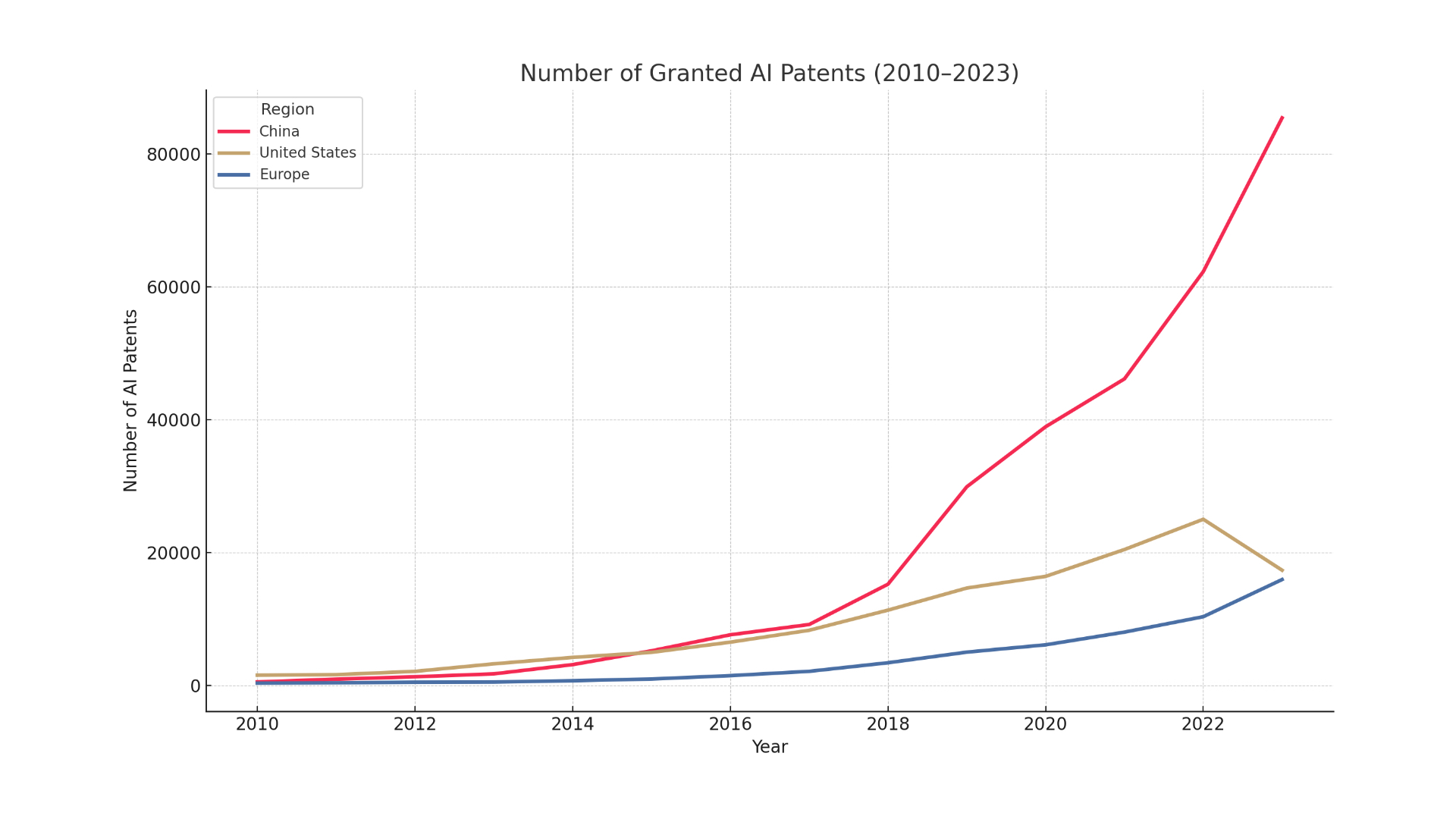
The data is clear: the number of AI-related patents granted globally has increased more than 31-fold since 2010. In 2010, only 3,833 patents were granted worldwide in this field. By 2023, this number has risen to a staggering 122,511, an increase of 29.6% on the previous year alone. This exponential growth is testament to the intense and ever-accelerating investment in AI research and development worldwide.
The tri-polar balance of power
When we look at the geographical distribution of these patents, a clear three-layered landscape emerges, with different players operating at very different scales.
China’s quantitative supremacy: China is the undisputed leader in terms of volume, accounting for an overwhelming 69.7% of all AI patents granted worldwide in 2023. This share has increased dramatically over the past decade, cementing China’s position as the most prolific innovator in terms of number of applications. Already in 2022, China has been granted more AI patents (around 40,000) than the rest of the world combined, while the US, in second place, has been granted around 9,000….
Position of the US and Europe: the US ranks a distant second with a share of 14.16% in 2023, and Europe is third with a share of 13.00%. These figures clearly indicate that in terms of pure patent numbers, Europe is not only failing to catch up with the US, but both regions are dominated by the scale of Chinese activity.
The scale of China’s quantitative dominance is so massive that it suggests more than just organic, market-driven innovation growth. Historically, in globally competitive technology fields, such a rapid and massive accumulation of intellectual property in one country is unusual. The data confirms that this is the result of a deliberate national strategy, supported by massive government funding and top-down directives. This means that China’s patent statistics cannot be interpreted solely as a measure of commercial innovation in the Western sense. They are also an indicator of the implementation of a state industrial policy aimed at declaring a technological presence and building a powerful national IP portfolio. This fundamentally changes the context of the comparison – it is no longer just a race for the best ideas, but for China, also a race for sheer volume as a strategic goal.
The European innovation frontline: analysis of data from the EPO
Global statistics, while impressive, only tell part of the story. To reliably assess Europe’s competitiveness, it is necessary to transfer the analysis to its ‘own backyard’ – the European Patent Office (EPO). This is because the EPO data reflects the real battle for the lucrative and technologically advanced European market, and these shed a whole new light on the continent’s position.
AI as the new engine of European innovation
The EPO Patent Index 2024 report brings breaking news: for the first time ever, Computer Technology, a category that includes Artificial Intelligence, has become the leading technology field in terms of the number of patent applications at the EPO, reaching 16,815 applications. This proves that AI is at the heart of the most advanced R&D aimed at the European market.
The main drivers of this growth over the past five years have been inventions directly related to AI – such as machine learning, pattern recognition and neural networks. Applications in these subcategories have grown at an average annual rate of 28% since 2019. In 2024 alone, the number of AI-related applications at the EPO increased by 10.6% compared to the previous year, confirming the unrelenting momentum in this area.
European innovators leading their own market
Most importantly, the EPO data shows that in the key area of AI-related inventions, it is “applicants from EPO member states that have maintained a leading position throughout this period [of the last five years]”. Although in the broader category of ‘computer technology’, US entities lead the way (with a 34.4% share compared to 29.5% for EPO countries), in the narrower but strategically key area of AI, Europe is in the lead.
The growth in filings from EPO countries in computer technology was very solid at +5.9% in 2024, driven by significant innovation jumps from Germany (+12.7%), Switzerland (+37.4%) and the UK (+12.4%). This indicates the existence of a thriving and dynamic innovation ecosystem in Europe.
Analysis of the EPO data leads to an important conclusion. Filing a patent application, especially at an office as rigorous and expensive as the EPO, is a significant strategic investment. Companies do not take such steps without a firm belief in the commercial potential of their inventions. The high level of EPO filings from all regions – the US, Asia and Europe – is indicative of the widespread perception that the European market is a key and highly profitable one. The fact that it is European entities that lead the way in AI-specific filings at their own patent office suggests that they are not only conducting advanced research, but are strategically focused on protecting and commercialising these innovations in their home economic zone. Global statistics may reflect broad research activity and national strategies, but EPO data is a much better indicator of the real-world, commercial race for Europe. And in this race, Europe is not just a participant – it is a leader. This completely changes the ‘catching up’ narrative.
Quality vs. quantity: a deeper look at patent strategies
The number of patents alone is an imperfect measure of innovative power. To fully understand the global dynamics, it is necessary to introduce the dimensions of quality, impact and strategic purpose behind patent portfolios. An analysis of these factors reveals that the US, China and Europe are not in one, but in three separate races, each with different rules and objectives.
US strategy: fundamental models and high-impact intellectual property
The US has a clear focus on the quality and fundamental importance of its innovations. The best evidence of this is the citation rate – US AI patents are cited almost seven times more often than Chinese patents, indicating that they form the basis for later inventions around the world.
What’s more, the US absolutely dominates the creation of ‘notable AI models’ – systems that represent key technological breakthroughs. In 2024, US institutions have created 40 such models, compared to 15 by China and just three by Europe.
This leadership is driven by corporate giants such as Google, Microsoft and IBM, who are investing billions in basic research.
China strategy: Volume, applications and academic innovation
The Chinese strategy is based on massive scale. However, the quality of this portfolio is subject to debate; the grant ratio for AI patents in China is estimated at only 32%. Furthermore, the vast majority of these patents are filed only in the domestic market, suggesting a focus on the domestic market and the building of a defensive IP wall.
A key differentiator is the source of innovation. In China, as many as 65 of the top 100 patenting organisations in computer vision are universities. In the US, the number is only three. This shows a model driven by the state and the academic sector, in contrast to the US model, which is commercially oriented and dominated by the private sector.
The European model: Industrial integration and applied AI
Europe’s leading patent applicants reflect the continent’s industrial strength. Companies such as Siemens and Bosch from Germany are key players, focusing on the application of AI in industrial automation, manufacturing and transportation.
This suggests a strategy of integrating cutting-edge artificial intelligence into already established, highly developed sectors of the economy, rather than competing directly in the creation of foundational models.
The patent data shows not one race, but three parallel, strategically distinct endeavours. The US ecosystem, driven by massive private capital, seeks to create and own the foundational platforms – the ‘shovels and picks’ of the AI era – on which others will build their solutions. Its patent strategy is selective and geared towards maximum impact. China’s state-controlled ecosystem is focused on rapid and widespread adoption, technological self-sufficiency and achieving dominance in specific application areas such as computer vision. Its patent strategy is a game of volume and control of the domestic market. Finally, the European ecosystem is a mature industrial economy that is adapting AI to strengthen its existing competitive advantages. Its patent strategy focuses on protecting highly specialised, high-value applications in key sectors. The question of whether Europe is ‘catching up’ with the US is therefore like asking whether a Formula One team is ‘catching up’ with an aerospace company. Both are competing in engineering, but in completely different disciplines and with different objectives.
Behind the numbers: strategic and geopolitical context
Patent trends do not exist in a vacuum. They are a direct reflection of deeper national strategies, investment realities and structural conditions. Analysis of this context is crucial to understanding Europe’s true position in the global AI race.
Europe’s dilemma: A pioneer of regulation, a marauder of investment
The European Union has adopted a proactive, regulation-oriented approach, culminating in the AI Act. The aim is to establish a global standard for ‘trustworthy’ artificial intelligence as a showcase for the European model. However, this ambitious regulatory vision is accompanied by a massive investment gap. In 2024, private investment in AI in the US reached USD 109.1 billion. This is almost 12 times more than in China (USD 9.3 billion) and significantly more than in the European Union, where estimates suggest around USD 8 billion. European strategic initiatives such as the ‘AI Factories’ programme (with a budget of EUR 20 billion) or the ‘Apply AI Strategy’ (EUR 1 billion) attempt to respond to this challenge. However, their scale pales in comparison not only to total US private investment, but even to individual corporate projects such as OpenAI’s Stargate.
Infrastructure gap – Europe’s Achilles heel
Europe’s greatest structural weakness is its critical dependence on foreign technology infrastructure. It is estimated that around 70% of Europe’s digital services run on the clouds of three US giants (so-called hyperscalers). At the same time, the European semiconductor manufacturing sector accounts for less than 10% of global production, making the continent dependent on chips designed in the US and manufactured in Asia. This fundamental weakness poses a direct threat to the EU’s strategic goal of achieving ‘digital sovereignty’.p
The table below synthesises the key differences between the three ecosystems, providing a summary of the AI strategic landscape.
Indicator
Europe
USA
China
Private Investment in AI (2024)
approx. USD 8 billion
USD 109.1 billion
USD 9.3 billion
Regulatory Philosophy
Proactive, risk-based, horizontal (AI Act)
Reactive, free market, voluntary framework
State-controlled, information control, sectoral regulation
Potential risk of lack of regulation, concentration of power in the hands of a few companies
Quality issues and international recognition of patents, political barriers
What does the future hold for Europe in the AI race?
After an in-depth analysis of the patent data and the strategic context, the answer to the question of Europe’s position in the global AI race becomes clear, albeit multidimensional.
Firstly, in terms of pure patent numbers, Europe is not catching up and will probably never catch up with China. The scale of Beijing’s state strategy makes volume an inadequate and misleading measure of success for Europe.
Secondly, Europe is significantly behind the US in developing fundamental models and raising venture capital. The financial strength and risk appetite of the US ecosystem are currently out of reach.
However, the key conclusion of this analysis is that Europe’s success should not be measured by its ability to copy American or Chinese models. On the contrary, its future lies in the skilful exploitation of its unique strengths. Europe is not a marauder, but a leader in the race for high-value, industrial and applied artificial intelligence. Its strength lies in the deep integration of AI into the world-class manufacturing, automotive, medical and green technology sectors. Data from the European Patent Office clearly confirms that in its own core market, Europe is winning the innovation race.
The future competitiveness of the continent will depend on two critical factors:
Bridging the infrastructure and investment gap: The success of initiatives such as AI Factories is absolutely crucial. Without sovereign computing power and a stronger venture capital ecosystem, Europe will always build its innovative applications on foundations owned by foreign powers.
Strategic use of regulation: Europe must effectively present its AI Act not as a barrier to innovation, but as a global competitive advantage. The aim is to create a premium market for ‘trustworthy’, secure and human-centred AI systems, which will increasingly be demanded by corporate customers and citizens around the world.
Europe may not win the sprint for the number of patents, but it is perfectly placed to compete in the marathon for sustainable, valuable and trustworthy integration of AI into the real economy. The race is far from over, and Europe is running its own distinct and well-considered path in it.
The European Union is entering a new phase of thinking about economic security. At a meeting of ministers in Denmark, which holds the rotating presidency, there was a proposal to impose additional conditions on Chinese investment in Europe – including the compulsory transfer of technology and know-how. This is a clear departure from the previous model of market openness and signals that Brussels is beginning to play by the rules that Beijing and Washington have been using for years.
Danish Foreign Minister Lars Rasmussen admitted that Europe had for too long assumed that adherence to free trade rules was enough in itself to win global competition. “If we invite Chinese investment to Europe, it must be linked to technology transfer,” he – he stressed. This phrase could become a turning point in EU industrial policy.
Brussels has been looking for months at how to mitigate the risks of capital inflows from authoritarian countries, particularly in strategic sectors – semiconductors, RES, critical infrastructure and electromobility. The European Commission is working on a document that is expected to present concrete tools by the end of the year: from screening investments to requiring ‘real investments’, as Trade Commissioner Maroš Šefčovič put it – those that create jobs, bring IP and transfer knowledge.
Beijing’s reaction was immediate. Chinese Foreign Ministry spokesperson Lin Jian criticised the idea, speaking of “protectionist and discriminatory practices”. China officially opposes forced technology transfer – although European manufacturers of cars, industrial goods or wind turbines have indicated for years that such transfer was often a condition for entering the Chinese market.
Thus, in the background, there is a dispute over the definition of fairness in global trade. Europe, which for decades has relied on openness, is beginning to adopt a logic of reciprocity: access for access, technology for technology.
Is the EU ready for the policies it has criticised so far? And will European companies – especially those dependent on Chinese supply chains – support such a direction? The coming months will show whether Brussels manages to create common rules that balance competitiveness with security. One thing is certain: the era of naive free trade in Europe is about to come to an end.
Tim Cook returns to Beijing with a clear message: Apple does not intend to abandon China as a strategic market and technology base. In a meeting with Industry Minister Li Lecheng, the Apple boss declared the “opening of a new chapter” of cooperation, although no specific amounts of investment were mentioned. A symbolic gesture at a time of rising trade tensions between the US and China.
For Apple, this is a moment of delicate balance. The company has announced that it will increase its investment in the US to $600 billion over four years – partly in response to pressure from the US administration and attempts to reduce its reliance on Chinese manufacturing. However, Cook is well aware that a complete ‘shift away from China’ is a myth: the Middle Kingdom remains the largest market and a key link in Apple’s supply chain, both in the manufacture of iPhones and the assembly of high-tech components.
Cook’s visit also had a clear image dimension. Apple’s chief executive appeared in Shanghai and met with local game developers and the designer of the iconic Labubu toys – a signal that Apple wants to be seen not as a foreign giant, but a partner of the local creative economy. At the same time, the company used the moment to confirm the introduction of eSIM in the Chinese market – a move that could facilitate sales of new iPhone models, including the announced iPhone Air.
Beijing, in turn, is sending a clear message: despite growing pressure to support domestic brands like Huawei, it still needs Apple as a guarantor of technological openness and an investor in the clean energy ecosystem. Recall – in March, Apple announced a 720 million yuan fund for renewable energy projects in China.
Behind the scenes, however, a difficult calculation is underway. Apple is looking for ways to circumvent US tariffs, including by diversifying production in India and Vietnam. But it is China that still offers a scale that cannot be easily replaced.
Today’s Apple policy is no longer to choose between the US and China, but to balance the two as flexibly as possible. Tim Cook did not bring any groundbreaking declarations to Beijing, but he did remind us of one thing: Apple in China is not an episode – it is a long-term game, the endgame of which cannot be predicted either in Washington or in Beijing.
The US Federal Communications Commission (FCC) is increasing pressure on Chinese electronics manufacturers. As reported by FCC chairman Brendan Carr, the largest e-commerce platforms in the US have already removed several million listings of devices deemed not permitted – from surveillance cameras to smart watches – from the likes of Huawei, ZTE, Hikvision and Dahua.
This is part of a broader strategy to limit the presence of Chinese technology in critical infrastructure. The FCC argues that the equipment could enable “citizen surveillance, disrupt communications networks and threaten US national security”. Technology companies have been ordered to implement new controls to prevent banned products from reappearing for sale.
The case is not new, but the intensity of the regulator’s actions is accelerating. Already, Huawei and ZTE were on the so-called Covered List – a list of restricted entities. Now, the FCC is preparing a vote on an even broader ban on the authorisation of devices containing components from companies deemed to be a risk. Significantly, the new regulations will also allow previous authorisations to be revoked if products are deemed a security risk.
This is the next stage in the technological separation between the US and China, covering telecommunications, semiconductors or the automotive sector. Cutting Chinese brands off from the US market has both a security and an economic dimension – it builds space for alternatives from domestic or allied manufacturers.
E-commerce platforms – although not officially listed – are likely to be giants such as Amazon, Walmart and eBay. For them, this means the need to build new certification filters and the risk of relationship tensions with Asian suppliers. For consumers, on the other hand – a possible restriction of access to low-priced electronics, which until now have come to the US in large numbers via marketplaces.
In the background, the question remains as to how much the FCC’s actions will actually curb the influx of unauthorised devices, and how much it will accelerate the growth of grey imports and intermediate platforms from outside US jurisdiction. However, Carr announces that the agency “will continue its efforts”, suggesting that this is just the beginning of a new chapter in the US-China technology war – this time at the level of retail platforms, not just infrastructure.
Cryptocurrency markets proved once again that they do not live in a vacuum. Bitcoinlplunged more than 8 per cent on Friday, slipping to around $105,000, after US President Donald Trump announced a doubling of tariffs on Chinese exports – up to 100 per cent – and the imposition of export controls on “any critical software”. This is Washington’s response to Beijing’s previous limits on the export of rare earth minerals, crucial to the production of semiconductors, electronics and energy infrastructure.
The signal from the White House triggered a sharp discount in global markets, with the S&P 500 index down more than 2% and investor sentiment clearly shifting towards ‘risk-off’. Ethereum, the second-largest cryptocurrency, lost nearly 6%, slipping below US$3.7k.
Although bitcoin is sometimes portrayed as ‘digital gold’, recent events are a reminder that it still behaves more like a speculative asset than a safe haven in moments of geopolitical tension. In previous quarters, cryptocurrencies benefited from the narrative of hedging against inflation and dollar weakness. This time, the trade conflict has triggered the opposite reaction, with investors fleeing to cash, bonds and traditional safe havens such as gold.
In doing so, the technology and trade escalation between the US and China is entering a new phase. Whereas previous rounds concerned steel, chips or mobile applications, the export of software and key raw materials for future technologies has now become a flashpoint. This could hit not only Big Tech, but also the entire Web3 and blockchain sector, which relies heavily on global supply chains for hardware and computing infrastructure.
For the cryptocurrency market, Friday’s move is a reminder that the global macroeconomy – not just industry regulation – remains a major risk factor. In the coming weeks, investors will look less to halving and ETFs and more to the headlines from Washington and Beijing.
Donald Trump’ s decision to impose 100 per cent tariffs on Chinese goods and impose export controls on ‘all critical software’ from 1 November is not just another move in the trade war. It signals that Trump’s possible return to the White House could mean a sharp acceleration of decoupling – the technological separation between the US and China that is already costing global markets billions of dollars.
It is rare for a policy decision to shake Wall Street within hours. This time, the announcement was enough for the S&P 500 index to dive 2.7% and the Nasdaq 100 to lose 3.5%. Investors read the move as a harbinger of a new era – one in which global trade is no longer based on price competition, but on the control of strategic resources, from software to rare earth metals.
Trump justified the decision on the grounds that China has “taken an extremely aggressive stance”, announcing broad export restrictions on virtually everything it produces – especially critical raw materials. This is particularly significant because Beijing has for months been signalling the possibility of restrictions on exports of metals such as gallium, germanium and graphite – key to the manufacture of chips, batteries and military technology.
A technological iron curtain
The most worrying element of Trump’s announcement concerns export controls on ‘all critical software’. In practice, this could mean restrictions on the sale of operating systems, AI tools, industrial software or cloud infrastructure – not only to China, but also to companies working with them.
For global supply chains, this would mean something of a digital iron curtain. Technology corporations would have to redesign distribution and licensing models. Scenarios of ‘dual versions’ of products are already circulating in the industry – one for Western markets, the other for China, with separate updates and repositories.
The market is looking for a new balance
Although Trump has hinted that he may back down if Beijing drops its threats of export restrictions, markets do not believe there will be a quick agreement. Agriculture is already counting losses – soybean futures in Chicago are down 1.9%, signalling fears of China’s trade counterattacks, which have hit farmers in key US states in the past.
In the background, a strategic question remains: is this conflict heading towards a permanent reconstruction of the trade order? Both the US and China are increasing subsidies to their own technology sectors. The EU is preparing its own export control and ‘de-risking’ mechanisms. More and more economists are pointing out that globalisation in its current form has come to an end – replaced by block economic and technological alliances.
Xi or the markets? Trump puts a deadline
“I have set a deadline of 1 November. We’ll see what happens,” Trump said. The date is a deadline not only for Beijing, but also for global corporations that will have to choose: either full compliance with US export rules or risk losing access to the world’s largest technology market.
The trade war that started with steel and soya tariffs is finally moving into the most sensitive area – software and critical technology. And this time it is not a conflict over trade. It’s a fight over the architecture of the future internet, AI standards and control of the geopolitical infrastructure of the 21st century.
Zarządzaj swoją prywatnością
To provide the best experiences, we and our partners use technologies like cookies to store and/or access device information. Consenting to these technologies will allow us and our partners to process personal data such as browsing behavior or unique IDs on this site and show (non-) personalized ads. Not consenting or withdrawing consent, may adversely affect certain features and functions.
Click below to consent to the above or make granular choices. Your choices will be applied to this site only. You can change your settings at any time, including withdrawing your consent, by using the toggles on the Cookie Policy, or by clicking on the manage consent button at the bottom of the screen.
Funkcjonalne
Always active
Przechowywanie lub dostęp do danych technicznych jest ściśle konieczny do uzasadnionego celu umożliwienia korzystania z konkretnej usługi wyraźnie żądanej przez subskrybenta lub użytkownika, lub wyłącznie w celu przeprowadzenia transmisji komunikatu przez sieć łączności elektronicznej.
Preferencje
Przechowywanie lub dostęp techniczny jest niezbędny do uzasadnionego celu przechowywania preferencji, o które nie prosi subskrybent lub użytkownik.
Statystyka
Przechowywanie techniczne lub dostęp, który jest używany wyłącznie do celów statystycznych.Przechowywanie techniczne lub dostęp, który jest używany wyłącznie do anonimowych celów statystycznych. Bez wezwania do sądu, dobrowolnego podporządkowania się dostawcy usług internetowych lub dodatkowych zapisów od strony trzeciej, informacje przechowywane lub pobierane wyłącznie w tym celu zwykle nie mogą być wykorzystywane do identyfikacji użytkownika.
Marketing
Przechowywanie lub dostęp techniczny jest wymagany do tworzenia profili użytkowników w celu wysyłania reklam lub śledzenia użytkownika na stronie internetowej lub na kilku stronach internetowych w podobnych celach marketingowych.