Tag: Work

  • Layoffs at IBM. Giant ‘balances’ jobs as cloud slows down

    Layoffs at IBM. Giant ‘balances’ jobs as cloud slows down

    IBM is embarking on the next phase of its strategic transformation with the announcement of job cuts this quarter. The company confirmed that the layoffs will involve a low single-digit percentage of the global workforce, which, with a headcount of around 270,000 at the end of 2024, could mean thousands of positions eliminated.

    The move is directly linked to CEO Arvind Krishna’s strategy to transform IBM into a company focused on high-margin software and hybrid cloud and artificial intelligence solutions. Acquired Red Hat plays a key role in this.

    However, this routine workforce review, as the company calls it, comes at a troubling time. Wall Street has been keeping a close eye on IBM’s ability to monetise demand for AI-linked cloud services, yet the giant reported a worrying slowdown in growth in its key cloud software segment last month. This wake-up call has made investors nervous.

    Although the company’s shares have risen by more than 35% this year, the news of the cuts, originally revealed by Bloomberg News, resulted in a nearly 2% drop in the stock price.

    IBM stresses that this is not about cutting costs, but about ‘rebalancing’ resources. The company points out that while some US employees will be affected by the reductions, overall US staffing levels are expected to remain stable on an annual basis. This suggests an active transfer of funds from redundant departments to hire new professionals in growth areas such as AI and software development. Nonetheless, the reductions show how much pressure IBM is under to prove that its bet on the cloud and AI is delivering.

  • Generation Z doesn’t run away from work, it hacks it. That’s why they choose several jobs at once

    Generation Z doesn’t run away from work, it hacks it. That’s why they choose several jobs at once

    Generation Z is starting to dismantle its own stereotype faster than employers can repeat it. A recent report by Hays Poland and OFF school shows that, contrary to the usual narrative of entitlement and convenience, the young are entering the market with an energy that can no longer fit into one company at a time. For them, multi-employment is not a substitute for a full-time job, but a strategy. In most cases, they combine two or three jobs. Often not full-time, because flexibility is more important than being present from-to.

    If this is seen as a move towards greater personal productivity, this thesis begins to stand up. The young are dividing their time and energies between companies and projects, because they want to grow faster competently and put together a more solid portfolio of skills. At the same time, they understand the cost of this strategy: overwork, stress, communication overload. But it is a conscious compromise. The generation has grown up with the myth of ‘you only get one shot’, so they are trying to maximise their exp in less time than their predecessors.

    Managers, especially those brought up on the model of one organisation and one clear career path, often read it differently. In their optics, multi-jobbing is more often a source of risks: dilution of responsibility, HR difficulties and legal risks. One in three employers surveyed sees no benefit in multi-jobbing. And this is perhaps the most important data: the asymmetry of perception.

    In practice, there is a large area of intersection of interests. Companies talk about competence benefits. Young people – about careers and earnings. This is the same language described from other directions. Dysfunction only arises where the framework for cooperation starts to lack precision. Some managers still expect autonomy to come from intuition and experience, which the young have not had time to acquire. Generation Z, on the other hand, assumes that transparency, feedback and communication standards should not be unspoken elements.

    There is another thread in the background: the market in Poland is accelerating and the very structure of work, especially design and technology work, increasingly resembles an ecosystem made of modules rather than a fixed FTE factory. The next few years will show whether multi-jobbing will remain a generational feature or become one of the standards for collaboration in modern organisations. There are enough arguments to assume that in many industries it is the latter.

    So the problem is not that Zetas don’t know how to work. The problem is that in most companies there are still no communicative rules of the game for teams, where one person consciously optimises their time between several organisations. What seems like a small generational revolution may turn out to be more of a test of the maturity of the work culture on both sides. In this sense, multi-jobbing is not a breakout, but a symptom of the state of the market: we are growing up to modular collaboration faster than we can name it.

  • IT costs are freezing digitalisation? How high IT salaries are blocking innovation

    IT costs are freezing digitalisation? How high IT salaries are blocking innovation

    A paradox has become entrenched in the Polish business landscape. On the one hand, the media report a normalisation and cooling in the IT labour market, which could suggest an end to salary pressures. On the other hand, finance and HR leaders budgeting for digital transformation see a different reality: the cost of acquiring and retaining technology talent has stabilised at a level that is becoming an insurmountable barrier for many companies.

    The thesis is unequivocal – high IT personnel costs have become a hidden tax on innovation, which is measurably inhibiting key digitisation projects in Polish companies.

    A new, expensive balance

    Analysis of hard market data debunks the myth that the era of expensive professionals is over. Although wage growth has clearly slowed down, this does not mean a return to pre-boom levels. Instead, a new high equilibrium has taken shape.

    According to the Hays Poland salary report for 2025, only 16% of technology companies are planning raises of more than 10%, a drastic change compared to 2021-2022. However, the slowdown does not mean a reduction in costs, only their stabilisation at a very high level.

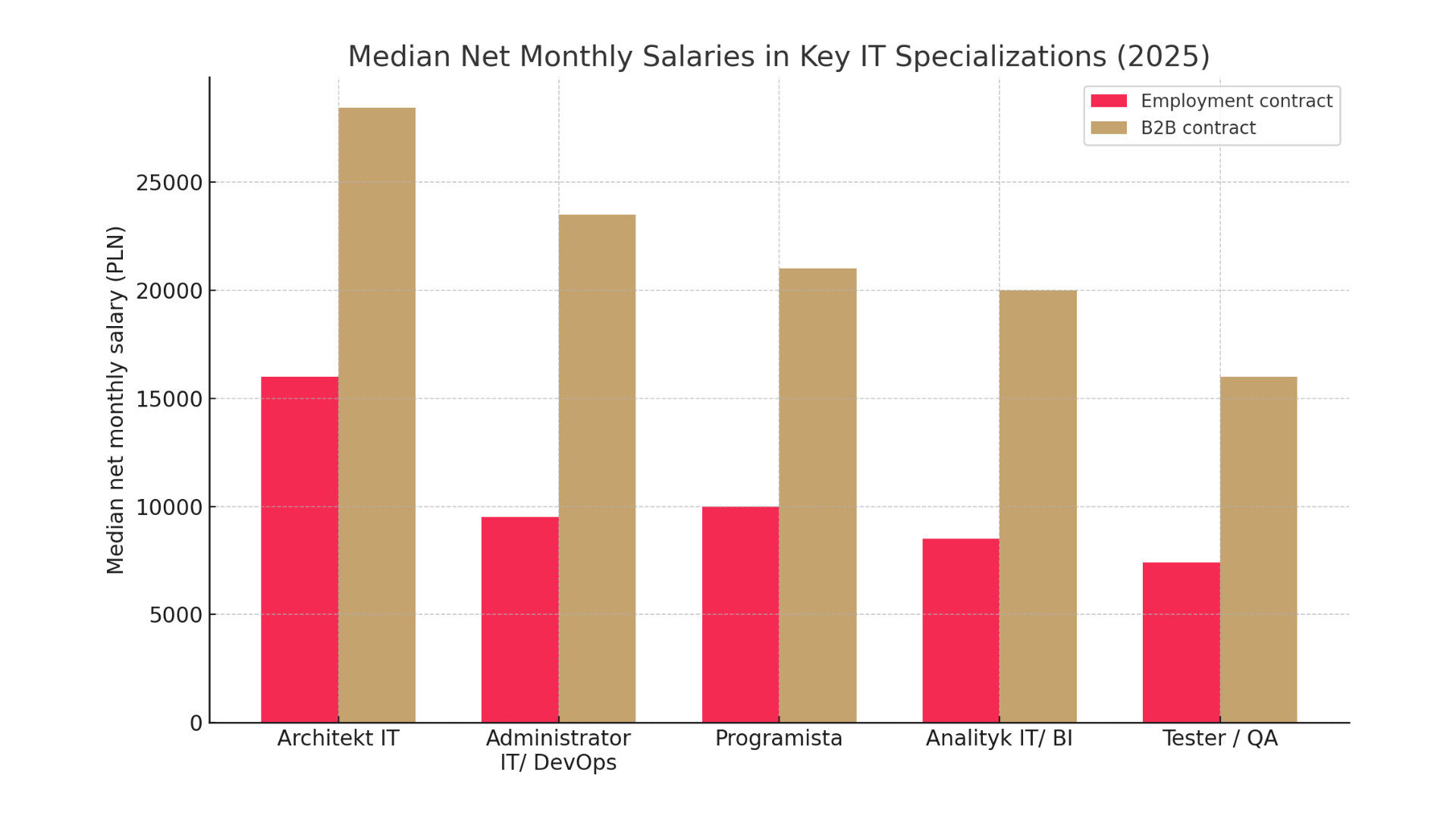
    The scale of the challenge is best illustrated by comparing salaries in IT with the rest of the economy. Data from the Central Statistical Office shows that in July 2025, the average salary in the ‘Information and Communication’ sector reached PLN 14,307 gross.

    At the same time, the average salary in the business sector was PLN 8,266. This means that IT specialists earn on average more than 70% more than the average employee. This gigantic salary premium, perpetuated by years of boom, is not diminishing, making digitalisation projects disproportionately expensive compared to other business initiatives.

    It is also crucial for budgeting to understand that the highest costs are generated by the most desirable, experienced professionals, often working on B2B contracts. In the first half of 2024, as many as 74% of senior offers included a proposal to work in this model.

    When the cost of talent becomes a barrier

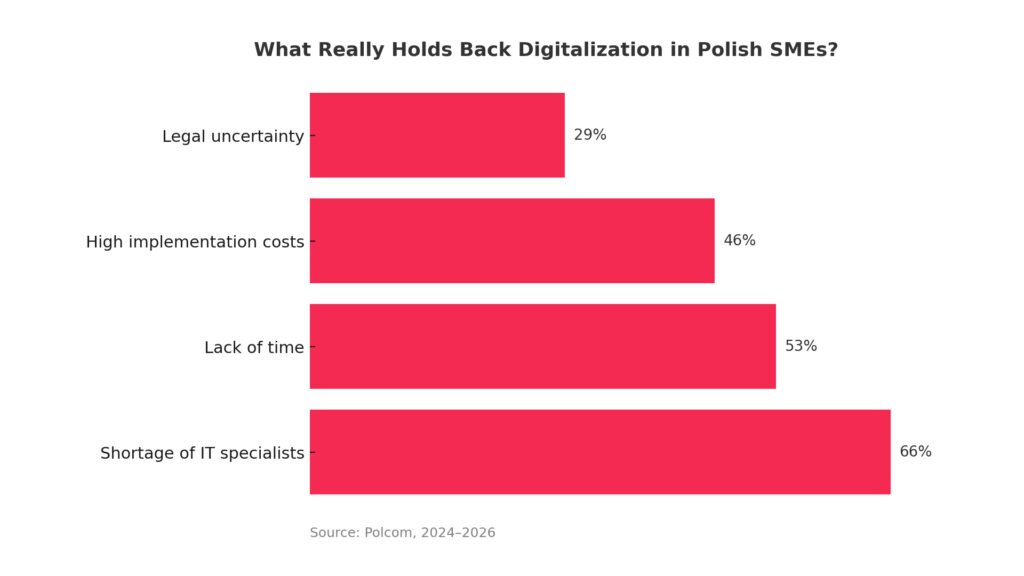
    High staff costs have ceased to be a mere statistic and have become a major brake on transformation. Market research leaves no illusions. A report by Polcom indicates that for Polish companies in the SME sector, the two biggest barriers to digitalisation are the shortage of IT specialists (indicated by 66% of companies) and the high cost of implementations (46%). These two factors create a vicious circle: the limited supply of talent drives up their price, while high costs limit companies’ ability to compete for them.

    This means that every IT project carries a huge amount of risk. In a typical technology implementation, 70% to as much as 90% of the budget is human costs – the time of developers, analysts and managers. This structure means that even a small overrun or delay in a project can negate the projected return on investment.

    The most serious consequence, however, is strategic paralysis. The decision to postpone a project because personnel costs are too high is not neutral. In fact, it leads to an accumulation of technological debt.

    Outdated systems, on which half of Polish companies still work, are becoming more and more expensive to maintain and are blocking innovation. Apparent savings today therefore become a high-interest loan taken out for the future.

    Wykres 3

    Strategic responses to bottlenecks

    Instead of engaging in a debilitating war for talent, business leaders can take a more sophisticated approach, based on three complementary pillars.

    The first is smart sourcing, i.e. diversifying sources of competence. Instead of relying solely on recruiting full-time employees, companies can build a flexible talent ecosystem. This includes strategic outsourcing and nearshoring, but also effective relationship management with B2B contractors.

    Data from the Central Statistical Office (CSO) and CEIDG show that as many as 70.3% of entities in the ‘Information and Communication’ sector are sole traders. This is a huge market of flexible experts that allows project teams to be dynamically scaled according to needs.

    The second pillar is the democratisation of technology through Low-Code/No-Code (LCNC) platforms. These tools enable business applications to be built using visual interfaces, allowing solutions to be created by business analysts or managers, referred to as ‘citizen developers’.

    This drastically reduces implementation time from months to weeks, reduces costs and relieves permanently overburdened IT departments. The growing popularity of this approach is a fact – according to the NoCode Poland report, as many as 77% of companies plan to implement LCNC technology in the next 12 months.

    The third key element is the use of automation and artificial intelligence (AI) as an efficiency lever. The aim here is to free up financial and human resources, which can then be reinvested in strategic projects. AI implementations can deliver operational cost reductions of 25-40%, and technologies such as Robotic Process Automation (RPA) can increase the productivity of teams by up to 40%.

    New game plan

    The high cost of IT competence is not a passing trend, but a new, structural feature of the market. Attempts to ignore it lead directly to a loss of competitiveness. Instead of seeing IT as a cost centre, CFOs should treat it as an investment portfolio in digital capabilities, diversifying it between strategic staffing, a flexible network of external partners and technologies that increase productivity across the organisation.

    The role of HR, in turn, is evolving from that of a recruiter to an architect of the talent ecosystem that builds and nurtures relationships with various competence providers. In the new market reality, the advantage will be built not by those companies that hire the most expensive developers, but by those that most cleverly reduce the need to hire them, achieving the same business goals faster, cheaper and with less risk. This is the essence of strategic leadership in the digital age.

  • The hidden brake of DevOps. Lack of CI/CD specialists blocks automation in IT

    The hidden brake of DevOps. Lack of CI/CD specialists blocks automation in IT

    In the world of business technology, automation is king. CI/CD (Continuous Integration / Continuous Delivery) and DevOps practices have become an absolute priority for companies, overtaking even hot topics like AI or cyber security. Research for 2025 shows that 52% of professionals identify CI/CD as a key area of use for open source software – more than for artificial intelligence (41%) or security (36%).

    The promise is enticing: full automation of software development and delivery processes. In practice, this means faster time-to-market, higher code quality, fewer bugs and failures, and therefore lower costs and higher competitiveness.

    The problem is that there is a deep chasm between ambition and realisation.

    Implementing CI/CD is not a simple installation of a new tool. It is a fundamental change in the way we work, and the data shows that companies are not ready for it.

    The main barrier holding back CI/CD adoption is not money or missing software, but the skills gap.

    Market analysis shows that more than 45% of organisations surveyed cite a lack of employee experience and skills as a key challenge. This is more than purely technical problems, such as complex configuration and upgrade of solutions (39%) or trouble keeping up with updates (35%).

    Interestingly, this problem is more acute in the largest organisations. In companies with more than 5,000 employees, as many as 50% of respondents complain about competency shortages, while in start-ups, only 34% do so.

    This paradox has a logical explanation. Implementing CI/CD is a cultural revolution that requires breaking down traditional organisational silos. As Tomasz Dziedzic, CTO of Linux Polska, notes, in large companies the process is more difficult both technically and organisationally.

    CI/CD forces seamless collaboration between developers, testers and system administrators. Implementing automation in a complex infrastructure that has been developed for years is a challenge, and decision-making and change approval processes take much longer than in agile, small teams.

    Companies are aware of the problem and have a plan to address it. The vast majority (66%) intend to increase the competencies and qualifications of existing employees in 2025. Only 21% plan to actively recruit new specialists and 13% intend to use external consultants.

    However, experts warn that technical training on tools alone is not enough. As Kamil Kwiatkowski, Senior Solutions Architect at Linux Polska, points out, it is crucial to promote a new organisational culture and engage employees in the change process. Teams need to feel confident in the new reality, and this requires not only knowledge of the technology, but above all understanding and acceptance of the new collaboration processes. The gap in CI/CD is as much a gap in soft skills and culture as it is in knowledge of specific platforms.

  • 38% of IT companies plan hiring, 27% cutbacks – IT job market before the end of the year

    38% of IT companies plan hiring, 27% cutbacks – IT job market before the end of the year

    At the finish of 2025, the IT job market in Poland is entering a phase of cautious selective recruitment. According to the latest ManpowerGroup Employment Outlook Survey, 38% of companies plan to increase hiring in Q4, but at the same time 27% are considering reductions and 32% intend to maintain current employment levels. The hiring outlook is +12% – the lowest in the industry for all of 2025, showing a cooling off after the intense demand of previous years.

    The main motivations of recruiters remain developmental: almost half of companies (48%) point to organisational expansion and 39% to technological advances generating new positions, especially in the areas of AI, cyber-security, cloud, data engineering or low-code. In the background, the pressure to diversify competencies and enter new markets remains – although these are more strategic than short-term goals.

    However, in parallel, there is a growing group of defensive companies. Staff reductions are mainly driven by economic challenges (31%) and process automation (31%), which signals that some organisations are entering a phase of cost optimisation and project extinguishment. 25% of IT companies say they have no plans to replace departing employees, which can be read as growing financial caution after a period of overheating in the labour market.

    Although the deceleration in momentum is evident, the IT job market is not headed for stagnation. Demand for specialists in critical domains – particularly security, cloud infrastructure and data analytics – remains above the market average. Salaries for such roles remain stable: PLN 10-15k gross for mid-levels and even PLN 25-40k for experts and managers.

    Against a global backdrop, the Polish sector is part of the ‘technological selection’ trend: companies are cutting back on mass recruitment, but investing in competencies that are key to business scalability and resilience. The IT industry may enter 2026 no longer with the question “who to hire?”, but “what to invest in: people or automation?”.

    This shift in emphasis from quantity to quality of staff may prove to be one of the most important turning points in the history of the Polish IT market.

  • AI will shake up the IT industry more strongly than others. What does this mean for professionals?

    AI will shake up the IT industry more strongly than others. What does this mean for professionals?

    Just a few months ago, generative artificial intelligence was a technological curiosity, a topic for coffee conversations and after-hours experimentation. Today, it is a powerful tool that has become a permanent part of the business landscape and is revolutionising the way we work.

    Behind the media hype around language models, however, is a fundamental question that everyone in the IT industry is asking themselves: “How will artificial intelligence affect my career?”. Indeed Platform’s latest report sheds new light on this question, providing concrete answers and identifying the IT sector as the epicentre of the changes to come.

    Is this a cause for concern or an unprecedented opportunity?

    Analysts from Indeed Hiring Lab conducted an in-depth analysis of more than 2,800 job skills to assess their vulnerability to the impact of generative AI. The conclusions are unequivocal and should come as no surprise to anyone in the industry – technology is changing itself first and foremost.

    It is IT people, who will feel this transformation most strongly. The results of the research paint a stark picture of the scale of this phenomenon. It turns out that more than half of all job-related skills in the technology sector are highly exposed to the transformation.

    When we look at the competences with the highest potential for near-total change, we see that almost three out of five of them are strictly technological skills. This trend affects developers the hardest, as the competences mentioned in a staggering 82% of developer job offers are among the group most susceptible to deep change.

    However, before anyone starts spinning science-fiction visions, it is worth quoting a key counterpoint from the report. The analysts point out that less than 1% of all skills surveyed are rated as fully replaceable.

    It is not a revolution that will wipe us out of the job market, but a profound evolution that will redefine roles in IT.

    Why is it that IT has found itself in the eye of the cyclone? The answer lies in the nature of the work. Generative AI, contrary to appearances, is not a creative entity, but an extremely sophisticated tool for recognising and replicating patterns in huge data sets.

    It excels wherever there are clear rules, logic and structured information. The work of a programmer is a perfect example of this. Programming languages are based on strict syntax and precise rules.

    Processes such as writing standardised code, refactoring, finding bugs or creating unit tests are largely repetitive in nature. These are tasks in which GenAI already demonstrates superhuman efficiency.

    Tools such as GitHub Copilot have ceased to be a novelty and have become a daily support for millions of developers around the world. GenAI is simply another, more powerful step along the same path.

    Now that we know what is changing and why, it is time to ask the most important question: what does all this mean for you? First and foremost, it signals that the role of the IT specialist is evolving. Skills that were valued just five years ago may soon become secondary.

    The ability to write simple, repetitive code or manually sift through tests will increasingly be delegated to machines. However, this does not mean that the demand for experts is declining. On the contrary, the demand for higher-level competences is growing.

    AI becomes our personal assistant, a coding partner that frees up our time and potential, allowing us to focus on what humans are irreplaceable at.

    The new role of the specialist requires a shift in emphasis from being a doer to being a strategist and architect. Professional value will depend less and less on the ability to write line-by-line code and more and more on the ability to design robust, scalable systems, deeply understand business objectives and select the right technologies to solve real-world problems.

    This strategic shift naturally entails an increase in the importance of soft skills. Effective communication with the team and the customer, a creative approach to the obstacles encountered and the empathy to translate human needs into the language of technology is a domain where AI will not be able to compete with humans for a long time to come.

    At the same time, mastering cooperation with artificial intelligence itself becomes a practical requirement. It must be treated as an extremely capable but initiativeless assistant, which means learning to formulate commands precisely, so-called ‘prompt engineering’.

    Ultimately, in this new working model, it is the human expert who remains in the key role of verifier and curator. The ability to critically assess the results generated by the machine, catch subtle errors and take full responsibility for the final product becomes absolutely fundamental.

    The Indeed report is not a prediction of the professional apocalypse. Rather, it is a roadmap of the changes to come and a valuable guide for anyone who wants to consciously shape their career. Transformation in IT is inevitable and will be more profound than in any other sector.

    However, this does not mean the end of work for professionals, but rather the beginning of an exciting new era. The question we need to ask ourselves is not “will AI take my job?”, but “how can I use AI to make my work more creative, valuable and effective?”.

    The future belongs to those who will stop seeing AI as a threat and start treating it as the most powerful tool in their arsenal. It is time to start learning it.

  • Ineffective meetings in IT: How to recover lost time and money?

    Ineffective meetings in IT: How to recover lost time and money?

    The autumn peak of activity in the corporate calendar – planning budgets, strategies for 2026 – again highlights one of the most costly and least efficient processes in modern companies: meetings. Employees in Europe spend an average of nearly five hours a week on them.

    But market research, including that conducted by Microsoft or the Asana platform, is unforgiving: more than two-thirds of this time is seen as a waste. This is an inefficiency measured in hundreds of billions of dollars a year globally. The problem, however, lies not in the idea of meetings per se, but in their anachronistic form, which is no longer responsive to the needs of a dynamic working environment.

    The scenario is familiar in thousands of technology companies. A virtual status meeting, dozens of participants, most with cameras turned off. The presentation scrolls slide by slide, and pro forma feedback questions are met with chat room silence and muted microphones.

    After 60 minutes of monologue, the participants’ windows disappear as quickly as they appeared. One hour of information transmission, zero minutes of authentic exchange of ideas. This is a symptom of a deeper, structural deficit. Companies invest in meticulously prepared presentations, but lose sight of the fundamental goal – engagement and dialogue.

    As a result, they not only incur financial costs but, above all, lose the innovative potential that lies within their teams.

    Experts on the organisation of the working environment are becoming increasingly vocal about the need for a paradigm shift. Rather than being an end in themselves, meetings should become a ‘collaborative operating system’. Like any system, however, they require regular updates and maintenance to operate efficiently.

    The transformation of meeting culture from passive reception to active collaboration is based on several key pillars.

    The first is a radical focus on purpose. Many meetings, especially cyclical ones, are held out of momentum, without a clearly defined objective. Participants do not know what is expected of them, which leads to passivity.

    The solution may be to rethink formats – for example, replacing the hour-long weekly status with a single 30-minute meeting dedicated to solving a specific problem, with rotating responsibility for leading it. Such a change forces focus and naturally raises engagement levels.

    The foundation of any productive discussion, however, is psychological safety. Studies, including the famous ‘Aristotle’ project conducted at Google, have shown that teams with a high sense of psychological safety perform significantly better.

    Employees who fear criticism or embarrassment keep quiet. A collaborative meeting culture needs to create a space where asking questions, expressing concerns and giving constructive criticism are not only accepted, but even welcomed. This builds trust and significantly speeds up the problem-solving process.

    Another element is the conscious flattening of hierarchies and the simplification of communication. In the traditional model, the discussion is dominated by the voices of managers or the most experienced employees, while the rest of the team remains in the shadows.

    The modern approach requires the active inclusion of quieter or younger team members in the conversation and the translation of hermetic, technical jargon into understandable language. Loss of engagement often begins where understanding ends.

    Perhaps the most important factor, however, is creating space for authenticity. People are more cooperative when they can be themselves and not just a cog in a project.

    Some companies successfully introduce short, personal rounds at the beginning of meetings, where everyone has a few minutes to simply say how they are doing – without statuses or reports. This seemingly trivial element builds bonds and openness, which are essential for a constructive exchange of ideas.

    Moving to a new model does not have to mean a revolution. Small but conscious changes can produce surprising results. Instead of another PowerPoint presentation, interactive formats can be used.

    A tried and tested method is the ‘silent Q&A session’, where participants ask questions anonymously on a shared document or chat room, which significantly lowers the barrier to entry. Another idea is the ‘open mic’ stage, which gives space for topics omitted from the official agenda.

    The ‘no new slides’ rule, where materials are sent in advance and the meeting time is devoted solely to discussion, saves time and focuses on the substance. The role of the leader, whose job is to listen and question more and speak less, becomes crucial.

    Technology companies, whose success depends on innovation and agility, need to make auditing their meeting culture a priority. A fundamental question needs to be asked: are our meetings still fulfilling their original purpose – facilitating knowledge exchange, providing inspiration and promoting collaborative development?

    If the answer is ‘no’, it is a sign that the collaborative operating system needs an urgent reboot. Otherwise, it will remain nothing more than a costly relic of the past that hinders the organisation’s growth instead of driving it forward.

  • New H-1B visa fee hits Big Tech. Trump administration introduces $100,000 fee

    New H-1B visa fee hits Big Tech. Trump administration introduces $100,000 fee

    President Trump’ s administration has announced the introduction of a new one-off $100,000 fee for H-1B work visa petitions. The decision caused an immediate and nervous reaction in the technology sector, which relies heavily on foreign professionals, mainly from India and China.

    Initial reports, suggesting that the fee would be annual, caused a wave of uncertainty. In response, tech giants such as Microsoft, Amazon, as well as investment banks including JPMorgan and Goldman Sachs, immediately recommended that their employees with H-1B visas refrain from international travel or return to the US as soon as possible.

    The White House eventually clarified that the fee would be a one-off and would only apply to new visa petitions, not to current visa holders or renewal applications. Nonetheless, the confusion has caused concern among thousands of workers and demonstrated how sensitive the sector is to changes in immigration policy.

    The administration argues that the drastic fee increase is aimed at levelling the playing field for American workers and discouraging companies from replacing them with cheaper foreign labour. The aim is to get corporations to invest in training US college graduates rather than importing talent.

    The move is part of the administration’s broader immigration policy, which has sought to restrict legal immigration since the beginning of its term. The new regulations are also intended to prioritise highly skilled and highly paid professionals under the H-1B programme.

    The technology sector and market analysts warn of the long-term consequences. The new costs are likely to hit smaller companies and startups particularly hard, for which it will become financially unattainable to hire a key specialist from abroad. There is a risk that companies, instead of hiring in the US, will start moving advanced projects and jobs abroad.

    Critics point out that such a policy could undermine the US economy’s innovative capacity and its position in the global technology race, especially in the crucial field of artificial intelligence. In the short term, Washington may gain additional revenue for its budget, but in the long term it risks losing the competitive advantage it has built up over the years by attracting the best talent from around the world.

    The stock market’s reaction was immediate, with shares of IT services companies, which rely heavily on workers with H-1B visas, seeing declines. The situation remains tense, with the technology industry anxiously awaiting further details and guidance on the implementation of the new regulations.

  • New bottleneck in IT. Companies are fighting not just for talent, but for the cognitive performance of their teams

    New bottleneck in IT. Companies are fighting not just for talent, but for the cognitive performance of their teams

    For years, the technology industry has focused on the battle for talent, assuming that attracting the right professionals is the key to innovation and growth. However, beneath the surface of this rivalry there is another bottleneck that is more difficult to diagnose.

    It is not a shortage of manpower, but the declining mental and cognitive resilience of teams already in place that is becoming the silent brake on growth. Cognitive exhaustion ceases to be a problem for HR departments and becomes a strategic challenge for the whole business.

    Invisible overload

    In the IT industry, where speed, focus and the constant solving of complex problems are the cornerstones of operations, the effects of mental overload are particularly acute. When cognitive fatigue rises, projects slow down, creativity fades and the whole organisation loses momentum. This is not a matter of lack of motivation, but a fundamental depletion of mental resources.

    Cognitive performance, understood as the ability to think clearly, be emotionally stable, make sound decisions and prioritise tasks, is being transformed from a ‘soft’ ability into a hard, measurable resource.

    In environments where developers, analysts or product managers must constantly juggle tasks, the ability to manage one’s own attention is crucial to maintaining productivity.

    The problem is that, unlike physical fatigue, cognitive exhaustion is difficult to observe. Many employees externally function flawlessly, while internally they have been working on cognitive debt for a long time.

    Instead of being proactive, they go into reactive mode, putting out fires and losing sight of strategic goals.

    Research provides evidence for a physiological basis for this phenomenon. Chronic cognitive stress leads to an increase of the neurotransmitter glutamate in the lateral prefrontal cortex, which, as shown in studies using magnetic resonance spectroscopy, directly impairs cognitive function.

    Other studies indicate that employees in digital work environments show measurable stress responses, such as reduced heart rate variability (HRV), which is an early sign of nervous system overload.

    Sources of mental friction

    The problem lies not in individual factors, but in the systemic nature of modern IT work. The erosion of cognitive productivity is due to several interrelated causes. One of the main sources is digital tool overload.

    The constant stream of notifications from instant messaging, emails and system alerts forces the brain to constantly switch context. This generates a state of permanent vigilance, making it impossible to enter the state of deep focus needed to solve complex problems.

    This digital chaos is compounded by the frequent lack of clear priorities. Fluctuating demands, vaguely defined goals and fuzzy responsibilities add to the psychological pressure, leaving employees living with the constant feeling that whatever they are doing, they are probably neglecting something more important.

    The situation is further complicated by the isolation of remote working. While hybrid models offer flexibility, they often lead to the disappearance of informal interactions and the weakening of team bonds, undermining the sense of psychological safety that is crucial for effective collaboration.

    From problem to strategy: investing in mental capital

    Companies that recognise this trend are beginning to treat cognitive performance as an asset that needs to be consciously managed. Successful strategies are based on actions at several intersecting levels. The foundation is clarity-oriented leadership.

    Managers play a key role in protecting the cognitive resources of their teams by being ruthless in setting priorities, creating a clear framework of expectations and modelling healthy communication habits.

    In parallel, it is necessary to reduce operational friction. Every extra tool, unnecessary meeting or ill-defined process is a cognitive cost for the team. Companies can reduce it by optimising their technology stack and introducing strict rules on meeting efficiency.

    Complementing these structural changes is the introduction of recovery rituals, which create space in the organisational culture for mindful breaks. These can be structured ‘focus blocks’ without notifications, short reflection sessions or regular workload check-ins.

    The conclusion is simple: in an age of constant change and increasing technological complexity, organisations need not only technical excellence, but above all mental stability. Companies that understand this invest not in a ‘soft’ topic, but in the backbone of their future profitability. The difference between exhaustion and creating innovation starts in the head.

  • IT jobs – AI is not slowing down juniors. It is closing its doors to them

    IT jobs – AI is not slowing down juniors. It is closing its doors to them

    The debate about the impact of artificial intelligence on the labour market is dominated by visions of mass redundancies. However, the latest data from the US market paints a very different and much more worrying picture.

    The real threat to entry-level professionals is not layoff notices, but a silent and invisible barrier – the drastic reduction in recruitment for junior positions. Companies that implement AI are not cleaning up their ranks. They are closing the gates to new recruits, creating a ticking bomb that will threaten the talent market for years to come.

    Quiet revolution: Less recruitment, not more redundancies

    The narrative of robots taking jobs is a media buzzword, but data shows that the reality is more complex. An analysis of nearly 285,000 US companies reveals that organisations actively implementing generative AI are following the path of least resistance.

    Instead of carrying out costly and image-damaging redundancies, they are simply cutting back on hiring new people at the lowest levels.

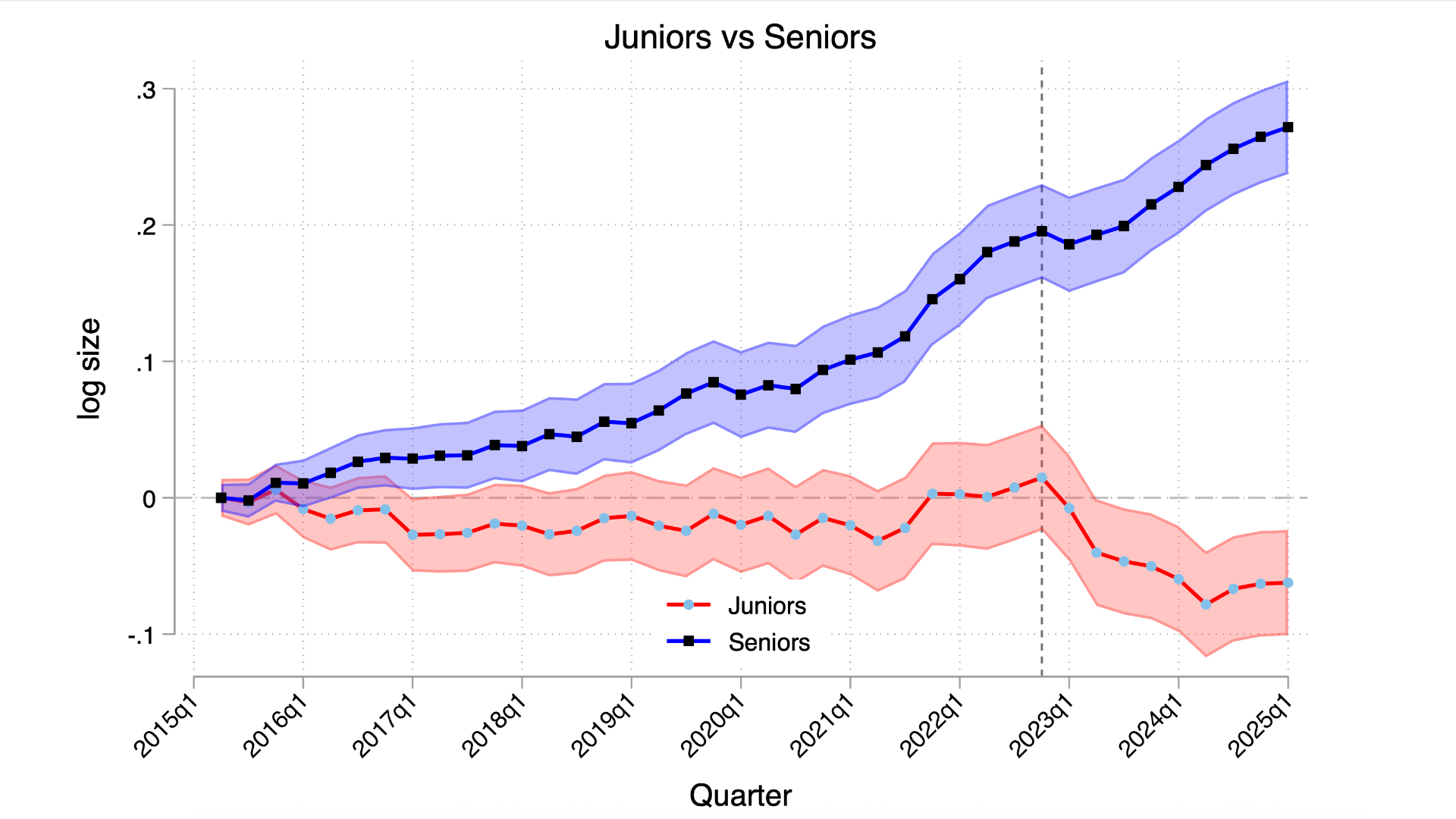
    The figures are unequivocal. Since the first quarter of 2023, when generative AI became widespread, companies implementing these technologies have seen a 7.7% drop in junior positions compared to companies that do not.

    Crucially, this decline is almost entirely driven by a slowdown in recruitment. AI ‘adopter’ companies hired an average of 3.7 fewer juniors per quarter after Q1 2023 compared to companies not investing in AI.

    What’s more, the departure rate (redundancy and natural turnover) of juniors in the same companies not only did not increase, but actually decreased slightly.

    Companies are therefore not getting rid of current juniors. They simply stop hiring new ones to replace them or fill vacancies. It’s a quiet, ‘invisible’ cutback that doesn’t generate headlines, but over the course of a few years it could dry up the source from which the market draws experienced professionals.

    Why is AI targeting the lowest rung of the ladder?

    To understand this mechanism, it is necessary to look at the nature of junior jobs. Careers in many white-collar jobs start with tasks that researchers describe as ‘intellectually mundane’ – routine but cognitively demanding.

    Examples include debugging code, reviewing legal documents, creating standard reports or responding to repetitive customer queries.

    It is these tasks – structured, pattern-based and information processing-intensive – that are the ideal target for the current generation of AI. Large language models excel at analysing and generating text, finding errors in code or conducting structured conversation.

    In effect, artificial intelligence does not replace the employee as a whole, but automates the core of their daily duties.

    The problem is that these ‘mundane’ tasks were never an end in themselves. They were a fundamental mechanism for learning and gaining experience. It is through debugging hundreds of code snippets that a young programmer acquires intuition and learns good practice.

    By automating these processes, companies are unknowingly automating their own talent development system, which raises a fundamental question: will a manager who has never performed the core tasks be able to effectively manage a team that does, even if with the help of AI?

    Unequal impact: Who loses the most?

    The wave of change brought about by AI is not hitting everyone with equal force. Sectoral and educational analysis shows that there are groups that are particularly vulnerable.

    The largest, almost 40 per cent, decrease in the employment of juniors was in the wholesale and retail sector. Tasks such as routine communication with customers, handling enquiries and processing paperwork were found to be highly susceptible to automation.

    Significantly, finance, manufacturing and professional services also suffered significant declines, confirming that this is not a phenomenon limited to the technology industry.

    Even more surprising are the findings regarding education. The study revealed a clear U-shaped pattern. It turns out that graduates from good but not elite universities (defined as Tier 2 and 3) are the most likely to reduce recruitment.

    Smaller declines affected graduates from universities at the very top (Tier 1) and, interestingly, those at the lower tiers (Tier 4 and 5).

    The logic behind this phenomenon is purely economic. Graduates from the elite are protected by their unique creativity, which is difficult to automate, and their high salaries are a justifiable investment anyway. In contrast, entry-level employees are protected by their low cost – implementing AI can be more expensive than their labour.

    In the ‘death zone’ were graduates from the middle – expensive enough to make their automation viable, yet performing tasks structured enough that AI can handle them well.

    Fortress of talent: Fewer doors, but a faster lift upwards

    However, the analysis also brings a glimmer of hope, at least for those already in the system. It turns out that companies implementing AI, while closing their doors to newcomers, are at the same time taking more care of existing employees. In these companies, the rate of promotions awarded to juniors has increased.

    This can be interpreted in two ways.

    Firstly, AI, which replaces the tasks of beginners, simultaneously becomes a ‘force multiplier’ for more experienced juniors, allowing them to focus on more complex problems and advance faster.

    Secondly, if a company is reducing external recruitment, it needs to rely more on an internal source of talent to fill senior vacancies.

    This creates a new dynamic of the ‘talent fortress’. Companies are raising the walls, making it more difficult to enter from the outside, but investing more heavily in developing those already inside.

    A clear divide is emerging between ‘insiders’, who have found themselves on an accelerated career path, and ‘outsiders’ – graduates for whom the barrier to entry is getting higher.

    Strategic challenge: Where will we get our seniors from in five years’ time?

    The figures presented lead to one fundamental question that should keep business leaders and HR departments awake at night: where will we get experienced professionals from in five years’ time if we cut off the supply of ‘fresh blood’ today?

    This is not a rhetorical question. It is a strategic challenge that requires a fundamental rethink of existing talent management models. The crisis in the market for experienced professionals, which will hit with full force at the end of this decade, is being created here and now.

    Decisions not to recruit juniors, taken en masse between 2023 and 2025, will directly translate into an acute shortage of qualified professionals with 3-5 years’ experience between 2028 and 2030.

    One can predict with a high degree of probability what will happen next. There will be a ‘missing generation’ of professionals on the market. The huge imbalance between supply and demand will trigger an unprecedented war for talent and a hyperinflation of salaries for the few who will have the desired experience.

    Companies that today, in the name of short-term optimisation, forgo investment in their talent pipeline will face a dramatic choice in a few years’ time: either they pay a gigantic premium for experienced employees or they will not be able to meet their business goals.

    This is the ultimate deferred cost of the ‘invisible cuts’ that are taking place before our eyes.
  • Back to offices – Why IT giants risk losing talent

    Back to offices – Why IT giants risk losing talent

    The wave of returns to the office, spearheaded by the giants, confronts the technology industry with a fundamental question: is it about real empowerment of collaboration, or about regaining control in a world that has successfully operated remotely for the past few years?

    Rigid attendance mandates, communicated as a recipe for innovation, are read by many employees as a signal of mistrust. This is a risky move in the battle for the most qualified professionals.

    Two reasons, one decision

    The official narrative of technology leaders focuses on the benefits of face-to-face interaction. They argue that spontaneous conversations over the coffee machine, collaborative whiteboard sessions and easier onboarding of new team members are key to building a strong organisational culture and accelerating innovation.

    From a management perspective, the centralised working model facilitates oversight and provides a sense that the whole organisation is rowing in the same direction.

    However, employees who have proven their effectiveness in the remote model over the last few years are asking themselves: why is it that what was working is suddenly no longer enough?

    The sudden change in policy, often without a sound business case, raises suspicions that the aim is not productivity but a return to traditional hierarchical structures based on attendance control rather than performance evaluation.

    For many professionals, flexibility and autonomy have become not just a benefit, but a symbol of a partnership with their employer. Taking this freedom away from them is seen as a step backwards.

    Hidden costs of rigid mandates

    Imposing the obligation to work from an office without flexibility can be counterproductive. The most talented and marketable professionals, accustomed to choosing where they work, may simply vote with their feet.

    In an industry where talent shortages are a reality, flexibility is becoming a key competitive advantage. Companies that offer sustainable hybrid models not only find it easier to attract new candidates, but also retain key employees more effectively.

    The problem goes deeper than just the risk of leaving. Employees who stay with the company but feel compelled to return against their will may experience a decline in commitment.

    The sense of loss of confidence and autonomy demotivates, and time spent commuting instead of working or relaxing directly affects work-life balance and overall satisfaction. This, in turn, translates into lower creativity and productivity – exactly the indicators that returning to the office was supposed to improve.

    In search of a smart hybrid

    The key to success is not to choose between the office and remote working, but to build a model that draws the best of both worlds. Rather than arbitrarily imposing the number of days in the office, mature organisations focus on intentionality.

    On-site attendance should have a specific purpose – creative workshops, project meetings or team integration. Conversely, tasks that require deep concentration can be more effectively carried out at home.

    Modern leadership is moving away from measuring time spent at the desk to managing by objectives and results. However, this requires an understanding that employees have different working styles and needs.

    Some people derive energy from interaction and a dynamic office environment, while others reach peak productivity in peace and quiet. Solutions such as the analysis of personality profiles or individual predispositions (a concept known as Human Design, among others) can help managers create teams and schedules that maximise each employee’s potential.

    Investment in technology for hybrid working is important, but without a fundamental change in organisational culture – based on trust and autonomy – it will remain just a facade.

    Companies that take the present moment as an opportunity to redefine their approach to work, communicating their motivations clearly and regularly collecting feedback from their staff, will build a sustainable advantage.

    Those that choose to take shortcuts by imposing old rules run the risk of the progress of recent years proving to be only a temporary experiment, for which they will pay with a loss of confidence and their most valuable talents.

  • Automation in HR IT: The symbiosis of AI effectiveness and human strategy

    Automation in HR IT: The symbiosis of AI effectiveness and human strategy

    HR departments face a double challenge: they must not only source the best talent, but also adapt the latest tools to do so effectively. Artificial intelligence and automation are revolutionising the industry, but do they aim to replace humans? On the contrary.

    Modern HR is a story of symbiosis, in which technology becomes a powerful tool in the hands of a human strategist.

    A new division of roles in modern HR

    Automation is redefining tasks in HR, creating a clear and logical division of responsibilities. AI and algorithms are taking over operational, analytical and repetitive tasks, allowing specialists to focus on what is human: building relationships, creative problem-solving and developing a talent strategy that realistically supports the business. This is an evolution of the role, not an elimination of it.

    Where does AI realistically support HR? A data-driven foundation

    Before moving on to strategic benefits, it is worth understanding where technology is already delivering the greatest value. Artificial intelligence is adept at processing huge sets of information, making it the ideal support for tasks that have previously taken up the lion’s share of HR teams’ time.

    “AI-supported HR process automation in IT mainly improves employee data management, performance monitoring, note-taking and correlating different data sources.” – says Karol Wasilewski, Head of Recruitment at RITS

    It is this solid foundation – structured and intelligently processed data – that allows better, more informed decisions to be made at higher levels.

    Recruitment with AI: An opportunity for efficiency and a risk for competence

    Recruitment is one of the first areas where AI has shown its capabilities. Analysing thousands of CVs in a few minutes or pre-assessing cultural fit is a huge help, but it also carries some risks.

    “AI can also assess CVs against requirements, but using AI alone can severely limit a recruiter’s competence if not taken care of in other ways. (…) Cultural matching using AI is helpful in analysing communication patterns and preferences, which supports recruitment and reduces turnover. However, AI cannot assess subtle soft skills and cultural nuances, so humans remain essential.” – highlights Karol Wasilewski, Head of Recruitment at RITS

    Technology can tell us whether a candidate meets the technical criteria, but only a human can assess how they will interact with the team, how they will handle pressure and whether their values align with the company culture. Over-reliance on a machine can dormant a recruiter’s most important sense – intuition backed by experience.

    The greatest value of automation: Human time

    The most important benefit of automation, then, is not the technology itself, but the resource it gives back – time. Time that can be devoted to activities with the highest added value.

    “Automation tools relieve the burden on HR teams by completing repetitive tasks, thus leaving time for creative meetings and relationship building, which increases motivation and employees have more space for constructive tasks.” – says Karol Wasilewski, Head of Recruitment at RITS

    When the algorithm schedules meetings, the recruiter can focus on preparing for the interview. When the system analyses the data, the HR Business Partner can spend time talking to the leader about their team’s development strategy. It is in these interactions that the true value of HR lies.

    The perfect balance – humans as strategist, AI as doer

    The AI revolution in HR is not leading to a world without people. On the contrary, it is creating an environment where human competencies – empathy, strategic thinking, creativity and relationship building – become more valuable than ever before.

    “In summary, AI is taking over operational/repeatable tasks, with humans taking on advisory and strategic roles, combining efficiency with retaining the human dimension.” – Karol Wasilewski concludes

    The ultimate goal is an intelligent symbiosis: the efficiency of machines combined with the wisdom and strategic insight of humans. This is the future of HR, which is happening before our eyes.

  • The 40 professions most likely to be affected by generative AI. Translators, teachers, analysts – who’s next?

    The 40 professions most likely to be affected by generative AI. Translators, teachers, analysts – who’s next?

    A new report by researchers from Microsoft Research and OpenAI analyses the real-world impact of generative AI on 800 professions, based not on predictions, but on data from hundreds of thousands of user interactions with tools like Copilot. The result? The result is a list of 40 occupations where AI is already doing a significant amount of the work – and these are not just the classic ‘knowledge workers’.

    What is the AI Applicability Score?

    The researchers collected more than 200,000 real-world queries from users using Microsoft’s Copilot. From this, they created a classification of the professions that most frequently use AI as a support – or whose tasks AI has already taken over.

    The AI Applicability Score shows how often users in an occupation delegate tasks to generative AI – such as writing, translation, content creation or consulting. Unlike previous predictive models, this report is not based on expert assessments, but on real data from the use of AI at work.

    The higher the score, the greater the proportion of tasks performed in the profession can be handled by AI. At the top of the ranking, we find many tasks related to communication, writing and working with text.

    Top 40 professions vulnerable to AI

    At the top of the list were occupations where AI performs between 80 and 98 per cent of typical tasks:

    1. Interpreters and translators (0.98)
    2. Historians (0.97)
    3. Writers and authors (0.95)
    4. Reporters and correspondents (0.94)
    5. Mathematicians (0.92)
    6. University lecturers (English, history, communication)
    7. HR specialists
    8. Education and career counsellors
    9. Data analysts
    10. Internet marketing specialists

    Occupations requiring content creation, information interpretation or communication support dominate the list. Interestingly, many professions from education and HR – fields traditionally seen as resistant to automation – were also included.

    Why exactly this competition?

    Generative AI – such as ChatGPT or Copilot – is designed to process and generate natural language. Professions that involve writing, summarising, translating or advising are therefore natural environments for such tools. Importantly, it is not just about repetitive tasks – AI can also generate analysis, summaries and contextualised responses, allowing it to support journalists, analysts or academics, for example.

    Example? In the case of translators, AI does much of the work: from automated translations to text editing and language proofreading. Similarly, in education – AI supports the preparation of materials, the creation of quizzes and even grading.

    Replacement or support?

    The report emphasises that in most cases AI does not replace humans, but supports them as a so-called copilot* This means a shift in the role of the worker – from executor to creator, editor and decision-maker.

    For example, a journalist can use AI for initial research and a teacher to generate lesson material. In both cases, a human is still responsible for content value and context, but the time to prepare the material is significantly reduced.

    Who doesn’t need to worry (yet)?

    At the other end of the spectrum are occupations whose nature requires physical action, direct contact or precise control of the environment – such as massage therapists, machine operators, technical staff or medical caregivers.

    AI in its current form is unable to manipulate objects in the physical world or take over manual tasks. Therefore, these professions are relatively immune for now – although developments in robotics may change this.

    The report also shows an interesting correlation: the higher the salary and level of education in an occupation, the higher the AI applicability score. This reverses the previous narrative that automation was mainly supposed to be about manual or repetitive work.

  • The evolution of phishing: From fake invoices to job interview invitations

    The evolution of phishing: From fake invoices to job interview invitations

    The job market has become a new hunting ground for cybercriminals. Instead of classic malware, they are reaching for a more sophisticated weapon: the tools that IT departments use on a daily basis for remote support. Legitimate and trusted applications thus become an attack vector, targeting the most susceptible – people actively seeking a new career path.

    Modern recruitment scams have abandoned primitive methods in favour of sophisticated social engineering. Recent analysis by Proofpoint shows a growing and worrying trend. Attackers are impersonating recruiters and HR professionals from high-profile companies, creating plausible scenarios designed to lull victims’ alertness. This process is part of wider phishing campaigns that use trust as the main currency.

    Anatomy of an attack: how legitimate software becomes a weapon

    The scheme of operations is deceptively simple but extremely effective. The potential victim receives an email or is contacted by a supposed recruiter via platforms such as LinkedIn. The communication looks professional – often based on copied, authentic job advertisements. After an initial exchange, the candidate receives an invitation to an online interview.

    It is here that the key moment of the attack occurs. Instead of a link to popular videoconferencing platforms such as Zoom, Microsoft Teams or Google Meet, the victim is prompted to download and install a small piece of software supposedly necessary to conduct the call. In reality, it is a legitimate remote management and monitoring (RMM) tool such as SimpleHelp, ScreenConnect (now ConnectWise ScreenConnect) or Atera.

    These applications, used on a daily basis by IT administrators to diagnose problems or install software on company computers, give almost complete control over the system. In the hands of criminals, they become a gateway to take over the desktop, steal data, monitor activity and, ultimately, gain access to bank accounts and other confidential information.

    The problem of undetectability

    The main advantage of this method is its apparent legality. RMM tools are digitally signed, commercial products. Traditional anti-virus software often does not classify them as a threat, because technically they are not. They work as intended – only that the purpose of their use is criminal.

    Proofpoint alerts that this tactic is becoming the preferred method for cybercriminals to gain ‘first access’ to a victim’s system. It replaces classic Trojans and keyloggers because it is more difficult to detect and does not arouse immediate suspicion. The attack can remain hidden for a long time while the criminals methodically explore the resources of the infected computer.

    Scale and sophistication of operations

    These attacks do not happen by chance. Criminals prepare their campaigns carefully. In order to acquire the email addresses of potential victims, they publish fake advertisements on job portals, use data from previous leaks or even take control of compromised company accounts and profiles on LinkedIn.

    In one case, attackers, using a hijacked LinkedIn account, made contact with candidates and then directed them to further correspondence from a fake, albeit credible-looking, email address. Such activity blurs boundaries and builds a false sense of security. The victim is led to believe that they are participating in a legitimate recruitment process with a real company.

    This problem is part of a wider trend of abuse of legitimate remote access software (RAS) that other cyber security companies are also seeing. Attackers are impersonating not only companies, but also government offices, banks or event organisers to maximise their chances of making the message credible.

    How to protect yourself? Steps for jobseekers

    With the rising tide of such attacks, jobseekers need to be more vigilant. It is crucial to adopt a zero-trust approach to unexpected offers.

    1. Source verification: When receiving a message from a recruiter, verify it through an independent channel. Instead of replying directly, it is advisable to go to the company’s official website, find the ‘Careers’ tab or contact details and make sure that such a recruitment is actually taking place. Never rely solely on the details in the message you receive.
    2. Email address analysis: Check the sender’s e-mail address carefully. Often scammers use domains that at first glance resemble the real one (e.g. `kariera@firma-it.co` instead of `kariera@firma-it.com`).
    3. Red flag: Software installation: the most important rule of thumb – no reputable company requires the installation of custom software to conduct an initial interview. The market standard is established platforms (Teams, Zoom, Meet), which typically run in the browser and do not require administrator privileges. A request to install an RMM tool should be a wake-up call to break contact immediately.
    4. Caution with links and attachments: Before clicking on any link, it is a good idea to hover over it to see its full destination address. Any shortened URLs and requests to download executable files (.exe) or archives (.zip) should raise suspicion.

    The evolution of cyber threats shows that the human being remains the weakest link. In a stressful and hopeful situation such as a job search, it is easy to lose vigilance. That is why awareness of criminals’ new methods and healthy scepticism are the most effective line of defence today. After all, one hasty click can ruin not only the chance of a new job, but also digital security.

  • The new elite of the job market. Here’s why Big Data and AI specialists are at a premium

    The new elite of the job market. Here’s why Big Data and AI specialists are at a premium

    Polish industry finds itself at the epicentre of a paradox. On the one hand, data shows an alarmingly low level of adoption of advanced technologies such as artificial intelligence (AI) and Big Data. On the other, it is these niche implementations that are triggering the most profound changes in the labour market, creating demand for new, elite competences. In the face of a demographic crisis and increasing competitive pressure from Europe, this divergence ceases to be a statistical curiosity and becomes a strategic challenge for the entire economy.

    Two-speed transformation

    Data for 2023 paints a picture of a two-speed digital Poland. Technologies perceived as mature and supporting day-to-day operations, such as cloud computing (used by 38% of industrial companies) and the Internet of Things (25%), have gained moderate popularity. However, they are often mainly used to optimise existing infrastructure, such as mail hosting or file storage.

    The real divide is revealed in the area of technologies with strategic, transformative potential. Only 3% of industrial companies have implemented artificial intelligence and only 2% have used Big Data analytics. These figures become even more alarming in the European context. With an overall AI adoption rate of 5.9% in 2024, Polish companies rank penultimate in the European Union, ahead of only Romania. The EU average is 13.48%, with leaders such as Denmark at 27.58%. This is no longer just a lag – it is a fundamental problem of competitiveness.

    Labour market: transformation instead of reduction

    Contrary to widespread fears of mass redundancies, the data shows that the impact of technology on the labour market is much more complex. It is the most avant-garde technologies, AI and Big Data, that are acting as a double-edged sword, making deep restructuring rather than simple downsizing.

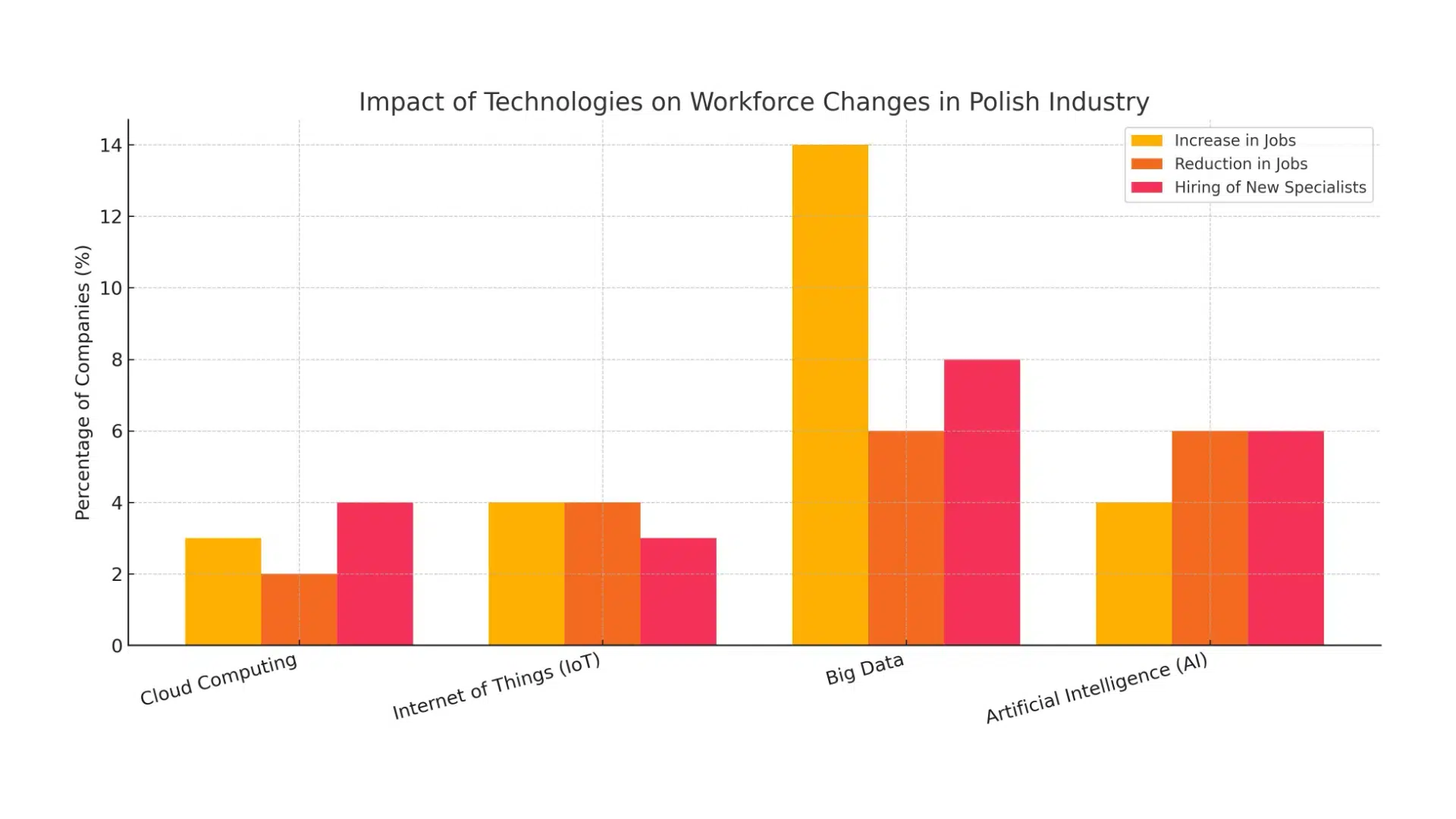
    Companies that dared to implement Big Data reported the highest percentage of new job creation (14%), but at the same time a high percentage of reductions (6%). Likewise for AI – 6% job cuts and 4% job growth. This means that these technologies are not so much eliminating work as fundamentally recomposing it. They are automating routine and analytical tasks while creating demand for roles that require data interpretation, strategic thinking and management of new systems.

    Crucially, the biggest beneficiaries of this change are highly skilled professionals. Big Data and AI implementations were the most likely to lead to the hiring of new experts (8% and 6% of companies respectively). A new professional elite is emerging in the market: data analysts (data scientists), software developers and AI and machine learning engineers.

    This picture is further complicated by demographics. Projections by the Polish Economic Institute are clear: by 2035, 2.1 million people will have disappeared from the Polish labour market, including 400,000 from the industrial sector alone. In this reality, automation ceases to be a threat and becomes a strategic necessity for maintaining productivity and economic growth in a shrinking workforce. The real risk for the worker is not the replacement by a robot, but the collapse of his or her company due to a lack of competitiveness.

    The glass ceiling of innovation: why are we standing still?

    If the need for digitalisation is so pressing, why is its rate so low? The answer lies in a vicious circle formed by three mutually reinforcing barriers.

    • Finance: for 67% of industrial companies, the main obstacle is the high cost of implementation. The problem is compounded by the difficulty of estimating return on investment (ROI), cited by 44% of companies.
    • Competence: The second most frequently cited barrier is the lack of qualified staff, signalled by 52% of companies. The gap concerns both technical specialists and managers who understand the potential of technology.
    • Strategy: as many as 44% of companies admit that digital transformation is simply not a priority for them. Nearly half of companies do not even know in which areas they could apply AI.

    These barriers create an impasse: companies do not invest because they lack the staff to estimate profitability and implement solutions. The education market is not training specialists because there is a lack of mass demand. Breaking this cycle requires bold decisions at board level.

    Strategies for the digital decade

    Polish industry is facing the confluence of two powerful trends: global technological acceleration and a national demographic slowdown. The coming years will be decisive. Continued inaction risks a permanent loss of competitiveness, while bold and strategic action may open the way to a leap in development.

    A synthesis of the analysis leads to one conclusion: Polish industry is at a critical point. It is caught between increasing pressure for innovation, dictated by global leaders , and decreasing availability of human capital. The persistent skills gap and strategic inertia at board level are the axis around which the future of the Polish economy will revolve. The window of opportunity to bridge this gap is closing – the next 5-7 years will determine whether Poland will join the ranks of digital innovators or fall behind.

    By 2030, the labour market will be further polarised. Market forecasts clearly indicate a growing demand for specialists in fields that are crawling in Poland today. Roles related to AI and machine learning engineering, data analytics (Data Science), cyber security and cloud architecture will be key. At the same time, soft competencies that are complementary to technology will gain in importance: analytical and creative thinking, flexibility, mental toughness and readiness for continuous learning (lifelong learning). These are the ones that will enable effective management of technology-enabled teams and processes.

    Polish industry is at a crossroads. Continued inactivity risks a permanent loss of competitiveness. To meet the challenges, business leaders must take decisive action:

    • Invest in People, Not Just Technology: move from a mentality of ‘buying’ talent to ‘building’ it internally. Reskilling and upskilling programmes need to become a key part of business strategy, not just a task for the HR department.
    • Strategy First: Digital transformation must be a boardroom priority, not an IT department experiment. Leaders must clearly communicate the business objectives behind investments and promote a data-driven culture.
    • Build Foundations: Before companies throw themselves into the pursuit of AI, they need to ensure a solid foundation in the form of information governance (data governance) and a modern infrastructure. Many failed AI projects are due not to flaws in the technology, but to poor data quality.

    The coming years will decide whether Poland will join the ranks of digital innovators or remain in the technological tail of Europe. The time to act is now.

  • Lenovo cuts US workforce, bets on AI and transformation

    Lenovo cuts US workforce, bets on AI and transformation

    Lenovo has announced a reduction of around 3% of its US workforce, meaning more than 100 employees will be laid off. While the numbers do not seem large, it is a signal part of a wider trend of cuts in the global IT industry – just a few weeks earlier, around 9,000 people lost their jobs at Microsoft.

    The Chinese computer manufacturer explains the decision as a ‘strategic reorganisation’ and to adapt its cost structure to changing market realities. The layoffs will include some of the teams in North America, mainly in North Carolina, where Lenovo’s headquarters for the region is located.

    The reductions are part of a familiar pattern for the company. Lenovo made similar cuts in 2015, 2017, 2019 and 2022 – usually during periods of restructuring or slower growth.

    This time, however, the background looks different. The company emphasises that it is in the process of investing in new areas, primarily artificial intelligence. In June, Lenovo unveiled new AI-based infrastructure solutions, and CEO Yuanqing Yang announced that “the coming decade will be the decade of AI” for the conglomerate. In line with this vision, the company is expected to produce more AI-enabled PCs and develop the smart infrastructure segment.

    Lenovo reported 21% year-on-year revenue growth in the last quarter, suggesting that the cuts are not due to the crisis, but rather the need to redefine priorities. The company is seeking a balance between optimising costs and preparing the ground for growth in a new, more automated world.

  • Burnt out but productive? IT is looking for a new working rhythm

    Burnt out but productive? IT is looking for a new working rhythm

    In the technology industry, productivity is sacrosanct. Speed, responsiveness and efficiency are the currencies used to pay for success. The problem is that many IT teams today are operating at breakneck speed, and professional burnout is becoming a costly side-effect of this pace. Is it possible to build a team that not only delivers projects, but doesn’t burn out in the process after a year?

    More and more technology companies are testing the answer to this question. They are abandoning endless sprints, shortening work weeks, introducing ‘no-meeting Fridays’ and starting to treat mental health as a viable performance indicator. This is not a fad, but a reaction to systemic overload.

    Chronic overload as the new normal

    Working in IT today is not just about programming, but also about constantly switching between tasks, synchronising with teams spread across time zones and living in a constant state of readiness. Added to this is the pressure of results – there is no room for a “moment of weakness” in software houses, DevOps departments or cyber security teams.

    Professional burnout is no longer an isolated case – rather, it is the result of a structural maladjustment of companies to the challenges of modern work. Leaders who ignore this signal pay the price: increasing turnover, decreased motivation and increased project errors.

    Instead of more – different. Leaders change the starting point

    Conscious technology leaders are no longer asking: “how do we increase productivity?”, but rather “what is limiting us – and how do we remove it?”. The first step is usually diagnosis – analysing work rhythms, team calendars, meeting frequency, overtime or sprint backlogs. Often, what appears to be an efficient organisation turns out to be a hidden source of stress.

    It’s not about spectacular changes, but thoughtful adjustments. Shortening sprints, loosening the pace of releases, planning holidays better – these are details that make a difference in the long run.

    Small practices, big effect

    A number of common solutions are emerging among companies that effectively counteract burnout:

    • The 4-day week tested by some software houses has been shown not to reduce productivity but to improve morale.
    • “No-meeting Fridays” allow teams to work deeply, without breaking their concentration with further video conferences.
    • Time blocks in the calendar – protected from meetings hours to focus, be creative or simply breathe.
    • Balanced pace of releases – SaaS companies that have slowed down their release cycles have seen fewer bugs and lower stress levels for development teams.
    • Rotation of tasks and zones without deadlines – so that not every day is a sprint to the goal.

    These solutions are not costly – they mainly require a change in thinking about work as a long-distance process, not a race.

    Communication: not soft skill, but core competence

    No process will work without good communication. Pressure-resistant teams are those in which leaders are able to pick up on signs of overload before burnout sets in. This is helped by informal check-ins, feedback not only on tasks but also on moods, and openness to different communication styles within the team.

    Not everyone wants to talk about fatigue in a group. Sometimes a space for individual conversation is enough. It’s also worth remembering that emotions in an IT team are just as important as technical competence – ignoring them is a simple path to turnover and burnout.

    Leader as a shock absorber, not an accelerator

    In the traditional management model, the manager was expected to ‘push’ the team forward. Today, an effective technology leader is more likely to ‘cushion’ the pressure coming from the top rather than amplify it. He or she is the one who sets the rules for after-hours communication, sets the example by taking leave, protects the team’s time and speaks out when a project is poorly planned.

    In companies that perform well without the cost of burnout, leaders do not glorify overtime. On the contrary, they regard it as a wake-up call.

    How do you measure what you can’t see?

    More and more IT companies are trying to combine classic performance indicators (e.g. velocity, delivery time) with soft data: retention, team sentiment, number of reported holidays or errors due to fatigue.

    There are even new KPIs emerging – for example, a composite score combining team satisfaction, response time in projects and overtime. This signals that companies are starting to see employee wellbeing as a competitive element, not a cost.

    A pressure-resistant team is an advantage, not a luxury

    Companies that invest in healthy working rhythms not only manage turnover better. They also often achieve higher code quality, greater project stability and stronger team engagement. These are not ‘soft’ effects – they are hard data.

    Productivity without burnout is not a utopia. However, it requires a decision: to stop, look at the reality and redesign the work. Where leaders dare to do this, the team repays the favor with efficiency that does not end in the third quarter.

  • Women at work 2025: Why are they less likely to reach for board positions?

    Women at work 2025: Why are they less likely to reach for board positions?

    Although women in Poland declare a desire for professional development, their aspirations more often end at managerial level. Only 6% of female professionals would like to become CEOs – this is one of the more telling indicators of the Hays Poland report ‘Women on the labour market 2025. DE&I policy in practice‘. In comparison, men are far more likely to equate success with taking on a director or board member role.

    However, it is not a lack of ambition, but differences in starting conditions and difficulties along the way. More than half of women (57%) say they have experienced barriers to their career because of their gender. This most often manifests itself in favouring men for promotions. Only 37% of women are convinced that gender does not affect promotion opportunities – among men, this percentage is as high as 68%.

    The manager’s ceiling of ambition?

    Thirty per cent of women consider taking on a management position to be a career success. At director level, this figure drops to 28%, and only 6% for the CEO role. This is a marked difference to men, who are more likely to associate success with high levels of management and global responsibilities.

    What is the reason for this? On the one hand, the lack of access to mentoring and support networks. Women are more likely than men not to apply for positions if they do not meet all the requirements. On the other – from a more demanding environment. They are still in the minority on boards of directors, which means that every female candidate is cutting corners and has to prove her worth under more pressure.

    Elections under pressure

    Even when women have ambitions, they often calculate whether achieving them will affect other aspects of their lives. 59% acknowledge that balancing work and raising children is a real challenge. The main problems are not being able to participate fully in their children’s lives and having to constantly choose between family and work. Among men, this experience is declared by 33%.

    These figures do not mean that women do not want to advance. Rather, they point to systemic constraints – cultural, organisational and social – that make the cost of getting to the top seem too high. As a result, women are more likely to stay where they still have the balance.

    Regression or stagnation of DE&I policy?

    Although the number of companies with diversity policies in place is increasing, confidence in their effectiveness is declining. Both women and men are less likely than a year ago to declare that opportunities for promotion and remuneration do not depend on gender. According to experts, this is the result of an organisation’s focus on performance during a period of economic uncertainty – DE&I is receding into the background.

    This is a warning signal. True equality does not end with declarations or job structures. It requires an ongoing commitment – including when it is more convenient to put it off.

  • Google DeepMind chief warns – AI will take away people’s jobs faster than you think

    Google DeepMind chief warns – AI will take away people’s jobs faster than you think

    In a tech world where an excess of information hype often dilutes the importance of statements, the voice of Demis Hassabis, head of Google DeepMind, sounds like a harbinger of seismic change. In a recent interview, he warns that artificial intelligence will have a huge impact on the job market within five to 10 years. On the surface, it’s another iteration of a familiar narrative. But this time it goes further: it’s a call for immediate action, especially for young people entering the education pathway.

    AI as a hallmark of the Alpha generation

    Hassabis draws an analogy that hits the nail on the head: the internet has defined the millenials, smartphones have defined generation Z, and generative artificial intelligence is to be the trademark of the Alpha generation. For the latter, this means not just getting used to the next technology, but consciously entering a world where automation, language models and decision-making algorithms will be the primary backdrop of working life.

    It is no longer a question of being able to ‘handle’ AI, but of understanding how it works and how it affects the environment. Hassabis points out that AGI – artificial general intelligence – could emerge in less than a decade. Even if this is an overly optimistic forecast, the pace of technological change is already outpacing the ability of educational systems to adapt.

    What should students learn?

    Hassabis’ answer is not revolutionary, but it is realistic: it is still worth investing in STEM (science and technology) fundamentals, especially programming. At the same time, however, soft skills – cognitive flexibility, creativity, mental toughness – are gaining in importance. They are the ones that are supposed to be ‘harder to automate’.

    This shift in emphasis is not new. Already the World Economic Forum’s 2023 Future of Jobs report indicated that up to 44% of workers’ core skills would change by 2027. However, in the context of AI, this gains a new focus – because for the first time, typically intellectual professions are also under threat: data analysis, copywriting and even some aspects of programming.

    Reviewing the value of manual skills

    Tellingly, Hassabis warns against overestimating purely technical knowledge. Machines are getting better and better at manual and schematic activities, from operating warehouses to analysing X-rays. Therefore, those competences that are difficult to describe formally – such as the ability to combine knowledge from different disciplines or to solve non-obvious problems – are becoming more future-proof.

    This message is part of a wider trend to redefine the concept of ‘future competencies’. Among technology and education companies, there is increasing talk of the need for ‘human-centred tech skills’ – that is, the combination of technology with empathy, ethics, the ability to work with machines and people at the same time.

    The present, not the future

    Hassabis’ key message is that AI is not a phenomenon of the future. It is already the present. And anyone planning their career path needs to take this fact into account immediately. For students, this means not only consciously choosing a course of study, but also actively testing new tools – from ChatGPT and Gemini to Midjourney and GitHub Copilot.

    It is worth noting that radical change will not necessarily affect all professions equally. Experts at McKinsey estimate that up to 30% of tasks in selected industries could be performed by AI by 2030. But this does not mean 30% unemployment. Some roles will be transformed, others will be given new meaning.

    AI is an adaptation test for education and labour market systems

    The biggest challenge is not in the technology itself, but in social adaptation. Education systems, especially in Europe, are not keeping up with the pace of change. There is still an emphasis on testing knowledge rather than developing cognitive skills. Labour markets, on the other hand, are unprepared for mass reskilling – and this will determine whether the transformation will be positive.

    That is why Hassabis’ voice should be taken not only as an appeal to students, but also as a warning to decision-makers: artificial intelligence will not wait for the world to catch up with it. Either we prepare today or we improvise tomorrow.