Tag: SMES

  • Digital myopia. Why SME boards should stop thinking about IT and focus on strategy

    Digital myopia. Why SME boards should stop thinking about IT and focus on strategy

    Bank Gospodarstwa Krajowego’s 2026 report ‘Digitisation in the SME sector. What will accelerate the transformation?” exposes a fascinating, yet worrying paradox of Polish business. On the one hand, as many as 64% of companies declare that digitalisation is a high or very high priority for them. On the other, however, an impressive 91.5% of organisations do not measure the results of these activities, abandoning any performance indicators. Digital transformation therefore often resembles a flight in the dark. Companies are keen to invest in modern systems, spending between 106,000 and 300,000, but this is rarely followed by a profound overhaul of decision-making processes. The difficulty lies not in the scarcity of software on the market, but in the lack of digital imagination at the highest levels of management.

    What emerges from reading the document is a picture of a market in which the main barrier to growth is the skills gap, understood, however, quite differently from what is commonly accepted. It is not the lack of technical skills among rank-and-file employees that is the biggest bottleneck, but the lack of technological insight among key decision-makers. Companies are still more willing to invest capital in infrastructure and off-the-shelf operating systems, forgetting the most important piece of the puzzle, which is staff capable of turning new tools into higher margins and better optimisation.

    Moving from intuitive innovation implementation to professional change management requires a fundamental rebuilding of perspective. The first step is to abandon conjecture-based activities in favour of implementing hard analytics, even before the first invoice for IT services is settled. The inability to measure the success of a planned technology project should be a clear warning signal before it starts. Another issue is the approach to budget modelling itself. The report shows a clear dominance of own funds, which are used by more than sixty-three per cent of respondents. Basing development solely on earned cash is safe, but can mean a loss of momentum. External support instruments, including EU programmes and earmarked funds, can serve as powerful leverage, allowing the business to scale much faster and build a competitive advantage.

    A change in optics in the area of cyber security is also extremely important. The protection of data and systems has long ceased to be solely the domain of IT departments. It is now an integral part of corporate risk management and an absolute guarantor of operational continuity. Treating investment in digital security as an unnecessary cost is a mistake that, in an age of increasing network threats, can weigh on the future of an entire organisation.

    An in-depth analysis of the statistics provided by Bank Gospodarstwa Krajowego makes it possible to distinguish clear market segments. Almost 12% of companies are true digital leaders, while less than 10% remain completely technologically passive. An organisation with a leader profile does not stop at implementing a basic customer relationship management system. It uses the data it collects to anticipate market trends, automate routine processes and stay ahead of competitors’ moves. The largest group, accounting for 57% of the sector, is still in its infancy. Looking ahead to the next few years, this safe middle ground will begin to erode in the market and cost pressures from the leaders will become ruthless.

    Digital maturity is not ultimately a product that can be acquired through a tender. It is a complex process of transforming the entire DNA of a company. Delegating responsibility for digitalisation solely to the technical divisions is commonplace, but from a strategic perspective deeply misguided. Allocating significant financial resources to new IT systems, while failing to invest in the development of management competencies, is a path fraught with unnecessary risk. The real transformation begins not in the state-of-the-art server room, but in the boardroom, where technology must finally begin to speak the language of profit, efficiency and long-term strategy.

  • The technology gap is widening: SMEs vs corporates in the race for AI

    The technology gap is widening: SMEs vs corporates in the race for AI

    Small and medium-sized enterprises (SMEs) are the backbone of the European economy. They account for 99.8 per cent of all companies, generate more than half of the added value and employ nearly two-thirds of the private sector workforce. In an era of global competition and rising customer expectations, digitalisation is no longer an option for them – it has become a condition for survival. However, the latest data from across the European Union paints a worrying picture: while large corporations are departing on the digital express, the SME sector is largely still waiting on the platform.

    An analysis of the adoption of the three pillars of modern business – cloud computing, artificial intelligence (AI) and cyber security – reveals a deep and widening gap. This ‘digital maturity gap’ threatens not only the competitiveness of individual companies, but also the achievement of the EU’s ambitious strategic goals, known as the ‘Road to the Digital Decade’.

    Two-speed Europe: who is the digital leader and who is being left behind?

    To understand the real level of digitalisation, it is not enough to see if a company has access to the internet. The key is how deeply technology is integrated into its business processes. This is measured by the EU’s Digital Intensity Index (DII), which assesses the use of 12 key technologies.

    Only 58% of SMEs in the EU have reached a ‘basic level’ of digitalisation, which means using at least four of these technologies. This is a far cry from the EU’s target that more than 90% of companies in the sector should reach this threshold by 2030.

    The map of Europe shows a clear division. The Nordic countries are at the head of the peloton, with as many as 86% of SMEs meeting the criteria for basic digitisation in Finland and 80% in Sweden. At the other extreme are Romania (27%) and Bulgaria (28%). Poland, with a score of 43% (data for 2022), is well below the EU average, which signals systemic barriers inhibiting the potential of our companies.

    The problem is the difference between ‘being online’ and ‘being digital’. Almost all companies in the EU have broadband, but they often use it passively – for email or social media profiles. The real transformation begins when technology becomes an integral part of the operating model, not just a facade.

    Cloud computing: a foundation that shows cracks

    Cloud computing is today the cornerstone of flexibility and scalability. In 2023, 45.2% of businesses in the EU will be using it, a steady but slow growth. However, the devil is in the detail.

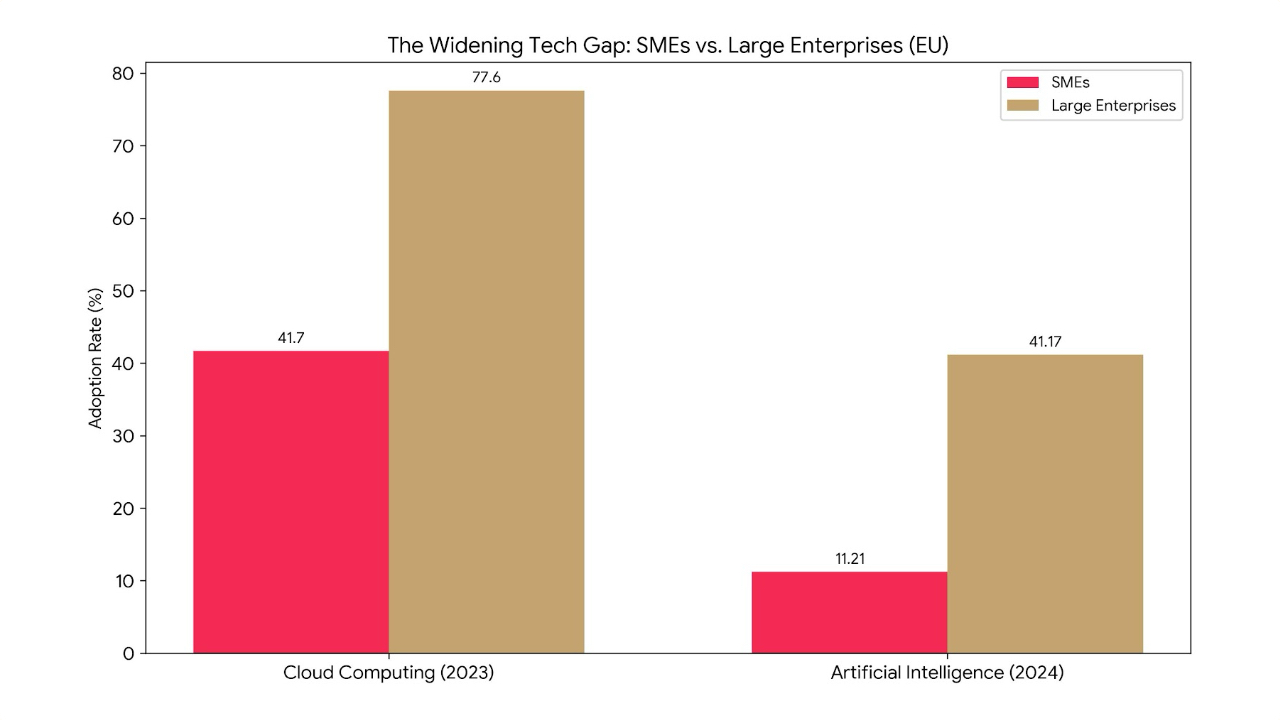
    The biggest challenge is the ‘cloud gap’ between companies of different sizes. While 77.6% of large corporations are actively using the cloud, the figure for small businesses drops to just 41.7%. This is a gap of more than 35 points, showing that SMEs still face barriers to accessing this fundamental technology.

    Moreover, companies that are already in the cloud mainly use it for basic tasks: email handling (82.7%), file storage (68%) or office software (66.3%). They are much less likely to use advanced services such as developer platforms (PaaS) or computing power (IaaS), which are essential for building innovation.

    The conclusion for managers is simple: the cloud is not just a storage facility for data, but first and foremost a launch platform for AI. Companies that do not invest in a mature cloud infrastructure today will have a double barrier to overcome tomorrow to enter the world of artificial intelligence.

    Artificial intelligence: the technology that divides most

    If the cloud shows the cracks, artificial intelligence reveals the real divide. Despite the huge interest, AI adoption in European companies remains alarmingly low, at just 13.48% in 2024. This is a result that is dramatically far from the EU target of 75% for 2030.

    “The AI implementation gap is gigantic. Artificial intelligence is used by as many as 41.17% of large corporations, but only 11.21% of small companies. This means that large companies implement AI almost four times as often. Poland, with a score of 5.9%, is at the grey end of Europe, ahead of only Romania (3.07%).

    Why is the gap so deep? Cloud deployment is often a decision to optimise costs. AI implementation is a strategic investment with an uncertain return, requiring not only capital, but above all competence and a mature data management strategy – resources that SMEs often lack.

    If this trend continues, AI, rather than levelling the playing field, will become the ‘great divider’. This could lead to a ‘winner-take-all’ scenario, in which large, data-rich corporations, thanks to AI, will become even more powerful, marginalising smaller players.

    Cyber security: the paradox of risk in the SME sector

    On paper, the situation looks good: 92.76% of companies in the EU use at least one ICT security measure. However, these are mainly basics, such as strong passwords or data backup. The real picture of digital resilience emerges when we look at proactive measures.

    A regular ICT risk assessment – the cornerstone of any mature security strategy – is carried out by only 34.1% of companies in the EU. The difference between large (75.62%) and small (29.35%) companies here is colossal. This means that most SMEs are operating ‘blindly’ without fully understanding their attack surface.

    This leads to the ‘SME digital risk paradox’. On the one hand, small businesses are increasingly being targeted, seen as ‘easier prey’ and a gateway to the supply chains of larger partners. On the other hand, they invest the least in strategic defence, mistakenly believing that they are too small to attract the attention of cybercriminals. In the connected economy, SME security becomes a security issue for the entire ecosystem.

    How to bridge the digital divide?

    Passivity is no longer an option. To survive and compete in the digital decade, SME leaders must take decisive action.

    It makes sense to start with strategy, not technology. Before you invest in any tool, define the key business problem you want to solve. Is it increasing sales, reducing costs or perhaps improving customer service? Only then select the right solution.

    Use the cloud as a foundation. Migrate core systems (email, files, accounting) to the cloud. This will not only free up resources and increase security, but most importantly create a centralised database – a prerequisite for future AI implementations.

    Invest in people, not just platforms. The best technology is useless without a competent team. Take advantage of available EU and national programmes (e.g. Digital Skills and Jobs Coalition, SME4DD) to upskill staff in data analytics, digital marketing and cyber security.

    Think security from the outset. Treat cyber security as an integral part of any digital project, not an expensive add-on. A proactive approach is always cheaper and more effective than reacting to a crisis.

  • IT partner in 2026: Why is the partner channel generating $2 trillion in SME sector spend?

    IT partner in 2026: Why is the partner channel generating $2 trillion in SME sector spend?

    Paradoxically, it is not algorithms but trusted human capital that is becoming the most valuable asset of smaller business. The SME sector is increasingly shifting its budgets towards specialised partners, looking to them not only as suppliers, but above all as architects of survival. In 2026, as much as 79% of IT spending in the SME sector flows through the hands of commercial partners. In regions such as EMEA or Latin America, this figure is even higher than 80%.

    This is no coincidence, but proof that relationship and local trust are becoming the hardest currency in business.

    Partner as ‘external brain’ of the operation

    For a small or medium-sized company, technology is rarely an end in itself – it is a tool for survival and growth. At the current rate of innovation, managing the technology stack alone is becoming an insurmountable barrier for SMEs. The difference between the market average (66.7% spend by partners) and the SME sector (79%) shows that the smaller the scale of the business, the greater the need for a trusted guide.

    The IT partner in 2026 has become the de facto ‘external technology director’ . Companies with between 100 and 499 employees, which account for as much as 42% of spend in their segment, are not looking for products on the shelves of digital giants. They are looking for someone who will take responsibility for consultancy, implementation and, most importantly, ongoing operational support.

    The end of the dictatorship of “boxed” solutions

    The SME market in 2026 has developed a defence mechanism against technological chaos. Although this sector’s spending is growing more slowly than the broader enterprise market, its structure is becoming increasingly consolidated around external advisors. While the largest corporations are pumping billions directly into hyperscale data centres, smaller companies have almost completely handed over the reins to local partners.

    This change is not a coincidence, but a pragmatic calculation. The medium-sized company is not looking for access to raw computing power, but a ready continuity of processes. In EMEA, where partners control as much as 82% of spending, technology has become a service whose stability must be vouched for by a specific individual, not the anonymous rules and regulations of a global provider

    Managed services: A new standard for security and peace of mind

    Omdia’s data analysis sheds light on a fascinating trend: the dynamic growth of managed services, which is expected to reach $251 billion at 9.7% growth. This signals a profound mental shift in business. Entrepreneurs have realised that a one-off implementation is only the beginning.

    Technology in the hands of smaller companies has become a test of character and trust. While the market giants are tempted by direct access to powerful infrastructure, the SME sector in 2026 is massively opting for the intermediation of local partners, seeing them not only as suppliers, but above all as guarantors of operational peace of mind. The eighty per cent dominance of the partner model is clear evidence that it is the personal relationship that is becoming the most effective fuse for business growth.

    Cloud and connectivity – foundations built by intermediaries

    Although cloud computing is associated with giants such as AWS, Microsoft and Google, partners are the ones ‘bringing it under the roof’ of medium-sized companies. The predicted 22.3% growth in cloud infrastructure services is largely due to integrators who can carry out a secure migration without paralysing the customer’s current operations.

    A similar mechanism is observed in the area of Unified Communications (UC). Since 9 out of 10 UC platforms are purchased through partners, this means that the key for the business is not the chat application itself, but its integration with sales processes, customer service and ERP systems. The partner is the architect here, making the individual building blocks from different suppliers start to form a coherent whole.

    cloud

    Regional dependency

    Geographical data confirms that reliance on the partner channel is a global trend and resilient to cultural differences. From Asia (81%) to Latin America (86%), the SME sector needs local support. Even in North America, where direct sales models are historically the strongest, up to 73% of budgets go through partners.

    The battle for the SME market is not taking place in the data centres of the hyperscalers, but in the relationships built by thousands of local IT companies. They are the ‘last mile’ of digitalisation, without which the global technology revolution would be bogged down by configuration problems and lack of technical support.

    Pragmatism instead of fascination

    An interesting phenomenon is the evolution of approaches to artificial intelligence. Although half of SME companies are already using AI tools, the time for hobbyist testing of chatbots is over. In 2026, AI has become an invisible component of analytics and compliance, and its implementation depends almost entirely on the competence of the IT partner. It is up to them to decide whether the technology will save money or merely increase the client’s technology debt.

    The real strength of the partner channel lies in its flexibility. While global providers standardise their offering to the limit, the IT partner adapts it to local legal and operational realities. It is this ‘last mile’ of implementation that generates the lion’s share of the $2 trillion that the SME sector puts on the table.

    The renaissance of relationships

    The addressable market for partners serving SMEs is expected to be worth as much as $1.87 trillion in 2026. This is evidence of a renaissance in professional advisory services, making it clear that the role of the partner as a trusted advisor is becoming more important than ever. Channel partners have won this battle because they are the only ones offering something that cannot be bought in a subscription model: personal accountability for the business outcome. For the SME sector, which cannot afford downtime and failed experiments, the professional IT partner has become the most important fuse for growth.

    Finally, it is worth adding that, according to Omdia data, the SME sector, with a budget of $2.38 trillion, will capture nearly 40% of the IT pie in 2026, creating a powerful space for partners to build business value.

  • Billions of euros are slipping through their fingers. European SMEs are oversleeping the energy revolution

    Billions of euros are slipping through their fingers. European SMEs are oversleeping the energy revolution

    Although the small and medium-sized enterprise (SME) sector is the backbone of the European economy, generating more than half of the EU’s GDP, its role in the green revolution remains surprisingly marginal. The latest report published by the Solar Impulse Foundation and Schneider Electric, entitled Unlocking SME Competitiveness in Europe, sheds light on an important paradox. Although these companies account for 99 per cent of all players in the market, only 11 per cent of them are making significant investments in sustainability. This sluggishness could cost the European economy billions of euros in potential value lost by 2030.

    The authors of the study point out that the key to unlocking this potential is the synergy of electrification and digitalisation. Estimates are promising: the implementation of appropriate technologies would reduce the sector’s energy consumption by 20 to 30 per cent and, in some industries, reduce CO2 emissions by up to 40 per cent. However, the problem lies in the approach to strategy. The report makes a clear distinction between ad hoc measures and long-term plans. While as many as 93 per cent of companies are taking single efficiency measures such as replacing equipment, only a quarter have developed a comprehensive decarbonisation strategy.

    The market needs systemic solutions, not just spot-on implementations. Digital integration is now a matter of tough competitiveness and cost control, not just image. Indeed, smaller players, due to their limited bargaining power, are extremely vulnerable to energy price shocks, making them ideal candidates for the adoption of models such as Energy-as-a-Service.

    However, this transformation faces infrastructural barriers. Europe, wanting to increase the electrification rate to 32 per cent by the end of the decade, has to face the fact that 40 per cent of electricity grids are over 40 years old. This modernisation requires an investment of €584 billion. Against this backdrop, the report calls on policymakers to take urgent action, including simplifying permitting procedures and revising tax directives, which could lower investment risks for the SME sector and accelerate the adoption of modern energy technologies.

  • The digital innovation trap: Why SMEs are losing out by chasing trends

    The digital innovation trap: Why SMEs are losing out by chasing trends

    The competition is already implementing AI, but are we? Will we be left behind? – This is the question that keeps many SME managers and business owners awake at night. Bombarded by headlines about revolutions, conferences promising breakthroughs and vendors guaranteeing that nothing will work without X, they feel immense pressure. Is this pursuit of every technological innovation a deliberate strategy or is it an act of panic?

    Unfortunately, it is too often the latter. Blindly following trends is a costly digital innovation trap. Instead of solving problems, it generates new ones. In an age of ubiquitous information noise, the real strength of mid-market business turns out to be not pursuit but pragmatism – its traditional foundation.

    The SME sector is particularly susceptible to trend pressure. It is not even about real competitive advantage, but about perception itself. The fear of being perceived as a backward company and on the threshold of extinction is sometimes stronger than cool business calculation. This psychological background sets in motion a typical vicious implementation cycle. It starts with panic and fear of missing a breakthrough (technological FOMO – Fear of Missing Out). Then a hasty implementation is undertaken, where a tool is chosen before the problem is defined. This ends in frustration, operational chaos and expensive island solutions. In the end, there is a bitter conclusion: this technology does not work, while only a flawed decision-making process was to blame.

    Decision-makers often focus on the cost of licensing, which is a mistake. The real costs of chasing trends are hidden and much deeper. The financial cost is not just the purchase, but the gigantic integration expenses, endless training, consultant support and the risk of dependence on a single supplier (vendor lock-in). Equally acute is the human cost. Frustration and resistance from the team is a guarantee of project failure; if employees see the new tool only as a pointless chore, the project will fail. However, the most serious is the strategic cost. The time, energy and budget spent on fighting a failed AI implementation are resources that have not been devoted to solving the company’s real problems. A chatbot has been implemented, but the company is still drowning in a flood of emails and critical data languishing in Excel sheets.

    No technology is bad in itself – what is bad is sometimes its application. Let’s look at the three most talked-about trends through the lens of pragmatism. The cloud offers flexibility, but does a company really need everything in the cloud? A hasty migration is sometimes unprofitable and generates serious legal risks. Blockchain is a revolutionary technology, but it is not the answer to everything. Do we really need a distributed registry to manage HR records when a robust database is 90% cheaper and 100% sufficient? Finally, AI – the biggest buzz of recent years. It’s supposed to automate and predict, but fed with chaos and junk data, it only produces expensive, junk results. Before we buy AI, we need to have something to analyse.

    So how do we escape this trap? Escaping the FOMO trap does not mean technological stagnation. It means returning to the foundations of healthy management, based on three steps.

    Firstly, diagnosis before prescription is essential. The order of asking the question needs to be fundamentally changed. Not “What technology should we implement?”, but “What specific problem do we want to solve?”. The problem is not a lack of AI, but invoices issued a week late. The solution then is to improve the workflow in the ERP system, not a chatbot.

    Secondly, you need to do your digital homework. High-tech is an arbitrary programme that is only possible once you have mastered the mandatory programme. For most SMEs, this homework is the foundations: mapped processes, clean CRM, structured data and consistent interfaces (APIs) between systems.

    Thirdly, it takes courage to say No. Nowadays, true business courage is not the pursuit of novelty. It is a conscious decision, backed up by analysis, not to implement something that does not fit in with the company’s strategy, is unprofitable or is implemented prematurely. This is not a sign of backwardness, but of strategic maturity.

    Medium-sized companies should not see technology as an end in itself. It doesn’t matter if there is a trendy AI, Blockchain or Cloud label on the solution box. What is decisive is only whether the solution realistically makes work easier, reduces costs or inspires customers. True innovation in SMEs is not an expensive pursuit of fashion. It is the continuous, pragmatic improvement of processes using the right tools – even if they are as unfashionable as a solidly implemented ERP system.

  • Asymmetry in business – why SMEs prefer to avoid large companies

    Asymmetry in business – why SMEs prefer to avoid large companies

    The relationship between small and large companies in Poland is still burdened by an imbalance of power. A study by the National Debt Register shows that as many as 72 per cent of micro, small and medium-sized enterprises believe that large entities exploit their advantages. For many SMEs, extended payment terms are a key problem – indicated by 60 per cent of respondents. Significantly, 44 per cent of companies admit that, for fear of risk, it is better to avoid cooperation with corporations altogether.

    This approach comes at a cost. Avoiding relationships with the big players means missed opportunities for SMEs – both for stable orders and for scaling the business. However, the fears of small companies are not unfounded. Almost 4 in 10 respondents admit that negative experiences of working with large contractors have become a reality.

    However, the survey indicates that there are ways to minimise risks and create a more collaborative relationship. The most frequently mentioned are precise contracts and their legal analysis (37 per cent of indications), transparent communication and regular discussions about the quality of cooperation (30 per cent), as well as the use of advance payments or factoring to secure liquidity.

    Companies also advise verifying counterparties in business information offices (28 per cent) and diversifying the client portfolio to avoid overdependence on one large entity (27 per cent). This is a pragmatic approach: a large partner can be a source of stable revenue, but over-dependence on one contract increases vulnerability to crises.

    According to entrepreneurs, the balance could be improved by systemic solutions – e.g. industry contract standards or restrictions on the use of assignment bans. The latter safeguard, readily used by large companies, prevents SMEs from benefiting from factoring and thus limits their ability to maintain liquidity.

    The problem of asymmetry is not exclusive to Poland. According to European Commission analyses, extended payment terms are one of the main factors in SME bankruptcy in the EU. Therefore, work has been going on for years to introduce uniform payment rules that would strengthen the position of smaller companies.

    The paradox is that, although cooperation with large counterparties is feared, in the long term it is precisely this that can open the way for small companies to larger markets and innovative projects. The key question remains how many SME entrepreneurs will abandon this path because of concerns – and how many will thus close the door to growth.

  • How to increase IT sales in the SME sector? KPMG segment analysis

    How to increase IT sales in the SME sector? KPMG segment analysis

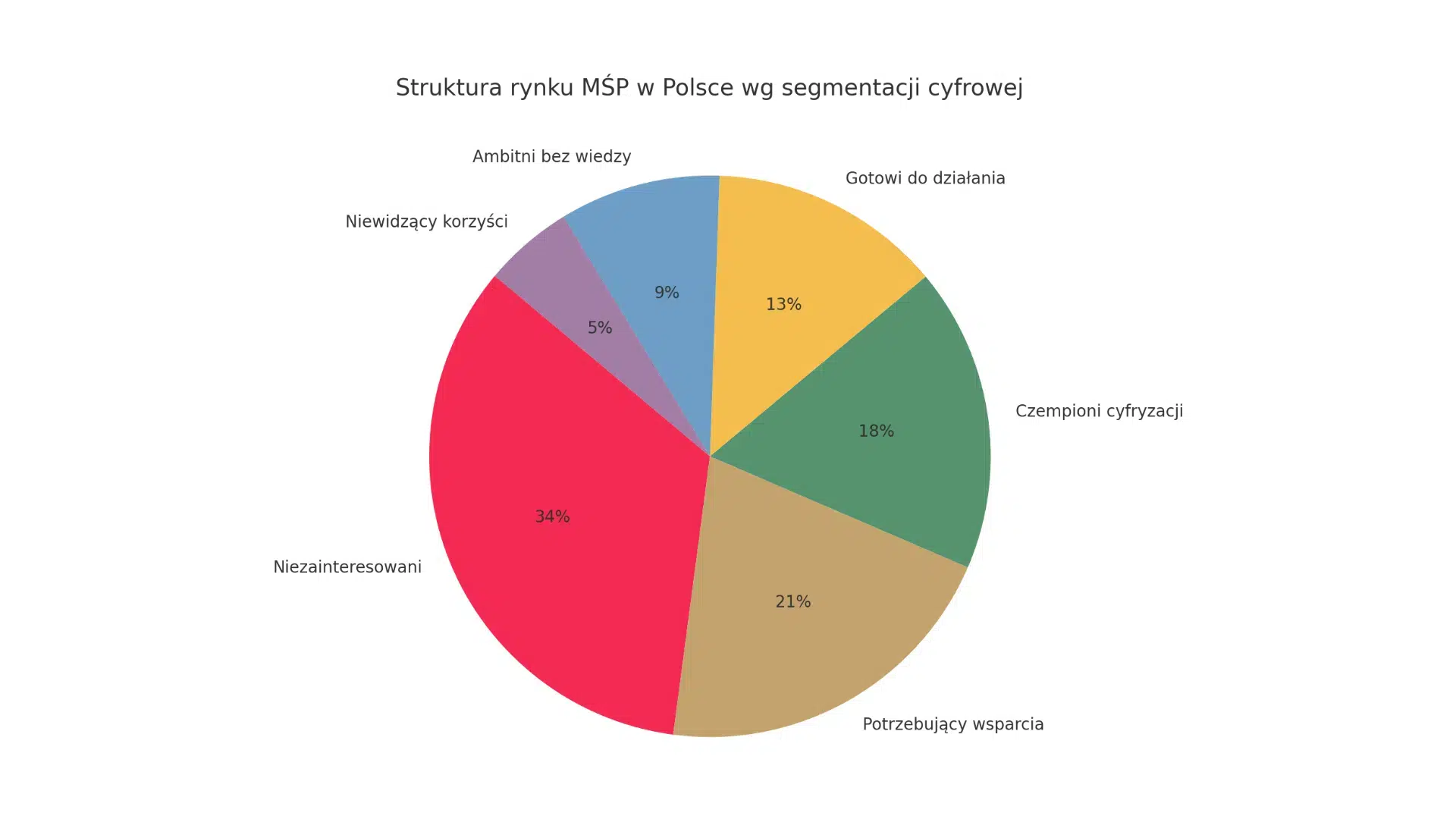
    Small and medium-sized enterprises account for 99.8% of all active companies in Poland. Although they are the foundation of the national economy, their level of digitalisation lags behind the European average. Poland ranks only 24th in the DESI ranking, and only 40% of domestic SMEs have reached a basic level of technology use. By comparison, this figure reaches 55% in the European Union. However, these overall figures do not reflect the complexity of the market. Detailed research conducted by KPMG as part of its report ‘Advancing the Digital Transformation of Polish Enterprises‘ showed that the SME sector is not homogeneous. It can be divided into six distinct segments, each with a different approach to technology, development motivation and transformation barriers.

    Digital map of Polish SMEs

    The largest group are companies identified as ‘Uninterested’, accounting for as much as 33% of the market. Their attitude towards technology is passive – they only implement new solutions when they are forced to do so, and digitisation itself makes them anxious. On the other side are the “Champions of digitisation”. – 17% of companies that treat technology as a key element of their business strategy and actively seek innovation. In between these poles, there are segments that are more diverse: ‘Needing support’ (20%), ‘Ready to act’ (13%), ‘Ambitious without knowledge’ (9%) and ‘Not seeing the benefits’ (5%).

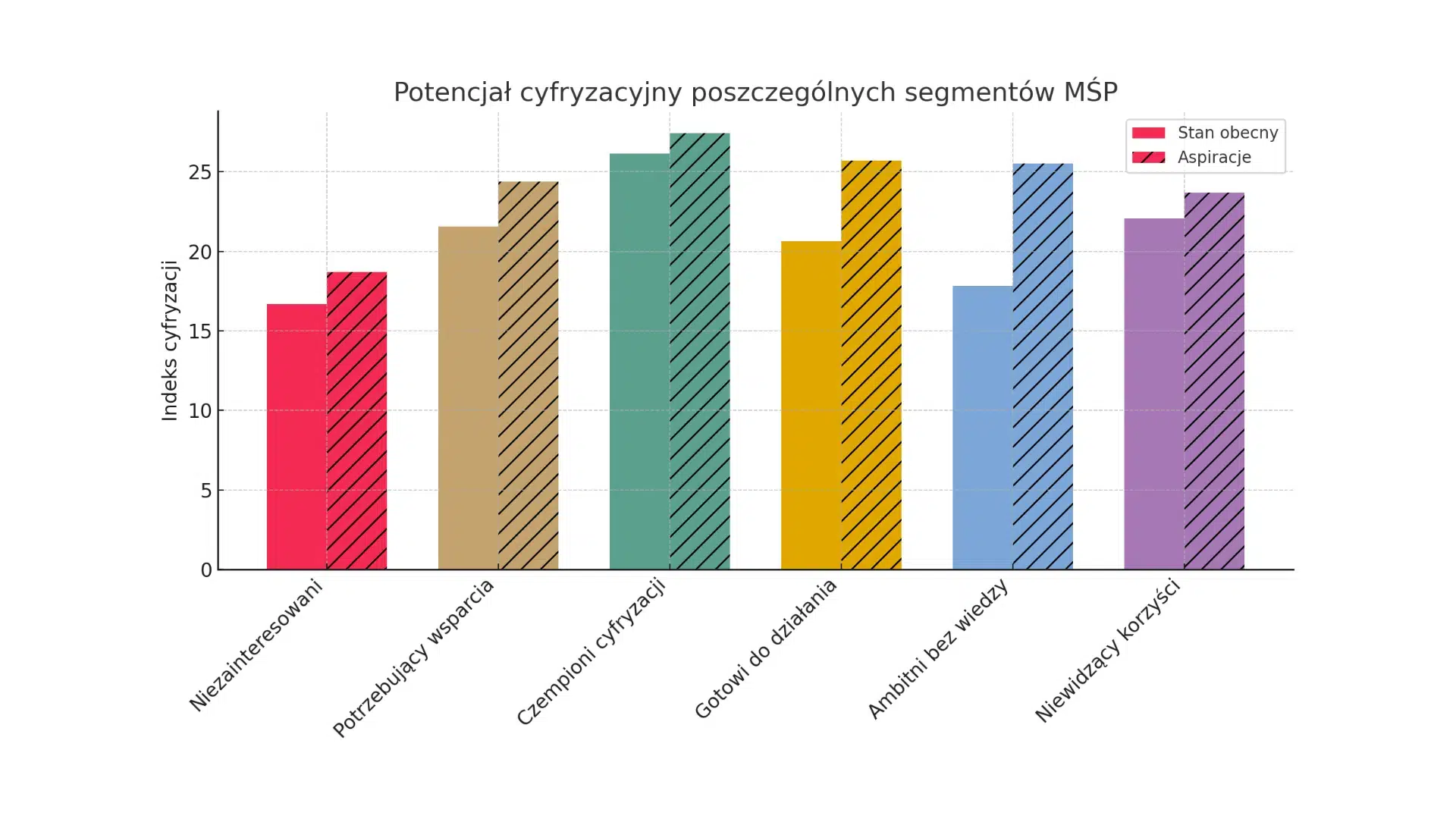
    A juxtaposition between the current level of digitalisation and the digital aspirations of the different groups reveals their development potential. The biggest differences between the current state and declared plans concern the ‘Ambitious without knowledge’ and the ‘Ready for action’. These are companies that are aware of the need for change and want to grow, but often lack knowledge, resources or the right technology partner.

    What distinguishes each segment and how to talk to them?

    “Uninterested” are usually long-established companies, operating locally, often in a B2C relationship. Their digitalisation is limited to basic areas such as finance or workflow. They are apprehensive about digital transformation and a key barrier is a lack of internal need for change. For this group, effective sales should be based on external impulses – such as regulatory changes – and simple financial messages. The offer should be as simple as possible and tailored to minimum expectations.

    A completely different approach should be taken with the ‘Ambitious without knowledge’. These younger companies are aware of the benefits of digitalisation and are strongly motivated to change, but face competence and budgetary constraints. An effective way to reach this segment is to take on the role of advisor and educator. Educational content such as webinars, tutorials or free audits are valuable support tools. The recommended offer should be scalable and flexible, allowing development according to the pace and capabilities of the company.

    “Not seeing the benefits” are companies that have already invested in technology and are using a relatively broad set of tools (8 out of 12 respondents on average), but do not see the point of further transformation. Their attitude is one of scepticism, and digitisation raises concerns especially among employees. For this group, concrete evidence – especially well-documented case studies from their industry – is crucial. It is not worth talking about revolution – it is better to focus on optimisation, integration of existing systems and improving efficiency.

    There is great potential for growth in the ‘Needs Support’ segment. These companies are convinced of the need to digitise, but lack the resources, time and access to knowledge about available forms of support. Their main motivation is the desire to keep up with modernity. Operational implementation is a key challenge – so comprehensive offers, including both consultancy and implementation and training, will be most effective. Of particular value here is assistance in obtaining funding, especially through public programmes.

    “Ready for action” is a segment that is aware of and well prepared for the next technological steps. Their main challenge is the lack of integration between existing systems – they have many solutions, but they do not form one coherent ecosystem. In this case, the merchant should be a knowledgeable partner, able to propose integration projects, infrastructure audits and training for more advanced users.

    At the end are the “Digitalisation Champions” – companies that are already using most of the solutions available today and are looking for innovations that will maintain their competitive edge. These are the customers who demand a strategic approach, technological innovations and partnerships. They are open to pilot projects, AI experiments, process automation or R&D joint ventures.

    potencjal cyfryzacyjny

    What are the lessons for the IT sales channel?

    Firstly, segmentation is a must. Trying to sell technology in a one-size-fits-all way is unlikely to work today. Precise customer qualification – even if only by asking a few questions about the strategy, challenges and the team’s approach to new tools – significantly increases the chance of success.

    Secondly, education is the most important sales tool today. Lack of knowledge, uncertainty and competence constraints appear in all less sophisticated segments. Providers who can deliver educational content and share expertise will not only sell more, but also build customer loyalty.

    Thirdly, the future belongs to services. The report clearly shows that SMEs do not have the resources to manage the digital transformation themselves. This signals that the market will grow where the offering goes beyond the provision of technology to include operational support: from consulting to implementation to managed services and IT outsourcing.