Tag: Cisco

  • Jacek Przybylski new General Director of Cisco in Poland

    Jacek Przybylski new General Director of Cisco in Poland

    Cisco, the networking infrastructure and cyber security giant, has made a strategic change at the top of its Polish structures. Jacek Przybylski, previously leader of the company’s Krakow centre and director of the Customer Experience area in EMEA, has taken over as general manager in Poland. This change comes at a critical time when the local market is shifting its centre of gravity from simple digitalisation towards advanced ecosystems based on artificial intelligence.

    Przybylski’s appointment is no coincidence and is part of Cisco’s broader strategy, which emphasises the synergy between professional services and security. The succession from Przemyslaw Kania, who was promoted to regional structures, suggests a continuation of steady growth, but with a new operational focus. Przybylski brings to the role a unique perspective built on 16 years’ experience at Atos, where he specialised in managed services and process optimisation. This proficiency in ‘delivery’ will be key as Polish companies increasingly look not just for hardware, but for comprehensive support in scaling AI technologies.

    New leadership means a partner that understands the European (EMEA) services market and is able to translate global innovation into the local realities of Poland’s dynamic economy. Pär Holgersson of Cisco EMEA North points to customer and partner relationships as a priority. Combining the engineering background of the Bydgoszcz University of Technology with the business acumen of HEC Paris, Przybylski seems ideally positioned to navigate this new and challenging technology landscape.

  • A silent threat in corporate networks. Critical vulnerability in Cisco SD-WAN

    A silent threat in corporate networks. Critical vulnerability in Cisco SD-WAN

    Critical infrastructure and large enterprises face an urgent cyber security challenge. Cisco has disclosed a critical zero-day vulnerability in its network management systems: Catalyst SD-WAN Controller and SD-WAN Manager. The vulnerability, designated CVE-2026-20127, received a maximum threat score of 10.0 on the CVSS scale. Most worryingly for security executives, advanced hacking groups had been actively exploiting the bug since at least 2023, remaining completely unnoticed until its official publication in February 2026.

    The problem relates to authentication mechanisms that, in theory, should protect access to key devices that manage a corporation’s network traffic. By exploiting this vulnerability, unauthorised attackers can take over top administrative privileges. Experts at Cisco Talos, who identified the attack group as UAT-8616, point out the sophisticated nature of their operations. The hackers, after gaining initial access, deliberately downgrade the software version to exploit an older 2022 vulnerability in order to gain full root-level control. They then discreetly restore a newer version of the system, effectively obliterating traces of their presence and securing permanent access.

    For business, this means risk at a strategic level. SD-WAN controllers are a kind of command centre for corporate wide area networks, managing virtual private networks (VPNs), routing and traffic segmentation. Taking control of them opens the way for the silent theft of sensitive data, sabotage or the deployment of ransomware on a massive scale. These activities are part of a wider, dangerous trend of targeting network edge devices, which provide an ideal beachhead for long-term espionage operations.

    Organisations cannot rely on half-measures as there are no temporary workarounds for this problem. IT departments must immediately deploy the patches provided by Cisco to solve the problem at source. Equally important is to conduct a deep security audit. Technical teams should analyse system logs from the past three years, looking for unauthorised peering connections, unexpected software version changes or anomalous logins from unusual IP addresses. Experts also recommend strictly isolating controllers inside the network and working with incident specialists when compromises are detected. A quick and decisive response is currently the only way to secure operational continuity.

  • Cisco paradox: Why didn’t $5bn in AI orders save the share price?

    Cisco paradox: Why didn’t $5bn in AI orders save the share price?

    Cisco Systems, the networking giant, has hit a point that perfectly illustrates the harsh reality of the artificial intelligence era. Although the company exceeded revenue expectations, its shares fell 7% in after-hours trading. The reason is simple but acute for investors: building AI infrastructure is becoming more expensive, which has directly hit the company’s margins.

    Cisco’s adjusted gross margin in the last quarter was 67.5%, which fell short of market forecasts of 68.14%. The reason for this is not a lack of demand, but a global scramble for components. Hyperscalers like Microsoft and Alphabet are absorbing almost every available batch of advanced memory chips needed to process AI models. As a result, semiconductor manufacturers are prioritising the most profitable modules for data centres, drastically increasing the price of the other components that Cisco relies on for its switches and routers.

    The situation puts CEO Chuck Robbins in a difficult position. On the one hand, the company has raised its revenue forecasts for 2026 to between $61.2-61.7bn, driven by a backlog of orders for AI systems worth more than $5bn. On the other hand, the company now needs to prove it can manage costs in an inflationary environment. Robbins has already announced product price adjustments and the renegotiation of contracts with partners, a classic run to protect profitability.

    Investors who hiked Cisco’s share price by 30% in 2025, hoping for an ‘AI dividend’, have been sent a clear message: simply being the ‘picks and shovels’ supplier to the technology revolution does not guarantee linear earnings growth. The key challenge for Cisco in the second half of the year will not be order acquisition per se, but the speed at which it manages to turn a record backlog into real, high-margin revenue.

    Cisco is no longer seen only through the prism of stability. The company is becoming a litmus test for the entire hardware industry. If a giant of this scale is struggling to maintain margins amid record demand, it suggests that AI infrastructure costs may soon force a broader adjustment in pricing strategies across the technology sector.

  • A 15-year alliance between R.Power and Cisco. Polish photovoltaics will gain new capacity in 2027

    A 15-year alliance between R.Power and Cisco. Polish photovoltaics will gain new capacity in 2027

    Securing the supply of green energy is becoming as important as software development. The latest deal between networking giant Cisco Systems and Poland’s R.Power Group sheds light on the maturation of the European vPPA (Virtual Power Purchase Agreement) market.

    The contract is for an impressive 470 GWh of energy to be produced by four new photovoltaic farms in Poland. For Cisco, this is not only an achievement of its ESG goals, but a strategic operational safeguard for key assets, including its expanded technology centre in Kraków. From a business perspective, the move shows that global corporations have stopped treating green energy as a marketing add-on and have started to see it as a key component of the supply chain.

    Capital leverage for the region

    For R.Power, an agreement with such a prestigious partner signals its readiness to serve the most demanding corporate customers. The 15-year time horizon of the contract provides the company with the cash flow stability necessary to finalise the construction of the power plants in Wydartów, Bieżyce, Ostrzeniewo and Nowy Zagórze. These projects are expected to reach operational readiness in 2027, which is part of a broader trend of accelerating RES investments in Central Europe.

    It is worth noting the role of the Sustainability Roundtable, Inc. (SR Inc.) and the Net Zero Consortium for Buyers initiative. Their participation in the transaction suggests that the market is moving towards greater standardisation and consolidation of demand. Such mechanisms make even complex, cross-border deals accessible to a wide range of players, lowering the barrier to entry for private capital into the energy transition sector.

    Balance of profits

    From a business strategy perspective, the vPPA with R.Power allows Cisco to decarbonise without physically owning the power infrastructure. This is an asset-light model that fits perfectly with the nature of the IT industry. At the same time, for the Polish energy market, the entry of such capital means an impetus to modernise the network and build a flexible system that will have to accommodate the growing demand from the technology sector in the coming years.

    In the face of rising allowance prices and regulatory pressure, the alliance between Cisco and R.Power is more than a press release – it is a pragmatic calculation in which the stability of energy costs becomes the new determinant of competitiveness in the global market.

  • Billions for network visibility. Will Cisco acquire the Axonius platform?

    Billions for network visibility. Will Cisco acquire the Axonius platform?

    Cisco Systems is not slowing down in its consolidation of the cyber security market. According to reports from Ctech by Calcalist, the tech giant is in advanced talks to acquire startup Axonius. An offer of around $2 billion is said to be on the table. Although officially Axonius denies the reports, claiming that it is solely focused on “customers and meeting targets”, market analysts read this as a classic negotiation game. Indeed, in the background of the transaction, there is a clear trend of unicorn valuation correction.

    For Cisco, which is still putting together its portfolio after giant acquisitions (including the acquisition of Splunk), Axonius would be a strategic piece of the puzzle. The New York-based startup, founded in 2017, is a leader in the category of cyber asset attack surface management (CAASM). In short: it solves one of IT’s oldest problems – inventory. Unlike traditional tools, the Axonius platform does not require agents to be installed. Instead, it connects to hundreds of existing data sources – from the cloud to vulnerability scanners – to create a single, consistent view of the infrastructure. This allows companies to detect ‘invisible risks’, i.e. forgotten devices or unmanaged accounts that often become gateways for hackers.

    The most interesting strand of this story, however, is the financial maths. In 2022, after a $200 million investment round, Axonius was valued at $2.6 billion. A possible sale for 2 billion would therefore mean a so-called down exit – an exit below the peak valuation. Such a scenario is becoming the new normal for many technology companies, which have to choose between a difficult IPO or a safe harbour alongside a giant.

    For Cisco, this price may seem promotional, especially given that Axonius’ direct competitor Armis is priced much higher. If the deal goes through, it would signal Cisco’s intention to dominate the asset visibility niche before that market has fully matured. For now, however, we are left to watch whether Axonius’ denials are the last line of defence for independence or just a prelude to an acquisition announcement.

  • Are the giants catching up? Ubiquiti and Huawei grow in the shadow of WLAN market leaders

    Are the giants catching up? Ubiquiti and Huawei grow in the shadow of WLAN market leaders

    The wireless market continues to grow, but the euphoria of the beginning of the year is clearly subsiding. Although the third quarter of 2025 closed with a solid result on the upside, the real revolution is not happening in the overall sales columns, but inside the leaderboard. Whilst the old stagers are stabilising their positions or losing share, the “contenders” are recording results that the partner channel cannot pass by. Are we witnessing a permanent reshuffling of forces in the network industry?

    As recently as the first half of 2025, the Enterprise WLAN market was still posting double-digit growth, whetting the appetites of integrators and distributors. However, the third quarter brought a slight cooling off. According to the latest IDC data, the sector grew by 7.8% year-on-year, generating sales of $2.7 billion. This is still a solid result, but clearly lower than the 10.5% or 13.4% recorded in the first and second quarters respectively.

    However, looking only at overall sales volumes can be misleading. For beneath the surface of stable growth, there is a fierce battle for customers in which the previous hegemons must increasingly look back.

    Stabilisation at the top, explosion in the “second line”

    The biggest surprise of the past quarter is not how much the market has grown, but who has gained the most from this growth. The vendor landscape (Vendor Landscape) has clearly polarised.

    Cisco still rules indivisibly at the top. With a market share of 37.4%, the US giant remains the default choice for the largest corporations. However, its revenues in the period under review fell by 3% year-on-year (to US$992.4 million). This may suggest some saturation in the premium segment or prolonged decision cycles at the largest customers, who are holding back on further investments.

    In second place on the podium, with a 19.3% market share, is HPE. The company, which finalised its acquisition of Juniper in July 2025, saw revenue growth of a modest 1.6%. While this merger may change the balance of power in the long term, for now we see stabilisation rather than synergies that would catapult sales performance upwards.

    However, the real dynamics can only be seen behind the leaders. The title of ‘dark horse’ of the third quarter unquestionably belongs to Ubiquiti. The manufacturer recorded impressive revenue growth of as much as 47.1%, achieving sales of over USD 300 million and capturing 11.3% of the market. This is a clear sign that customers – especially in the SME and mid-market sectors – are increasingly looking for solutions that offer better value for money, abandoning expensive licences and complex enterprise ecosystems in favour of simpler-to-use platforms.

    Huawei is performing equally impressively . Despite global challenges and trade barriers, the Chinese giant increased WLAN revenues by 33.7%, now controlling 9% of the market. The list is rounded off by CommScope (Ruckus Networks), which also boasts a great result – growth of 18% confirms that in specific verticals (e.g. hospitality or high-density), Ruckus still has a loyal customer base.

    Europe buys the most

    For the Polish IT channel, however, it is not only global brands that are key, but also the geography of sales. Here we have excellent news. It is the EMEA region (Europe, Middle East, Africa) that is currently driving the global WLAN market.

    In the third quarter, the market in our region grew by as much as 12.8% year-on-year. By comparison, the Americas, traditionally the bastion of the largest investments, grew by “only” 6%, and the Chinese market even contracted (-1.3%).

    What does this mean for resellers and integrators on the Vistula? Europe is in a phase of intensive infrastructure modernisation. Companies are catching up with technology and are opening up budgets for new networks more readily than their US or Asian counterparts. This is a moment worth seizing, especially by offering upgrades to the latest standards.

    Wi-Fi 7: It’s no longer a novelty, it’s the standard

    Where is this demand coming from if the market is slowing down a bit globally? The answer is simple: the 6 GHz band. Business customers have realised that it is no longer possible to work efficiently in the crowded ether of the 2.4 GHz and 5 GHz bands.

    Adoption of the new standards is progressing rapidly. Wi-Fi 7 already accounted for 31.3% of market revenue in Q3 2025 (a jump from 21% a quarter earlier!). If we add in the Wi-Fi 6E standard (24.5% share), we find that more than half of the money spent on wireless networks goes to devices that support the 6 GHz band.

    Companies have stopped treating Wi-Fi 7 as ‘tomorrow’s technology’. It has become the ‘for today’ standard. The tripling of bandwidth and new radio spectrum capabilities are arguments that convince IT departments to replace their access point fleets, even if the previous generation has not yet been fully depreciated.

    What is the modern customer looking for?

    Analysing market data and the opinions of IDC experts, it can be concluded that the very criteria for choosing a supplier are changing. The era of “buying boxes” (Access Points) is definitely over.

    The modern organisation is not looking for connectivity alone – it is looking for an intelligent platform. Market experts point out that the key to customer portfolios today is a holistic approach. Systems that offer:

    • Deep integration: WLAN must be part of a larger network stack, not a separate island.
    • AI and automation: With increasing network complexity, administrators need tools that detect and fix problems themselves (AIOps).
    • Built-in security: Wi-Fi becomes the first line of defence and security functions must be integrated into the access point.

    Perhaps this approach is the secret of the success of companies like Ubiquiti – they offer sufficiently advanced management in a model that is easy to deploy and maintain, without the need to maintain an army of certified engineers.

  • The AI paradox: Emerging markets are outperforming the West, but paying the price

    The AI paradox: Emerging markets are outperforming the West, but paying the price

    The traditional model of innovation diffusion, in which wealthy Western economies dictate the rate of adoption of new technologies, is being reversed. The latest Cisco and OECD data from 8 December 2025 shows that India, Brazil, Mexico and South Africa have become global leaders in the use of generative artificial intelligence. However, this technological accelerator has a second bottom – the growing challenges of digital wellbeing.

    Until recently, it was assumed that infrastructure barriers in emerging economies would delay the implementation of advanced AI tools. Reality has verified these predictions. Not only do users from the Global South show a higher level of activity in using GenAI, but they also have significantly more confidence in the algorithms than respondents from Europe or the US. The Old Continent, despite easier access to technology, is currently characterised by greater scepticism and caution.

    The key to understanding this phenomenon is demographics. We are dealing with the emergence of ‘Generation AI’ – a group of people under the age of 35 for whom artificial intelligence is a natural part of the digital ecosystem. More than 75 per cent of representatives of this group find AI tools useful, and almost half of millenials and Generation Z have already had their first training in this area. At the other extreme are the over-55s, where uncertainty is prevalent, often due to a lack of knowledge rather than the actual shortcomings of the technology.

    An important conclusion flows from this: technology adoption alone is no longer a meaningful indicator of success. Research within the Digital Well-being Hub reveals a worrying correlation in countries with the highest digitalisation rates. There, intensive use of screens for entertainment (more than five hours a day) is associated with a decline in well-being and greater emotional vacillation.

    Guy Diedrich of Cisco rightly points out that the indicator of success should not be the number of users, but the real impact of the tools on the quality of work and life. The challenge for 2026 and beyond therefore shifts from the area of infrastructure accessibility to the field of education and digital hygiene. Without bridging the skills gap – both geographic and generational – and taking care of ‘digital wellbeing’, the enthusiasm of emerging markets may quickly collide with the barrier of digital burnout. For integrators and solution providers, this means offering technology as a package with informed education, not just as a boxed product.

  • Cisco is betting on AI. Forecasts up, shares soar

    Cisco is betting on AI. Forecasts up, shares soar

    Cisco Systems is sending a strong signal to the market: the AI revolution is not just the domain of chip manufacturers, but also a fundamental driver for network infrastructure. The company raised its full-year revenue and profit forecasts, which the market immediately rewarded with a significant increase in its stock price.

    Underpinning this optimism is the unprecedented demand generated by hyperscalers. Technology giants such as Alphabet, Microsoft and Meta are investing billions of dollars in data centre expansions to meet artificial intelligence workloads, and Cisco is a key beneficiary of this spending.

    The company revealed that it has already secured AI orders worth more than $2 billion for fiscal 2025, mostly from major cloud players. The dynamics are impressive – in the last quarter alone, orders for AI infrastructure from hyperscalers totalled $1.3 billion.

    CEO Chuck Robbins predicts AI infrastructure revenue from hyperscalers alone will reach $3bn by 2026. Analysts see this as a key catalyst for the networking business, which many considered mature.

    However, Cisco is not just limiting itself to data centres. The company recently launched the ‘Cisco Unified Edge’ platform, moving AI computing closer to where it is created – into factories, retail shops or medical facilities.

    In light of these contracts, the updated forecast for fiscal 2026 is for revenues in the range of $60.2-61bn (up from $59-60bn) and adjusted earnings per share of $4.08-4.14. Although first-quarter results ($14.88bn) only slightly beat expectations, it is future orders driven by AI that dominate the narrative and make investors optimistic.

  • Cisco and NVIDIA want to simplify building clouds for AI

    Cisco and NVIDIA want to simplify building clouds for AI

    Cisco and NVIDIA are clearly positioning themselves at the centre of the hardware debate about what AI infrastructure should look like in practice after an era of early implementations. The San Jose-based company showed off the N9100 switch, the first data centre switch based on NVIDIA’s Spectrum-X chip and compatible with the NVIDIA Cloud Partner programme. It’s seemingly just another piece in a networking offering, but it’s actually an important piece of the meta-game: Cisco is entering the future league of neocloud infrastructure and sovereign clouds, a segment where it is not so much a single hyperscaler that will count, but an architecture that can be deployed locally, controlled and optimised for AI.

    The real infrastructure revolution won’t happen in LLMs, it will happen on the network. Cisco’s Patel talks about the biggest DC expansion in history – and it’s not marketing: spending on AI data centres in 2025 is already counted as growth-class CAPEX from the 4G peaks and hyperscaler boom of 2016-2020; the biggest bottleneck is no longer GPUs, but network topology and capacity (including front-end and back-end Ethernet). Cisco’s announcement joins a trend that is evident in industry reports: hyperscalers have started to move from hardware GPU wars to network wars.

    Cisco is making two moves at once here. The first is a product: the N9100, with a choice of NX-OS or SONiC, showing that the flight of enterprise and telco customers towards greater system software sovereignty is starting to be a fact, not a slide. The second is an attempt to build a Cloud Reference architecture shared with NVIDIA. The idea is to have a common configuration for sovereign AI clouds – from switches to DPUs to SuperNICs. This is not another product line, but a move towards an AI factory that the customer can deploy as a blueprint.

    The additional layer is AI Security. Cisco was already set on a hybrid: security + observability + AI after the Splunk acquisition. Now it is adding a layer of integration with NVIDIA NeMo Guardrails, a signal that AI compliance and policy enforcing in LLMs will be part of the security stack. Splunk Observability Cloud is the catalyst here: it provides a single view of the cost and quality of inference. This is not a product firework, it is an approximation to the operational model of AI in large enterprises.

    The most interesting part of the announcement, however, is AI-RAN for telecoms, as an announcement of 6G networks with native AI. This is a move strictly under mobile operators, who are expected to see AI descend closer to base stations, rather than into cloud regions. The telco industry will need to improve traffic handling efficiency before AI goes massively live in smartphones, AR and robotics. This collaboration with NVIDIA at the RAN layer could be the first real 6G prototype that will make business and operational sense for MNOs.

    Cisco is gambling on becoming an AI ready infrastructure integrator and having ownership of the definition of the term. That’s why this announcement is more important than it looks at first glance. Cisco is trying to become the place where hardware, networking, security, observability and AI operability meet. In 2025, this could be the strongest definition of value in infrastructure.

  • How Cisco wants to combine AI data centres into one system – Silicon One P200 chip

    How Cisco wants to combine AI data centres into one system – Silicon One P200 chip

    Cisco is opening a new chapter in its network infrastructure story with the unveiling of the Silicon One P200 chip and 8223 router, specifically designed to connect distributed data centres supporting artificial intelligence. This is not the next iteration of hardware, but, as the company points out, a response to the growing power and bandwidth constraints facing the AI industry today.

    The new chip is intended to act as a ‘glue’ between data centres, which are increasingly being set up in remote locations where energy is cheaper or more readily available. In an era where single centres cannot meet the computational needs of generative AI, engineers are beginning to think in terms of ‘scale-across’, or horizontal scaling – multiple data centres working together like a single organism. The P200 chip is designed to enable just such an architecture, synchronising huge data streams over distances of thousands of kilometres.

    Cisco claims that the P200 achieves 51.2 Tbps throughput and replaces 92 separate chips previously used in similar solutions. In doing so, the new 8223 router consumes around 65 per cent less power, which is crucial in an environment where AI infrastructure is already consuming gigawatts of power. Partners for the first deployments include Microsoft Azure and Alibaba Cloud, which use Cisco technology to connect their own globally distributed data campuses.

    As Martin Lund, executive vice-president of Cisco, notes, the problem is no longer connecting thousands of GPUs in one place, but synchronising multiple data centres “thousands of miles apart”. Cisco’s solution is designed to help with this through extensive caching – a technology the company has been working on for decades to ‘absorb’ traffic spikes in AI networks.

    According to analysts, this is also part of a wider battle for the artificial intelligence infrastructure market, where Cisco is up against Broadcom, Marvel or Juniper. The success of the P200 and the 8223 router, however, depends not only on their technical performance, but on whether these solutions find sustained application in real-world hyperscale environments.

    For Cisco, it’s back in the game for a key position in a world where data and energy are becoming the new currencies of the AI economy. If the company’s announcements come to fruition, the P200 could become what the Catalyst switch once was – a chip that will set the standard in next-generation networks.

  • Cisco sets its sights on sovereignty. New offering for critical infrastructure in Europe

    Cisco sets its sights on sovereignty. New offering for critical infrastructure in Europe

    Cisco has unveiled its new Sovereign Critical Infrastructure offering, aimed at European customers seeking complete control over their data and systems. This portfolio of configurable on-premise solutions is the company’s direct and strategic response to the growing demand for digital sovereignty in Europe.

    The US tech giant’s move fits into a wider geopolitical and regulatory context. In an era of legislation such as RODO, the NIS2 directive and concerns about foreign governments’ access to data (e.g. under the US CLOUD Act), European organisations in the public sector and regulated industries – such as finance and healthcare – are actively looking for ways to make their infrastructure independent.

    Cisco is adapting its strategy to meet these market and political expectations by offering a product that is designed to minimise external jurisdiction risk.

    At the core of the offering is the ability to build fully isolated, localised environments (air-gapped). A key element is the licensing model, which guarantees that Cisco will not have the technical ability to remotely disable systems, leaving full control in the hands of the customer. This is an important declaration in the context of business continuity concerns for critical systems.

    The portfolio ranges from network fundamentals such as routing and switches to collaboration and cyber security tools, including integrated solutions from the recently acquired Splunk.

    Compliance with European standards, such as Common Criteria, and the pursuit of the new EUCC (European Cybersecurity Certificate) are expected to further build confidence in the local market.

    Cisco is targeting the most sensitive and profitable market segments. For the public sector, it means being able to keep key state systems under national jurisdiction. For banks and hospitals, it is a way to ensure compliance with stringent industry regulations.

    The company is also positioning itself as a provider of the foundations for Europe’s ‘sovereign AI’, i.e. data centres independent of non-EU technologies. The step is also an acknowledgement that, contrary to the narrative of total cloud dominance, spending on on-premise infrastructure in key sectors remains high.

    As market analysts point out, network sovereignty is becoming a key new requirement for critical infrastructure managers, and Cisco’s offering is one of the first such comprehensive responses to this challenge.

  • Global network infrastructure under acceleration: Market grows despite challenges

    Global network infrastructure under acceleration: Market grows despite challenges

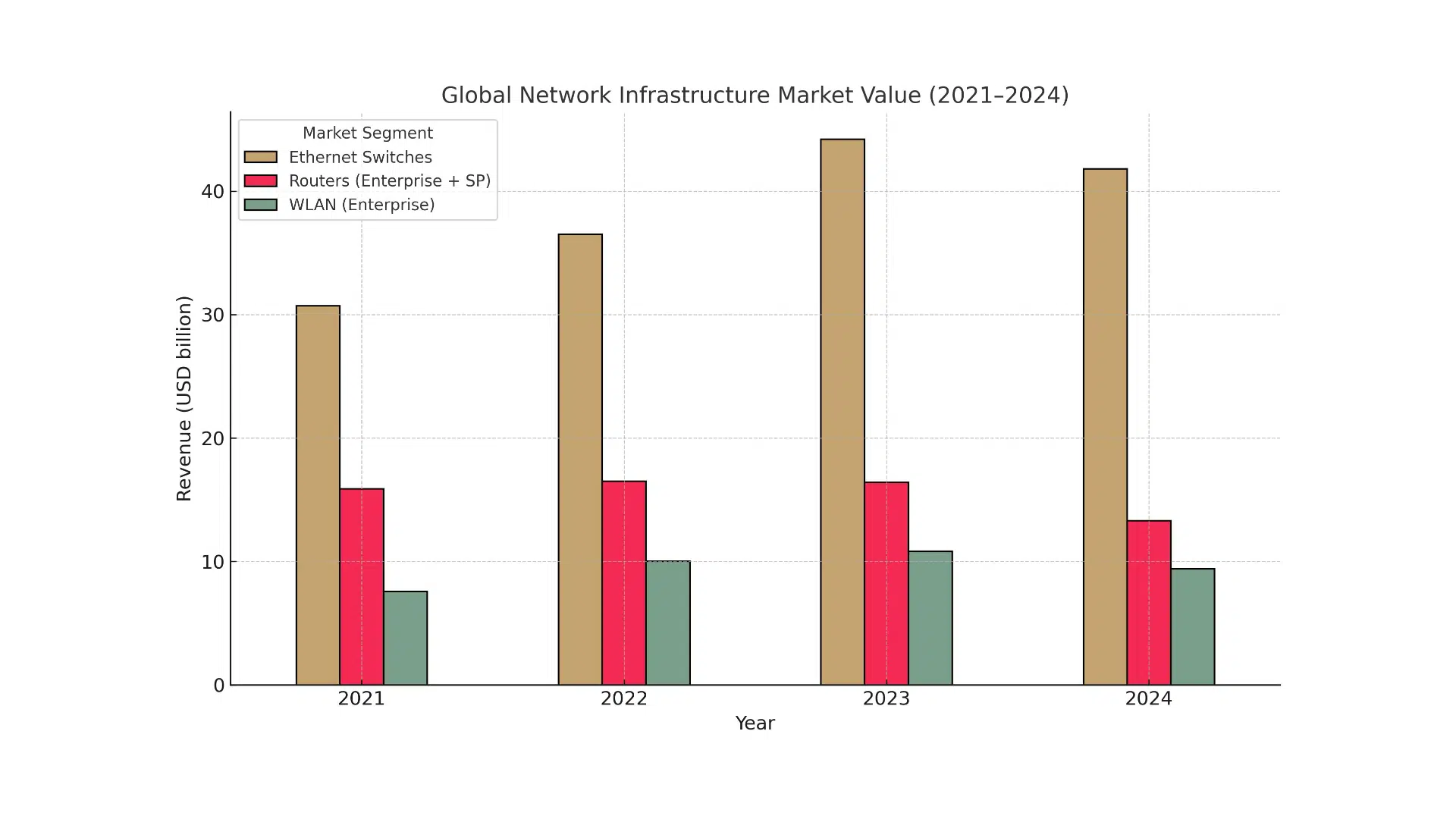
    The network infrastructure market is the foundation of the digital economy – encompassing hardware, software and services that provide connectivity and data exchange on a global scale. The dynamic development of mobile technology, cloud computing and the Internet of Things (IoT) is driving investment in modern networks. As a result, network infrastructure is undergoing intense modernisation: telecom operators are deploying 5G, companies are migrating to the cloud and the hybrid working model, and organisations are betting on network automation. This article analyses the current value of the global network infrastructure market, its growth forecasts, regional differentiation, key technology trends (5G, edge computing, SD-WAN, AI) and key market players. It also provides an expert assessment of the outlook for the next 5-10 years and the key challenges – from costs to security to problems with outdated systems.

    Market value and growth forecasts

    The global network infrastructure market is worth hundreds of billions of dollars and is showing steady growth. Its value reached around USD 248.8 billion in 2024 and is forecast to grow to USD 463.9 billion in 2033. This means that the market will grow at a compound annual growth rate (CAGR) of around 7.2 per cent on average between 2025 and 2033. Such growth reflects the increasing demand for advanced networking technologies around the world – from data centre modernisation, cloud and 5G integration to the development of smart cities. Demand is driven by both the private sector (digital transformation of businesses) and public investment in broadband and mobile infrastructure.

    In 2024, the market was valued at just under USD 250 billion, to almost double its value to around USD 464 billion by 2033. The growth trend is relatively uniform and stable – reflecting the maturity of the market and the continued organic growth in demand for network capacity, security and new functionality. Importantly, the structure of the market includes network hardware (around 48% market share) and network software and services (together the remaining 52%), which means that, in addition to investment in physical equipment, the role of software solutions that define network operations is growing.

    Regional market structure

    Network infrastructure is growing in all regions of the world, but the dynamics and scale of investment vary by area. Asia and the Asia-Pacific region currently represent the largest segment, accounting for around 34% of the global market and showing the fastest growth rate. The main driver here is the expansion of next-generation mobile networks and urbanisation: it is estimated that more than half (51%) of all 5G base stations worldwide are located in Asia-Pacific. Countries such as China, Japan, South Korea and India are leading the way with investments in 5G and smart city projects. For example, some 68% of enterprises in the APAC region are betting on migrating to the cloud, and 59% are deploying advanced industrial networks for smart manufacturing and urban infrastructure.

    North America accounts for approximately 31% of the value of the global market and remains at the forefront of deploying the latest network solutions. The US accounts for the lion’s share of this market, with approximately 84% of North American infrastructure investment occurring in the US. The region has the highest density of data centres, widespread fibre availability and a rapid pace of 5G deployment. Already 48% of organisations in North America are using 5G connectivity in their operations. In addition, companies are placing a strong emphasis on security, with nearly 69% of US companies prioritising the integration of cyber security into their network infrastructure. Government programmes supporting network expansion and the widespread digitisation of business are also contributing to the growth.

    Europe accounts for approximately 27% of the global network infrastructure market. With key markets in Germany, the UK and France, the region is focusing on modernising corporate and telecom networks based on software-defined networking architectures. Already, some 61% of European enterprises are deploying SDN (Software-Defined Networking) solutions and 58% are investing in multi-cloud strategies – integrating multiple clouds for greater flexibility. European operators and companies are also intensively developing data centre infrastructure and fibre networks, preparing the ground for 5G rollout and future 6G deployments around the end of the decade. Despite a slightly smaller share of the global market, Europe maintains high standards of security and interoperability and is paying increasing attention to the energy efficiency of infrastructure – some 31% of new network investments in Europe and Asia are already directed towards green, energy-efficient technologies.

    Other regions are also seeing growth: The Middle East and Africa together account for around 8% of the market, catching up through digital infrastructure projects often funded by government funding and public-private partnerships. Latin America, meanwhile, is investing in the expansion of 4G/5G and fibre networks, although the scale of spending there is smaller compared to the three main regions.

    Leading technological trends

    Several key technology trends are clearly emerging in the network infrastructure that are shaping the development of the market:

    • 5G networks: 5G technology is being deployed globally in mobile operators’ networks, offering many times higher speeds and minimal latency. Investments related to 5G already account for approx. 21% of the total capital expenditure of telcos, and spending on 5G equipment accounts for 24% of telecoms network infrastructure budgets. Fifth-generation networks not only serve the growing mobile traffic of consumers, but also enable the development of new applications – from industrial IoT to autonomous vehicles. Of increasing importance are private 5G networks deployed by industrial and logistics companies that need reliable, unbundled connectivity with ultra-low latency for their own production needs. 5G will continue to be a catalyst for investment in the coming years, with more than 50% of global mobile connections expected to be 5G-enabled by 2029.
    • Edge computing: edge computing architectures, or computing at the edge of the network (closer to the data source and the user), are gaining popularity in response to the demands of real-time applications. Some 47% of organisations plan to deploy edge solutions to support critical systems that require minimal latency. Moving computing power closer to users improves the responsiveness of services such as video streaming, online gaming, telemedicine or autonomous vehicle systems. The proliferation of IoT also forces the local processing of huge streams of sensor data. The edge trend goes hand in hand with 5G – an estimated 39% of new network infrastructure projects combine 5G deployments with edge components to provide ultra-low latency and local data analytics for industry, smart cities or energy grids.
    • SD-WAN and Software-Defined Wide Area Networks: SD-WAN (Software-Defined Wide Area Network) are solutions that manage wide-area enterprise networks through the software layer, ensuring traffic is optimised between branch offices and the cloud. Demand for SD-WAN is growing exponentially in the age of remote and hybrid working – businesses need flexible and secure access to corporate applications in the cloud regardless of location. More than 68% of companies are shifting to a more flexible working model, stimulating SD-WAN deployments to ensure consistent connectivity and security policies across all departments. SD-WAN solutions, often offered by vendors as a managed service, also reduce data costs through the intelligent use of Internet connections and MPLS networks. A broader context is network virtualisation – SDN and NFV (Network Function Virtualisation) – where network functions, such as routing or firewall, are implemented programmatically. In Europe, the aforementioned ƒ~61% of companies are already using SDN architecture. Global vendors are intensively developing SD-WAN/SDN offerings – an example is Cisco, which in 2024 introduced a new generation of SD-WAN solutions adapted to the hybrid operating model, providing, among other things, 34% faster access to cloud applications while maintaining centralised security control.
    • Artificial intelligence (AI) in networks: AI is playing an increasingly important role in both the management of network infrastructure and in new security functions. Network operators and administrators are deploying machine learning algorithms to automate network configuration, monitoring and optimisation. More than 39% of enterprises are using AI-based analytics tools to optimise network performance and detect problems faster. At the same time, equipment manufacturers are integrating AI elements into their products – around 37% of new network devices have AI-based features for threat detection and automated response to security incidents. An example is the next-generation data centre switches from Huawei, equipped with AI mechanisms to increase performance by ~40% and improve traffic management. In the coming years, AI is expected to enable the implementation of so-called self-optimising networks (self-driving networks), which automatically adjust parameters to changing conditions and can predict failures through data analysis (predictive maintenance).

    Major market players

    The network infrastructure market is dominated by a handful of large global vendors who compete in both the telecoms equipment and corporate network solutions segments. These include Cisco, Huawei, Nokia and Ericsson, among others:

    • Cisco Systems (USA): The world’s largest provider of enterprise networking solutions. Cisco leads in the area of network equipment (switches, routers, Wi-Fi access points) and develops advanced software for network management and security. The company is adapting its offering to new trends – investing in SDN/SD-WAN solutions (the aforementioned latest products for software-defined WAN are an example) as well as cloud and data centre solutions. Many corporations base their infrastructure on Cisco hardware as standard, which gives the company a strong market position.
    • Huawei (China): A global telecommunications and networking giant that is one of the leaders in the deployment of 5G technology. Huawei offers a full infrastructure portfolio – from access equipment (5G base stations, fibre equipment) to backbone routers and cloud solutions. Together with Cisco, it is among the largest players – together the two companies control nearly 29% of the network infrastructure market share. Huawei has enjoyed tremendous success in the Asian, African and Latin American markets, although in recent years it has struggled with restrictions in some Western markets for geopolitical reasons. Despite this, the company continues to invest in research (including the development of AI-enabled switches for data centres) and maintains a strong position in global vendor rankings.
    • Nokia (Finland): One of the two European leaders in telecommunications infrastructure. Nokia (alongside Ericsson) is a leading supplier of equipment for mobile networks – especially for 4G/5G infrastructure (RAN, core network) – as well as optical and IP transport solutions. The company is using its telecoms know-how to enter new areas, such as private 5G networks for industry. In 2023. Nokia announced a number of deployments of private 5G wireless networks for industrial sectors and smart city projects, responding to business customers’ demand for dedicated, high-performance communication networks. Globally, Nokia is competing for 5G contracts with Huawei and Ericsson, with a strong presence in markets where alternatives to Chinese vendors are required.
    • Ericsson (Sweden): The second European network infrastructure giant next to Nokia, with more than a century of history in telecommunications. Ericsson specialises in equipment for mobile and radio networks – it is one of the main suppliers of 5G base stations to operators worldwide. The company is also investing in the development of core network solutions, managed services and IoT. With a strong position in North America and Europe, Ericsson is benefiting from operator demand for 5G equipment amid restrictions imposed on Huawei in these regions. In addition, Ericsson is engaged in standardisation work on future technologies (6G) and is working with partners (e.g. cloud providers) to virtualise network functions. As a company focused on the operator segment, Ericsson – like Nokia – complements the offerings of Cisco and Huawei, particularly dominating global mobile access network deployments.

    In addition to those mentioned, there are other major players in the network infrastructure market specialising in selected areas – including ZTE, Juniper Networks, Arista Networks, Dell EMC, HPE (Aruba), Extreme Networks or CommScope. The aforementioned companies compete in segments such as data centre switches, campus LAN/WLAN equipment, cabling or cloud solutions, completing the global network infrastructure ecosystem.

    Development prospects for the coming years

    According to experts, the growth prospects for the network infrastructure market over the next 5-10 years remain very promising. A projected average annual growth rate of 7% means that the sector will grow faster than many traditional industries, although slightly slower than the most dynamic segments of the IT market. The key technology trends described above will continue to drive investment: the global roll-out of 5G (and, looking ahead to the end of the decade, the first 6G deployments) will ensure continued demand for equipment and operator network upgrades. Edge computing will become an integral part of the network architecture – more and more data will be processed locally, creating a demand for distributed network nodes close to the user. Cloud and multicloud solutions will force the construction of networks capable of handling dynamic, distributed workloads, fostering the development of intelligent, software-defined networks. Automation using AI is likely to transform the way networks are managed – we are already seeing a trend towards autonomous networks, able to optimise traffic and respond to incidents autonomously. In the long term, this could result in significant operational savings and improved security.

    Regionally, the current balance of power is expected to continue, with Asia-Pacific remaining the largest and fastest-growing market due to investment in China and developing countries, North America maintaining high levels of innovation and corporate spending (especially in the US), and Europe consistently upgrading infrastructure with a focus on security and efficiency. However, the disparity between regions may narrow as network technologies become ubiquitous and deployment costs fall.

    Experts also highlight new areas of growth that may become increasingly important: private 5G networks for enterprises (e.g. in factories, ports or university campuses), networks for IoT supporting billions of devices (including narrowband LPWAN networks for sensors) or the development of the satellite internet (e.g. constellations in low orbit providing global connectivity). The digital transformation of sectors such as energy (smart grid), automotive (connected vehicles) or medicine (telemedicine, wearable devices) will generate demand for a reliable communication infrastructure. A further increase in research and development (R&D) spending in the network area can be expected – both by market giants and new players (startups), which will result in further innovations and even more efficient network technologies in the future.

    Market challenges

    Despite the positive outlook, the global network infrastructure market faces several significant challenges. The biggest barrier is high cost – network upgrades require huge capital expenditure. More than 44% of enterprises cite budget constraints as a factor inhibiting infrastructure upgrades. Next-generation hardware (e.g. 5G devices, backbone routers, edge nodes) and associated software and integration are costly investments that not all organisations can afford immediately. At the same time, obsolete (legacy) systems are still common – it is estimated that around 27% of the network infrastructure in use globally is made up of older, previous-generation equipment. Migrating from these legacy systems is difficult: nearly 38% of companies struggle to replace old hardware with newer hardware. Maintaining such solutions raises not only opportunity costs (lower performance, lack of new features), but also security risks – almost 33% of security breaches are related to vulnerabilities in outdated infrastructure.

    Cyber security is itself another challenge. The increasing complexity of networks (especially those distributed across multiple clouds and locations) means that 59% of organisations find it difficult to manage security in multicloud and hybrid environments. Attacks on network infrastructure are increasing in sophistication and the attack surface is widening with the connection of more IoT devices and the proliferation of 5G networks. Ensuring consistent security policies, network segmentation and data protection in such a heterogeneous environment is a heavy burden for IT departments. Many companies also face staff shortages, with some 29% of enterprises citing a shortage of qualified advanced network professionals as a limiting factor to progress.

    Another challenge is interoperability and integration of new technologies with existing infrastructure. Companies often use multi-vendor solutions, which raises compatibility issues. More than 34% of organisations experience integration issues when deploying disparate platforms and services. Standardisation of protocols and openness of ecosystems are therefore becoming crucial to avoid technology silos. Additionally, regulators are imposing requirements on the industry (e.g. on cyber security, data privacy or spectrum allocation), which can slow down deployments, especially in the telecoms sector.

  • Cisco is betting on experience. Gordon Thomson new head of EMEA

    Cisco is betting on experience. Gordon Thomson new head of EMEA

    Cisco is betting on continuity and experience, with Gordon Thomson taking over as president of the company’s Europe, Middle East and Africa (EMEA) region on 28 July 2025. This is a pivotal moment for the company, as the EMEA market is rapidly accelerating its digital transformation, investing more and more heavily in AI, cloud infrastructure and cyber security.

    Thomson is a Cisco veteran, having been with the company for 27 years, the majority of his career having just been spent in EMEA. For the last few years, he has been responsible for the Service Provider sector, developing the company’s next-generation network and cloud solution offerings. He will now head up structures spanning 64 countries and more than 15,000 technology partners.

    His appointment coincides with the growing demand for technologies that enable data control, optimise operations and use AI to increase productivity. Cisco is responding to this wave of demand by, among other things, investing in infrastructure management platforms, AI model-based solutions and competency support.

    – Taking on the role of President of Cisco in EMEA is a great honour for me. I have worked for the company for almost 30 years in many different roles and I am excited about the challenges ahead in my new role. This is a unique moment in Cisco’s history and I look forward to working with the EMEA team to shape the digital future of the region,” said Gordon Thomson.

    Gordon knows Cisco and the needs of our customers very well. His experience in leveraging AI, networking and cyber security solutions across industries and countries is of great value to the company. He is an inspirational leader who has repeatedly led teams to success. I am confident that he will do the same with the EMEA team, added Oliver Tuszik, Executive Vice President of Global Sales and Chief Sales Officer at Cisco.

    It is worth recalling that the company does not just sell technology – it actively contributes to the innovation ecosystem. Through its Country Digital Acceleration programme, Cisco is involved in more than 1,200 transformation projects in EMEA. In parallel, nearly 9 million people have already been trained through the Networking Academy – a real answer to the skills gap that is affecting more and more companies in the digital age.

    The EMEA region is today one of the most diverse and promising fields of operation for global IT giants. On the one hand, we have mature markets – such as Germany, the UK or France – on the other, the rapidly developing countries of Central Europe and Africa. Cisco has the ambition to be an integrator of development in this space – both technologically and educationally.

    Thomson has an ambitious task ahead: to maintain the growth momentum and deepen Cisco’s presence in the countries of the region. The new boss will also have to position the company effectively against increasing competition – both from hyperscalers and local IT integrators. But all indications are that he has the facilities to do so.

  • How can technology help in the fight against coronavirus? (interview)

    How can technology help in the fight against coronavirus? (interview)

    “We are seeing digital transformation being realised at an accelerated pace,” – says Andrzej Lodziana, IT Architect, Netology, in an interview with BrandsIT.

    Przemysław Kucharzewski, BrandsIT: The outbreak of the coronavirus pandemic has put the whole world in a completely new situation. We have to honestly admit that as a society we were not prepared for it. What does this look like in the IT industry? How are companies in the technology sector currently coping?

    Andrzej Łodziana, IT Architect, Netology: It’s true that the coronavirus pandemic was a new situation for everyone, which literally and figuratively brought the world we knew before to a halt. We had to change priorities in our personal and professional lives quickly, virtually overnight, and this led to changes in the way we worked. The changes on a formal, legal and organisational level forced us to look for solutions to maintain continuity in communication, information exchange, but also to adapt production capacity to current demand and minimise the risk of potential downtime due to the pandemic.

    Let’s go back for a moment to the situation before December 2019, when life was going on as normal. Few thought about the consequences of contracting the virus from another person, much less did large production facilities, factories, business at large, take this into account. Suddenly, everything changed by 180 degrees and the risk of jeopardising the continuity of business operations due to infection of a significant part of the workforce definitely increased. This prompted a search for salvation, including through the use of new technologies.

    Thus, IT companies now faced new challenges for their customers. At net-o-logy, we have noticed that new challenges mean an increased search for new solutions. For example, over the past few years we have been gathering experience in the area of data analytics. It turned out that advanced technology is applicable in the era of COVID-19. The GANZ Thermometer system is proving itself for the so-called screening of persons. Combining image analytics with automatic temperature measurement can help minimise the risk of spreading the SARS-CoV-2 virus.

    BrandsIT: Let’s pause for a moment on technologies that could prove themselves just today in the fight against coronavirus. Can you say more about the GANZ Thermometer system?

    Andrzej Łodziana: The GANZ Thermometer is a system that was developed a few years ago and has been successfully used in many countries as a temperature verification tool in kindergartens (here’s an interesting fact – the camera resembles a Panda so that children can become more familiar with it). In these troubled times of the coronavirus, it turned out that the GANZ Thermometer could also be used in other places.

    The GANZ Thermometer system is a combination of different technologies and provides a robust solution to serve people and make their lives easier. It enables very fast, non-contact and precise temperature measurement in multiple people simultaneously. The detection of a feverish state in any of the scanned persons immediately activates an automatic alert for the operator, indicating precisely the feverish person.

    Imagine an analogous situation in a production plant, where a large number of people arrive at the entrance at the beginning of each shift and only a manual thermometer is available. Checking the temperature of each employee seems unfeasible. The GANZ Thermometer system comes to the rescue, and it is worth remembering that it will prove its worth not only during a coronavirus pandemic.

    The added value of the tool is that it can minimise the number of people on sick leave, as we prevent the spread of disease among employees. This benefits not only the employer, but also society. The implementation of the GANZ Thermometer also shows that the organisation cares about the safety of its employees and provides them with a comfortable working environment.

    We are currently in the process of implementing the first contracts using the GANZ Thermometer system, which will certainly bring tangible results for customers in the coming weeks.

    BrandsIT: How does the GANZ Thermometer system work?

    Andrzej Lodziana: The system consists of a bispectral camera and uses a synthesis of video analytics and thermal imaging. As a result, each person (or more precisely their face) appearing in the camera’s field of view is precisely ‘targeted’ and tracked as a target for temperature measurement. The thermal imaging module then measures the temperature of the tracked target, relating the measurement result to a so-called standard, i.e. a constant reference temperature generator, also located in the detector’s field of view.

    This solution guarantees very high accuracy and repeatability of measurement results. The system’s functionality is complemented by the automatic detection of feverish persons on the basis of predefined thresholds of the so-called normal temperature. Alarm notifications can take place in various forms, such as a message on the screen, notification sent to a mobile application, or activation of other systems (such as door lock, siren). The system can collect temperature measurement results, assigning them to people registered in the database (based on facial identification). And this creates opportunities to analyse trends and make more effective decisions.

    BrandsIT: The use of Video Content Analytics tools to measure body temperature sounds interesting and really shows that technology is not an end in itself, but helps us to solve specific problems. Can you point to other positive examples of the use of technology in the age of coronavirus?

    Andrzej Lodziana: It is certainly important to highlight the very important role currently played by communication tools that enable remote working. This is an area that has definitely had its five minutes recently, from education and schooling to administration and business. The number of teleconferences, remote training and lectures is increasing. The number of people working in home office mode has definitely increased. This is made possible by solutions such as Cisco Webex or Microsoft Teams, which we also use in net-o-logy.

    The increasing scale and intensity of the use of such tools is at the same time a new stimulus for IT companies, as it forces technology providers to continuously optimise performance and ensure the security of transmitted and stored data.

    Let us not forget what we do “after hours”, when we stay at home according to the guidelines. We struggle with network bandwidth problems, for which streaming platforms are “responsible” when used much more intensively than under normal conditions. For this reason, among others, Netflix has reduced the quality of the films it streams in response to an appeal by EU Commissioner Thierry Breton.

    As a result, we are seeing digital transformation taking place at an accelerated pace.

    BrandsIT: Thank you for the interview. What can we wish for each other at this difficult time?

    Andrzej Lodziana: Thank you also for the interview. We should wish each other good health and a readiness for even greater social solidarity and a return to the normal state of the pre-Cronavirus era as soon as possible.

    netology logo