Tag: AI PC

  • AI PC: Desktop revolution or expensive gadget? How to wisely distinguish between need and marketing

    AI PC: Desktop revolution or expensive gadget? How to wisely distinguish between need and marketing

    The PC market has been waiting for such a strong boost for years. We have found it, or at least that is what the major players claim. The terms ‘AI PC‘ and ‘NPU’ are being conjugated in all cases and the marketing departments of the giants are promising a new era of productivity. Analysts seem to confirm this trend. Gartner estimates that AI PC shipments will reach 31% of all shipments as early as 2025, a massive jump from just 15% in 2024. Manufacturers are rubbing their hands together, but IT leaders are scratching their heads as they look at their budgets.

    Indeed, this AI ‘gold rush’ has a second, more prosaic background. It is a ticking time bomb: the end of support for Windows 10 in October 2025. Millions of companies are facing massive hardware replacement anyway. So the question becomes a burning one: is the AI PC wave a true revolution on the scale of the advent of the internet, or an ingeniously executed marketing manoeuvre to sell much more expensive hardware to companies that need to go shopping anyway?

    The heart and marketing lure of the new AI computer is the NPU (Neural Processing Unit), or specialised neural processing chip. This is the new ‘brain’ in the machine, which functions alongside the well-known CPU and GPU. Its task is one: to handle artificial intelligence tasks locally, directly on the device. The promise the manufacturers make to us is based on several pillars. The most important of these is security and privacy. The processing of sensitive data, be it financial analyses, strategic plans or code snippets, takes place on the laptop, without sending it to an external cloud. Less risk of leakage is a real value.

    Another argument is speed and responsiveness. When AI works locally, we are not limited by network latency. This means instant transcription of a meeting in real time, immediate AI prompts in apps or seamless video analysis without buffering. Then there is the energy efficiency. The NPU consumes significantly less power than the CPU or GPU for AI tasks, which in the era of hybrid working translates directly into longer battery life. Finally, there is the promise of deep personalisation, where an AI model running locally learns the specifics of the user, offering much more tailored assistance than a generic model in the cloud.

    The promises sound excellent. The problem is that when we buy an AI PC today, we are largely buying potential, not a finished solution. The clash with reality can be painful for the wallet. Let’s be honest: most of the generative AI applications we use today run 100% in the cloud. ChatGPT, Claude, Midjourney or even the basic Microsoft Copilot functions do all the hard work on powerful servers. All you need to run them is a decent browser and a stable connection.

    The arguments against a mass, no-frills replacement of hardware with AI PCs are tough. Firstly, there is the cost. These machines are more expensive, and the ROI of the purchase for an employee who mainly uses Office is close to zero. Secondly, we are seeing the immaturity of the ecosystem. Manufacturers have delivered the hardware, but software developers are just starting to learn how to use it. Business applications that realistically *require* NPUs are scarce. So we’re buying computing power ‘for spare’. Third and finally, for the overwhelming majority of office tasks, cloud computing is simply “good enough”.

    We are at a classic tipping point. The IT leader’s response should be neither ‘we buy for all’ nor ‘we ignore the subject’. The answer should be: “we implement selectively”. Instead of succumbing to marketing pressure, IT departments should create an internal ‘needs matrix’ and identify the specific roles and departments that will be the first to experience real benefits from local AI processing.

    Who is on the priority list? It will certainly be developers and IT teams, who can run local models to assist with coding or analyse logs without sending sensitive code outside the company. It will also be marketing and creative teams, for whom local AI will speed up graphics and video rendering while maintaining confidentiality over a new campaign. It’s also worth considering data analysts and financiers, processing huge, confidential data sets on their own laptops. Finally, and perhaps surprisingly, executives may be on the list. Not because of the need for computing power, but because of the guarantee of privacy when analysing strategic reports with the help of an AI assistant. For the rest of the workforce, a solid, modern laptop without an NPU will be absolutely sufficient in 2025.

    AI PC is undoubtedly the future and the inevitable direction of personal computer evolution. However, the current market hype is an explosive mix of genuine innovation, gigantic marketing budgets and the perfect timing of the end of Windows 10 support. A wise IT strategy for the coming years is not a blind pursuit of every ‘buzzword’, but the art of selective investment.

    The recommendation for business is simple. Don’t panic and replace your entire machine fleet. Instead, use the forced migration from Windows 10 as an ideal time for a pilot programme. It’s worth buying wisely: identify 10-15% of ‘power users’, equip them with AI PCs and let’s collect hard data on productivity gains, realistically counting ROI. For the remaining 85% of employees, the safe and sensible choice remains robust, modern hardware. When the next refresh cycle arrives in 2-3 years, the application ecosystem will have matured, AI PC prices will have come down and their purchase will no longer be a marketing promise but a standard business decision.
  • AI PC: real revolution or the biggest marketing bubble of the decade?

    AI PC: real revolution or the biggest marketing bubble of the decade?

    The PC market, after a period of pandemic revival, stagnated. Innovation seemed to be only cosmetic and hardware replacement cycles were lengthening. In this landscape, however, a powerful new catalyst for change has emerged: AI PC. This is not another fashionable buzzword, but the announcement of a fundamental transformation in PC architecture that is set to redefine the role of the PC in our lives and initiate a massive hardware replacement cycle.

    But what exactly is an AI PC? It is not simply a computer with access to cloud-based AI services. The definition goes back to the silicon itself. A true AI PC is a device equipped with a specialised, three-element computing architecture: a traditional CPU for general tasks, a powerful GPU for parallel processing and, crucially, an NPU (Neural Processing Unit). It is the NPU, a dedicated and energy-efficient accelerator, that is at the heart of the revolution, enabling AI tasks to be efficiently processed directly on the device, without burdening other components .

    The key parameter here became performance measured in TOPS (trillions of operations per second) . The turning point turned out to be Microsoft’s establishment of a threshold of at least 40 TOPS for the NPU itself as a condition for ‘Copilot+ PC’ certification . This strategic move redefined the market, forcing the entire industry into a race to exceed the imposed threshold.

    This brings us to the main thesis: AI PC is not just a hardware evolution, but a fundamental paradigm shift. We are witnessing a shift from a fully cloud-dependent architecture to a hybrid model in which AI computing power is strategically dispersed between data centres and the end device. This shift carries profound implications for cost, privacy and the entire IT ecosystem.

    Market drivers: why now?

    The sudden emergence of the AI PC category is the result of a confluence of three powerful forces that made moving AI to the device not only possible, but necessary.

    A technological necessity: privacy, security and latency

    In an era of increasing awareness of data protection, cloud computing raises concerns. AI PC addresses these challenges by offering analysis of sensitive data directly on the device, enhancing privacy and security.

    What’s more, for real-time applications like live translation, the elimination of delays (latencies) associated with communication with the cloud is crucial to the quality of the user experience.

    Economic impetus: the hidden cost of cloud AI

    The boom in generative AI has revealed a brutal economic truth: while training models is a huge but one-off expense, the real budget ‘eater’ is the cost of inference, i.e. actually using the models.

    Every query to cloud-based AI generates a cost that, at scale, becomes difficult to predict and is a barrier to enterprise adoption of the technology. By moving some of the computing to the end-device, technology giants such as Microsoft are strategically passing on some of the rising operational costs to customers who are investing in new, more expensive hardware.

    Market maturity: the boom effect of generative AI

    The explosion in popularity of tools such as ChatGPT has fundamentally changed user expectations. Consumers and business employees alike now expect AI to be an integral part of their everyday tools. The timing coincides perfectly with the natural cycle of post-pandemic hardware replacement and the impending end of Windows 10 support in October 2025, creating the perfect ‘window’ for the introduction of a new product category.

    Battlefield: architects of the new PC era

    The entry of AI PC into the market has sparked the most intense rivalry in the industry for years, with traditional and new players facing off against each other.

    Chipmakers: the war of architectures

    The competition is no longer just between Intel (Core Ultra) and AMD (Ryzen AI) within the same x86 architecture. The real breakthrough is the entry of Qualcom (Snapdragon X Elite), which brings ARM architecture to mainstream Windows PCs, promising unprecedented energy efficiency . This is the biggest challenge to the ‘Wintel’ duopoly (Windows + Intel) in decades, initiating a fundamental war of architectures – x86 versus ARM – on the same system platform.

    Although Microsoft has created an advanced emulation layer, history teaches that this always involves compromises in performance, especially in games and specialised software . It is also worth remembering that the pioneer in this field is Apple, which has been integrating dedicated neural engines into its processors since 2017, exploiting the advantage of full control over hardware and software.

    Software giants: Microsoft as market conductor

    In this revolution, it is not hardware manufacturers but the software giant that is dealing the cards. Microsoft, through Windows and the new Copilot+ feature category, has become the main conductor of the market . By introducing exclusive tools such as Recall (photographic computer memory) or Cocreator (real-time image generation), the company has created a real demand for hardware capable of running them locally . Microsoft’s strategy is clear: transform the operating system into a proactive, intelligent assistant.

    The market in figures: growth forecasts and potential

    Market analysts agree: we are standing at the threshold of an exponential increase in AI PC adoption. Although short-term forecasts are being adjusted due to macroeconomic uncertainty, the long-term trend is clear.

    • Canalys predicts that AI PC shipments will reach 48 million units in 2024 (18% of the market) and will reach 205 million by 2028, representing a compound annual growth rate (CAGR) of 44% .
    • Gartner forecasts that AI PC market share will reach 31% in 2025 and exceed 54% in 2026 .
    • IDC estimates that AI PCs will account for nearly 60% of the total market by 2027, with a CAGR of 42.1% between 2023 and 2028.

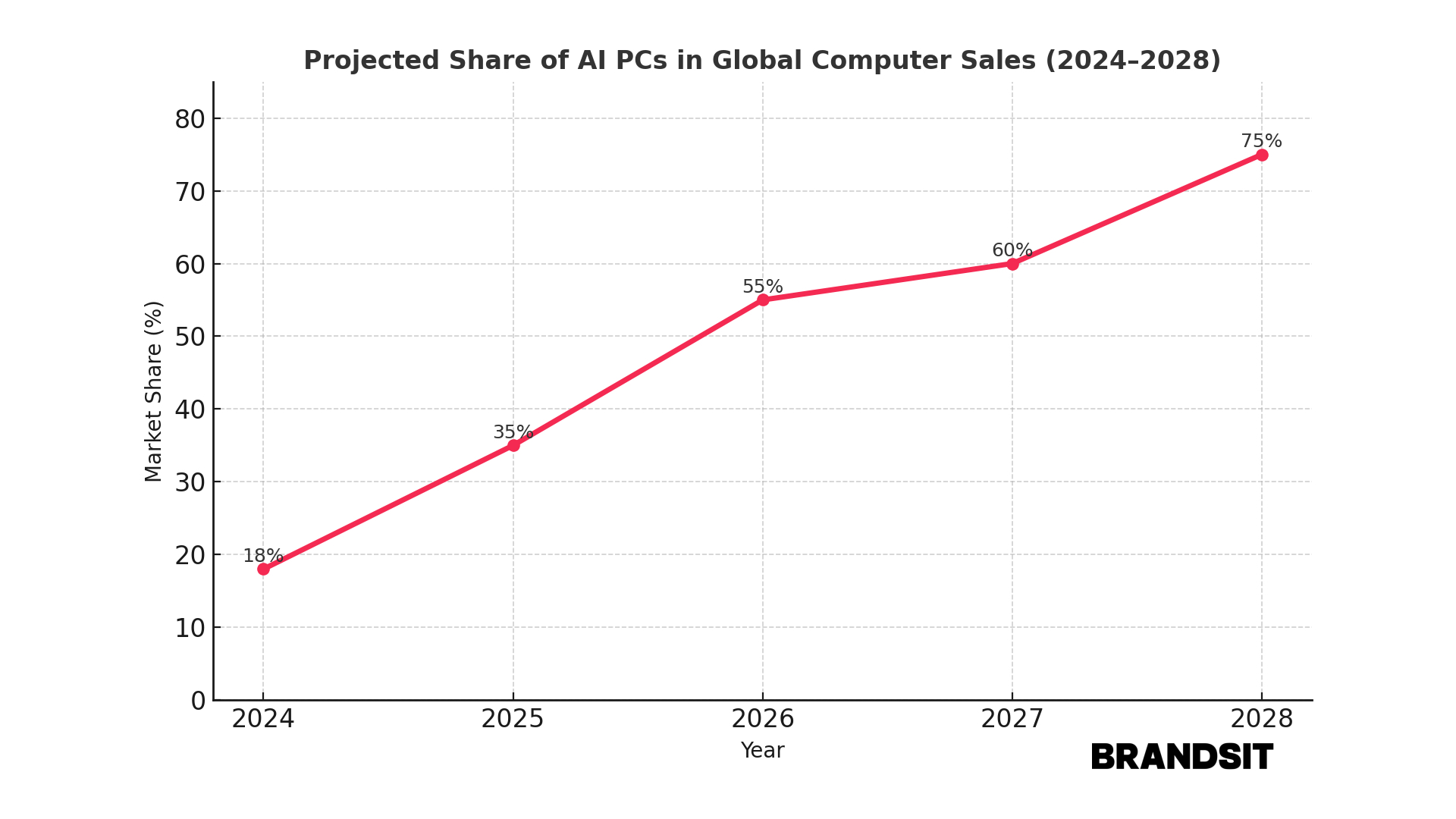
    Projected Share of AI PCs in Total PC Sales (2024-2028)

    • 2024: 18%
    • 2025: 35%
    • 2026: 55%
    • 2027: 60%
    • 2028: 75%

    This dynamic adoption curve shows that AI PC is not a fad, but a technological standard that will dominate the market before the end of this decade.

    Strategic implications: opportunities and threats

    The move to an AI PC architecture has fundamental implications for the entire IT ecosystem.

    For business: productivity versus security

    The promise of AI PC for business is to leapfrog productivity by automating routine tasks. However, the revolution comes at a price. AI PCs will be 10-15% more expensive, requiring IT departments to analyse their total cost of ownership (TCO). The biggest challenge, however, is security.

    Case study: Microsoft Recall

    Nothing illustrates this better than the controversy surrounding the Microsoft Recall feature. Designed as a computer’s ‘photographic memory’, the original version stored the user’s entire activity history in an unencrypted database. This meant that any malware could steal a victim’s entire digital life in seconds . Public criticism forced Microsoft to redesign the feature, making it disabled by default and adding advanced encryption . The Recall saga is a fundamental lesson: local processing creates powerful new attack vectors, and the promise of privacy is empty without a robust security architecture.

    For the software market and the risk of a “marketing bubble”

    For developers, the emergence of the NPU is an opportunity to create a new generation of ‘AI-native’ applications . On the other hand, the fragmentation of platforms (x86 vs. ARM) creates a risk of chaos and increased developer costs.

    At the same time, a question hovers over the market: are current applications revolutionary enough to justify a mass replacement of hardware? The industry has been searching for decades for a “killer app” – an application so groundbreaking that people buy new hardware for it . For now, the AI PC market does not have a single, obvious ‘killer app’, which fuels fears of a marketing bubble in which promises overtake actual value. However, it is possible that the strength of AI PC will be the sum of hundreds of small enhancements running in the background that will gradually improve the PC experience .

    Analysis of the AI PC market leads to a clear conclusion: we are witnessing more than just another hardware refresh cycle. Driven by the need for privacy, economic pressures and expectations shaped by generative AI, NPU integration is initiating a fundamental paradigm shift in PC architecture.

    This confirms our central thesis: AI PC is a revolution, not an evolution. It is a strategic shift to a hybrid AI architecture that will change not only how computers process information, but also how they interact with us. Predictions clearly point to exponential growth and the inevitable domination of this category in the market.

    The personal computer, for years seen as a mature tool, is on the threshold of reincarnation. It is being transformed from a passive window on the digital world into an intelligent, proactive partner. The biggest challenge for the industry as a whole now is not whether this transformation will happen, but how to manage it in a way that is safe, productive and of value to the user. Avoiding the trap where marketing promises trump real-world usability will determine whether AI PC becomes a true revolution or just an expensive bubble. This is not the end of the history of the personal computer – it is the beginning of a whole new chapter of it.

  • Is the hype for AI PC dimming? The real revolution is just beginning

    Is the hype for AI PC dimming? The real revolution is just beginning

    Could it be that the great revolution in the world of personal computing, driven by artificial intelligence, has lost momentum before it has begun in earnest? Recent data from analysts at Gartner, suggesting a revision of growth forecasts, may dampen enthusiasm and provoke questions about the reality of the announced breakthrough. However, nothing could be further from the truth. What we are seeing is not an emergency brake, but a natural course correction in the face of global economic challenges. The reality is that the technological wave is gathering strength just over the horizon, and the current calm is just the calm before the inevitable storm.

    Understanding breathlessness – or why the numbers slowed down for a while

    There is no denying that the original forecasts were extremely optimistic. Gartner has revised its prediction for the share of AI PCs for this year from 43% to less than a third of the market. Similarly, instead of 114 million units, closer to 78 million will hit the market. Why the change? The reasons lie not in the technology itself, but in the macroeconomic environment. Global uncertainty, fluctuating markets and a complex trade policy situation are making companies around the world more cautious about large investments and equipment replacement cycles.

    This is a natural phenomenon – at a time when it is harder to predict the future, budgets become less flexible. However, it is important to understand that this is a delay in purchasing decisions, not a rejection of the AI PC idea itself. The problem lies not in the potential of the new machines, but in external factors that have pressed pause for a while.

    The train has already left – Giants put it all on the line

    While analysts are correcting short-term forecasts, in the labs and on the production lines, the revolution continues at its best. The truth is that the entire technological ecosystem is already fully engaged in the transformation. This is no longer an experiment – it is a strategic market redesign from which there is no turning back.

    The hardware foundations have long been in place. Intel with its Core Ultra processors has integrated NPUs (Neural Processing Units) directly into the silicon, making on-device AI processing a standard. On the other hand, Nvidia, the giant in graphics and AI computing, has formed strategic alliances with absolutely all the key players in the market – Acer, ASUS, Dell, HP and Lenovo – to deliver powerful machines to the market ready for the AI era.

    What’s more, let’s look at the scale of the increase. Although the figure of 78 million units shipped this year is lower than the original target, it still represents an almost fourfold increase on the just over 20 million units that hit the market in 2023. This is a growth rate that most industries can only dream of. This is not deceleration, this is the unleashing of a powerful machine.

    A tsunami of software is coming – the real reason AI PCs will win

    Ultimately, the success of any hardware platform is determined by the software that can harness its power. And herein lies the strongest argument for the inevitability of the AI PC revolution. The hardware itself is only a promise – the real value will come from the applications.

    According to Gartner, by the end of next year as many as 40% of software vendors will be investing in AI features running locally on the PC. This is a seismic shift, given that just last year the percentage was only 2%.

    What does this mean for us users? It marks the end of an era where advanced AI features were only available through the cloud. This means:

    • Greater privacy and security: Data will be processed locally on our device, without being sent to external servers.
    • Instant responsiveness: No more internet connection delays. Editing video, generating graphics or working with the intelligent assistant will be instantaneous.
    • Powerful new possibilities: Imagine a real-time video call interpreter working offline. Or an office suite that intelligently summarises documents and prepares replies to emails without network access. It is these ‘killer-apps’ that will ultimately convince the market.

    Time for preparation, not hesitation

    Momentary turbulence on the sales charts cannot stop a revolution whose foundations are already built of silicon, steel and code. The engine of change is in full swing and long-term forecasts leave no illusions: AI PCs will capture more than half of the market as early as next year, and by 2029 they will become the absolute norm.

    That is why it is worth treating the current moment of market calm not as a cause for concern, but as a strategic opportunity. It is the perfect time for companies and technology enthusiasts to plan their strategy calmly, update their knowledge and prepare for the moment when the storm of innovation will hit full force. Because the fact that it will hit is already certain.