Category: Startups and innovations

  • New Fujitsu technology: Quantum computing improves robot precision by 43%

    New Fujitsu technology: Quantum computing improves robot precision by 43%

    The hybrid approach from Fujitsu and leading universities reduces posture calculation errors by 43%, paving the way for more complex humanoid machines.

    A consortium involving Fujitsu, Shibaura Institute of Technology and Waseda University has developed a novel hybrid method to control the posture of multi-jointed robots. By harnessing the power of quantum computing, the researchers have solved one of the classic problems of robotics – the high computational complexity of inverse kinematics.

    A key challenge in advanced robotics is inverse kinematics, i.e. the process of calculating the angles in the individual joints of a robot to bring its tip (e.g. the gripper) to a precisely defined point. In the case of machines with a large number of degrees of freedom that mimic the human body (e.g. 17 joints), the number of possible combinations becomes so enormous that classical computers cannot cope with real-time calculations. This leads to simplifications, limiting the fluidity and range of movement of the robot.

    The new approach involves representing the orientation and position of each part of the robot using cubits. Crucially, the technique uses quantum entanglement to recreate the physical relationships between joints – the movement of one segment immediately affects the segments connected to it. The calculation of the simple kinematics (the position of the tip based on the angles) takes place in the quantum circuit, while the task of inverse kinematics remains with the classical computer.

    Verification on a Fujitsu quantum simulator showed a reduction in positioning error of up to 43% with fewer calculations compared to conventional methods. The effectiveness of entanglement was also confirmed in an experiment on a 64-kubit quantum computer built by Fujitsu and the RIKEN institute. Trial calculations for a complex 17-set model were achieved in about 30 minutes.

    The method is so efficient that it can be implemented on existing, still noisy Intermediate-Scale Quantum (NISQ) era computers. In the future, the technology could find applications in real-time control of humanoid robots and manipulators, optimisation of their energy consumption or advanced obstacle avoidance.

  • AI is building a new startup elite. Eight leaders worth more than $500bn

    AI is building a new startup elite. Eight leaders worth more than $500bn

    The ecosystem of technology startups is undergoing a fundamental transformation. The new determinant of value is no longer simply growth rate or market share, but the ability to commercially exploit artificial intelligence. Data compiled by Stocklytics.com based on CB Insights shows that 40% of the world’s ten most valuable unicorns are active in the field of AI.

    The value of the eight largest of these has already exceeded USD 543 billion. For comparison – more than the current capitalisation of the entire energy sector in Germany. What’s more, 28 AI startups have already made it to the list of unicorns in 2025 alone. This is more than half of all newly valued technology companies from that year.

    OpenAI leading the new hand

    The leader remains OpenAI, whose value has risen to a record $300 billion after a funding round led by SoftBank in March 2025. This is the second highest valuation for a private technology company in the world – just behind SpaceX. OpenAI is followed by Databricks (USD 62 billion), Anthropic (USD 61.5 billion) and xAI – Elon Musk’s startup valued at USD 50 billion.

    Companies such as Safe Superintelligence ($30bn), Scale AI ($13.8bn), Celonis ($13bn) and Grammarly ($13bn) complete the list. Together, they have already raised more than $147bn from investors. It is worth mentioning that most of these rounds are not so much typical VC investments, but strategic partnerships with major infrastructure companies such as Microsoft, AWS and Nvidia.

    US in a dominant position

    Seven of the eight most valuable AI unicorns are based in the US, mainly in California. The only exception is Celonis, a German startup specialising in so-called process mining, which, despite its European roots, today conducts most of its customers and development overseas.

    US dominance in the field of AI is not just the result of technological superiority. It is also the result of a pre-built ecosystem: cloud infrastructure, VC capital and open regulation. By comparison – in Europe, AI unicorns can be counted on the fingers of one hand and their valuations rarely exceed $5 billion.

    Boom despite cautious VC market

    Surprisingly, the AI sector is growing rapidly despite a marked cooling in the venture capital market. After the record years of 2021-2022, funding for startups in general fell significantly. However, AI has broken out of this trend – both in terms of the number of rounds and valuations.

    There are now already 273 AI unicorns operating worldwide – 11% more than a year ago and almost four times as many as in 2020. This means that the sector is now the largest generator of new technology companies with billion-dollar valuations. The scalability, efficiency and potential of AI deployments across a wide range of industries are leading investors to treat it as a systemically important technology – much like the cloud or mobile internet used to be.

    Vertical markets and infrastructure dominate

    The highest valuations are achieved by companies in two categories: Infrastructure AI (such as OpenAI or Anthropic) and specialised AI for vertical markets (such as Celonis, Scale AI or Grammarly). This confirms that the greatest investment potential lies in those areas where AI can either scale solutions horizontally or dramatically improve productivity in narrow domains.

    However, there is a lack of unicorns in consumer AI segments outside the area of LLMs and chatbots. Paradoxically – even though ChatGPT has been the face of the revolution, most of the capital is flowing to the underlying models and developer support tools, not to the end applications.

    From a B2B market and technology sales channel perspective, the rise of AI unicorns signals a structural transformation. Technology partners, integrators and distributors should keep an eye not only on established brands, but also on fast-growing infrastructure companies and specialised AI startups, which may soon become key players in the enterprise market.

    At the same time, a scenario in which the largest AI companies do not go public, but are absorbed by the technology giants, seems increasingly likely. Already today, Alphabet, Microsoft and Amazon are strategic investors in most of them. As a result, AI could not only dominate the technology market, but also concretise the dominance of the existing leaders.

    AI as the engine of a new paradigm

    The AI revolution is a paradigm shift that affects how value is created, how companies are valued, how they relate to investors and how they define innovation. In such an environment, the advantage will be gained not only by those who are first to implement new technologies, but also by those who can build a sustainable, scalable business model around them.

  • Post Quantum Cryptography: Business implications of algorithm choice

    Post Quantum Cryptography: Business implications of algorithm choice

    Today’s digital economy rests on an invisible but fundamental pillar: public key cryptography. Algorithms such as RSA and ECC have become synonymous with digital trust, but this foundation faces an existential threat. The advent of quantum computers capable of breaking current encryption standards is not the next evolutionary step in cyber security; it is a revolution that is forcing technology leaders to fundamentally change their thinking about data protection.

    The quantum threat is not a distant, theoretical possibility. It materialises today through a strategy known as ‘Harvest Now, Decrypt Later’ (HNDL), or ‘Harvest Now, Decrypt Later’. Adversaries, including state actors, are actively capturing and storing vast amounts of encrypted data, patiently waiting for the moment when a cryptographically-relevant quantum computer (CRQC) becomes operational. At that point, the data we consider secure today will be retrospectively breached. This fundamentally changes the risk model, shifting the responsibility from purely operational to strategic, related to protecting the long-term value of the company. Any information whose confidentiality lifecycle extends beyond the anticipated moment of CRQC is already at risk.

    The arguments for postponing migration to post-quantum cryptography (PQC) have run out of steam. In August 2024, the US National Institute of Standards and Technology (NIST) published the first finalised PQC standards: FIPS 203 (ML-KEM), FIPS 204 (ML-DSA) and FIPS 205 (SLH-DSA). This event sends a key signal to the global market: the research phase is over and the standards are awaiting implementation.

    End of the era of “one right encryption”

    For the past decades, public key cryptography decisions have been relatively straightforward, mostly boiling down to a choice between RSA and ECC. The post-quantum era puts a definitive end to this paradigm. We are entering a world where there is not and will not be a one-size-fits-all PQC algorithm. Choosing the right solution becomes a conscious strategic decision that must be precisely tailored to the specific use case.

    The world of PQC is inherently heterogeneous. NIST deliberately standardises algorithms from different mathematical families because each offers a unique set of trade-offs between computational efficiency, data size, resource usage and security level. Algorithm selection ceases to be solely the domain of cryptographers and becomes an architectural and product decision. Differences in the characteristics of individual algorithms lead to drastically different consequences depending on the deployment scenario.

    For high-performance TLS servers supporting, for example, an e-commerce front-end, minimal latency is a priority. Benchmark data clearly shows that CRYSTALS-Kyber (ML-KEM) leads the way, offering negligible performance overhead. In contrast, in VPNs where maximum throughput is crucial, algorithms with very large keys, such as BIKE, can become an issue, causing massive IP packet fragmentation and degrading network performance. In the world of IoT devices, where resources are extremely limited, algorithms with high memory requirements can be completely impractical, directly impacting component cost.

    The data speaks for itself

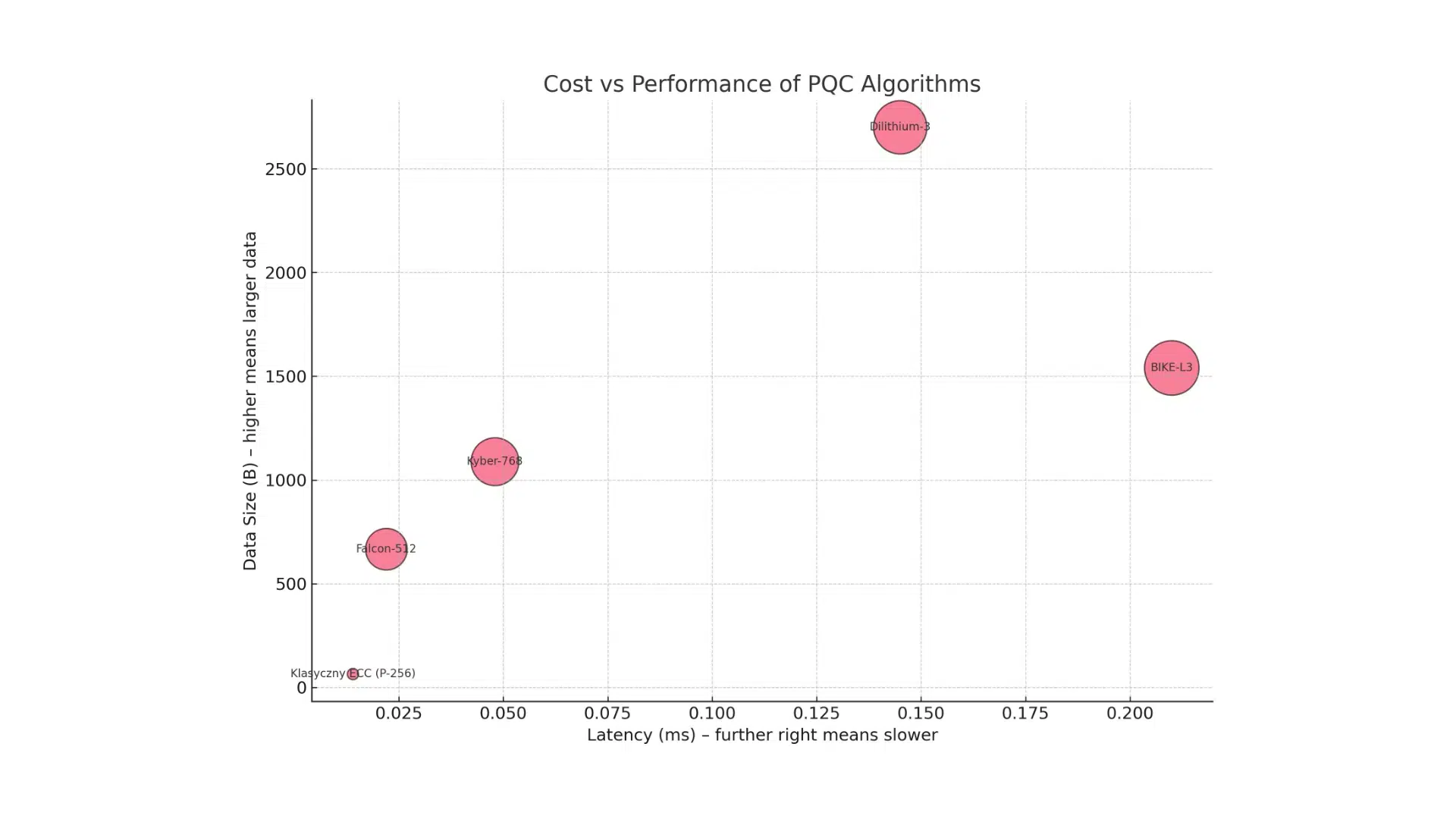
    Abstract discussions become real when hard data is analysed. Translating milliseconds of latency and kilobytes of data into concrete business implications is key to making informed decisions. Analysis based on comprehensive benchmarks shows that the choice of PQC algorithm is not only a question of security, but also of real operational costs.

    The performance leader is undisputedly CRYSTALS-Kyber, which shows negligible computational overhead in server tests. Its public keys and ciphertexts are compact, occupying just over 2 KB in total, and peak RAM consumption is minimal, making it an ideal candidate for a wide range of applications. At the other extreme is BIKE, a code-based algorithm. Despite its advantages, its implementation comes at a tangible cost: the sum of data exchanged during connection reconciliation exceeds 10 KB, which is more than four times that of Kyber. This size not only increases the cost of data transfer, but above all risks fragmenting network packets.

    Even more striking is the example of the Falcon signature algorithm. It offers extremely small signatures, which is a huge advantage in IoT applications where bandwidth is at a premium. However, its peak memory consumption is more than 26 times that of the competing Dilithium. For an engineer designing a medical device, this means that he or she may have to choose a more expensive microcontroller, increasing the unit cost of the overall product.

    Hidden risks and recommendations for CISOs

    Achieving compliance with PQC standards is just the first step. The biggest risks lie not in the theory of the algorithms, but in their practical implementation. Mathematical robustness is worthless if the physical implementation on the processor ‘leaks’ information about the secret key through side-channel attacks. Research has already shown successful attacks on Kyber and Dilithium implementations using analysis of power consumption or electromagnetic emissions.

    A key implication for CISOs is the hidden cost of security. Securing an implementation requires specialised countermeasures, such as masking, which introduce a significant performance overhead. NIST representatives have admitted that a well-secured implementation of Kyber can be up to twice as slow as its baseline version. This means that infrastructure budgets based on benchmarks of unsecured implementations are fundamentally flawed.

    Another area of risk is the supply chain. The security of a PQC system is only as strong as its weakest link, and these are often outside the company’s control – in open-source libraries or cloud providers. The CISO needs to start asking vendors tough questions about their roadmap for implementing NIST standards, support for hybrid modes and documented resilience to physical attacks.

    The solution to these challenges is crypto-agility – the ability of an architecture to easily and quickly replace cryptographic algorithms without fundamental changes to the infrastructure. In the dynamic world of PQC, where new standards are already emerging, this approach is a recipe for avoiding costly and risky migrations in the future. Investing in a crypto-switching architecture now, as part of the first PQC project, is a strategic decision that will drastically reduce the total cost of security ownership over the coming decade.

    Migration to PQC is not a one-off project, but a strategic transformation programme. It should proceed in a methodical and phased manner. The first, fundamental phase is in-depth preparation and inventory. Crucial here is the creation of a detailed cryptographic inventory that maps all systems using vulnerable cryptography. Then, based on a risk analysis, the migration should be prioritised, focusing on assets with the longest required confidentiality lifecycle. The second phase is to build technical capacity, including designing systems for the aforementioned crypto agility and launching controlled pilot projects in hybrid modes. This approach allows the collection of real data on the impact of PQC on the company’s specific environment. The final phase is the actual phased migration of production systems and the establishment of continuous monitoring processes.

    The move to post-quantum cryptography is an evolution in technology risk management. The key long-term investment is not in implementing a specific algorithm, but in building a crypto agile architecture. It is this agility that will allow the company to adapt quickly and efficiently to the inevitable changes in the cyber security landscape, ensuring resilience and protecting its future.

  • Quantum computers create new jobs. Here is the most important role at the interface between IT and science

    Quantum computers create new jobs. Here is the most important role at the interface between IT and science

    Quantum computers, long seen as the domain of physics laboratories, are beginning to find practical application in business. With the increasing availability of hardware via the cloud, there is a demand for a new type of specialist – a hybrid of data scientist and physicist who can translate business problems into the language of qubits.

    For decades, quantum computers were a technological promise, a distant vision with computing power capable of cracking modern cryptography and simulating molecules with unimaginable precision. This vision is slowly becoming a reality, albeit in a more subdued and pragmatic form. The discussion in the IT industry is quietly shifting from ‘if’ to ‘how and when’ we can use these machines to solve real-world problems.

    The fundamental change that is driving this transformation is accessibility. Technology giants are making their, for now imperfect and ‘noisy’ (NISQ – Noisy Intermediate-Scale Quantum), quantum processors available via cloud platforms. In parallel, software libraries such as Qiskit or Cirq are being developed that abstract away much of the complexity of quantum physics. They allow programmers and analysts to focus on the logic of the algorithm rather than directly manipulating the states of individual particles.

    This opens the door for an evolution in the world of data analytics and artificial intelligence. And it creates a gap that needs to be filled by a new professional profile: the quantum data scientist (Quantum Data Scientist).

    Who is a quantum data scientist?

    This is not a theoretical physicist locked in an academic ivory tower. Nor is it a classic data scientist who merely swaps the `scikit-learn’ library for `qiskit-machine-learning’. The quantum data scientist is a bridge specialist who stands at the interface of three worlds:

    1. a deep understanding of business problems in sectors such as finance, pharmaceuticals, logistics or energy.

    2. proficiency in data modelling and classical artificial intelligence techniques.

    3. a working knowledge of quantum architectures and the algorithms that can operate on them.

    His key task is to identify problems that have the potential for ‘quantum supremacy’ – that is, where even early quantum computers can offer better, faster or more accurate results than the most powerful classical supercomputers. He or she must then be able to translate this problem into the language of quantum algorithms, integrate them with classical data flows and interpret the probabilistic results that cubits generate.

    Where does the potential lie?

    While a universal, fault-tolerant quantum computer is still a distant future, applications are already being experimented with in several key areas:

    • Optimisation: Logistics problems (e.g. optimising routes for a fleet of vehicles), financial problems (e.g. optimising an investment portfolio) or manufacturing problems are challenges in which the number of possible combinations grows exponentially. Quantum algorithms, such as QAOA (Quantum Approximate Optimisation Algorithm), are designed to search this huge solution space more efficiently.
    • Simulations: The chemical and pharmaceutical industries stand to gain the most in the near term. Simulating the behaviour of molecules to design new drugs or materials (e.g. more efficient batteries) is extremely difficult for classical computers. Since nature at its core is quantum, simulating it on a quantum computer is more natural and potentially much more efficient.
    • Artificial intelligence: The area of quantum machine learning (Quantum Machine Learning) is also being explored. The idea here is to use quantum phenomena to improve predictive models, recommendation systems or inference engines, especially when working on complex, multidimensional data sets.

    A collaborative ecosystem

    Creating valuable quantum applications is not a one-man job. It is a team sport, requiring interdisciplinary collaboration. A quantum data scientist will work hand in hand with:

    • Domain experts (chemists, engineers, financial analysts) who understand the physical or business ground on which they operate.
    • Computer scientists and software engineers who can build robust, scalable data pipelines that integrate classical and quantum systems.
    • Physicists and mathematicians to help develop new algorithms and understand the limitations of current hardware.

    The dynamics are also fuelled by a global open source community that collectively develops algorithms, frameworks and platforms, creating an unprecedented pace of innovation.

    We stand at the threshold of a new era in technology. Like the early days of the internet or the Big Data revolution, the quantum phase will create new roles and require new skills. Companies that start exploring this area today and invest in developing talent capable of quantum thinking will gain a strategic advantage. The race for the hardware is on, but the real battleground in the coming years may be the battle for the people who can use it. The quantum data scientist will be one of the key protagonists in this change.

  • Google acquires Windsurf talent – $2.4bn for AI technology licence

    Google acquires Windsurf talent – $2.4bn for AI technology licence

    Google has just pulled off another manoeuvre in the race for dominance in artificial intelligence, acquiring key employees of start-up Windsurf and licensing its technology to generate code. The deal doesn’t involve a share acquisition, but amounts to $2.4 billion in royalties – one of the largest examples of so-called ‘acquihire’ deals in the AI industry.

    Windsurf, a young startup specialising in AI for automatic code generation, was recently in talks with OpenAI, which was considering acquiring it for around $3 billion. In the end, however, it was Google that managed to secure access to its know-how without breaking strict antitrust laws. The structure of the deal does not involve an acquisition of control – Alphabet is not acquiring a stake and Windsurf’s investors are keeping their holdings and gaining liquidity through a licence fee.

    Joining Google DeepMind are Windsurf CEO Varun Mohan, co-founder Douglas Chen and part of the R&D team. Their task will be to develop so-called coding agents – components of the Gemini project, Google’s flagship AI venture. This is another sign that code generation has become one of the most strategic and growing branches of AI applications, alongside language models and conversational agents.

    This is also another case of Big Tech bypassing full-fledged acquisitions. Over the past year, similar moves have been made by Microsoft ($650m deal with Inflection AI), Amazon (Adept AI team) and Meta (49% stake in Scale AI), among others. These unusual structures, often balking at acquisitions, allow them to bypass regulatory reviews, although they are increasingly coming under the radar of antitrust authorities in the US.

    Google, with its decision, not only strengthens DeepMind’s position, but also shows that the AI race is no longer just about data or models – but about the people who can create them. The future will belong to those who can combine talent with technology, regardless of the formal structure of the deal.

  • Don’t assume in advance that everything in the company works, just because your technology works – Dr Chrystian Poszwinski, HWF Partners

    Don’t assume in advance that everything in the company works, just because your technology works – Dr Chrystian Poszwinski, HWF Partners

    The M&A market in the IT sector in Central and Eastern Europe is evolving dynamically, with key trends pointing to increasing activity of regional companies in foreign markets, especially in the United States. Dr Chrystian Poszwinski, Head of CEE at HWF Partners, an experienced advisor in the area of M&A transactions, talks about current developments, challenges and the future of technology investments.

    Klaudia Ciesielska, Brandsit: What key trends are you currently observing in the M&A market in the CEE IT sector?

    Dr Chrystian Poszwinski, HWF Partners: Changing trend. Back in the covid era, numerous US IT companies were operating in Poland and the region, pursuing their ‘acqui-hire’ policy. Nowadays we see a trend going the other way, i.e. Polish companies, often backed by capital from regional funds, are looking for their ‘targets’ overseas. What is the reason for this? The main reason is the distance of the American customer from using the products or services of companies that do not have a so-called presence in the USA. Another argument is simply the potential development that Polish and regional entrepreneurs see in cooperation with US entities and the opportunities offered by using the US market to sell their products or services. Poland has ceased to be a country with cheap developers and has become a significant player in the IT field. This policy means that investors are increasingly looking to countries such as Romania to ‘outsource’ their services.

    “In recent years, the VC market has not ‘let’ many new entrants out from under its wings.”

    K.C.: Is the IT M&A market in this region different from the rest of Europe?

    Ch.P.: It seems that differences are slowly disappearing. In the context of the aforementioned trends, entities originating from the CEE region are increasingly recognised as global players, hence attracting the interest of foreign investors. If we look at the European market, there are few entities to buy and more and more willing buyers. This is brilliantly illustrated by the entry into the region in recent years of funds that focus exclusively on technology. However, it is increasingly seen that they cannot find a convenient ‘target’ to justify the risk of a Western European investor to invest in our region. What we hear in the market is also the problem of valuation, which is often based solely on intangible components. In recent years, the VC market has not ‘let’ many new players out from under its wings, and the trend is shifting especially in Poland to investments by strategic players, building their portfolios and expanding their services by buying businesses that are compatible with their current operations. Such an investor, however, is more conservative and cautious.

    K.C.: What factors most often influence M&A decisions in the technology industry?

    Ch.P.: There are several. First and foremost is whether the technology can be scaled, i.e. not just whether the technology itself has potential, but whether it was created with that in mind from the start and the system allows it to scale realistically. Investors are looking more than ever at intellectual property at this point. A project can no longer just innovate using publicly available source code. Investors expect to be able to not only sell the product resulting from the technology in the future, but also to license the technology itself and make the most profit from that. It is also worthwhile if the product can be sold in a B2B model.

    K.C.: You have worked on a number of transactions in different sectors. Does M&A in IT have any specific challenges that are not present in other industries?

    Ch.P.: Until recently, one could point, for example, to the cyber security aspects that investors saw mainly in the IT sector. Interestingly, this trend is also changing, due to the increasing automation of companies and processes. It is no longer just the technology company that is exposed to a potential cyber attack. Insurers who offer policies to protect buyers in M&A transactions have started to pay attention to cyber security elements for manufacturing companies as well. In contrast, it used to be in the manufacturing industry that we looked for potential risks in the quality of the materials used or the condition of the machinery and equipment used in production. With the development of technology, computer hardware, servers and their security have become an important factor in risk analysis, making due-diligence increasingly required not only for source code, but also for software and hardware. The IT industry is also characterised by its own approach to employee issues – the market is based on a completely different type of contract, which would be unacceptable in other industries.

    “We are getting bogged down with bans and regulations instead of creating development-friendly environments.”

    K.C.: Can we expect more mergers and acquisitions in the CEE IT start-up segment in the coming years?

    Ch.P.: The answer to this question unfortunately depends very much on how the current start-ups perform in the coming years. If you look at IT deals, outside of the recently fashionable area of AI, we only see large deals involving companies with an established history and a sizeable customer base. The startup market has declined a lot in the last 18-24 months, which it is now trying to rebuild, in a way using capital from PFR. The problem, however, is that those funds that are thriving in our market are now mainly looking abroad. Our region, unfortunately, has still not created an environment where there is a lot of room for development. We have ideas, but money is very hard to come by at the moment. What’s more, if the market sees any entity with potential, surprisingly not only VC funds are looking at it, but increasingly PE funds are starting to reach for these smaller companies, for which there is a shortage of mid-sized companies. The number of deals from the IT sector has tended to decrease in recent years, but this does not reflect the appetite of investors at all, but highlights the weaknesses of regional ecosystems.

    “European countries aim to ‘push’ Chinese technology, but (…) unfortunately it is often light years ahead of us”.

    K.C.: What technologies and innovations are likely to become the main drivers of M&A in IT in the coming decade?

    Ch.P.: Investors are less and less interested in technologies that are directed at consumers. To a certain extent, this problem is also due to regulations around consumers, including, for example, in the area of personal data protection and others, which have begun to place a significant burden on entities operating in this area. We are even talking about pan-European regulations rather than strictly Polish ones. Theoretically, the countries of Europe are striving to “push out” Chinese technology, but unfortunately it is often light years ahead of us. We are getting bogged down with bans and regulations instead of creating development-friendly environments. It seems that the technology around small nuclear batteries and quantum computers could be something that revolutionises the market. The technology of today is no longer just a platform on a website, but increasingly robotics just combined with artificial intelligence. The market has also started to recognise that the population is ageing and, as a result, we have more and more sick people. This translates, for example, into interesting investments in the area of state-of-the-art apparatus or chips, which are intended to support either brain function or even to help the blind by mapping the area in which they move. Biometric technology is also gaining in importance. Perhaps the biggest disappointment seems to be virtual reality, which has not attracted as many users as the market originally expected.

    “The technology around small nuclear batteries and quantum computers could be something that revolutionises the market.”

    K. C.: What advice would you have for IT entrepreneurs who want to prepare their company for a potential sale?

    Ch.P.: Don’t assume in advance that everything in the company works, just because your technology works. Investors will be looking at many other areas and it’s a shame to let them downgrade your company just because other areas have been ‘forgotten’. Of course, it is easier said than done, but that is why we encourage you to discuss a potential transaction with your advisers as early as possible and prepare your company for the process.


    Dr Chrystian Poszwinski specialises in international business development in Central and Eastern European countries and regional investment promotion. He has a PhD in law and is a practicing legal advisor with 10 years of experience in mergers and acquisitions (M&A) transactions.
    On a day-to-day basis, he manages the CEE region at the UK-based advisory firm HWF Partners. He is an expert in transactional insurance (W&I), providing services to private equity funds and local and international corporate clients.
    Prior to joining HWF, his domain for almost 8 years was M&A transactions at the international law firm BakerMcKenzie, where he gained experience in foreign offices (Vienna, Zurich) and supporting the Nokia team in Poland from the in-house legal department.
    He is the author of scientific publications on the borderline of M&A transactions and personal data protection. He is a regular speaker at numerous panel discussions on transaction-related topics, foreign markets, including in particular the CEE region.

  • “Poland is facing challenges in the area of startups, many of which are moving abroad in search of better funding” – Piotr Sankowski, IDEAS NCBR

    “Poland is facing challenges in the area of startups, many of which are moving abroad in search of better funding” – Piotr Sankowski, IDEAS NCBR

    In the face of global challenges, such as the technological rivalry between China and the United States, Poland faces the need to define its position in the international AI arena. In an interview with Piotr Sankowski, Ph.D., professor at the University of Warsaw and president of IDEAS NCBR, we discuss topics concerning the future of artificial intelligence, startups and innovation in Poland. Dr Sankowski emphasises that despite existing barriers, such as limited funding or ‘perpetual startups’, there are opportunities for the development and commercialisation of innovative technologies.

    Bartosz Martyka, BrandsIT: Thinking about the topic of this talk, the topics of start-ups and the interaction between science and business in Poland obviously came to mind first. The topic of artificial intelligence, which has also been widely commented on, seems to be key. However, I also see room for a discussion on geopolitics, as I think it is difficult to discuss AI topics widely without including geopolitical aspects. I am curious to hear your opinion on this issue.

    Piotr Sankowski, PhD, Prof. UW, President of IDEAS NCBR: Of course, we are certainly at some distance from the mainstream, both because of the changes in the political environment that have been going on for several years, as well as other factors. I hope that this situation will change thanks to the initiatives of the Minister of Digitalisation. I also hope that artificial intelligence will gain importance in Polish science.

    “Above all, however, Poland’s position on the international AI scene is weaker due to the lack of financial investment that standardly supports startups in other countries.”

    Above all, however, Poland’s position on the international AI scene is weaker due to the lack of financial investments that standardly support startups in other countries. A startup seeking investment in Poland usually finds significantly less capital, even 10 times less, than similar projects in the United States or Western Europe. Such financial disparity makes it extremely difficult to compete on the international market.

    Bartosz Martyka, BrandsIT: Is it realistic for a figure of Bill Gates’ stature to emerge in Poland, a visionary capable of creating a company comparable to Microsoft, in light of the promises and policies of Mateusz Morawiecki’s government?

    dr hab. Piotr Sankowski, prof. UW, President of IDEAS NCBR: The realisation of such a scenario seems unlikely, given the experience to date, that in Poland we often end up with promises, e.g. such as plans for electric cars, which turned out to be unrealistic. One wonders on what basis these announcements were made and how they were shaped. The current rhetoric, of the new administration, also seems to be carried out with great panache, which raises some concerns. For example, the vision set out on aidla.co.uk suggests that we are to become a world power, which raises questions about the realism of such declarations. It would be nice if such declarations were followed by announcements of real action.

    There is also a problem with our approach to science and innovation. In Poland, we tend to overestimate our achievements, as in the case of graphene, expecting each of them to be groundbreaking and gain global recognition. However, such a perspective is rarely confronted with international standards, making it difficult to realistically assess our place in the world of science and innovation. Improving this situation would require a more realistic view of our capabilities and achievements.

    The Ministry of Digitalisation has taken steps in this direction, engaging experts with international experience to help assess our situation from a broader perspective. This approach is also evident in NCRD’s IDEAS activities, where we have sought to ensure that the Scientific Council evaluating the research has an international composition. We have sought to have the majority of members from abroad to provide a global perspective on the innovation and research being conducted at our site. A change in mentality towards openness to international evaluation and collaboration seems crucial for future success in science and innovation.

    Bartosz Martyka, BrandsIT: We are currently observing a technological rivalry between China and the United States. Where does Poland stand in this race, especially in the context of artificial intelligence?

    Piotr Sankowski, Ph.D., Prof. UW, President of IDEAS NCBR: I hope that strategic steps will be taken to make Poland appear on the global map of artificial intelligence in a meaningful way. As I mentioned earlier, we are currently on the margins – Polish scientists are rarely visible on the international scene in the field of AI, and publications at prestigious conferences are still few. So we need to make efforts to increase our visibility.

    Poland faces serious challenges, also in the area of startups, many of which are moving abroad in search of better funding. For example, the founders of ElevenLabs are creating their company outside Poland. We should therefore fight to create favourable conditions for the development of these ventures in the country. So far, we are far behind the leaders.

    “Poland is facing serious challenges, also in the area of startups, many of which are moving abroad in search of better funding.”

    However, changes are coming. For example, NCBR’s IDEAS is gaining international recognition, we are a member of the ELLIS network, which demonstrates our contribution to the development of the European AI ecosystem. Thanks to this collaboration, we will be able to participate more actively in obtaining grants from EU projects, benefit from academic exchanges on a larger scale – these are tangible benefits that will improve things in the long term.

    Nevertheless, if the level of funding for AI research remains unchanged, we will continue to remain on the periphery. More state investment in infrastructure and research is needed. Establishing a government agency with a budget comparable to the likes of NCBiR, for example, could significantly improve our position. This will enable Poland to take a prominent place among the leaders in Europe and effectively co-create the European innovation system in AI.

    Poland, however, has no chance of competing alone with giants such as the USA or China. China invests huge resources in research, as do private companies in the United States. Europe can compete at this level, but this requires decisive government action and international cooperation.

    Bartosz Martyka, BrandsIT: What are the key technological innovations supported by NCRD’s IDEAS?

    dr hab. Piotr Sankowski, prof. UW, President of IDEAS NCBR: IDEAS NCBR focuses primarily on addressing the fundamental weakness of the Polish scientific system, which particularly affects computer scientists. We have a problem with their education at the stage of doctoral studies. The financial offer of doctoral studies is unattractive compared to what is offered by the labour market, which results in few people opting for a full-time scientific career.

    It is difficult to expect someone to dedicate his or her life to science by engaging in full-time research for a very low salary.

    Real innovation and high-quality research require full commitment and time. If we do not reform doctorates and enable young researchers to focus on research it is difficult to expect spectacular results in the future.

    The first step to generating innovation and creating AI startups is to educate the right people. So far in Poland, the early stage of scientific career has not been adequately supported. Ambitious people have often not had the opportunity to develop due to financial barriers and lack of access to interesting projects and support from established scientists.

    The situation is particularly difficult in IT, where the pay gap between academia and industry is huge and industry work often offers equally interesting projects.

    Bartosz Martyka, BrandsIT: Isn’t it the case that companies that want to launch some new innovative product or service on the market operate from grant to grant? There are several such projects in Poland that could have been successful. However, the managements of these startups were strongly focused on obtaining grants instead of commercialisation. After some time, American companies, for example, developed similar technology, and these companies were able to bring the product to the market much faster and were successful. In our country at that time, the pioneers – the companies that first attempted to bring these technologies to market – were perpetually struggling.

    dr hab. Piotr Sankowski, prof. UW, president of IDEAS NCBR:This is a complicated issue. I agree that there is a problem with the so-called ‘perpetual startups’ in Poland, where for some companies the goal is not to create an innovative product, but to get another grant. It is a kind of mental problem because there are not enough people capable of taking startups through the research process to the commercialisation stage. This transition requires a different knowledge, competence, attitude and full commitment.

    Many of the innovative projects you talk about are often extra tasks for academics or a company that focuses solely on clearing grants. We need to change people’s attitudes to innovation by promoting the principle of ‘fail fast’ – getting ideas to the stage quickly where they can be tested in the market and validated by customers.

    “Many innovative projects (…) are often additional tasks for academics or a company that focuses solely on accounting for grants.”

    In Poland, there is a belief that innovation should be managed by experts and that decisions on new projects should be made by councils or agencies. We need a change of mindset so that innovations we fund are brought to the market as quickly as possible and vetted by the market. In Silicon Valley, innovations are quickly confronted with investors and the market at an early stage, and subsequent funding rounds depend on real product sales.

    In Poland, we are not adapting this model, among other reasons, because of easy access to state funds and the belief that projects cannot fail. We believe for too long in the words of scientists about the value of their innovations, instead of allowing them to be verified by the market. We need to learn to accept negative market feedback, shut down unsuccessful projects and use this knowledge to create better solutions, more tailored to real needs.

    “In Silicon Valley, innovations are quickly confronted with investors and the market at an early stage, and subsequent funding rounds depend on real product sales.”

    Bartosz Martyka, BrandsIT: Could the problem stem from a lack of teamwork skills? The question can be asked whether Wozniak needed Jobs or Jobs needed Wozniak. In Poland, there seems to be a widespread belief that everyone wants or needs to play a leadership role – Wozniak needs to be Jobs and Jobs needs to be Wozniak at the same time. It seems to me that combining these two roles is impossible, not only from a psychological point of view. The person creating the technology and the person selling it have to take different approaches.

    dr hab. Piotr Sankowski, prof. UW, President of IDEAS NCBR: I agree with your point of view. An innovator, responsible for creating a technology, should often not be in the business of selling it. This brings us back to Steve Jobs’ famous speech in which he answers a somewhat critical question by emphasising that he does not ask ‘wowers’ what technologies they have because they do not understand customer needs. The needs of the market should shape the product, and engineers are often unable to properly dialogue with the market or anticipate its needs.

    “The innovator, responsible for creating the technology, should often not be in the business of selling it.”

    We often focus excessively on the creators of the technology, instead of those who sell it. As you mentioned, startup ideas are emerging all over the world, not just in Poland. Graphene, for example, is not an exclusively Polish discovery; it has been developed in many places. The success of the commercialisation of a technology depends on the sales process and the people who make contact with the market.

    Bartosz Martyka, BrandsIT: The problem is that science centres are funded from the state budget and in a sense intellectual property belongs to the state. In the US, the situation seems to be different.

    Dr Piotr Sankowski, Prof. UW, President of IDEAS NCBR: In fact, in many places the regulations are more restrictive than in Poland. Polish law is relatively liberal, especially compared to US law.

    Bartosz Martyka, BrandsIT: I am referring to the United States.

    Piotr Sankowski, Ph.D., Professor at the University of Warsaw, President of IDEAS NCBR: Labour law in Poland is more liberal than in the US. Our law can be compared to the one in California, which is the most liberal in this respect, i.e. we do not really have the possibility to introduce non-competition in employment contracts. In Poland, we also have more flexible rules in terms of intellectual property (IP). In the US, often any intellectual product of an academic employee, regardless of whether he or she creates something during working hours at the university or outside, belongs to the university. In Poland, the situation is different. As an employee of the university, I can engage in additional projects outside the university walls..This restrictive approach in the US may force academics to decide to disassociate themselves from the university in order to develop their own projects. Liberal IP laws in Poland and Europe make it possible to conduct scientific and commercial projects at the same time. I have had this opportunity myself.

    Bartosz Martyka, BrandsIT: I agree with your point about the researchers’ perspective. However, when it comes to bringing research results to the market and commercialising them, the situation seems to be different. The example with graphene shows that a Polish scientist developed the cheapest method to produce graphene, but this project was not successfully commercialised by the authorities. We were overtaken by others, whereas in the private sector a faster monetisation would probably have taken place.

    dr hab. Piotr Sankowski, prof. UW, president of IDEAS NCBR: That is what I was saying. It is the market and not, for example, the state that should verify innovations. I completely agree with this.

    “It is the market and not, for example, the state that should verify innovation.”

    Bartosz Martyka, BrandsIT: What successes has IDEAS NCBR achieved so far?

    Piotr Sankowski, PhD, Prof. UW, President of IDEAS NCBR: Firstly, the need for our initiative has been recognised by academia, which has resulted in the signing of 11 agreements with doctoral schools. As part of these agreements, we are cooperating to run PhD programmes focused on artificial intelligence, which has significantly increased the number of PhD students in this field.

    Young people are fully dedicating themselves to research in this area, which is reflected in an increase in the number of publications at prestigious international conferences such as NeurIPS and ICLR. The number of these publications is increasing, and we expect this trend to continue in the coming years.

    Our presence is also noticeable internationally. The ELLIS Unit Warsaw, the first branch of the ELLIS network in Poland, was established at IDEAS NCBR. This required meeting high scientific standards, which were positively verified by the network, opening the way for us to recruit doctoral students at European level.

    We have also managed to initiate several projects with commercial potential. We are working on their development so that they can soon be on the market as subsidiaries of IDEAS NCBR. These are the first steps towards the commercialisation of technologies developed under our auspices. However, it is important to remember that this process is time-consuming, and although IDEAS NCBR has only been in existence for three years, we have spent the first period of operation organising and developing research.

    Bartosz Martyka, BrandsIT: What will be the long-term effects of your activities for Poland?

    Piotr Sankowski, Ph.D., Prof. UW, President of IDEAS NCBR: I believe that the most significant effect will be the education of a new generation of innovators focused on artificial intelligence and digital economy, who will find their place outside the structures of IDEAS NCBR. We are not educating them exclusively for our needs, but in line with the Western model, where most PhD graduates enter the job market outside the academy.

    “The most significant impact will be the education of a new generation of innovators focused on artificial intelligence and the digital economy, who will find their place outside the IDEAS structures of NCBR.”

    These graduates will have an in-depth knowledge of artificial intelligence and new technologies, which will enable them to conduct advanced research at various institutions or to set up innovative companies and co-create industrial innovations. We expect this impact to be significant, representing a change that we have not seen before in Poland.

    In the past, Polish universities have educated outstanding scientists, but many of them have gone abroad. In recent years, we have seen a slowdown in the number of specialists being educated, which has led to a generation gap among scientists. This is not just about computer scientists or programmers, but scientists in a broad sense. We are counting on NCRD’s IDEAS to effectively fill this gap, contributing to the creation of new and interesting solutions in both science and industry.

    Bartosz Martyka, BrandsIT: What plans does IDEAS NCBR have to support the IT sector in Poland?

    Piotr Sankowski, Ph.D., Prof. UW, President of IDEAS NCBR: Our plans to support the IT sector are based on openness to cooperation. We already interact with various institutions, both public and private. On our side, we involve scientists, and on the side of our partners, they are often programmers and people with a scientific approach who aspire to create innovative and unique products. These collaborations are based on the need for support in cutting-edge technologies, where the involvement of experienced scientists who follow global innovations is key.

    “Our plans to support the IT sector are based on openness to collaboration. We already interact with various institutions, both public and private.”

    We carry out several such collaborations, including more well-known projects such as our work with the Railway Security Guard, where we support them in implementing new security management systems using artificial intelligence. There are also other, less high-profile projects that we mention less often in public, focusing on their effectiveness and concrete results rather than promoting these activities.

    Bartosz Martyka, BrandsIT: Thank you very much for the interview.


    Piotr Sankowski – President of IDEAS NCBR – is a professor at the Institute of Computer Science at the University of Warsaw, where he received his habilitation in 2009 and his PhD in computer science in 2005. His research interests focus on problems of practical use of algorithms, ranging from economic applications, through learning data structures, to parallel algorithms for data science. In 2009. Piotr Sankowski also received a doctorate in physics in the field of solid state theory. He is the first Pole to receive four European Research Council (ERC) grants: ERC Starting Independent Researcher Grant (2010), ERC Proof of Concept Grant (2015, 2023), ERC Consolidator Grant (2017). He is also co-founder of the spin-off MIM Solutions.