Tag: Rozwiązania sieciowe

  • Microsegmentation 2.0 – how to effectively protect a network without agents

    Microsegmentation 2.0 – how to effectively protect a network without agents

    Today’s IT environments, dominated by virtualisation, containers and cloud services, are characterised by dynamics that challenge classic security models.

    As infrastructure complexity increases, traditional perimeter security is proving insufficient to protect against advanced insider threats. Against this backdrop, the concept of micro-segmentation is gaining prominence, and its latest agentless incarnation is changing the rules of the game when it comes to network protection.

    Limitations of traditional security models

    Historically, network security was based on macrosegmentation. It consisted of dividing the infrastructure into large zones of trust, such as a production, development or office network. Such a model assumed a high level of trust in the resources inside a zone.

    Its main limitation, however, is the risk associated with lateral movement. Once an attacker has succeeded in compromising one device, they can move relatively freely within the entire zone, using standard administrative protocols to infect further systems.

    It is this mechanism that is often crucial to the success of large-scale ransomware attacks.

    The concept of microsegmentation and its initial implementation challenges

    Microsegmentation addressed the weaknesses of this approach. It aims to implement a Zero Trust model by creating granular security zones around individual applications or resources. Every communication, even inside a previously trusted zone, is subject to verification.

    However, the first generations of microsegmentation solutions faced significant deployment barriers that limited their widespread use. The reliance on software agents, installed on each protected system, generated an operational burden in terms of management, updates and potential performance or compatibility issues.

    Moreover, the configuration process was extremely labour-intensive. Manually mapping dependencies, tagging resources and creating thousands of rules in a dynamic environment was extremely challenging.

    All of this, combined with significant licensing costs, made traditional microsegmentation a complex project, available mainly to the largest organisations.

    Modern approach: agentless microsegmentation

    Developments in technology have led to a new, more practical approach that removes many of the historical barriers. Modern microsegmentation is based on the use of native security mechanisms built into operating systems, such as the Windows Filtering Platform or Linux IPtables.

    Such a solution is inherently agentless, which simplifies implementation and maintenance.

    Central to this architecture is the segmentation server, which acts as the analytical brain of the system. Its operation is methodical. In the first phase, the server learns the network topology, passively analysing traffic to understand the legitimate communication patterns between applications.

    It then automatically classifies and tags resources based on the data collected. In the final stage, based on this information, the system autonomously generates a precise set of firewall rules that only allows authorised traffic.

    Administrative access management is also a practical aspect of this solution. Rather than keeping ports permanently open, these systems integrate with multi-factor authentication(MFA) platforms.

    The administrator, wishing to access the server, initiates a request which, after successful MFA verification, temporarily opens the required communication path for a predetermined period of time.

    Operational and strategic benefits

    There are tangible benefits to moving to an agentless model. From a security perspective, it is a highly effective method of limiting the reach of attacks by blocking lateral movement.

    From an operational point of view, automating the mapping and rule creation processes significantly reduces administrators’ workload and minimises the risk of configuration errors. The use of existing system components lowers the total cost of ownership (TCO) and simplifies the security architecture. Finally, organisations gain detailed insight into the actual data flows in their infrastructure, which facilitates management and auditing.

    We are seeing an important evolution in network security today. Microsegmentation, which was once seen as a complex and costly project, is becoming an accessible and practical tool thanks to modern, agentless approaches. It enables organisations to implement granular control and Zero Trust policies, which are essential to effectively protect dynamic, virtualised and cloud-based IT infrastructures.

  • Global network infrastructure under acceleration: Market grows despite challenges

    Global network infrastructure under acceleration: Market grows despite challenges

    The network infrastructure market is the foundation of the digital economy – encompassing hardware, software and services that provide connectivity and data exchange on a global scale. The dynamic development of mobile technology, cloud computing and the Internet of Things (IoT) is driving investment in modern networks. As a result, network infrastructure is undergoing intense modernisation: telecom operators are deploying 5G, companies are migrating to the cloud and the hybrid working model, and organisations are betting on network automation. This article analyses the current value of the global network infrastructure market, its growth forecasts, regional differentiation, key technology trends (5G, edge computing, SD-WAN, AI) and key market players. It also provides an expert assessment of the outlook for the next 5-10 years and the key challenges – from costs to security to problems with outdated systems.

    Market value and growth forecasts

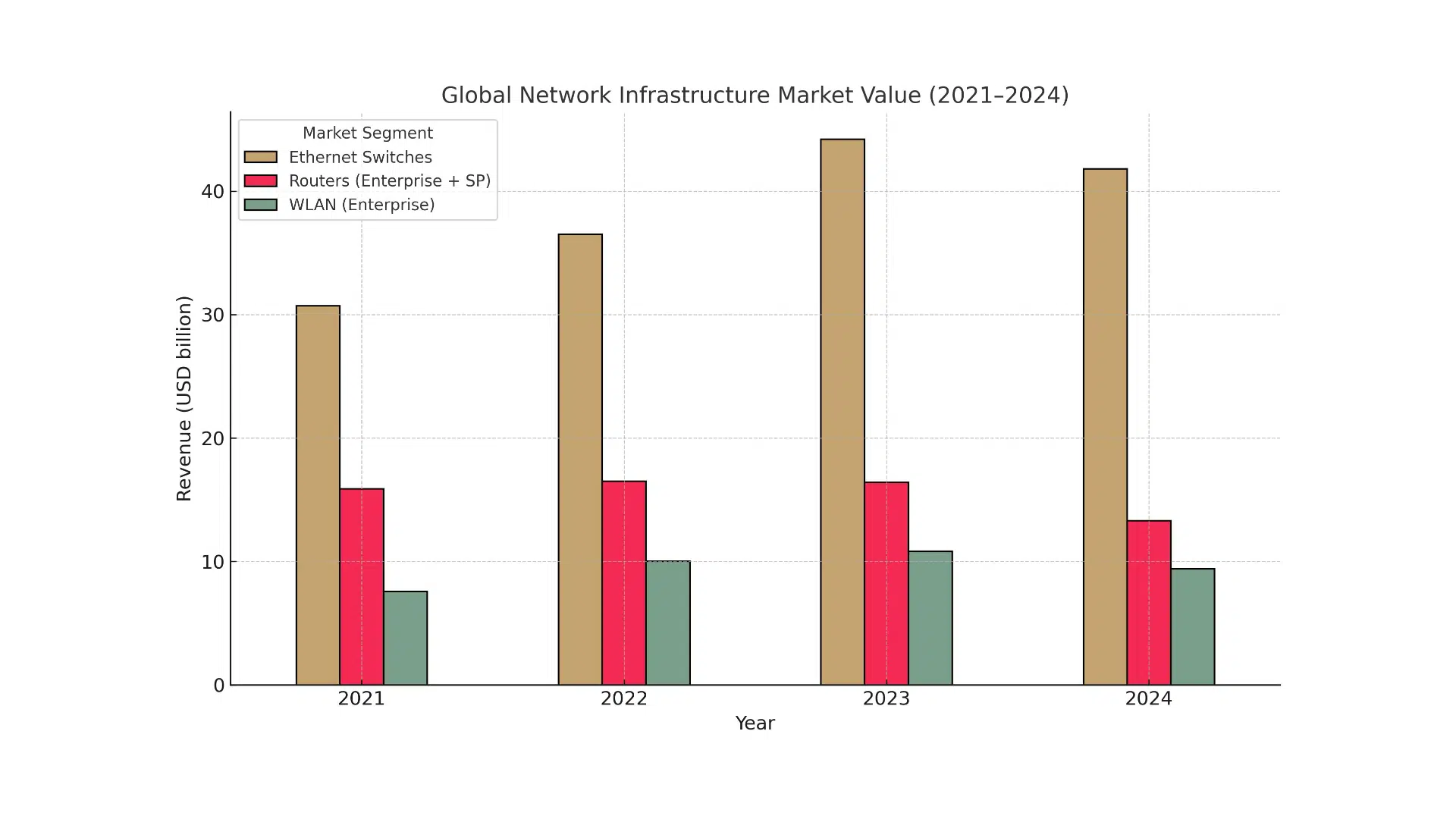
    The global network infrastructure market is worth hundreds of billions of dollars and is showing steady growth. Its value reached around USD 248.8 billion in 2024 and is forecast to grow to USD 463.9 billion in 2033. This means that the market will grow at a compound annual growth rate (CAGR) of around 7.2 per cent on average between 2025 and 2033. Such growth reflects the increasing demand for advanced networking technologies around the world – from data centre modernisation, cloud and 5G integration to the development of smart cities. Demand is driven by both the private sector (digital transformation of businesses) and public investment in broadband and mobile infrastructure.

    In 2024, the market was valued at just under USD 250 billion, to almost double its value to around USD 464 billion by 2033. The growth trend is relatively uniform and stable – reflecting the maturity of the market and the continued organic growth in demand for network capacity, security and new functionality. Importantly, the structure of the market includes network hardware (around 48% market share) and network software and services (together the remaining 52%), which means that, in addition to investment in physical equipment, the role of software solutions that define network operations is growing.

    Regional market structure

    Network infrastructure is growing in all regions of the world, but the dynamics and scale of investment vary by area. Asia and the Asia-Pacific region currently represent the largest segment, accounting for around 34% of the global market and showing the fastest growth rate. The main driver here is the expansion of next-generation mobile networks and urbanisation: it is estimated that more than half (51%) of all 5G base stations worldwide are located in Asia-Pacific. Countries such as China, Japan, South Korea and India are leading the way with investments in 5G and smart city projects. For example, some 68% of enterprises in the APAC region are betting on migrating to the cloud, and 59% are deploying advanced industrial networks for smart manufacturing and urban infrastructure.

    North America accounts for approximately 31% of the value of the global market and remains at the forefront of deploying the latest network solutions. The US accounts for the lion’s share of this market, with approximately 84% of North American infrastructure investment occurring in the US. The region has the highest density of data centres, widespread fibre availability and a rapid pace of 5G deployment. Already 48% of organisations in North America are using 5G connectivity in their operations. In addition, companies are placing a strong emphasis on security, with nearly 69% of US companies prioritising the integration of cyber security into their network infrastructure. Government programmes supporting network expansion and the widespread digitisation of business are also contributing to the growth.

    Europe accounts for approximately 27% of the global network infrastructure market. With key markets in Germany, the UK and France, the region is focusing on modernising corporate and telecom networks based on software-defined networking architectures. Already, some 61% of European enterprises are deploying SDN (Software-Defined Networking) solutions and 58% are investing in multi-cloud strategies – integrating multiple clouds for greater flexibility. European operators and companies are also intensively developing data centre infrastructure and fibre networks, preparing the ground for 5G rollout and future 6G deployments around the end of the decade. Despite a slightly smaller share of the global market, Europe maintains high standards of security and interoperability and is paying increasing attention to the energy efficiency of infrastructure – some 31% of new network investments in Europe and Asia are already directed towards green, energy-efficient technologies.

    Other regions are also seeing growth: The Middle East and Africa together account for around 8% of the market, catching up through digital infrastructure projects often funded by government funding and public-private partnerships. Latin America, meanwhile, is investing in the expansion of 4G/5G and fibre networks, although the scale of spending there is smaller compared to the three main regions.

    Leading technological trends

    Several key technology trends are clearly emerging in the network infrastructure that are shaping the development of the market:

    • 5G networks: 5G technology is being deployed globally in mobile operators’ networks, offering many times higher speeds and minimal latency. Investments related to 5G already account for approx. 21% of the total capital expenditure of telcos, and spending on 5G equipment accounts for 24% of telecoms network infrastructure budgets. Fifth-generation networks not only serve the growing mobile traffic of consumers, but also enable the development of new applications – from industrial IoT to autonomous vehicles. Of increasing importance are private 5G networks deployed by industrial and logistics companies that need reliable, unbundled connectivity with ultra-low latency for their own production needs. 5G will continue to be a catalyst for investment in the coming years, with more than 50% of global mobile connections expected to be 5G-enabled by 2029.
    • Edge computing: edge computing architectures, or computing at the edge of the network (closer to the data source and the user), are gaining popularity in response to the demands of real-time applications. Some 47% of organisations plan to deploy edge solutions to support critical systems that require minimal latency. Moving computing power closer to users improves the responsiveness of services such as video streaming, online gaming, telemedicine or autonomous vehicle systems. The proliferation of IoT also forces the local processing of huge streams of sensor data. The edge trend goes hand in hand with 5G – an estimated 39% of new network infrastructure projects combine 5G deployments with edge components to provide ultra-low latency and local data analytics for industry, smart cities or energy grids.
    • SD-WAN and Software-Defined Wide Area Networks: SD-WAN (Software-Defined Wide Area Network) are solutions that manage wide-area enterprise networks through the software layer, ensuring traffic is optimised between branch offices and the cloud. Demand for SD-WAN is growing exponentially in the age of remote and hybrid working – businesses need flexible and secure access to corporate applications in the cloud regardless of location. More than 68% of companies are shifting to a more flexible working model, stimulating SD-WAN deployments to ensure consistent connectivity and security policies across all departments. SD-WAN solutions, often offered by vendors as a managed service, also reduce data costs through the intelligent use of Internet connections and MPLS networks. A broader context is network virtualisation – SDN and NFV (Network Function Virtualisation) – where network functions, such as routing or firewall, are implemented programmatically. In Europe, the aforementioned ƒ~61% of companies are already using SDN architecture. Global vendors are intensively developing SD-WAN/SDN offerings – an example is Cisco, which in 2024 introduced a new generation of SD-WAN solutions adapted to the hybrid operating model, providing, among other things, 34% faster access to cloud applications while maintaining centralised security control.
    • Artificial intelligence (AI) in networks: AI is playing an increasingly important role in both the management of network infrastructure and in new security functions. Network operators and administrators are deploying machine learning algorithms to automate network configuration, monitoring and optimisation. More than 39% of enterprises are using AI-based analytics tools to optimise network performance and detect problems faster. At the same time, equipment manufacturers are integrating AI elements into their products – around 37% of new network devices have AI-based features for threat detection and automated response to security incidents. An example is the next-generation data centre switches from Huawei, equipped with AI mechanisms to increase performance by ~40% and improve traffic management. In the coming years, AI is expected to enable the implementation of so-called self-optimising networks (self-driving networks), which automatically adjust parameters to changing conditions and can predict failures through data analysis (predictive maintenance).

    Major market players

    The network infrastructure market is dominated by a handful of large global vendors who compete in both the telecoms equipment and corporate network solutions segments. These include Cisco, Huawei, Nokia and Ericsson, among others:

    • Cisco Systems (USA): The world’s largest provider of enterprise networking solutions. Cisco leads in the area of network equipment (switches, routers, Wi-Fi access points) and develops advanced software for network management and security. The company is adapting its offering to new trends – investing in SDN/SD-WAN solutions (the aforementioned latest products for software-defined WAN are an example) as well as cloud and data centre solutions. Many corporations base their infrastructure on Cisco hardware as standard, which gives the company a strong market position.
    • Huawei (China): A global telecommunications and networking giant that is one of the leaders in the deployment of 5G technology. Huawei offers a full infrastructure portfolio – from access equipment (5G base stations, fibre equipment) to backbone routers and cloud solutions. Together with Cisco, it is among the largest players – together the two companies control nearly 29% of the network infrastructure market share. Huawei has enjoyed tremendous success in the Asian, African and Latin American markets, although in recent years it has struggled with restrictions in some Western markets for geopolitical reasons. Despite this, the company continues to invest in research (including the development of AI-enabled switches for data centres) and maintains a strong position in global vendor rankings.
    • Nokia (Finland): One of the two European leaders in telecommunications infrastructure. Nokia (alongside Ericsson) is a leading supplier of equipment for mobile networks – especially for 4G/5G infrastructure (RAN, core network) – as well as optical and IP transport solutions. The company is using its telecoms know-how to enter new areas, such as private 5G networks for industry. In 2023. Nokia announced a number of deployments of private 5G wireless networks for industrial sectors and smart city projects, responding to business customers’ demand for dedicated, high-performance communication networks. Globally, Nokia is competing for 5G contracts with Huawei and Ericsson, with a strong presence in markets where alternatives to Chinese vendors are required.
    • Ericsson (Sweden): The second European network infrastructure giant next to Nokia, with more than a century of history in telecommunications. Ericsson specialises in equipment for mobile and radio networks – it is one of the main suppliers of 5G base stations to operators worldwide. The company is also investing in the development of core network solutions, managed services and IoT. With a strong position in North America and Europe, Ericsson is benefiting from operator demand for 5G equipment amid restrictions imposed on Huawei in these regions. In addition, Ericsson is engaged in standardisation work on future technologies (6G) and is working with partners (e.g. cloud providers) to virtualise network functions. As a company focused on the operator segment, Ericsson – like Nokia – complements the offerings of Cisco and Huawei, particularly dominating global mobile access network deployments.

    In addition to those mentioned, there are other major players in the network infrastructure market specialising in selected areas – including ZTE, Juniper Networks, Arista Networks, Dell EMC, HPE (Aruba), Extreme Networks or CommScope. The aforementioned companies compete in segments such as data centre switches, campus LAN/WLAN equipment, cabling or cloud solutions, completing the global network infrastructure ecosystem.

    Development prospects for the coming years

    According to experts, the growth prospects for the network infrastructure market over the next 5-10 years remain very promising. A projected average annual growth rate of 7% means that the sector will grow faster than many traditional industries, although slightly slower than the most dynamic segments of the IT market. The key technology trends described above will continue to drive investment: the global roll-out of 5G (and, looking ahead to the end of the decade, the first 6G deployments) will ensure continued demand for equipment and operator network upgrades. Edge computing will become an integral part of the network architecture – more and more data will be processed locally, creating a demand for distributed network nodes close to the user. Cloud and multicloud solutions will force the construction of networks capable of handling dynamic, distributed workloads, fostering the development of intelligent, software-defined networks. Automation using AI is likely to transform the way networks are managed – we are already seeing a trend towards autonomous networks, able to optimise traffic and respond to incidents autonomously. In the long term, this could result in significant operational savings and improved security.

    Regionally, the current balance of power is expected to continue, with Asia-Pacific remaining the largest and fastest-growing market due to investment in China and developing countries, North America maintaining high levels of innovation and corporate spending (especially in the US), and Europe consistently upgrading infrastructure with a focus on security and efficiency. However, the disparity between regions may narrow as network technologies become ubiquitous and deployment costs fall.

    Experts also highlight new areas of growth that may become increasingly important: private 5G networks for enterprises (e.g. in factories, ports or university campuses), networks for IoT supporting billions of devices (including narrowband LPWAN networks for sensors) or the development of the satellite internet (e.g. constellations in low orbit providing global connectivity). The digital transformation of sectors such as energy (smart grid), automotive (connected vehicles) or medicine (telemedicine, wearable devices) will generate demand for a reliable communication infrastructure. A further increase in research and development (R&D) spending in the network area can be expected – both by market giants and new players (startups), which will result in further innovations and even more efficient network technologies in the future.

    Market challenges

    Despite the positive outlook, the global network infrastructure market faces several significant challenges. The biggest barrier is high cost – network upgrades require huge capital expenditure. More than 44% of enterprises cite budget constraints as a factor inhibiting infrastructure upgrades. Next-generation hardware (e.g. 5G devices, backbone routers, edge nodes) and associated software and integration are costly investments that not all organisations can afford immediately. At the same time, obsolete (legacy) systems are still common – it is estimated that around 27% of the network infrastructure in use globally is made up of older, previous-generation equipment. Migrating from these legacy systems is difficult: nearly 38% of companies struggle to replace old hardware with newer hardware. Maintaining such solutions raises not only opportunity costs (lower performance, lack of new features), but also security risks – almost 33% of security breaches are related to vulnerabilities in outdated infrastructure.

    Cyber security is itself another challenge. The increasing complexity of networks (especially those distributed across multiple clouds and locations) means that 59% of organisations find it difficult to manage security in multicloud and hybrid environments. Attacks on network infrastructure are increasing in sophistication and the attack surface is widening with the connection of more IoT devices and the proliferation of 5G networks. Ensuring consistent security policies, network segmentation and data protection in such a heterogeneous environment is a heavy burden for IT departments. Many companies also face staff shortages, with some 29% of enterprises citing a shortage of qualified advanced network professionals as a limiting factor to progress.

    Another challenge is interoperability and integration of new technologies with existing infrastructure. Companies often use multi-vendor solutions, which raises compatibility issues. More than 34% of organisations experience integration issues when deploying disparate platforms and services. Standardisation of protocols and openness of ecosystems are therefore becoming crucial to avoid technology silos. Additionally, regulators are imposing requirements on the industry (e.g. on cyber security, data privacy or spectrum allocation), which can slow down deployments, especially in the telecoms sector.

  • TP-Link: Small businesses bet on quality. Wi-Fi 7 and SDN are hitting the SMB sector

    TP-Link: Small businesses bet on quality. Wi-Fi 7 and SDN are hitting the SMB sector

    Over the past several months, the market for network solutions for the SMB and SME sector in Poland and the CEE region has undergone a noticeable transformation. Companies – even the smallest ones – are increasingly moving away from a ‘cheap and fast’ approach to a conscious investment in a stable, secure and scalable infrastructure. Central management, quality of service (QoS), network segmentation or redundancy – until recently reserved for large enterprises – are gaining in importance.

    Robert Gawronski, B2B Channel Manager at TP-Link Polska, talks about technological trends, the gradual adoption of the Network as a Service model, the role of artificial intelligence in network management and the challenges facing integrators and operators. The expert also takes a closer look at three key business network developments for the coming years: Wi-Fi 7, multigigabit switches and management systems based on cloud and SDN architecture.

    Klaudia Ciesielska, Brandsit: What changes in the market for network solutions for SMBs and SMEs do you observe in Poland and the CEE region in the last 12-18 months?

    Robert Gawronski, TP-Link: In the last several months or so, we have observed a clear change in attitude among SMB and SME partners – they are increasingly placing emphasis on the conscious selection of network infrastructure. The approach in which only price was the key criterion and consumer access points or routers were installed in companies is disappearing. Today, companies – even the smallest ones – recognise that the network is the foundation for the functioning of the entire organisation.

    “The approach where only price was the key criterion is disappearing”.

    There is a growing awareness that infrastructure stability, security and scalability have a direct impact on operational performance. We are also seeing that partners are increasingly asking about issues related to network segmentation, access control, redundancy or quality of service (QoS) – topics that until recently were the domain of large organisations only.

    In Poland and CEE as a whole, this increase in technical awareness makes us very happy – this is a space where, as TP-Link with Omada SDN solutions, we can really support the digital transformation of companies by offering business-class infrastructure in an affordable form factor.

    K.C.: Are you seeing an increase in interest in Network as a Service (NaaS) models?

    R.G.: At the moment, we do not see much interest in NaaS models in the segment in which we operate – that is, mainly SMBs and MSPs. The traditional model based on the purchase of equipment and deployment by local integrators is still dominant.

    However, we are seeing a growing openness to managed services – especially among IT providers who are looking to diversify their offerings and increase their revenues by providing ongoing support for their network infrastructure. In this perspective, NaaS may become a natural direction for growth in the coming years.

    “We are seeing an increasing openness to managed services”.

    As TP-Link, we are ready to support partners in this transformation – both through flexible licensing models and the integration of Omada SDN with remote management tools (e.g. RMM/PSA), allowing them to create their own network services in a subscription model.

    K.C.: Which technologies (e.g. Wi-Fi 7, mesh networks, edge computing, SD-WAN) are currently riding a wave of growth among professional customers and operators? Has any trend particularly accelerated?

    R.G.: The SMB and SME sector continues to be dominated by wireless technologies – primarily Wi-Fi 6, which has become the standard for new deployments. However, there is a growing trend towards Wi-Fi 7, especially in environments with high user density, using real-time applications or requiring high quality multimedia services.

    At the same time, mesh topology is growing in popularity, which is ideal for multi-storey buildings, dispersed locations or hotel facilities, providing seamless roaming and simplified configuration.

    The importance of SDN solutions is also increasing – centralised network management from the cloud is now increasingly a requirement rather than a ‘value-add’. Omada SDN addresses these needs by enabling easy infrastructure scaling, automation of administrative tasks and access to real-time diagnostic data.

    “Centralised network management from the cloud is increasingly a requirement today, rather than a ‘value-add’.”

    K.C.: What is the adoption of AI/ML solutions in network management (e.g. automatic optimisation, threat detection) by MSPs and operators?

    R.G.: Solutions using artificial intelligence and machine learning are increasingly becoming an integral part of network management systems – and not just in large corporations. In the case of TP-Link, many of the features available as part of the Omada SDN platform are based on AI algorithms – such as automatic optimisation of radio settings, predictive problem detection, network load analysis and proactive anomaly alerting.

    From an MSP perspective, this is a huge value, as it enables the delivery of higher quality services without manual intervention in each configuration. This allows a single administrator to manage dozens of end-customer locations.

    At the same time, we realise that not every partner or administrator feels confident about AI. Therefore, we design our tools so that AI-based functions are intuitive, transparent and fully transparent – supporting administrators, not replacing them. This ‘AI as an assistant’ approach is perfect for the MSP and SMB sector.

    K.C.: What are the biggest challenges facing integrators and operators in this market segment, and how are they changing?

    R.G.: One of the main challenges remains the ever-increasing number of network-connected devices – from computers and smartphones to POS systems, surveillance cameras to sensors and IoT devices. The BYOD phenomenon further complicates issues of access control, bandwidth and security.

    Another challenge is the integration of new technologies into the existing infrastructure. Companies expect to modernise, but without having to replace everything – so it is important that network solutions are scalable, modular and easy to expand. Omada SDN addresses these needs by enabling phased deployments with central management and consistent network policies.

    “It is important that network solutions are scalable, modular and easily expandable.”

    The pressure to provide a high level of security is also increasing – even the smallest organisations today are becoming targets for attacks. This is why our solutions offer advanced security features such as ACLs, VLAN isolation, guest access control or threat analysis.

    And we must not forget the integrators themselves – these are faced with the increasing complexity of technology and the need to continuously improve their skills. This is why TP-Link invests in educational programmes and technical support for partners, helping them to successfully implement our solutions and advise customers at a strategic level.

    K.C.: In which areas of the business networking market do you expect the most intensive growth over the next 2-3 years?

    R.G.: In the coming years, we expect dynamic growth primarily in three areas:

    • Wi-Fi 7 – a new standard offering even faster speeds, stability and low latency. It is a technology that perfectly meets the needs of modern working environments, cloud-based services, 4K/8K video, and AR/VR.
    • Multigigabit (2.5G/10G) switches – with the development of Wi-Fi 6/7 and the increase in devices requiring high bandwidth, the importance of wired infrastructure is growing. Multigigabit is now becoming essential both at the network backbone level and for access to workstations or NAS servers.
    • Cloud and SDN management – solutions that enable remote configuration, monitoring and optimisation of the entire infrastructure from a single platform are growing in importance. For companies with multiple locations, IT service providers and system administrators, this is the basis for efficient operations today.

    We are also seeing the growing importance of wired and wireless network integration – administrators expect consistent management of QoS, VLAN, security and reporting policies regardless of connection type. Omada SDN is ready for these challenges – both technologically and operationally.

  • HPE acquires Juniper Networks. What’s next for the networking market?

    HPE acquires Juniper Networks. What’s next for the networking market?

    The closing of the acquisition of Juniper Networks by Hewlett Packard Enterprise is more than just the consolidation of two networking companies. It signals that HPE is putting everything on the line: an IT future that will be defined by the convergence of hybrid cloud, security and artificial intelligence. The deal, worth $14 billion, has the potential to change the balance of power in the IT infrastructure market – and beyond.

    HPE’s new position in the network market

    The acquisition doubles the scale of HPE’s networking business, whose strength to date has been the Aruba brand in the campus solutions segment. Juniper, meanwhile, brings expertise in data centres, service providers and native AI solutions. The result is a portfolio that covers the entire cross-section of needs: from edge networks to data centres to cloud-based distributed environments.

    This is not just product consolidation – it is a shift in strategic alignment. HPE is moving from being an IT infrastructure provider to being an integrator of modern network environments that are ‘built with and for artificial intelligence’. Positioned in this way, the offering is intended to meet the needs of customers deploying AI generative models, where networking becomes as critical as computing power.

    The web as the foundation of the AI era

    Artificial intelligence, especially the generative version, requires huge amounts of data and low latency. Traditional approaches to traffic and security management are no longer sufficient. The new architecture must be dynamic, scalable and – crucially – intelligent.

    Juniper brings here its heritage in the area of so-called AI-native networking, with the Mist platform as an example of operations supported by machine learning. HPE intends to integrate this approach with GreenLake services and its own operational model to create a unified network and security management platform.

    Against this backdrop, HPE strongly emphasises the uniqueness of its proposition: agent-based AI management in multi-tenant environments, a consistent user experience (UX) and operator experience, and a security engine integrated into the network rather than added externally.

    A game for higher margins and a bigger market

    The acquisition of Juniper is also a financially sound move. Juniper’s high-margin business is expected to increase the share of higher-profitability activities in HPE‘s structure. In practice, this means shifting the focus from traditional server and storage products to software, security and network services – areas with faster growth and better operating margin ratios.

    The new HPE Networking segment, led by former Juniper CEO Rami Rahim, is expected to account for more than 50% of the company’s future operating income. For HPE, this is a significant change in operating model – closer to Cisco than Dell.

    Challenges: integration, positioning, competition

    While the strategic benefits are obvious, the challenges are not small either. First and foremost, HPE must seamlessly integrate the Juniper team – both operationally and culturally – while maintaining continuity of support for both companies’ customers. Added to this is the need to clearly position the new portfolio against the Aruba offering to avoid internal cannibalisation.

    In the market, meanwhile, the competition is not sleeping. Cisco is already investing in AI in its network management and cyber security platforms. Dell is going deeper into partnerships with Nvidia and Broadcom. Startups such as Arista and Arrcus are gaining traction in cloud environments. HPE will not only have to prove its technological edge, but also build new channels to reach customers – especially those who have so far opted for more ‘software-based’ providers.

    What next?

    HPE today stands at the threshold of a transformation that could redefine its role in the IT ecosystem. The combination with Juniper Networks creates one of the most complete networking stacks on the market, ready to support cloud and AI needs. The key, however, will be how the company integrates technology, people and processes. The success of this operation could put HPE in a whole new league – not as an infrastructure provider, but as an integrator of intelligent IT environments.

  • “Innovation is the DNA for OVHcloud” – Michel Paulin, CEO of OVHcloud

    “Innovation is the DNA for OVHcloud” – Michel Paulin, CEO of OVHcloud

    Last week saw the release of ‘The Forrester Wave: Hosted Private Cloud Services in Europe, Q2 2020’, a report whose authors spoke highly of OVHcloud’s range of services, the company’s vision, its strategy and its customer base. We talk to Michel Paulin, CEO of OVHcloud, about what makes up OVHcloud’s success and the company’s strategy for the future.

    BrandsIT: Let’s first talk about the Forrester Wave report. Why is this report so important to you and to cloud providers?

    Michel Paulin: The report is important for us because of the leadership title we have been awarded and important for the industry because it is a valuable source of knowledge. Of course, we watch the market closely, but the report offers an objective assessment, hence it is crucial for us. We are pleased with the result because we are at the forefront and we are proud of this.

    BrandsIT: Excellent. We expect to find a lot of information about the private cloud in the Forrester Wave. Which cloud do you see your customers’ future in: public or private?

    Michel Paulin: In both. We should listen to what customers and analysts are saying. Four years ago, we thought that the solution at the time was great because it addressed all the problems, but the reality turned out to be more complicated, especially in large corporations with data centres. Corporate systems are modern and often made up of multiple solutions, hence multi-location cloud and hybrid cloud are the models of the future. At OVHcloud, we offer three types of cloud: bare-metal, private and public servers. This gives the customer the flexibility to choose depending on whether they have their own infrastructure or are ready to move their data to the cloud. The future is undoubtedly the cloud.

    Michel Paulin_CEO OVHcloud

    BrandsIT: What would you say about the innovation of your services? What makes you better than your competitors?

    Michel Paulin: This is not an easy question. First of all, I think it comes from our fundamental characteristics. We have our own infrastructure. We have local data centres, including in Poland, which we designed. We design our servers, build them and operate them. Our business model is completely integrated. We do not rely on subcontractors, suppliers from Asia, and this approach offers many advantages. Firstly, we work on the basis of specific needs while being fully transparent. This leads to another conclusion, that trust is key in the cloud, and for us this is extremely important. Furthermore, we focus on innovation, which is the DNA for OVHcloud. We are the creators of many innovations and, for example, in July we will launch a new private cloud based on VMware, with high performance computing and networked storage. This is the first step in our plan, which we will successively implement until December, proposing a new solution every month or two. Among other things, we will introduce new high-capacity dedicated servers in November and December. We have adopted a fast-track approach to innovation.

    BrandsIT: Could you explain your phase model to our readers? Is it still complex, indirect and direct? What about the benefits of collaboration for partners?

    Michel Paulin: Yes, we combine an indirect and direct approach. Some of our clients prefer to talk to us directly, while others work with our partners through a partner programme. Although our partner programme only launched at the beginning of this year, we can already boast cooperation on various activities, such as those carried out in Poland with Hostersi and Cloudical. Here, I would like to emphasise that we focus primarily on the quality of cooperation, rather than the number of partners in the portfolio, which is seen by them as a great advantage. In addition, we are not in competition with our end customers and work with partners to provide them with final solutions. As a supplier, we are responsible for the infrastructure and our partners, system integrators and software manufacturers work with us on the final projects for our end customers.

    BrandsIT: Great. I would like to ask you about your company strategy for the next few years?

    Michel Paulin: First and foremost is trust. We believe that the cloud must be open, reversible, trustworthy, giving our clients the feeling that we are protecting their data, both private and company data, from outside intervention. Hence, RODO and national legislation are key for us. Our data protection is in line with RODO and the European Commission’s recommendations on data protection. We also protect our customers’ data from the Cloud Act, which means being subject to US federal authorities. Secondly, we are prioritising innovation in our triple-cloud world and, for example, in the public cloud, we will be launching 12 new solutions in the next few weeks so that we can propose further features and improvements. Thirdly, expansion. At the moment we have 30 data centres around the world and we have our own network. We want to offer the same services to customers all over the world and expand to every place on Earth. As far as Poland is concerned, we have an on-site data centre, a customer support team or R&D teams in Wroclaw, we have been here for 16 years and, importantly, the founder of the company, Octave Klaba, is Polish and founded this branch by himself. Fourthly, we understand that the cloud can be very complex, so we will innovate in such a way as to help our customers monitor and automate the cloud and the tools they will use to create a private, public and local cloud. These are our assumptions for next year.

    Michel-Paulin-Octave-Klaba-OVHac
    Michel Paulin and Octave Klaba

    .

    BrandsIT: What are your market share expectations for next year in Poland, Europe and worldwide?

    Michel Paulin: Currently, the world is divided into 9 regions in our strategy, Poland is in the east-central one. This is where our support centre, R&D and sales and marketing departments are located, and this is the structure we plan to introduce in each region. We are recruiting intensively because we want to support our customers even more effectively. We are the only player from Europe that is at the global forefront. We will continue to try to reach countries outside Europe and continue to penetrate the US market. North America is home to our subsidiary, data centres and infrastructure. We are growing dynamically outside of France; in fact, France only accounts for 40% of our revenues. We will continue this dynamic.

    BrandsIT: That is correct. That was the last question about the cloud. Is there anything else you would like to share with BrandsIT readers?

    Michel Paulin: First and foremost, we are delighted to be the leader of such a prestigious ranking. It proves that a European provider can compete with American and Chinese players. I also think it is worth pointing out that OVHcloud’s strategy is to deploy our services globally. I would add that this year we conducted a local survey in collaboration with VMware, which showed that 91% of companies store data in Poland. This means that a hosted private cloud located in a Polish data centre by OVHcloud is the perfect solution for them. Our customers can build a hybrid cloud, combine their own infrastructure with our hosted private cloud services and create an extended cloud tailored to their needs. Our customers can use the same hosted private cloud, the same technologies and the same business facilities in other regions. This is very important because it responds to the specifics of the Polish market. This part of Europe is home to many excellent developers who create fantastic solutions for companies around the world. Often they start their business locally, in Poland, and gradually develop it in the regions where our data centres are located around the world and get customers everywhere. And on the other hand, if companies want to move to another region, OVHcloud makes it possible to provide services worldwide. We respond to customers’ data centre needs locally. Finally, it is worth mentioning the GAIA-X initiative, which is designed to integrate cloud providers and involves, among other things, building an integrated login capability for different cloud services. Reversibility will be a key element of this initiative. This is a unique value for European companies as it will facilitate relationship building and collaboration with other companies. We Europeans are different and we do not want to be dependent on a particular provider’s platform.

    BrandsIT: Thank you for the interview, it was a pleasure.

    Michel Paulin: Thank you.

  • Business written in fibre

    Business written in fibre

    Providinginternet is a profitable business, but it involves constant investment in infrastructure, customer retention and building a position in the market. In an interview with Radosław Lewandowski, Head of Customer Service and Sales at MOICO, Bartosz Martyka examines what the operator’s business looks like from the inside.

    BrandsIT: How is Moico doing in relation to regional competition?

    Radosław Lewandowski: According to research we conducted last year, MOICO is the only regional brand that is present in the Top of Mind of the industry (this means that we are the most recognisable brand in the regional market). In addition, around 60% of people who know MOICO consider us to be the best or one of the best home utility providers in the market. This allows us to compete effectively even in a highly saturated market, i.e. in buildings where users have a choice between several operators. There are places where seven out of ten residents just use our network, despite the fact that we are not the cheapest provider. This proves that, when it comes to services such as home utilities, it is quality, not price, that counts above all.

    How does the Operator win in comparison with the nationwide competition?

    We are the kind of operator we would like to have ourselves.

    We win against the nationwide players with the overall user experience. The basis is the quality of service – we make sure that our network is as stable as possible and allows for very fast connections. Plus a symmetrical connection, own IP address, Jambox TV. However, this is not the most important thing. We treat our customers as we would like to be treated ourselves. Firstly, we do not use loyalty (term) contracts; any MOICO user can resign from our services at any time. Secondly, existing customers are more important to us than new ones, which is why we do not use sales promotions; instead, we periodically increase the speed of existing users, without increasing the price or having to sign annexes to contracts. Thirdly, from time to time we offer customers additional services that can make their everyday life easier. One example is the BillTech system that MOICO customers have access to, which allows them to automate payments for all their household bills. In the near future, we are also launching free access for 3 months to CDA Premium for all MOICO network users. Our customers recognise and value this. A kind of community has formed in Wrocław around MOICO, which strongly supports us against national and foreign Internet providers.

    What distinguishes Moico’s services?

    All of the above. In a nutshell: no loyalty in contracts, external IP address, symmetrical link, cyclical increase in link speed (the first users used a 12 Mb/s link, now the minimum link speed is 100 Mb/s) and comprehensiveness of the whole service.

    What does the infrastructure look like?

    Our infrastructure is built on the principle of a MESH network, which makes it easy to protect the physical failure of fibre optic cables. In the event of a failure, the signal is routed via an alternative path. Therefore, our customers often do not experience network failures on their own. Connections are made using FTTH and GPON technology, depending on the installation location. All new connections have the capacity to deliver internet at 1Gbps (symterly) and remote service connection. With our own infrastructure, we are currently present in Wrocław (most districts and practically all new housing estates), Oława, as well as smaller towns around Wrocław (e.g. Bielany, Żerniki, Wilczyce, Dobrzykowice, etc.).

    Is the operation of both TV and Internet a technological challenge?

    We use technology that allows us to deliver both a quality internet connection and state-of-the-art Jambox TV without any problems. These are independent bands on which the TV and Internet signals are routed, which means that the use of the Internet connection does not affect the quality of TV reception.

    What is the key element determining the success of the Operator?

    Radosław Lewandowski: We are the kind of operator we would like to have ourselves: we do not take up customers’ time, we provide services that allow our users to use the possibilities of the network to the full, without thinking about the speed of the connection, we do not attack with promotions. All this adds up to a customer experience that has allowed us to build a very strong position in Wrocław and the surrounding area and has created a community of people around MOICO who share our philosophy.