Tag: Managed services

IT in an outsourcing model – SME strategies, benefits of IT infrastructure management and the latest solutions to support companies.

  • Challenges and priorities in the managed services market: Evolving from ‘handyman’ to business partner

    Challenges and priorities in the managed services market: Evolving from ‘handyman’ to business partner

    Imagine two scenarios. In the first, it’s 2003, and the owner of a small manufacturing company looks anxiously at a silent server that has paralysed the ordering system.

    In a panic, he calls his ‘IT man’, hoping that he will find time to come and diagnose the problem. Every minute of downtime is a measurable loss.

    In the second scenario, it is today. The CEO of a technology company receives a notification on his smartphone. It’s an automated report from his Managed Service Provider (MSP), informing him that a potential vulnerability in the company’s cloud security was discovered and patched overnight, before cybercriminals had time to exploit it.

    The company’s operations were not disrupted even for a second.

    This contrast perfectly illustrates the fundamental transformation that has taken place in the world of IT services. The evolution of managed service providers is not just a story of adaptation to new technologies.

    It is a story of a complete redefinition of the business model, driven by escalating cyber threats, the increasing complexity of cloud environments and the need for automation.

    The modern MSP has ceased to be just an external IT department called in to put out fires. It has become a key partner in risk management, an engine of digital transformation and a guardian of business continuity.

    Foundations of the past: the era of the “Break-Fix” model

    Before IT service providers became proactive partners, the dominant operating model was the so-called ‘break-fix’. Its logic was simple: when something breaks, a specialist is called in to fix it.

    The process was purely transactional: the customer experienced a breakdown, the technician arrived, repaired it and invoiced for his time and parts.

    The biggest drawback of this model was its fundamental economic structure, which created an inevitable conflict of interest. The IT service provider only made money when there were problems at the client.

    The more failures, the higher the provider’s profits. The customer sought maximum stability, while the provider’s business model depended on instability.

    This structural flaw prevented the building of relationships based on trust and had to give way as soon as companies understood that their survival depended on reliable technology.

    Proactive breakthrough: the birth of the modern SME

    The twilight of the ‘break-fix’ era has been accelerated by technologies that have enabled fundamental change. Remote monitoring and management (RMM) and professional services automation (PSA) platforms have catalysed the revolution.

    RMM tools allowed suppliers to continuously monitor the health of customer systems in an automated manner, enabling issues to be identified and resolved before they led to downtime.

    The most important innovation, however, was a change in the business model. MSPs moved away from hourly rates to a fixed monthly subscription fee (Monthly Recurring Revenue, MRR).

    For the customer, this meant cost predictability and for the SME, a stable revenue stream. The introduction of service level agreements (SLAs) gave customers contractual guarantees on response times or system availability.

    Most importantly, this model has united the interests of both parties. The MSP’s profitability became directly proportional to the stability of the client’s IT environment. Each failure was now a cost to the provider, rather than an opportunity to make money, motivating the provider to ensure maximum efficiency.

    The cyber security imperative: from administrator to defender

    If proactivity was the spark that started the revolution, the explosion of cyber threats has become the fuel that drives further evolution. Small and medium-sized enterprises (SMEs) have become a prime target for cybercriminals, and the fear of attack has become one of the top business priorities.

    Research from 2024 revealed that as many as 78% of SME companies fear that a major cyber-attack could bankrupt them.

    In response, cyber security has ceased to be an add-on and has become central to the MSP’s offering and a key driver of revenue growth.

    Market analysis shows that 97% of the highest revenue MSPs offer a wide range of managed security services. Clients are no longer just looking for tools; 64% expect strategic guidance from their MSP.

    This has forced providers to evolve towards a managed security service provider (MSSP) model, offering advanced solutions such as managed detection and response (MDR), security information and event management (SIEM) and security awareness training.

    By taking responsibility for cyber security, the MSP has fundamentally changed its role – it no longer just manages the technology, but the customer’s business risk.

    The cloud revolution: managing hybrid complexity

    Contrary to early predictions, the growth of public clouds has not made MSPs redundant. On the contrary, the mass adoption of hybrid and multi-cloud (multi-cloud) strategies has created an intense new level of complexity that companies have been unable to cope with on their own.

    This has opened up a huge opportunity for mature MSPs. They have transformed themselves into cloud strategists and integrators, helping clients develop strategies, implement complex migrations and, crucially, optimise cloud costs (FinOps).

    In an era of increasing data privacy regulation, MSPs have also started to act as a ‘data sovereignty broker’, advising on where data can and should be stored to comply with regulations.

    The ability to design and manage a fully customised hybrid environment, combining on-premises resources with private and public cloud, has strengthened the MSP’s position as a central coordinator of the client’s entire IT ecosystem.

    Innovation horizon: AIOps and Hhperautomation

    The most mature MSPs today stand on the threshold of the next evolutionary leap, whose horizon is marked by AIOps (AI for IT Operations) and hyper-automation. AIOps uses big data and machine learning to automate and streamline IT operations, moving management from proactive to predictive.

    Instead of reacting to known potential problems, AIOps predicts and prevents them before any symptoms become apparent.

    Practical applications include intelligent correlation of thousands of alerts into a single usable incident, predictive analytics that forecast future resource requirements and automated remediation that resolves repetitive problems without human intervention.

    Combined with hyper-automation, which streamlines entire business processes (e.g. implementation of new customers), these technologies become a key competitive advantage.

    AIOps is becoming a prerequisite for managing modern, complex IT environments, and vendors who successfully implement these technologies will be able to serve more demanding customers with greater efficiency.

    An essential engine for digital transformation

    The evolution of managed service providers is a story of remarkable adaptation and continuous climb up the value chain. From a reactive technician whose success was measured by the speed of repair, to a predictive, strategic partner whose value is defined by its contribution to the innovation, resilience and profitability of the client’s business.

    The MSP of the future is not a technology vendor, but a consultancy with deep technical expertise. It thrives in an environment of complexity, actively manages risk and uses intelligent automation to deliver measurable results.


  • IT partner in 2026: Why is the partner channel generating $2 trillion in SME sector spend?

    IT partner in 2026: Why is the partner channel generating $2 trillion in SME sector spend?

    Paradoxically, it is not algorithms but trusted human capital that is becoming the most valuable asset of smaller business. The SME sector is increasingly shifting its budgets towards specialised partners, looking to them not only as suppliers, but above all as architects of survival. In 2026, as much as 79% of IT spending in the SME sector flows through the hands of commercial partners. In regions such as EMEA or Latin America, this figure is even higher than 80%.

    This is no coincidence, but proof that relationship and local trust are becoming the hardest currency in business.

    Partner as ‘external brain’ of the operation

    For a small or medium-sized company, technology is rarely an end in itself – it is a tool for survival and growth. At the current rate of innovation, managing the technology stack alone is becoming an insurmountable barrier for SMEs. The difference between the market average (66.7% spend by partners) and the SME sector (79%) shows that the smaller the scale of the business, the greater the need for a trusted guide.

    The IT partner in 2026 has become the de facto ‘external technology director’ . Companies with between 100 and 499 employees, which account for as much as 42% of spend in their segment, are not looking for products on the shelves of digital giants. They are looking for someone who will take responsibility for consultancy, implementation and, most importantly, ongoing operational support.

    The end of the dictatorship of “boxed” solutions

    The SME market in 2026 has developed a defence mechanism against technological chaos. Although this sector’s spending is growing more slowly than the broader enterprise market, its structure is becoming increasingly consolidated around external advisors. While the largest corporations are pumping billions directly into hyperscale data centres, smaller companies have almost completely handed over the reins to local partners.

    This change is not a coincidence, but a pragmatic calculation. The medium-sized company is not looking for access to raw computing power, but a ready continuity of processes. In EMEA, where partners control as much as 82% of spending, technology has become a service whose stability must be vouched for by a specific individual, not the anonymous rules and regulations of a global provider

    Managed services: A new standard for security and peace of mind

    Omdia’s data analysis sheds light on a fascinating trend: the dynamic growth of managed services, which is expected to reach $251 billion at 9.7% growth. This signals a profound mental shift in business. Entrepreneurs have realised that a one-off implementation is only the beginning.

    Technology in the hands of smaller companies has become a test of character and trust. While the market giants are tempted by direct access to powerful infrastructure, the SME sector in 2026 is massively opting for the intermediation of local partners, seeing them not only as suppliers, but above all as guarantors of operational peace of mind. The eighty per cent dominance of the partner model is clear evidence that it is the personal relationship that is becoming the most effective fuse for business growth.

    Cloud and connectivity – foundations built by intermediaries

    Although cloud computing is associated with giants such as AWS, Microsoft and Google, partners are the ones ‘bringing it under the roof’ of medium-sized companies. The predicted 22.3% growth in cloud infrastructure services is largely due to integrators who can carry out a secure migration without paralysing the customer’s current operations.

    A similar mechanism is observed in the area of Unified Communications (UC). Since 9 out of 10 UC platforms are purchased through partners, this means that the key for the business is not the chat application itself, but its integration with sales processes, customer service and ERP systems. The partner is the architect here, making the individual building blocks from different suppliers start to form a coherent whole.

    cloud

    Regional dependency

    Geographical data confirms that reliance on the partner channel is a global trend and resilient to cultural differences. From Asia (81%) to Latin America (86%), the SME sector needs local support. Even in North America, where direct sales models are historically the strongest, up to 73% of budgets go through partners.

    The battle for the SME market is not taking place in the data centres of the hyperscalers, but in the relationships built by thousands of local IT companies. They are the ‘last mile’ of digitalisation, without which the global technology revolution would be bogged down by configuration problems and lack of technical support.

    Pragmatism instead of fascination

    An interesting phenomenon is the evolution of approaches to artificial intelligence. Although half of SME companies are already using AI tools, the time for hobbyist testing of chatbots is over. In 2026, AI has become an invisible component of analytics and compliance, and its implementation depends almost entirely on the competence of the IT partner. It is up to them to decide whether the technology will save money or merely increase the client’s technology debt.

    The real strength of the partner channel lies in its flexibility. While global providers standardise their offering to the limit, the IT partner adapts it to local legal and operational realities. It is this ‘last mile’ of implementation that generates the lion’s share of the $2 trillion that the SME sector puts on the table.

    The renaissance of relationships

    The addressable market for partners serving SMEs is expected to be worth as much as $1.87 trillion in 2026. This is evidence of a renaissance in professional advisory services, making it clear that the role of the partner as a trusted advisor is becoming more important than ever. Channel partners have won this battle because they are the only ones offering something that cannot be bought in a subscription model: personal accountability for the business outcome. For the SME sector, which cannot afford downtime and failed experiments, the professional IT partner has become the most important fuse for growth.

    Finally, it is worth adding that, according to Omdia data, the SME sector, with a budget of $2.38 trillion, will capture nearly 40% of the IT pie in 2026, creating a powerful space for partners to build business value.

  • Managed services is a marathon, not a sprint. 5 steps to choosing a strategic partner

    Managed services is a marathon, not a sprint. 5 steps to choosing a strategic partner

    Demand for managed servicesis growing exponentially, driven by the need to upgrade infrastructure and implement artificial intelligence. However, many organisations are faced with the challenge of how to effectively implement managed services to gain not just technical support, but a viable partner who understands business objectives.

    Just a decade ago, IT outsourcing was mainly associated with simple cost reduction and ‘firefighting’ in the helpdesk. Today, this model is receding into the background. According to analyses by consultancy CGI, the market is evolving towards advanced partnerships. Companies are no longer just looking for hands to work, but heads to think – experts who can help them through digital transformation, process automation and AI implementation .

    However, for this collaboration to bear fruit rather than frustration, the supplier selection process needs to be thoughtful. Here are 5 key steps to move you from haphazard commissioning to strategic advantage.

    1. Before you send in your enquiry: Inventory your own backyard

    A fundamental mistake many companies make is trying to outsource problems that they themselves do not fully understand. Before even sitting down at the discussion table with potential suppliers, it is essential to look in the mirror. According to CGI experts, the key to success is a sound baseline assessment.

    It is important to identify precisely which business processes are critical to the survival of the company and which are merely support functions. Equally important is a technology inventory – what we have, what is obsolete and where we lack internal competence.

    Risk assessment should not be forgotten either. Issues such as data security, compliance or reliability of systems are the foundations on which trust is built. Such an internal ‘inventory’ provides a solid basis for future contracts. Without it, the contract will be riddled with holes and responsibilities will be unclear.

    2. Define success: what do you really want?

    “We want it to be cheaper and better” is a wish, not a strategy. For managed services to deliver real value, an organisation needs to know where it is going. Goals must be clearly defined and, more importantly, measurable.

    Is the priority really to save operational costs? Or is the aim to free up internal IT resources so that they can focus on innovation and building competitive advantage? Often, the motivation is also to improve service quality or to gain access to technologies that would be too expensive to implement in-house.

    By precisely defining the organisation’s weaknesses, specific success criteria (KPIs) can be formulated. The more precise the specification of expectations at this stage, the easier it will be to monitor the partner’s performance later on. The supplier needs to know what it will be held accountable for before signing a contract.

    3 People, not just servers: A strategic model for adoption

    Technology is not everything. Even state-of-the-art solutions provided by an external partner will not work if they clash with resistance from within the company. The decision on whether to outsource only selected areas or entire IT departments should be driven by the company’s wider strategy, not by chance.

    CGI highlights a key, and often overlooked, aspect: the human factor. The successful implementation of managed services requires that the client’s employees are part of the change, not victims of it. In the transformation process, ‘internal multipliers’ – opinion leaders and change ambassadors who help teams understand and accept the new working model – play an invaluable role. Without the right cultural and mental preparation, innovation will only remain on paper.

    4. clear rules of the game: A model of control and accountability

    Outsourcing does not mean getting rid of responsibility – it means changing the way it is exercised. A transparent governance model is necessary for a smooth collaboration. It must be clear who makes key decisions, what the process for escalating problems looks like and how service performance is verified.

    Companies can choose between different control models: from central control, which provides uniform standards across the organisation, to decentralised models that offer greater local flexibility, to hybrid solutions. Each has its advantages, but the most important thing is that the rules are set at the start. This will avoid a competence ‘grey area’ where no one feels responsible for mistakes.

    5 Choose a partner: Look for a strategist, not just a contractor

    The final decision should fall on a company that offers more than a standard catalogue of services. In the age of digital transformation, the supplier must be a strategic partner. This means that it should not only carry out outsourced technical tasks, but actively contribute to the business development of its customer.

    The ideal partner, according to the approach suggested by CGI, combines industry knowledge with technological competence and operational flexibility. He or she must understand the specifics of the client’s market and offer scalable solutions that will grow with the company.

    Location is also playing an increasingly important role. In times of geopolitical uncertainty and the growing importance of digital sovereignty, having a partner in the local market is becoming an asset. This ensures not only a better understanding of regulations and organisational culture, but also greater security in handling sensitive data.

    Choosing a managed services provider is one of the most important strategic decisions IT leaders make today. Treating the process solely in purchasing terms is a mistake. Success depends on a thorough understanding of your own needs, preparing your organisation for change and finding a partner that can translate the language of technology into the language of business benefits.

  • The end of the ‘lone wolf’. The future of cyber security is managed services

    The end of the ‘lone wolf’. The future of cyber security is managed services

    Statistics can be unforgiving, and in the case of cyber security, they shed new light on the state of modern business. It is estimated that just 0.009 per cent of the world’s one million companies have a chief information security officer, or CISO, on staff. For years, this organisational luxury was reserved exclusively for corporate giants with huge budgets. However, in the face of new regulations such as NIS2 and DORA, and the increasing aggressiveness of cyber gangs, the ‘IT guy for everything’ model in the SME sector is definitely becoming history. Regulatory requirements and market realities are forcing entrepreneurs to radically change their paradigm and move from owning tools to buying competence.

    The IT sector is facing a structural problem that will only get worse in the coming years, with the Bitkom association forecasting a shortage of more than 650,000 experts by 2040. This is not a temporary staffing hole, but a new economic reality in which medium-sized companies stand at a loss in the fight for talent. SMEs rarely have salary budgets or benefit packages that can compete with the offers of global corporations, and even if they do manage to hire a specialist, keeping them within the company borders on the miraculous. Market researchers predict that almost half of current CISOs will change employer by 2025, making recruitment processes drag on for months and consuming resources that smaller players simply do not have.

    The consequences of this are already clearly measurable, with companies with fewer than 500 employees citing a lack of specialists as the second biggest threat to their security. This leads to a paradoxical situation in which company boards are consciously accepting cyber risks. This is not due to ignorance or underestimation of the risks, but to simple helplessness and lack of access to human resources capable of implementing effective protection. In Germany, a sizable percentage of organisations link successful ransomware attacks directly to a lack of internal knowledge and the ability to detect threats in time.

    In response to these staff shortages, the market has turned to automation, and managed security services are gaining popularity as a pragmatic alternative to building in-house. Central to this are MDR, or Managed Detection and Response, services, which combine EDR and XDR technologies with external teams of analysts available around the clock. Using advanced machine learning and artificial intelligence, these teams can detect anomalies and stop attacks in real time, often acting faster and more effectively than any in-house administrator.

    However, there is a dangerous trap of thinking that technology alone will solve all an organisation’s problems. MDR services are great at the operational layer, as they are great at putting out fires, detecting intruders or isolating infected workstations, but they are not designed for strategic thinking. No algorithm will create a RODO-compliant security policy, prepare a company for a complex NIS2 audit and explain to the board why investing in backup systems is more important at any given time than implementing a new ERP system. A clear distinction needs to be made between operational security, which operates in the here and now, and strategic security, which is about managing risks, planning for growth and building a long-term security culture.

    This is where the concept of a virtual CISO enters the scene as an answer to the needs of companies needing to meet stringent regulatory requirements but not needing a full-time director. Both the EU’s NIS2 directive and the DORA regulation for the financial sector require organisations to have a clear allocation of responsibilities and to prove that security strategies are not only in place but also monitored by a qualified body, making paper-based security no longer sufficient. Incorporating the role of a vCISO within managed services allows SME companies to access enterprise-class expertise, as they gain an expert who works with multiple organisations on a daily basis and is familiar with the latest threat vectors.

    The model also brings tangible financial and organisational benefits. Subscription billing is only a fraction of the cost of hiring a full-time expert, while eliminating high recruitment and training costs. What’s more, the solution provides strategic continuity because, while MDR services protect the infrastructure at night, a virtual director by day plans the development of digital resilience, creates procedures and oversees audits. With this approach, the CISO role ceases to be an optional extra and becomes an available service that bridges the gap between complex technology and business objectives.

    The skills shortage is a structural challenge that will not go away in the foreseeable future, so instead of fighting windmills in a tough recruitment market, mid-sized companies should redefine their approach to data protection. The future belongs to a hybrid model that coherently combines modern technology based on artificial intelligence, managed operational services running continuously and external strategic oversight. Such an arrangement achieves a level of cyber resilience that was previously beyond the reach of smaller market players. Cyber resilience must not be the prerogative of the largest corporations, but must become a standard available to every business entity, and managed services with a virtual CISO is currently the most pragmatic and economically viable way to achieve this.

    It is crucial for IT decision-makers and integrators to analyse the current strategy in view of upcoming regulations. It is worth asking whether there is a clearly defined role within the organisation responsible for security strategy, or whether it relies solely on tools and software. An honest answer to this question can define a company’s resilience for years to come and protect it from serious legal and financial consequences.

  • Selling value in IT: effective communication in a managed services model

    Selling value in IT: effective communication in a managed services model

    The days of the IT ‘fireman’, called in only to put out technological fires, are inevitably coming to an end. The break-fix business model, in which an IT company makes money from customer failures and problems, is not only outdated – it has become a strategic trap. In today’s economy, where every minute of downtime generates quantifiable losses and cyber threats evolve day by day, being a reactive provider is a simple path to marginalisation.

    The future belongs to those who can transform themselves from technicians into trusted business advisors, offering proactive partnerships within Managed Services.

    The fundamental change that needs to take place is not about pricing, but about mindset. In the reactive model, the interests of the provider and the customer are in conflict: the more problems on the customer side, the higher the revenue for the IT company. Managed services reverse this dynamic by 180 degrees.

    In a subscription model, every failure is a cost to the provider, eroding its margin. Suddenly, both parties have a common goal: maximum infrastructure stability, performance and security. This convergence of interests is the most powerful sales argument, and understanding it is the first step to successful transformation.

    The key to success is to stop selling technology and start selling business benefits. Customers are not buying ’24/7 monitoring’ or ‘backup management’. They are buying peace of mind, guaranteed business continuity and financial risk insurance.

    Instead of starting the conversation with a list of functions, the effective sales person becomes a consultant who asks questions about the customer’s business. He is interested in the company’s biggest operational pain points, downtime costs and strategic goals. Only after thoroughly understanding these challenges does he present managed services not as a product, but as a bridge from a problematic current state to a desired future state.

    The narrative needs to shift from the language of features to the language of benefits: not ‘we are implementing EDR software’, but ‘we are protecting your company from a ransomware attack that could paralyse its operations for days’.

    In order to simplify the process and make the customer’s decision easier, intelligent bundling of offerings is essential. Instead of presenting a complex price list of individual services, professional providers group them into logical, tiered packages, often referred to as ‘Bronze, Silver, Gold’.

    This structure has a key psychological and educational function. The basic package (Bronze) addresses fundamental needs such as monitoring and basic security. The standard package (Silver) is a sensible choice for most companies, adding proactive maintenance and backup management.

    The highest package (Gold) is a strategic partnership offering that includes advanced security, business continuity planning and virtual IT director (vCIO) services. This gradation allows the client to self-diagnose their needs and risk appetite, while increasing the perceived value of the overall offering.

    The ultimate argument when talking to decision-makers, especially the finance department, is hard data. This is where Total Cost of Ownership (TCO) and Return on Investment (ROI) analyses come into play.

    TCO analysis is a powerful tool that exposes the hidden costs of the reactive model. By adding up not only repair invoices, but more importantly the costs of downtime, lost employee productivity and cyber security risks, it can be proven that a fixed, predictable subscription is significantly cheaper in the long run.

    ROI, in turn, shows how an investment in managed services translates into tangible returns – by increasing productivity, enabling the team to focus on strategic projects or avoiding catastrophic failures.

    Presenting the client with a solid financial analysis that shows in black and white that proactive care is not a cost but an investment is the most effective way to close the sale.

    Transforming into a managed service provider is a demanding process that touches every aspect of the business – from the competence of the team, to the tools used, to the marketing strategy. However, the reward is building a stable, scalable and highly profitable business, based on long-term relationships with loyal customers.

    In today’s technology landscape, companies are no longer just looking for someone to fix their computer. They are looking for a partner who will take responsibility for their digital stability and help them grow. It’s time to ditch the fireman’s helmet and put on the strategist’s suit. There is simply no other way.

  • MSP 2.0: How managed service providers are transforming into strategic partners in cyber security

    MSP 2.0: How managed service providers are transforming into strategic partners in cyber security

    For years, managed service providers(MSPs) were seen as external IT teams – helpful but on the sidelines. Today, their role is changing. With the increasing complexity of IT environments and the growing emphasis on cyber resilience, MSPs are becoming key players in companies’ security strategies – not just contractors, but full partners.

    This is not a cosmetic change. It is a full transformation of the operating model.

    MSP on a new course

    According to the SME Customer Insight Report 2025, prepared by Barracuda Networks in collaboration with Vanson Bourne, up to 73% of organisations worldwide are already using SME services, with a further 23% actively exploring the possibility. Importantly, the customer profile is also changing: from the typical SME sector to medium-sized and larger companies. In the segment with 1,000 to 2,000 employees, as many as 85% of companies are using MSPs – more than in the 50-100 employee group.

    Behind this change is primarily the increasing fragmentation of IT security environments. Companies increasingly use multiple tools, platforms and vendors that require integration, coordination and continuous oversight. MSPs that are able to provide this are beginning to take on the role of ‘conductor’ in a complex technology orchestra.

    From IT support to strategic partnership

    The traditional problem-response relationship is fading into the background. Companies today expect proactive support from MSPs – both in day-to-day protection and in planning their long-term security strategy. In the DACH region, 56% of organisations use MSP services available 24/7. This is no longer a luxury – it is a necessity.

    Clients are looking not just for incident response, but for support in growth, scaling and digital transformation. They increasingly expect MSPs to advise on which technologies to deploy, how to optimise security architecture and how to ensure regulatory compliance.

    In this role, MSPs need to speak the language of risk, operational continuity and resilience – not just SLAs and patch management.

    New requirements: AI, zero-trust and operational continuity

    Growing expectations translate into specific competences. MSPs today not only need to know the basics of cyber security, but integrate advanced solutions based on artificial intelligence, implement zero-trust architectures, provide SOC-type services, and deliver threat analysis and penetration testing.

    Globally, 39% of companies indicate AI/ML as one of the most desirable competences in managed services. In the DACH region, this figure is 37%. In parallel, there is growing interest in threat intelligence, risk analysis and resilience planning services.

    All this means that SMEs are increasingly competing not only with other IT providers, but with consultancies, systems integrators and the internal security teams of large organisations.

    Not everyone can keep up with the change

    The transformation of SMEs into strategic partners is a big opportunity, but also an even bigger challenge. Organisations are prepared to pay more – as many as 92% of those surveyed say they will accept up to 25% higher costs for MSP services, as long as they meet real business needs. But this rise in expectations carries risks.

    Companies are less and less willing to tolerate deficiencies in the SME offering – such as lack of business continuity, poor quality of crisis response or inability to scale services. In the DACH region, as many as 50 per cent of companies surveyed say that a lack of 24/7 support would be reason enough to switch providers.

    In addition, there is growing pressure on MSPs to be resilient themselves – customers expect the IT partner itself to meet security standards, not be an attack vector and have transparent response procedures.

    Co-management and ecosystems – the future of managed services

    In response to changing customer needs, an increasing number of SME companies are opting for a co-managed services model. In this arrangement, the service provider does not completely replace the client’s IT department, but acts as an extension of it – providing specialist expertise, tools and scalability where they are needed.

    This model works particularly well for larger organisations that want to retain strategic control of IT while gaining access to the latest technologies and competencies without having to build them internally.

    On the other hand, technology vendors are increasingly developing integrated partner programmes for MSPs – offering access to platforms like XDR, SIEM tools or off-the-shelf components for SOC-as-a-Service. This makes MSPs part of a larger security ecosystem, where interoperability, response time and quality of threat data are key.

    SMEs as the axis of digital business security

    SME transformation is not happening in a vacuum. It is a response to growing business pressures: staff shortages, the rapid pace of digitalisation, new regulations and increasingly sophisticated cyber threats.

    Companies no longer want to have an ‘IT someone’. They need a partner who understands their risks, can design resilient infrastructure and ensure business continuity even in crisis conditions. SMEs that meet these expectations can take a central position in the value chain of IT and security services.

  • Managed services need a new model. AI is already writing it

    Managed services need a new model. AI is already writing it

    Managed services are currently undergoing their biggest transformation since the emergence of the MSP model. MSPs are operating in an increasingly challenging environment – increasing competitive pressures, economic uncertainty and cyber security threats. In the face of these challenges, AI is becoming a key growth driver: up to 90% of MSPs consider AI solutions important or very important to their growth strategy. What’s more, most providers are already implementing AI in their operations – from infrastructure monitoring to customer service – redefining traditional service delivery models. This handout presents key trends and market data related to automation and AI in managed services, illustrating how the technology is changing MSPs’ efficiency, market dynamics and key areas of their business.

    AI adoption trends in the SME sector

    The percentage of companies declaring the use of AI in at least one business function increased from ~20% in 2017 to 78% in 2024. The rapid jump occurred especially between 2023 and 2024 due to the uptake of generative AI (pink line, 71% in 2024). For IT managers and service providers, this means that AI has become a common business tool on a global scale. This trend is also reflected in the SME industry – according to the survey, more than two-thirds of SMEs have implemented AI in areas such as systems monitoring or ticket automation. Importantly, the transformation is accelerating: in Q4 2023 alone. 62% of MSPs have expanded their use of AI, and analysts predict up to 11% growth in their revenues in 2024 thanks to these technologies. The world of managed services is thus entering a new era, where AI-supported automation is becoming the standard that defines competitiveness.

    Impact of AI on service efficiency and quality

    AI promises significant operational improvements for SME companies. By automating routine tasks and using machine learning, they can speed up responses and improve customer service. Suppliers report tangible benefits: AI-enhanced teams can handle more requests and issues in the same amount of time, reducing delays and errors.

    Impact of AI implementation on the operational efficiency of the SME. The baseline (100) represents team productivity without AI support. The use of AI tools raises this indicator to ~120, representing a ~20% increase in productivity. This order of magnitude improvement translates into faster incident resolution and reduced operational costs. For example, the introduction of AI-based automation has reduced the average time to resolve a ticket by up to 68%, and operational costs have fallen by ~20%. This allows staff to focus on more complex tasks and proactive customer support, which increases customer satisfaction. As a result, MSPs using AI are seeing a marked increase in internal productivity and the quality of services provided, building a competitive advantage.

    wzrost rynku msp 2020 2033 scaled

    Market dynamics of managed services in the AI era

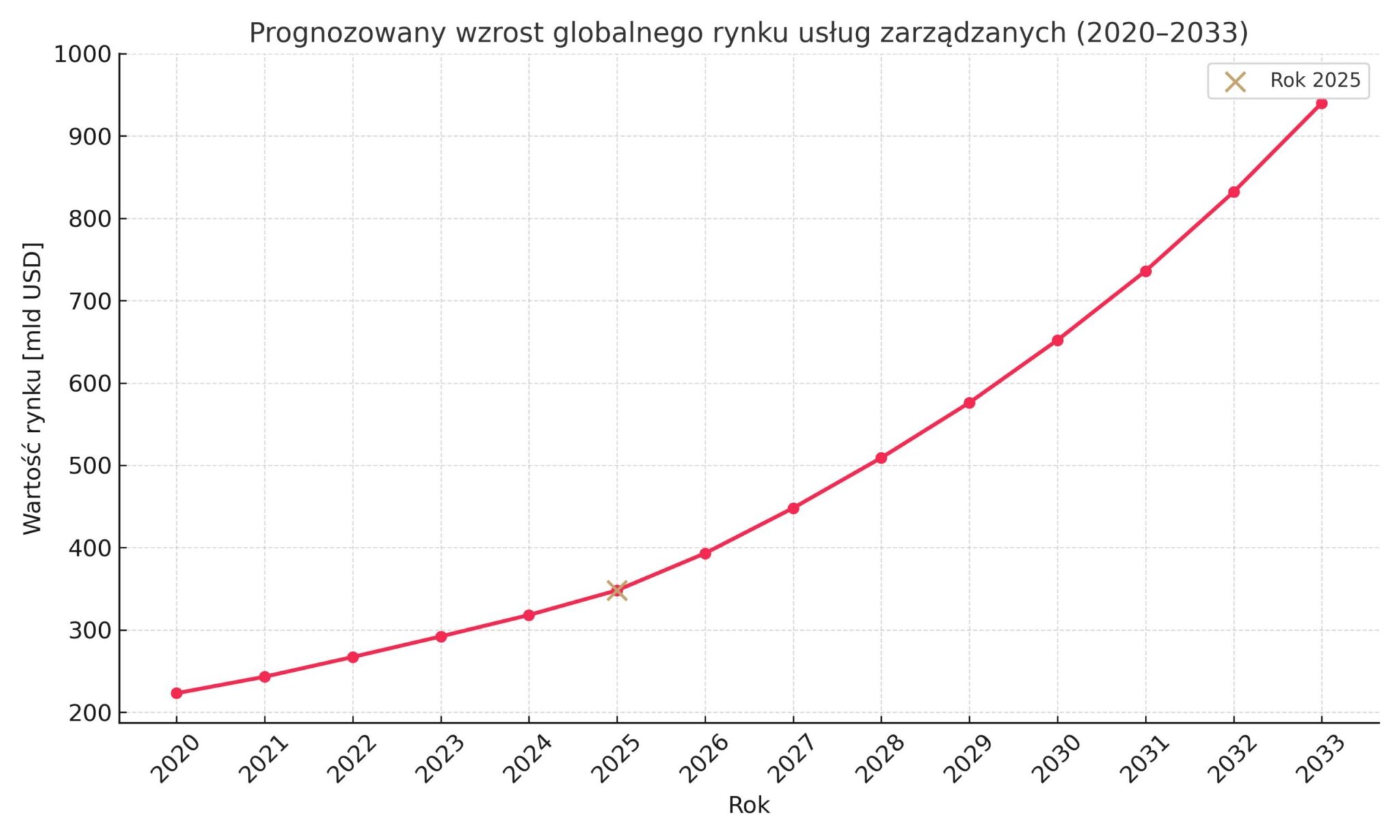
    Automation is driving not only efficiency, but also growth in the overall SME market. More and more companies are opting to outsource managed IT services, expecting providers to use modern AI technologies for better performance. Global forecasts indicate a continued high growth rate for this industry in the coming years. The global managed services market is forecast to grow from approximately USD 348 billion in 2024 to approximately USD 393 billion in 2025 and over USD 1 trillion by 2033. By 2030, the market could already reach approximately USD 730 billion, representing high double-digit average annual growth. Such rapid expansion reflects the growing demand for specialised IT services delivered efficiently and at scale. Automation and AI are a key driver of this growth – streamlining the work of SMBs, enabling new services and business models, and attracting customers looking for innovative solutions. According to experts, AI is becoming one of the main drivers of managed services, and providers investing in these technologies can expect a greater share of the rapidly growing market.

    afa973fc 04d8 4c94 8116 a42636e4bf9e

    Key application areas for AI in SME services

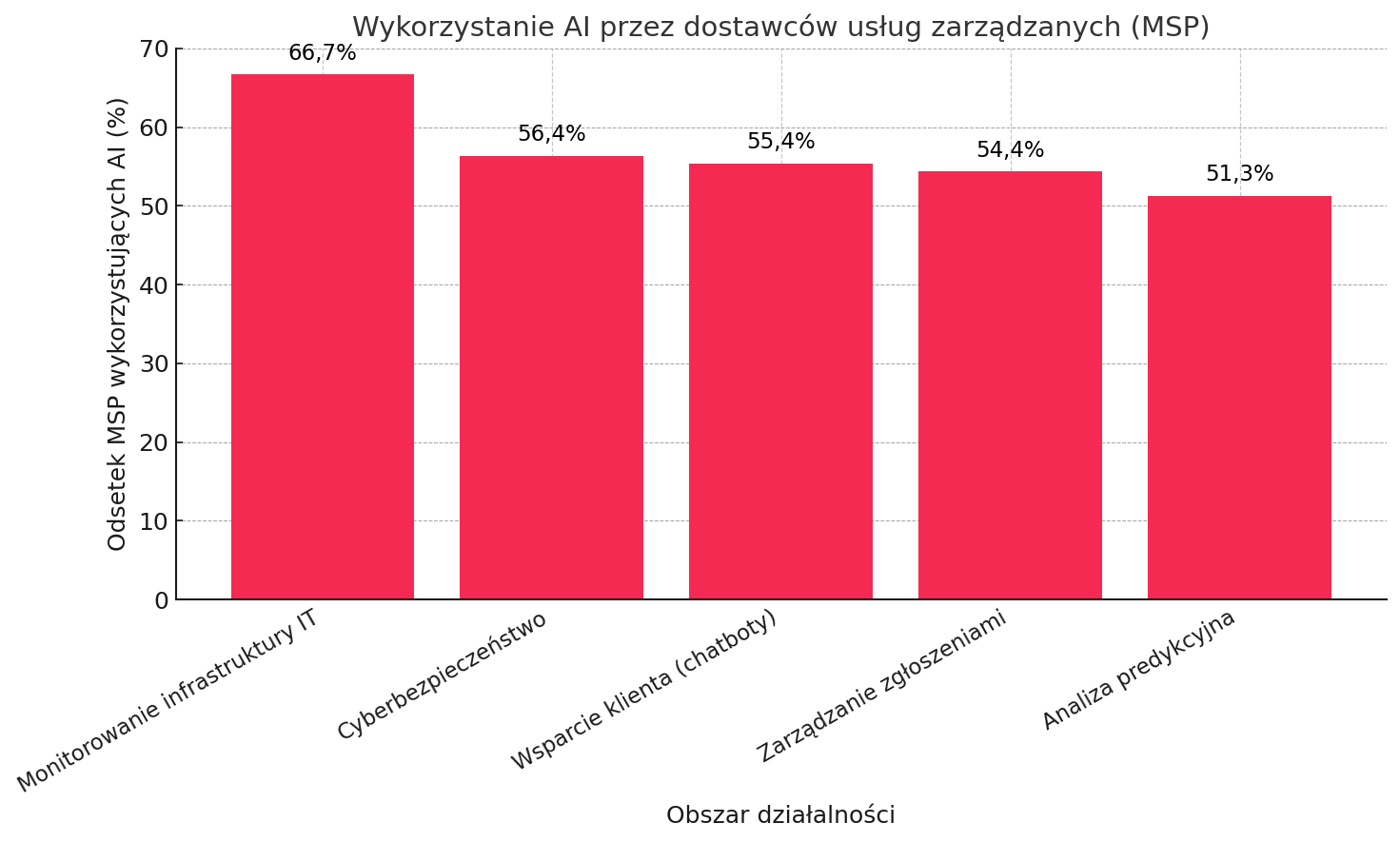
    AI is being applied to many aspects of managed service providers. The main domains in which automation and intelligent algorithms are changing the way MSPs deliver services, and the degree of adoption, are highlighted below. Percentage of MSPs using AI in different business domains. The most common use of AI is in infrastructure monitoring (67% of MSPs) and service request automation (54%). A slightly smaller percentage uses AI in the areas of cyber security (56%), customer support (chatbots – 55%) and predictive analytics (51% ). It is clear that IT systems monitoring and cyber security are at the forefront – AI here helps with 24/7 anomaly detection, threat detection and proactive incident response. Customer service automation (e.g. chatbots) relieves the burden on support teams, speeding up the resolution of common issues and improving customer satisfaction. Request and incident management gains agility thanks to AI – systems automatically categorise and prioritise tickets, reducing queues and response times. Predictive analytics tools, in turn, enable MSPs to predict failures or resource expansion needs before problems occur, minimising customer downtime.

    As can be seen from the data above, AI-supported automation covers the full range of managed IT services processes – from the basics of infrastructure maintenance to advanced analytics. In each of these areas, AI not only improves efficiency (e.g. fewer alerts slipping through the cracks, fewer false alarms in the SOC), but also expands the range of services that MSPs can offer (e.g. predictive customer optimisation recommendations, intelligent advice through assistants). This shows that AI has become a versatile tool to improve MSP operations on many fronts simultaneously.

    Challenges in implementing AI automation

    Despite the obvious benefits, implementing AI in managed services brings with it a number of challenges. IT managers need to consider these when planning automation strategies to avoid pitfalls and maximise return on investment. The main obstacles include:

    • Data quality and availability – AI requires large sets of reliable data to train models. Many companies struggle with scattered, incomplete or poor quality data, which limits the effectiveness of algorithms.
    • Complexity of integration – Implementing AI into existing processes and systems can be difficult. It is necessary to adapt the IT infrastructure, integrate with a variety of tools and ensure that the new solutions are compatible with current procedures.
    • Security and privacy – AI-based automation raises questions about data security (especially in the context of models that learn from customer data) and potential new attack vectors. MSPs need to ensure that the models they implement do not introduce additional security vulnerabilities.
    • Skills gaps – Effective use of AI requires expertise that may be lacking in typical SME teams. The problem is a shortage of machine learning experts and the need to train staff to use the new tools.
    • Costs and ROI – AI technology (from tool purchase to integration and maintenance) involves significant financial outlay. Companies must carefully calculate whether the expected improvements and savings will outweigh the costs incurred.
    • Ethical aspects and regulatory compliance – With the increasing use of AI, issues of accountability of algorithms, transparency of decisions made by models and compliance with regulations (e.g. RODO for automated processing of personal data) arise. MSPs need to develop appropriate AI management policies to maintain customer trust and meet regulatory requirements.

    Awareness of the above barriers is key to successful AI implementation. Technology leaders should prepare a comprehensive transformation plan, including phased implementation (e.g. piloting on a limited function), providing training for employees and selecting proven, secure AI solutions. This will ensure that automation becomes a permanent part of the MSP’s strategy and not just a one-off experiment.

    Prospects for the future

    Automation and AI are redefining the managed services model, but many changes are yet to come. In the coming years, expect the MSP offering to continue to evolve, with MSPs increasingly delivering AI-based services beyond the traditional framework. For example, the concepts of proactive, predictive services are already emerging: providers can anticipate customer needs and propose solutions before a problem arises (e.g. preventative upgrades before a failure occurs, automated suggestions for performance improvements). More integrated service platforms are also being developed, where the customer receives a personalised, adaptive set of managed services that adapt dynamically to their needs. All this means that MSPs that adopt AI quickly will gain an advantage. They will be able to offer innovative, higher value-added services that are difficult to achieve through traditional methods. In contrast, providers that delay investing in intelligent automation risk being left behind – their services may prove to be less efficient, more expensive and unable to meet growing customer expectations of proactivity and personalised service. As one industry report put it, this is only the beginning of the transformation: the most innovative MSPs will be able to provide services still unimaginable today, from ‘bespoke’ marketplaces that adapt to user needs to cyber security bordering on precognition (predicting and stopping breaches before they happen).

    In summary, automation and AI are becoming the new face of managed services. What this means for IT managers and technology decision makers is the need to boldly but thoughtfully enter the world of AI – to harness its potential to increase efficiency and create new value for the business, while consciously managing the challenges. MSPs that successfully integrate AI into their offerings can bring service quality to unprecedented levels, shaping the future of the entire industry. Conversely, those who stay with old methods risk losing competitiveness in the face of the coming automated future of IT services.

  • Artificial intelligence as a tool of the future in the UX/UI industry

    Artificial intelligence as a tool of the future in the UX/UI industry

    In a rapidly changing technological world, the emergence of artificial intelligence(AI) and its sudden development has caused considerable confusion for representatives of various IT-related positions. Some perceive it as an opportunity and a support, while others worry about losing their jobs and sense the real threat it may bring.

    Can artificial intelligence completely replace designers?

    This is a question that has come up frequently in many forums recently. However, the correct approach seems to be that AI will be an indispensable assistant, allowing us to focus on creative and strategic aspects. In this article, I will discuss how AI affects the UX/UI design process, what benefits and challenges it brings, and what changes can be expected in the near future, where intuitiveness and simplicity of use are key.

    With the development of artificial intelligence, the market for UX/UI design tools has been enriched by a number of innovative AI-supported solutions. These technologies not only make the design process faster and easier, but also allow for a more precise and efficient approach to creating interfaces and user experiences.

    One category of tools that seems to carry a lot of value for the designer are those related to automating the process of generating prototypes and mockups. The algorithms of tools such as: FIGMA AI, Sketch AI, Uizard or Designs AI, are able to analyse user data, visual trends and best design practices to create initial versions of interfaces that can then be customised by designers. This makes the design process faster and more efficient, allowing designers to focus on the more creative aspects of their work.
    After using some of the tools a few times, it is clear that they are still far from perfect. The designs created often deviate from the original intentions. However, I am convinced that in the future the process will be refined and the results of work using AI will increasingly meet the expectations and needs of users.

    Another branch of AI worth looking at for design is assisting and systemising project work. Artificial intelligence can significantly influence and facilitate the project and schedule management process. Advanced algorithms can automatically analyse the progress of the work, detect difficulties and delays and immediately present changes to help meet the objectives.

    AI effectively allocates tasks, taking into account the skills and availability of team members, allowing for optimal work distribution and minimising the risk of overload. Additionally, by monitoring performance in real time, AI provides valuable data that enables faster decision-making. Tools such as Trello, Asana or Monday, enhanced with AI, allow for more organised and predictable project management, saving time and increasing efficiency. In this way, artificial intelligence supports designers, enabling better planning and execution of tasks.

    Another example is the use of AI to collect user data and analyse it afterwards, enabling a better understanding of behaviour and needs. Tools that enable such analysis include Hotjar, Mixpanel, Amplitude and Google Analytics 4 (GA4). Artificial intelligence allows designers to process and interpret vast amounts of data, which can then be used to more accurately determine user needs and what the interface of the systems or services being designed should look like.

    Projects based on data, not just intuition

    Artificial intelligence helps to identify behavioural patterns, predict future user actions and automatically segment users based on their interaction with the product. For example, Google Analytics 4 uses predictive models to determine the probability of conversion, while Hotjar allows you to analyse recordings of user sessions and heatmaps, pinpointing areas that need to be optimised. As a result, UX/UI designers can respond more quickly to customer needs and make more accurate business decisions based on data rather than just intuition.

    In an era of increasing importance of accessibility and inclusivity, artificial intelligence tools cannot be forgotten to support the design of user-friendly and accessible solutions for all users.

    Accessibility – which is one of the most important aspects of modern design – means creating digital products that are accessible to all users, regardless of their technological, cognitive or physical limitations. In this area, artificial intelligence has really great potential. It allows the automatic generation of subtitles for audiovisual material (e.g. Whisper from OpenAI) and, during design, makes it possible to analyse parts of the interface for users with disabilities.

    Look at the project from the perspective of a person with a disability

    Artificial intelligence is able to bring the designer closer to how people with specific dysfunctions can use the solution being created. This makes digital solutions more inclusive and better suited to a wide audience. The Stark plug-in, developed for the Figma design tool, offers a range of features to simulate how people with different visual problems might perceive a design.

    In summary, AI-supported automation is becoming an increasingly important part of the UX/UI design process. AI-based tools and technologies offer designers a range of opportunities that can significantly speed up and streamline their work, while maintaining high quality and customisation for users. In the future, we can expect AI to play an increasingly important role in UX/UI design, supporting designers and making their work easier. However, it will not completely replace human input in design, but rather become an invaluable support, enabling better and more advanced solutions to be created in far less time. Collaboration between humans and AI will be crucial for further development and innovation in UX/UI design.


    Karol Danis Opi Pib

    About the author: Karol Danis – Information Processing Centre – National Research Institute.
    Junior UX Designer with a passion for learning by doing. Believes that simplicity and intuitiveness are the foundation of any design. In her work she seeks a balance between aesthetics and functionality. She values empathy and enjoys working close to users and the team.

  • 5 questions to… Monika Roś-Gruszczyk, 3S Group

    5 questions to… Monika Roś-Gruszczyk, 3S Group

    The great need for digitalisation and the advantages of cloud services are causing the data centre market in Poland, both before and during the pandemic, to grow steadily. This potential is recognised by domestic companies as well as global players. The level of investment in data centres in Poland is therefore quite high, although the market will not run out of space in the near future, according to Monika Roś-Gruszczyk, Member of the Management Board, 3S Group.

    Last year was marked by the accelerated digitisation of enterprises. However, analysts indicate that the largest increase in investment in data centre services is expected to occur in 2021 and beyond. Is an increase in demand now visible compared to last year?

    Monika Roś-Gruszczyk: 2020 was a relatively good year for us, although, being aware that not all customers were able to grow as fast as they would have liked, we are hoping for more in 2021. Industries affected economically by the pandemic are returning to growth, and this in many cases brings with it the need to invest in IT infrastructure, telecommunications and security. We are seeing an increase in demand above all in the area of outsourcing of IT resources in the broadest sense. Disaster Recovery solutions, which allow environments to be dispersed over several geo-locations, are becoming increasingly popular. Customers now need solutions for business continuity and access to computing power that can be easily scaled. However, that is not all. Our observations show that customers often choose a business partner with a very high level of experience and engineering competence and offer a financial model based on subscription fees. It is this growing interest from the market that motivates us to develop the 3S Data Centre Cluster and invest further in data centres.

    According to PMR data, 38% of respondents would be willing to pay more for certified data centre services. How do you assess the role of certification in the development of the data centre market in Poland?

    Monika Roś-Gruszczyk: Our experience confirms that they play an important role in the purchasing process of many customers. In particular, large companies or those operating in sectors such as finance, public administration, medicine, IT or eCommerce treat having ISO 9001 and ISO 27001 certification as a prerequisite for starting cooperation. Companies in the SME sector do not attach as much importance to this; trust is built here primarily through recommendations from our existing customers.

    Recently, the 3S Group announced a new investment in Katowice, thanks to which the Katowice data centre is to expand to an area of 4,400 m2. How much power will the facility then have?

    Monika Roś-Gruszczyk: We are rapidly running out of space in our two data centres in the Katowice- Gospodarcza complex, hence the need for new investment. The excellent location, energy security, telecommunications accessibility or the restrictive rules of physical access already organised here have motivated us to launch another, third facility, in this very location. We have already started the preparatory and administrative work, and construction itself will start in January 2022. The new data centre will have an area of 2,200 m2, thus doubling our resources at this location. Once it is up and running, the Katowice Gospodarcza 12 complex will have a gross floor area of 4400 m2 with 2 x 4MW of available connection power.

    With this investment, our potential for geographically dispersed customer communities is also growing. Less than 10 km away, we still have a data centre at Ligocka Street in Katowice. We are also completing the modernisation of a server room in Bytom. In addition to housing the main customer resources, both of these facilities will also act as backup centres for DRC solutions in many projects.

    Currently, most data centres are located close to large cities and this is justified if only because of the presence of large organisations in such locations. However, it is also associated with higher costs for the construction and maintenance of data centres. Do you think there will be a move away from this trend in the next few years?

    Monika Roś-Gruszczyk: It is difficult to say. Urban agglomerations have many advantages, such as the presence of fibre-optic networks or, for example, access to qualified employees. Trends related to automation may bring an important change here. The construction of data centres away from agglomerations, in better locations in terms of energy, with less need for staff, may have a raison d’être.

    What are the challenges for the development of the data centre market in Poland?

    Monika Roś-Gruszczyk: The industry is becoming more and more diversified. There are large investments by global players with their great potential and a broad spectrum of services. On the other hand, smaller, local providers who rely on their flexibility are often better able to meet customers’ needs.

    Although the market is growing, its saturation in Poland is still relatively low. In my opinion, there is still a lot of room for development for all suppliers. Hybrid models combining on-premise and various cloud models (private / global cloud) are becoming increasingly popular.

    The biggest challenge, in my opinion, is the availability of highly qualified specialists. It is already not easy to find people who can build a solution for a customer based on the resources of both global and local players. Added to this is the need to create services in a way that is relevant to the rapidly changing needs of Customers, all while ensuring security, scalability and anticipating the growth of their business. Working in data centres is becoming increasingly exciting, but also demanding.