Tag: Iran

  • More expensive servers and smartphones? How the war in the Middle East is crippling production

    More expensive servers and smartphones? How the war in the Middle East is crippling production

    While Silicon Valley’s attention is focused on the architecture of the latest GPUs, the real threat to the pace of artificial intelligence development has manifested itself in the petrochemical sector. Recent disruptions in the Middle East, including the hit to the Saudi Jubail complex, have exposed the heavy dependence of global electronics on a narrow set of feedstock suppliers.

    A key flashpoint has been the stalled production of high-purity polyphenylene resin (PPE). This material is essential for the laminates in modern printed circuit boards (PCBs), the backbone of everything from smartphones to powerful AI servers. The fact that SABIC accounts for around 70% of the world’s supply of this component means that any break in its Gulf Coast facilities immediately resonates with factories in South Korea and China.

    The effects are tangible and costly. In April alone, PCB prices rose by 40% compared to March, which overlapped with the ongoing copper boom. Copper foil, which accounts for nearly 60% of raw material costs in wafer production, has become 30% more expensive this year. For manufacturers such as South Korea’s Daeduck Electronics, which supplies Samsung and AMD, this situation has forced a complete shift in management priorities. Instead of negotiating contracts with customers, operations directors now spend most of their time securing chemical supplies. Waiting times for epoxy resins have increased dramatically – from three to as much as fifteen weeks.

    The AI infrastructure sector is feeling the most pressure. Multilayer circuit boards used in data centres are many times more expensive than standard models, and prices can exceed 13,000 yuan per square metre. Despite this, cloud providers seem ready to accept these increases. With talk of the PCB market growing to nearly $96 billion by 2026, key players are prioritising continuity of supply over margins.

  • Attacks on US critical infrastructure. How Iran exploited flaws in the OT

    Attacks on US critical infrastructure. How Iran exploited flaws in the OT

    The false sense of security of modern infrastructure is shattered not by sophisticated algorithms, but by mundane negligence, which in the hands of state actors is gaining the status of a strategic weapon. Incidents targeting US operational technology systems prove that the weakest link in digital power can sometimes be a lack of elementary network hygiene, turning a routine configuration into a critical point for state stability.

    While the public debate revolves around mythical zero-day tools and sophisticated cyber-espionage, the reality turned out to be painfully trivial. The key to physical process control systems was not a new generation of digital lockpicks, but an open door that no one saw fit to close.

    Fundamental to this problem is the methodological regression of the aggressors. Traditionally, we view state-owned hacking groups as digital laboratories creating unique code with huge market value. Meanwhile, actions targeting the water or energy sectors reveal a shift towards an operational model based on cost efficiency.

    Instead of investing millions of dollars in finding unknown software vulnerabilities, the attackers used widely available scanners of network resources. In this new doctrine of ‘cyber-pragmatism’, it is not the hacker that adapts to the target, but the target that is chosen because of its public visibility and lack of elementary barriers such as unique passwords or multi-component authentication.

    This situation exposes a profound crisis in the concept of air-gapping, the physical isolation of operational technology (OT) systems from external networks. For decades, the belief in the security of PLC logic controllers or SCADA systems was based on their supposed inaccessibility. However, the Industry 4.0 paradigm, enforcing a constant flow of analytical data and the need to remotely service devices, has quietly and effectively crushed this wall.

    In many cases, systems that were listed as isolated in the documentation actually had active connections to the internet, configured on an ad hoc basis for the convenience of administrators or external providers. This ‘digital convenience’ has become the most effective ally of foreign intelligence.

    Operational technology has specific characteristics that make it extremely vulnerable to simple attacks. Unlike the dynamic world of IT, where the life cycle of hardware closes in a few years, industrial infrastructure is designed for decades. Many of the controllers currently in operation date back to a time when communication protocols such as Modbus were built with performance in mind, completely ignoring security aspects. In that world, trust was the default.

    Today, these same devices, lacking encryption or identity verification mechanisms, are rendered defenceless against anyone who can establish a communication session with them. This is not a bug in the code; it is a bug in the very design philosophy of systems that have suddenly gained global connectivity.

    An analytical look at the timing of these attacks allows us to see them as a form of digital signal diplomacy. These incidents occurred at a sensitive moment of international tensions, suggesting that their main objective was not total physical destruction, but a demonstration of capability. Hitting the municipal sector, often seen as less protected than military systems, allows the aggressor to dose the pressure with precision. It is a kind of proof of access – proof of having access to the critical switches of the state, which can be used as a bargaining chip at the negotiating table. Such a strategy allows operating below the threshold of open armed conflict, while creating real social and political unrest.

    It should be noted that attribution in cyberspace always remains subject to a degree of uncertainty, which favours a strategy of so-called plausible deniability. The use of simple tools and known vulnerabilities means that traces left by attackers can mimic the actions of amateur hacking groups or common cyber criminals. For the targeted state, this creates a doctrinal dilemma: how to respond to an incident that is technically primitive but strategically strikes at the heart of citizen security.

    The lessons learned are harsh for existing risk management models. Focusing resources on combating the most advanced threats while ignoring digital hygiene in the OT sphere is akin to building an armoured door in a house with open windows. The challenge is no longer simply to purchase more expensive AI-based defence systems, but to return to rigorous network segmentation and auditing of the simplest access settings.

  • The war in Iran and cloud pricing – How geopolitics is hitting the IT sector

    The war in Iran and cloud pricing – How geopolitics is hitting the IT sector

    The modern global economy resembles an intricate network of interconnected vessels, in which a tremor caused at one point on the globe resonates with unexpected force at the opposite end. While it might seem that the sterile, air-conditioned halls of Europe’s data centres are separated by an infinite distance from the dust and chaos of the Middle East, reality brutally verifies this belief.

    Today’s technology, despite its apparent ethereality, remains deeply rooted in the physicality of raw materials and the stability of trade routes. What is happening in the bottleneck of the Strait of Hormuz is not just a local armed incident, but a direct impetus adjusting the IT sector’s operating margins globally.

    This phenomenon can be described as a geopolitical risk premium. The market for digital services has ceased to respond solely to classic supply and demand mechanisms and has begun to price uncertainty. When the world’s key energy arteries are compromised, the price of technology rises not because the power socket has run out, but because the cost of maintaining the stability of this flow becomes dramatically higher.

    The foundation of any cloud infrastructure is energy. In Europe’s energy mix, natural gas still acts as the marginal price-setting fuel. Any disruption in the Middle East, which is the planet’s energy granary, immediately translates into higher electricity bills, which the operators of large server farms have to pay to keep their computing processes running.

    Often seen as an immaterial entity, the cloud actually ‘breathes’ electricity, and its breath becomes more expensive the more turbulent the regions of fossil fuel extraction.

    The situation is complicated by the fact that modern data centres are facilities designed for absolute reliability. Guaranteeing service availability of more than ninety-nine per cent relies on extensive emergency power systems. These generators, which are the last line of defence against a blackout, run on diesel.

    Rising oil prices therefore directly increase the cost of maintaining operational readiness. These accumulating energy costs cease to be just a spreadsheet item and become a barrier to entry for innovative projects, especially when AI, with its exponentially growing appetite for computing power, is developing rapidly.

    When analysing the supply chain, it is important to recognise that the impact of conflict goes far beyond energy alone. The logistics of IT equipment, including the transport of servers, disk arrays and advanced components, is extremely sensitive to fluctuations in transport fuel prices. However, even more acute, although less visible, is the increase in the cost of associated services.

    Geopolitical instability is forcing logistics and insurance companies to renegotiate rates. Risk premiums in maritime and air transport act as a hidden tax that ultimately burdens the end customer’s wallet.

    A particularly worrying aspect is the fate of critical raw materials such as helium supplied from Qatar. This gas is indispensable in the production of state-of-the-art semiconductors. A transport blockade in the region could paralyse factories in Taiwan, with a consequent return to the days of drastic component shortages.

    From a bizneus perspective, this means having to abandon the ‘just in time’ delivery strategy in favour of building up costly strategic reserves.

    The current balance of power on the world map is forcing a redefinition of digital asset placement strategies. Technological security today is also a geographical analysis. Cloud regions located in countries with high political risk are losing their attractiveness, while countries offering a stable energy mix, based on nuclear or renewables, are becoming new bastions of operational sovereignty.

    A key task for executives therefore becomes optimising cloud costs through advanced FinOps practices. IT financial management is now part of a company’s defence strategy.

    Understanding that every inefficiency in application code or unused server instance is a waste of resources that are becoming scarcer and more expensive is fundamental to modern technology leadership.

    In conclusion, the conflict in the Strait of Hormuz region represents a test of sorts for the resilience of the global technology sector. It demonstrates emphatically that the digital world is not isolated from tectonic shocks in geopolitics.

    Business must accept the new reality that energy inflation and supply uncertainty are constants in the equation. Adapting to these conditions requires, first and foremost, a deep awareness that cloud stability begins where dependence on uncertain energy sources and threatened trade routes ends.

  • Iranian hackers broke into the FBI director. Private data leaked

    Iranian hackers broke into the FBI director. Private data leaked

    The hacking of FBI Director Kash Patel’s private email inbox by Handal’s group – associated with Iranian intelligence – is more than just a tabloid leak of photos with cigars and rum in the background. It is a precisely aimed message in a psychological war that is increasingly permeating from the government sphere into the private sector. While the FBI is reassuring that the stolen data is historical and does not contain state secrets, the incident exposes a gap in the security architecture of modern leaders: the blurring line between the professional and personal spheres.

    A strategy of public humiliation

    Experts, including Gil Messing of Check Point, point to a clear shift in Iran’s tactics. Instead of sophisticated attacks on critical infrastructure, which could be met with a devastating military response, Tehran is betting on hack-and-leak operations. The aim is simple: to make US policymakers feel vulnerable. The publication of Patel’s private correspondence from 2010-2019 is intended to show that no one, not even the head of the Federal Bureau of Investigation, is beyond the reach of the Islamic republic’s digital tentacles.

    Risks to business: The case of Stryker and Lockheed

    For business, however, the most important wake-up call is not the attack on Patel, but Handala’s parallel actions targeting giants such as Stryker and Lockheed Martin. The group is not confined to politics; it is hitting medical supply chains and the data of defence workers. This shows that Iran’s cyber units treat corporations as an extension of state targets. Leaking employee data in the Middle East is a direct physical threat that goes beyond the typical cybercrime.

    The Patel incident is reminiscent of the 2016 scenario and the hacking of John Podesta’s inbox. Despite the passage of a decade, relatively simple breaches of private Gmail or AOL accounts remain the most effective method of infiltration. For executives, there is one lesson here: digital hygiene in private life is now an integral part of corporate risk management. A private message from a decade ago can become a weapon in today’s conflict. Iran, analysts suggest, is ‘firing everything it has’, heralding a series of further leaks targeting those closest to the administration and key industries.

  • Iran war hits financial sector. 245% increase in cyber attacks in Akamai report

    Iran war hits financial sector. 245% increase in cyber attacks in Akamai report

    In classical military doctrine, a kinetic strike is preceded by a phase of prolonged and painstaking reconnaissance. Drones appear over enemy territory and electronic intelligence maps the location of key communication nodes. In digital reality, this process is accelerated and almost completely automated, blurring the lines between peacetime and hybrid warfare states. The latest data provided by Akamai, showing an unprecedented 245 per cent increase in malicious internet traffic linked to tensions over Iran, demonstrates that the European and global business sector has become an active, though often unwitting, training ground for big politics.

    This phenomenon should not be interpreted merely in terms of incidental hacking attacks. The scale and nature of the recorded activity suggest an intelligence operation on a massive scale. Instead of spectacular but short-lived acts of sabotage, what is being observed is a systematic ‘tug on the handles’ of digital infrastructure. Botnets based on advanced algorithms are constantly scanning ports, searching for open services and cataloguing security vulnerabilities. This phenomenon can be described as digital asset mapping. For operators, this means that every publicly accessible element of their IT architecture has most likely already been included in the databases of geopolitically inspired actors. The aim is not immediate destruction, but to create a precise map of targets to be used when political tensions reach a critical point.

    The logistics of these activities provide a picture of the extremely complex nature of contemporary threats. Although the political vector points to Tehran, the digital footprints lead to infrastructure located in Russia and China. More than a third of malicious traffic operates via Russian proxy servers, creating a kind of infrastructure of impunity. The use of systems located in countries that rarely co-operate with Western cybercrime law enforcement agencies allows attackers to almost completely obliterate attribution trails. In this context, the origin of the IP address ceases to be a reliable indicator of the location of the aggressor, becoming merely an element in a complex game of appearances. The conclusion for business decision-makers is that traditional traffic filtering methods based solely on geographical blacklists are becoming an inadequate tool against an adversary with such a deep logistical base.

    Of particular concern is the fact that the financial sector and the thriving fintech industry have become the main targets. Four out of ten recorded attacks targeted banking institutions. This choice is no accident. The financial system is the lifeblood of the modern economy, and customer confidence in the stability of their funds is the foundation of social order. The paralysis of a transaction system or the massive leakage of access data generates consequences far more severe and long-term than the destruction of physical infrastructure. The case of the US financial institution, which had to fend off 13 million packets of data coming from the Iranian direction in a short period of time, shows that we are dealing with attempts to create a digital shock that has a direct impact on the operational stability of entire countries.

    The concept of digital isolationism, or geofencing, is gaining ground as a pragmatic risk management strategy. The suggestion by experts to completely prevent access to key services from regions in which an organisation has no real business appears to be a rational response to the asymmetry of modern conflicts. There may be resistance to this approach, but from a capital security and data protection perspective, minimising points of contact with potentially hostile environments is a purely economic decision. Keeping infrastructure fully accessible to regions that generate only harmful traffic is a cost that becomes difficult to justify to shareholders and regulators in the current geopolitical situation.

    The role of boards of directors and chief operating officers in this process is evolving. Cyber security has become an integral part of political and strategic risk analysis. The realisation that the 245% increase in botnet activity is not information hype, but a precise preparatory exercise, is changing the way infrastructure protection investments are viewed. They are no longer just a fail-safe policy, but an essential part of defending against the effects of global political reshuffling.

    To summarise the scale of the challenges facing modern business, it is important to acknowledge that in the digital space, the first shot in the conflict with Iran has long since been fired. It was every automated port scan, every password collected and every data packet blocked as part of the shockwave that has been recorded in recent months. The adversary is not waiting for an official declaration of war; he is already there, patiently mapping resources and looking for the weakest link. For the organisation, the key question becomes how much of an unreadable and difficult-to-fix picture of their own structure they will present to those who are secretly watching their every digital move. In this game of survival, the advantage will be gained by those who are able to turn cold statistical data into a far-sighted strategy for protecting their own digital sovereignty.

  • Conflict in the Middle East and electronics prices: What lies ahead for the IT industry in 2026?

    Conflict in the Middle East and electronics prices: What lies ahead for the IT industry in 2026?

    The armed conflict involving Iran, the United States and Israel sheds new light on a fundamental paradox of modernity: the world’s most advanced technologies are being held hostage to resource extraction processes whose logistics rely on the stability of regions that have for decades been described as powder kegs.

    Fundamental to the current unrest in the high-tech industry has been the issue of the availability of helium, a noble gas whose role in the process of semiconductor lithography cannot be overestimated. While the public associates helium with entertainment applications or medical MRI equipment, for chipmakers it is an essential coolant and a medium for maintaining thermal stability in the most precise manufacturing equipment. The fact that nearly thirty-eight per cent of the world’s production of this raw material is concentrated in Qatar creates a dangerous tipping point in the global supply chain. QatarEnergy’s decision to declare a state of force majeure, prompted by attacks on refining infrastructure, is a wake-up call for the entire silicon ecosystem. Halting operations at natural gas processing plants means not only a shortage of fuel, but more importantly an interruption in the supply of petrochemical components, without which modern electronics cannot function.

    However, the problem goes far beyond helium alone. Market analyses show the industry’s deep dependence on fourteen other critical materials from the Middle East, including bromine and specialised process gases. In the semiconductor sector, where purity standards are measured at the nanoscale, switching suppliers is not a simple logistical operation. It is a process of months of validation and rigorous quality testing, violations of which could destroy entire production runs worth hundreds of millions of dollars. In the face of protracted conflict, the flexibility of giants such as TSMC, Samsung and GlobalFoundry is being put to its toughest test since the global pandemic, with the current crisis being far more structural and unpredictable.

    The geopolitical Gordian knot remains the Strait of Hormuz. A key artery for global energy trade, this narrow maritime isthmus also acts as a fuse for global digital transformation. The blockade or significant obstruction of shipping in this body of water is hitting the cost of the energy required to power giant server farms and the price of polymers used in the manufacture of computer components with a ricochet. The observed increase in energy prices is therefore not just a transport issue, but a direct operating cost for any company operating a SaaS model or cloud infrastructure provider. The disruption to supply in this region is forcing a shift away from the previous dogma of just-in-time logistics management to costly strategic stock-building strategies, which will inevitably impact the operating margins of the technology sector.

    This situation is particularly acute in the context of the unprecedented demand for computing power generated by the development of artificial intelligence. The industry is in ticks: on the one hand, demand for advanced computing units is growing exponentially, while on the other hand, production capacity is encountering a raw material glass ceiling. The risk of technological involution is becoming real and may manifest itself not only in delays in the release of new generations of processors, but above all in the forced cannibalisation of resources. Sectors such as automotive or industrial automation may be forced to compete for the same limited chip resources with technology giants, leading to drastic price increases for end devices and stifling digitalisation in less profitable industries.

    Undisrupted globalisation, in which access to technology was guaranteed by efficient market mechanisms, is a thing of the past. It is now giving way to an era of strategic resilience. The stability of the Middle East has become a key element of technological security for any business using digital working tools. The current crisis shows that the future of artificial intelligence and global connectivity depends on the permeability of sea lanes and the political stability of raw material exporting countries, which are often forgotten in the daily pursuit of innovation.

    Managing an organisation in 2026 therefore requires not only proficiency in anticipating market trends, but also a deep understanding of the physical map of the world. The cost of technology ceases to be a function of the progress of miniaturisation and becomes a product of the security price of physical assets. In this new reality, the winners will be those who can integrate geopolitical risk analysis with technology planning, understanding that the blue gas in Qatar’s tanks has a direct impact on the fluidity of a mobile app in Europe or the agility of an ERP system in North America. The Middle East is now becoming the catalyst for a major shift in the way the world thinks about technology: no longer as an unlimited resource, but as a precious asset whose foundations are extremely vulnerable to shocks.

    Further developments between Tehran and Washington will determine whether the current perturbations turn out to be merely a short-term shock or the beginning of a profound reconfiguration of the global technological order. The illusion of the autonomy of the digital world from the problems of the physical world has finally been dispelled. It is therefore worth keeping a close eye not only on the stock market quotations of technology companies, but also on the movements of ships in the Gulf, as this is where the source code for next year’s IT sector margins is currently being written.

  • Foxconn warns of impact of Middle East conflict on IT industry

    Foxconn warns of impact of Middle East conflict on IT industry

    Young Liu, CEO of Foxconn sent a clear message on Friday: the ongoing conflict in the Middle East has ceased to be just a matter of headlines in news outlets and has become a real risk factor for the margins of the AI sector.

    For Liu, who runs the world’s largest electronics manufacturer, the key question is not whether demand for AI servers will continue at record levels, but how long the global economy can withstand the pressure on commodity prices. If the US-Israeli confrontation with Iran drags on, the markets must prepare for oil to return to the $100 per barrel level. For the technology industry, which has invested billions in computing infrastructure, this means a dramatic increase in the cost of logistics and the energy required to power data centres.

    The situation is paradoxical in that the Gulf region has recently become the new promised land for giants like Nvidia and Microsoft. The UAE is being intensively positioned as a regional AI hub to drive future iterations of models such as ChatGPT. However, the escalation of hostilities and Iran’s recent missile attacks cast a shadow over these ambitions, calling into question the security of the physical infrastructure in a region that was supposed to guarantee stability and capital.

    Despite this turbulence, Foxconn is trying to remain calm. While the current market volatility is being felt, Liu is looking further ahead, pointing to 2026 as the point at which the company is expected to reach its full operational capacity. For now, the impact of the conflict on the company’s financial performance remains limited, with record revenues driven by artificial intelligence fever providing a solid cushion of safety.

    The real test for investor sentiment will come on 16 March, when Foxconn will present its fourth quarter report and update its forecasts. That’s when we’ll find out whether CEO Liu’s optimism is based on solid fundamentals or whether the industry is starting to overestimate its resilience to macroeconomic shocks.

  • Conflict with Iran and IT sector resilience – How do financial markets forecast broken supply chains?

    Conflict with Iran and IT sector resilience – How do financial markets forecast broken supply chains?

    Modern geopolitics resembles an extremely complex operating system in which every line of code is responsible for the stability of the global flow of capital, goods and data. When reports of escalating tensions between the US, Israel and Iran circulated around the world on Saturday, most observers focused on the purely informational sphere – headlines that inherently feed on emotion and ad hocity. However, at the same time, almost imperceptibly to the layman, mechanisms much deeper and more precise were set in motion. The financial markets, opening on Monday morning, did not wait for official diplomatic announcements. They had already carried out a compilation of data, making a merciless revision of asset values. What to the casual media viewer is a chaos of reports, to the savvy business leader is a raw, binary signal about the future state of the economy.

    This phenomenon can be described as market ‘debugging’ of reality. While politicians operate with narratives, investors operate with probabilities. There is a fundamental paradox of information: the mainstream media often generates noise that makes it difficult to make rational decisions, while charts of bond yields or the forward curve of oil prices provide hard evidence of how deeply conflict can penetrate the fabric of global business. The ability to read this thermometer is becoming an extremely important management competency to protect operational continuity in a world where peace is a temporary state and volatility is the only constant.

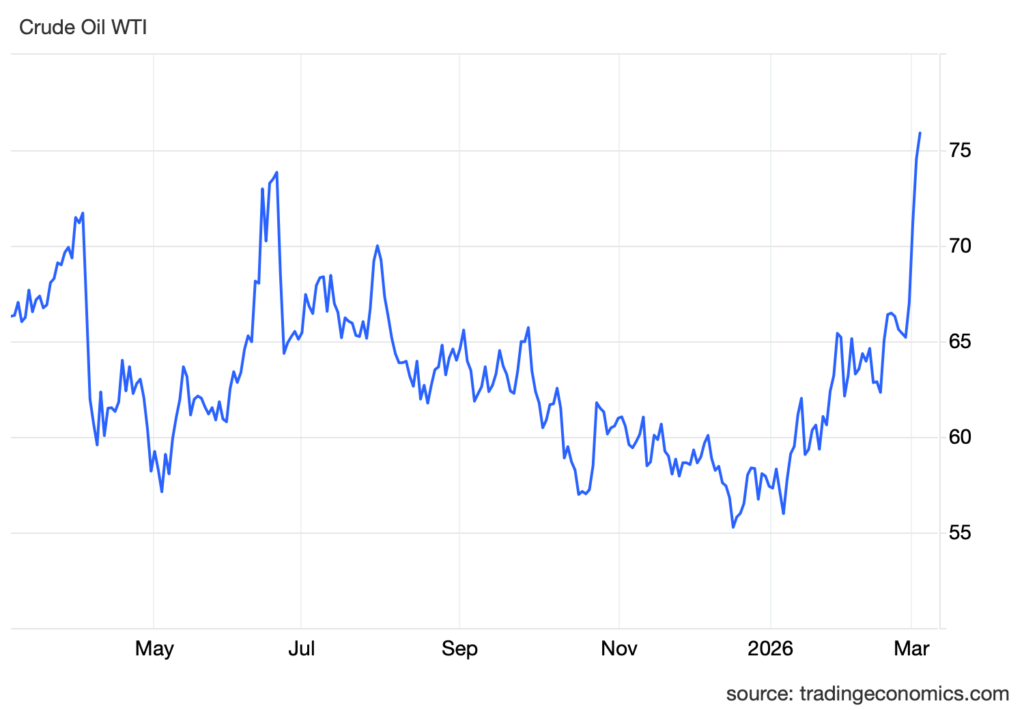
    Oil has traditionally acted as the first sensor of failure. In the architecture of global supply, the Middle East region is a critical node and the Strait of Hormuz is a textbook example of a ‘single point of failure’. When oil prices surge, it is not just the result of speculation, but a form of collective risk insurance. The market is not pricing what has already happened, but the likelihood of a transport paralysis that could occur in a week or a month. For the technology and modern digital services sector, oil has ceased to be just a fuel cost in truck tanks. It has become the foundation of energy costs in data centres and an underlying inflationary parameter that will hit operating margins sooner or later. If crude prices remain at elevated levels for an extended period of time, the markets send out a warning of impending cost pressures that will force the renegotiation of SLAs and the revision of pricing strategies.

    Wykres ropy - 4.03.2026

    An equally important indicator is the behaviour of the bond market and currencies considered to be safe havens. When capital flees en masse towards the US dollar or the Swiss franc, we have a so-called flight to safety. This sends a clear message that the big players no longer believe in the short-term stability of international trade. Such a move could be a warning signal regarding the cost of money. In periods of high uncertainty, capital becomes more choosy and more expensive. High-risk R&D projects, technology start-ups requiring continuous recapitalisation or ambitious overseas expansion plans may face a barrier in the form of a sudden drain of liquidity from emerging markets. Watching bond yields provides insight into whether the global anxiety is just a temporary mood correction or perhaps the beginning of a deeper structural change in access to finance.

    The most tangible effect of geopolitical upheaval, which directly affects the operational sphere, is the destabilisation of supply chains. The shift from a just-in-time model to a just-in-case strategy is becoming a requirement for survival. Financial markets are typically trembling several weeks in advance of real delays at ports. If today we see freight rates rising and war allowances imposed by logistics companies, we can predict the occurrence of the so-called Bullwhip Effect with high probability. A small disruption at the source, such as instability at a key transit point, is compounded as it moves up the supply chain, ending in acute component shortages or drastically increased lead times. In this context, the concept of building supplier relationships in politically stable and culturally close regions becomes an imperative.

    Strategic management in an age of uncertainty requires leaders to develop a specific cognitive resilience. The biggest mistake is succumbing to geopolitical FOMO – reacting feverishly to every headline and making chaotic decisions under the influence of emotion. Professional analysis requires distinguishing between momentary volatility, which is a natural part of the market game, and signals indicating a permanent crack in economic fundamentals. Proper assessment of the situation allows you to maintain operational calm and avoid costly mistakes, such as panic selling of assets or prematurely halting key investments. Instead of following social media, it is worth analysing the hard data coming from the futures markets, which indicate with great precision where professional investors are placing their fears and hopes.

    Financial markets do not have a moral compass or empathy, but they do have a unique ability to aggregate dispersed knowledge. They do not judge the ethics of a conflict, but its economic efficiency and impact on future profits. The organisations that win are those that can read these early warning signals and adapt their cost and logistical structures before the market ultimately values their lack of preparedness. It is not the headlines, but capital flows that shape the reality of how we come to do business. Understanding that the current silence or the rapid movement of the stock market is just another language to describe the same reality allows us to build companies that are more resilient, flexible and, above all, aware of the mechanisms that govern the modern world.

    It is therefore worth looking at the current situation not as a single crisis, but as the next stress test of the global ecosystem. The ability to distinguish noise from signal, emotion from analysis and ad hoc from strategic are the qualities that define modern leadership. Markets may be wrong in the short term, but from a strategic perspective, they rarely leave any illusions about the direction of the global economy. The role of the leader therefore boils down to being a translator of this complex data into the language of concrete business decisions that will allow the organisation to not only weather the storm, but emerge from it with a strengthened structure and a clear vision of the future.