Tag: Public sector

  • Cashless payments in offices 2025: Growth of 23% year-on-year

    Cashless payments in offices 2025: Growth of 23% year-on-year

    Polish public administration, historically associated with bureaucracy and paper circulation, is currently undergoing the most pragmatic phase of its transformation. The latest figures from the Foundation for Cashless Poland for 2025 indicate a trend that goes beyond mere citizen convenience – it is the optimisation of processes that is beginning to relieve the burden on local government budgets in real terms.

    Last year, more than 12 million digital payments were made in the public sector, a dynamic increase of 23% year-on-year. The Foundation has already installed more than 20,000 payment devices in 3,600 offices. However, it is not the physical terminals, but the integration of payments with the mCitizen mobile ecosystem that seems to be the direction that will most powerfully change the landscape of local finance.

    Taxes within thumb’s reach

    A model example of this change is the ePayments service. Although it is currently used by 26% of the population nationwide, the structure of transactions clearly shows where the greatest business potential for local authorities lies. As many as 75% of all transactions in the mCitizen app were for property tax, with a further 23% for waste management fees. The total amount of PLN 54.5 million transferred digitally is a signal that Poles are ready for the full digitalisation of public tributes.

    Tomasz Misiak, vice-president of the Foundation for Cashless Poland, emphasises that the aim is to make contact with the administration “fast and secure”. From a business perspective, this primarily means shortening the settlement cycle and reducing cash handling costs, which translates into measurable operational savings for thousands of municipalities.

    Trust infrastructure

    The success of this implementation is based on a unique public and private sector partnership. Supported by giants such as Mastercard and Visa and the Ministry of Finance, the Foundation has created an infrastructure that is becoming a market standard. The fact that nearly 150 local authorities have joined the ePayments project – including 50 as part of a dedicated pilot programme – suggests that the barrier to entry for technology in offices is steadily falling.

    For decision-makers and fintech entrepreneurs, the conclusion is clear: the Polish public sector is no longer a digital open-air museum. It is becoming a receptive market for solutions that improve cash flow efficiency. The next step is likely to be the automation of cyclical payments, which will further strengthen the bond between the citizen and the modern state.

  • Sovereignty or a bottomless pit? Government, Microsoft and billions for licences

    Sovereignty or a bottomless pit? Government, Microsoft and billions for licences

    In February 2026, the Polish debate on digitalisation entered a new, hot phase. The Central Informatics Centre (COI) announced an ambitious plan: to build a national office suite for public administration to replace the Redmond giant’s solutions. This move is part of the broader European trend of ‘digital sovereignty’, but the Polish version raises as much hope as justified scepticism. For business and IT leaders, it is a signal that the hitherto “licence first” model is no longer the only path to state development. But is Poland ready for its own ‘Office’, or are we in for another billion-dollar project of dubious quality?

    The dictate of one supplier: Diagnosing the monopoly

    The starting point for the COI initiative was the Instrat Foundation report ‘Seemingly open procurement’, published at the end of 2025. The data are merciless: as much as 99% of the analysed public procurement of office software in Poland directly or indirectly favours Microsoft products. In one in five tenders, competitors are excluded outright, and in the rest, through specific technical requirements that only one ecosystem meets.

    The vendor lock-in phenomenon has ceased to be a theoretical academic problem and has become a real threat to government budgets. As licence costs rise, the administration has nowhere to run, because the entire infrastructure, from mail to advanced spreadsheets, is based on closed standards. The head of the COI, Radosław Maćkiewicz, makes it clear: Poland spends too much money on Microsoft software, and these funds could support an indigenous IT ecosystem.

    The other side of the coin: The spectre of “billionaire systems”

    When the administration talks about ‘building its own solutions’, a red light goes on in the private sector. The history of Polish public IT is full of projects whose costs ran into billions and whose quality left much to be desired. A symbol of these concerns is the ZUS Comprehensive Information System (KSI ZUS). According to figures from recent years, the maintenance and development of this system over a six-year cycle (2015-2020) cost the state nearly PLN 2.8 billion. What is more, current contracts for the maintenance of KSI ZUS alone amount to hundreds of millions of zlotys (e.g. Asseco’s offer for nearly 350 million zlotys).

    Critics rightly ask: should a state that struggles to manage such molochs efficiently embark on building an ecosystem from scratch to compete with Microsoft 365, which has been fine-tuned over decades? Building a modern office suite is not just a word processor, it involves hundreds of thousands of hours of developer work, security testing and cloud integration. There is a real risk that the ‘national alternative’ will become another bottomless pit, with billions of public money disappearing into it and the end product lagging behind market standards.

    At the same time, it is worth bearing in mind the expert opinion on the quality of the software built by the COI, e.g. on the occasion of mCitizen. Although the application is popular, reports by the Defence CSIRT have pointed to security gaps, such as ‘dead code’ or vulnerabilities in the library supply chain. The scaling of these problems to a system on which every official in the country will depend for their work raises understandable fears.

    Lesson from The Hague: Why sovereignty is not just about austerity

    Arguments about costs are only part of the equation, however. The geopolitical turning point came in May 2025, when the Prosecutor General of the International Criminal Court (ICC) in The Hague was to lose access to his Microsoft-provided email account. The official reason was said to be the sanctions imposed by the Donald Trump administration.

    Regardless of the corporation’s subsequent denials, the incident horrified European decision-makers. It became clear that relying on the US SaaS model was not only a matter of convenience, but also an exposure to US extraterritorial law (e.g. CLOUD Act) and the political decisions of a foreign power. It is this fear that is driving migrations today in the German state of Schleswig-Holstein (60,000 posts switching to Linux and LibreOffice) or the Danish Ministry of Digitalisation. In these cases, sovereignty over data is valued more highly than the polished interface of a US-based giant.

    Transparency of savings: The myth of ‘free’ Open Source

    The COI initiative is to be based on open (open source) solutions. This is key, because it lowers the barrier to entry – we don’t have to write everything from scratch, we can draw on projects such as LibreOffice, Collabora Online or Nextcloud. However, in the IT business, ‘open’ rarely means ‘cheap in the short term’.

    Transparency of savings requires an honest look at TCO (Total Cost of Ownership). While the cost of Microsoft’s licences (around £38-49m per year for ZUS alone in 2024/25) is easily measurable, the hidden costs of migration are huge. Germany’s Schleswig-Holstein estimates that it will save €15m per year on licences, but at the same time invest €9m in 2026 alone in the transformation and training process.

    The real cost of the national office suite will be:

    1. training and adaptation: officials accustomed to Outlook can lose productivity drastically in their first year with the new tool.

    2. maintenance and SLA: Open Source requires strong local support teams. Instead of paying Microsoft, we will pay Polish companies (e.g. in a PPP model), which supports the economy but does not necessarily mean a drastic decrease in budget expenditure.

    3 Compatibility: Millions of historical.docx documents and advanced.xlsx worksheets must work flawlessly. The cost of fixing formatting errors can run into the millions.

    European trend: Lyon and Schleswig-Holstein lead the way

    Poland is not alone. Lyon, France’s third-largest city, is already deploying OnlyOffice and Linux on 10,000 workstations, arguing not only for sovereignty but also for ecology – open software allows older hardware to be used for longer. In contrast, the German openDesk project, developed by ZenDiS under the aegis of the German Interior Ministry, is becoming a ready-made standard for the whole of Europe.

    This is where the opportunity for COI lies: not to build the wheel from scratch, but to become a Polish integrator of European sovereign solutions. Using Collaborator Online in conjunction with the Polish government cloud would avoid the fate of ZUS’s KSI, while at the same time providing a guarantee that citizens’ data will never leave the country.

    Value for business

    The COI initiative should be read as a call for diversification. A complete abandonment of Microsoft in commercial enterprises is unlikely today, but building ‘hybrid resilience’ is slowly becoming a necessity.

    This is a huge opportunity for the Polish IT sector. The shift from a model of selling licences (where most of the margin goes to the US) to a model of high-margin implementation and maintenance services around Open Source can be a ‘flywheel’ for domestic integrators. However, business needs to watch the state’s back. If the ‘national package’ is locked within the walls of a single institution, it will become an expensive monument. If, on the other hand, it is built on transparent public-private partnerships and open standards, it can become the foundation of a modern state that invests in its own intellect instead of paying a ‘digital tax’ to giants.

    The key to success will not be the technology – because LibreOffice or OnlyOffice are already ready – but the transparency of how these ‘saved’ millions are spent. True sovereignty is the ability to freely choose technology, not being forced to use software just because it is ‘national’. Poland must prove that it can build systems that are not only expensive, but above all effective.

  • AI agents vs ‘old’ automation. The hype trap in the public sector

    AI agents vs ‘old’ automation. The hype trap in the public sector

    It is rare in the world of government technology for budget forecasts to go up against macroeconomic gravity. However, 2026 promises to be an anomaly. Despite global pressure to cut spending and balance sheets, government IT departments – excluding the US – are bracing themselves for budget increases. The reason is clear, albeit risky: the boundless belief that artificial intelligence will modernise public services faster than they can grow old. However, behind the optimistic excel columns lies a serious challenge highlighted by Gartner analysts: the risk of getting carried away with novelty at the expense of technological fundamentals.

    If we had to define the one key word that will open the wallets of government CIOs in the coming months or so, it would be ‘productivity’. It is the one that is becoming the new holy grail of digital government, pushing soft image metrics somewhat to the side. But the road to this productivity is a bumpy one, and the roadmap drawn by Gartner shows that decision-makers are faced with a dilemma: invest in trendy ‘Agent AI’ or patch holes in business processes?

    The investment landscape: the Big Four and a new player

    The figures from market analyses are clear. Governments are not planning minor adjustments, but a technological offensive. As many as 85% of IT directors in the public sector plan to increase spending on cyber security. This is understandable – in the age of hybrid warfare, a digital shield is a priority. Right behind security, however, comes a trio of innovations: artificial intelligence (80%), generative artificial intelligence (GenAI) (also 80%) and cloud platforms (76%).

    It is particularly interesting to see how quickly the appetite for AI is evolving. Not so long ago, we were talking about simple chatbots. Today, 74% of offices have already implemented or plan to implement AI within a year, and the figure for GenAI is up to 78%. However, the real news that is electrifying the industry is so-called Agentic AI (Agent Artificial Intelligence).

    Unlike the models we are familiar with, which ‘just’ generate text or images, AI agents have the ability to autonomously take action and perform complex tasks on behalf of the user. This is the promise of a civil servant that never sleeps. Not surprisingly, nearly half (49%) of government CIOs say they are interested in this technology. For the IT industry, this sends a signal: the government customer is looking for solutions that don’t just ‘support’, but actually ‘perform’.

    Voice of reason: Between hype and craftsmanship

    In this technological race, however, it is easy to become breathless. Arthur Mickoleit, chief analyst at Gartner, pours a bucket of cold water over the heated heads of enthusiasts in his predictions. While he acknowledges that agent-based AI is emerging as a powerful facilitator of transformation, he warns of a phenomenon we know all too well in the industry – the ‘hype cycle’.

    There is a real risk that the media hype around autonomous agents will divert the attention of decision-makers away from technologies that are less media-savvy, but much more mature and necessary. We are talking about classic machine learning (Machine Learning) and business process automation (BPM).

    For IT integrators and suppliers, there is a key lesson here: the role of the technology partner in the coming years will not just be to deliver the latest innovation. It will be to educate and bring the customer down to earth. Deploying a sophisticated AI agent on ‘dirty’ data or based on a non-optimised, analogue process is a simple recipe for a costly disaster. Innovation in the public sector must be an evolution, not a revolution detached from the foundations. Mickoleit rightly points out that it is this next, less glamorous wave of innovation that will be needed to meet the sector’s priorities.

    ‘Check’: The end of art for art’s sake

    The change in narrative in government IT is also evident in the strategic objectives. The days when digitalisation was an end in itself are over. By 2026, technology is expected to ‘prove’ concrete results.

    More than half of directors (51%) cite increasing employee productivity as their main goal. This is a drastic change in optics. Until now, it was common to talk about ‘citizen experience’ (CX) – this goal, while still important (37%), is giving way to the pressing need for internal optimisation. Governments are struggling with staff shortages and an ageing workforce. Technology is set to fill this hole.

    In practice, this means that CIOs are now being asked for hard evidence of the impact of investments on the office’s mission. They have to demonstrate cost savings and real improvements in the quality of work. For software and service providers, this means they have to change the language of benefits – instead of ‘modernity’ and ‘innovation’, they have to talk about man-hours, automation of repetitive tasks and ROI. The pressure for results is high, especially as the public and budget overseers have years of investment in e-government in their minds and now expect dividends from these outlays.

    Geopolitics enters the server room

    The final, but perhaps most important piece of the puzzle for 2026, is digital sovereignty. IT purchasing decisions are no longer the domain of technical performance and price alone. Big politics have come into play.

    As many as 55% of government executives expect changes in the way they interact with technology providers due to geopolitical tensions. The location of the supplier is becoming a critical factor, put on a par with the cost or scalability of the solution.

    This is excellent news for local and regional technology companies. Nearly 40% of decision-makers plan to work more closely with suppliers based in their region. This is a clear shift away from an unreflective reliance on global hyperscales. Governments want to identify risks in their technology stacks, avoid reliance on a single supplier (vendor lock-in) and build resilience to future shocks.

    Gartner experts emphasise that the identification of dependencies and risks is becoming the new standard. For the Polish and European IT sector, this opens a window of opportunity. The argument “we are from here, we are subject to the same law and we guarantee data sovereignty” is gaining as much weight as the technical specification of a server or the functionality of an algorithm.

    What does the market need in 2026?

    Looking at the projections for 2026, we see a picture of a sector that is ambitious but also cautious. Money is on the table, but it is money marked by high expectations.

    The ideal IT project for government in the coming period is one that combines fire and water: harnessing the potential of modern AI (including generative and agent-based AI), but embedding it on a solid process foundation and a secure, preferably local or diversified infrastructure.

  • Digitisation of public services in Europe: leaders, laggards and the Polish paradox

    Digitisation of public services in Europe: leaders, laggards and the Polish paradox

    Set up in minutes from your smartphone, without a single paper document. Access to all medical records in a few clicks. Settling taxes thanks to forms that the administration has filled out for us.

    This is not a vision of the future, but an everyday reality in the digital vanguard of the European Union. At the same time, in other member states, the same processes can still be a multi-stage, bureaucratic ordeal. This contrast perfectly illustrates the revolution that is the digitalisation of public services – a fundamental change in the relationship between the state, the citizen and the entrepreneur.

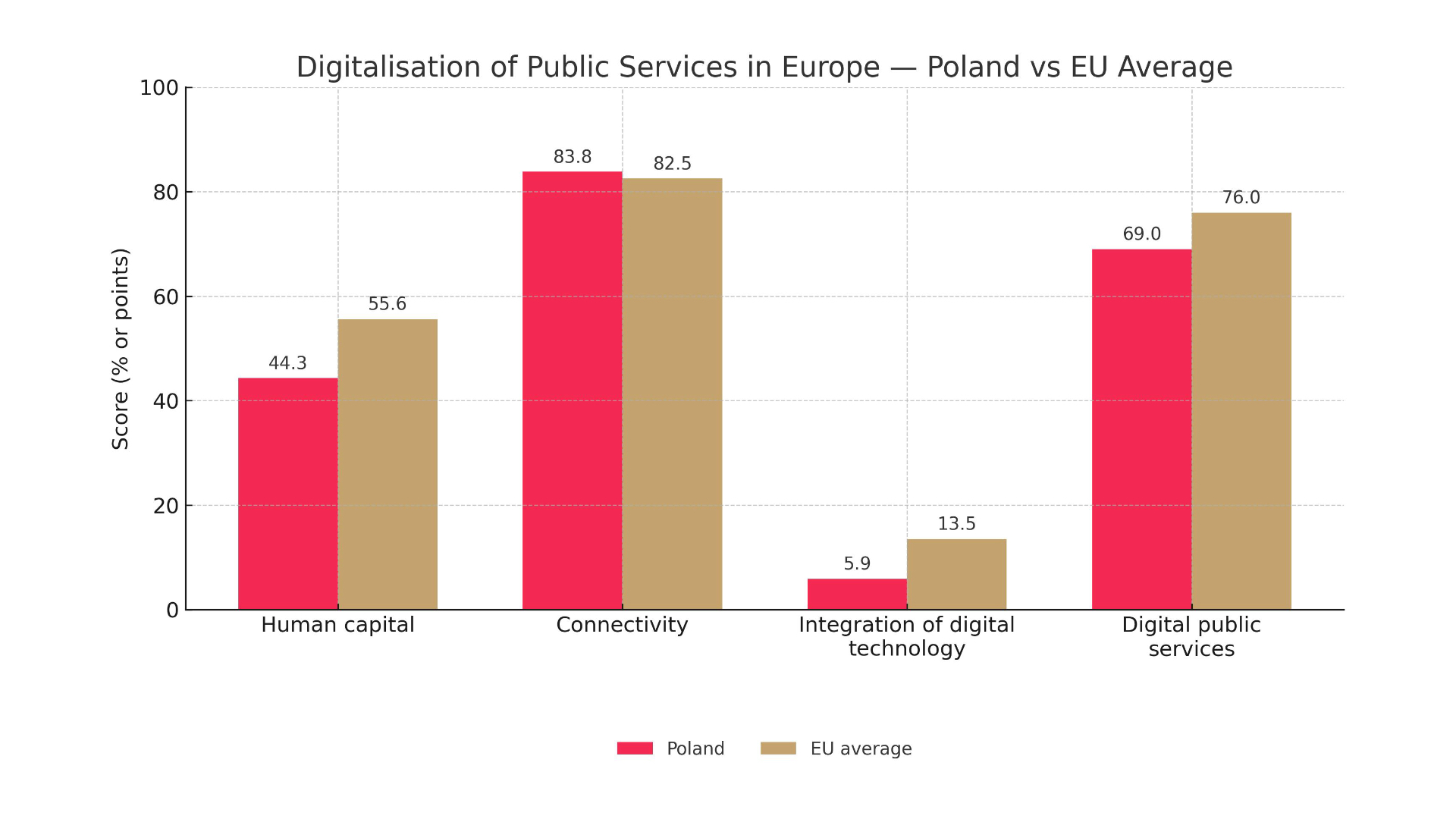
    To measure progress in this transformation, the European Commission has been publishing the Digital Economy and Society Index(DESI) since 2014. It is a key analytical tool that assesses countries in four areas: human capital, connectivity, digital integration and digital public services.

    From 2023, the DESI indicators became part of the Road to the Digital Decade programme, setting ambitious 2030 targets for the entire Union, such as 100% availability of key public services online.

    Analysis of DESI data paints a picture of a two-speed Europe. On the one hand, we have a group of leaders who are setting global standards, on the other, a peloton of countries still catching up. Poland occupies a fascinating and contradictory position in this landscape – a country that impresses in some aspects of e-government and lags far behind in others.

    EU leaders: anatomy of a digital success story

    The same group of countries has been at the top of the European digitalisation rankings for years: the Scandinavian countries (Finland, Denmark), the Benelux countries (Netherlands, Luxembourg) and an absolute phenomenon in this field – Estonia. Countries such as Malta and Spain have also joined the top, having made a huge leap in quality in recent years.

    Their success is not a coincidence, but the result of a coherent, long-term strategy based on several pillars.

    Firstly, long-term vision and political will. In these countries, digitalisation is a strategic state priority, pursued regardless of changes in the political scene.

    Secondly, strategic investment. Leaders not only allocate sizable resources, but also make effective use of EU funds such as the Reconstruction and Resilience Facility (RRF).

    Third, a solid foundation. A high level of e-services is inextricably linked to the digital competence of the population and universal access to ultrafast internet – areas in which the Nordic countries are world leaders.

    The most important factor, however, is the culture of trust. Citizens in Scandinavian countries or Estonia trust the state to process their data securely and transparently. This trust is the currency that enables the implementation of advanced services such as digital identity (eID) or centralised medical e-documentation.

    These elements create a ‘flywheel effect’. The successful implementation of one key service builds trust and gets citizens used to interacting with the state online. This, in turn, creates demand for further and more advanced solutions, driving further development.

    In this way, the leaders not only maintain their lead, but actually increase it, making it extremely difficult for the rest of the stakes to catch up with them.

    To understand how this works in practice, just look at some examples:

    • Estonia is a global model of a ‘digital nation’, where 99% of public services are available online. The backbone of the system is X-Road, a secure data exchange platform that implements the “once-only” principle. – a citizen only provides their data to the administration once. Every Estonian has a digital identity card (e-ID) that allows for a legally binding signature, saving everyone an average of five working days per year. The country has even gone a step further by creating e-Residency, a programme that allows entrepreneurs from all over the world to set up and run a company remotely in the EU.
    • Denmark is a champion of user-centred service design. Instead of forcing citizens to navigate a complex structure of offices, Denmark has consolidated services into portals based on ‘life events’. Borger.dk is a one-stop shop for citizens to deal with almost any issue, from taxes to enrolling a child in school, and virk.dk is its counterpart for business.
    • Finland and the Netherlands are examples of pragmatism and innovation. Finland is developing proactive services based on artificial intelligence (AuroraAI programme) to anticipate citizens’ needs at key moments in their lives. The strength of the Netherlands, on the other hand, is its extremely solid foundations – the highest digital competence rates of the population in the EU and the excellent infrastructure on which the entire ecosystem of services centred around the DigiDdigital identity is based.

    The Polish paradox: the leader at the back of the pack

    An analysis of Poland’s position on the digital map of Europe leads to surprising conclusions. In the overall DESI 2022 ranking, Poland ranks at the bottom, taking 24th place out of 27 countries. Our performance in key areas, such as human capital or the integration of digital technologies by companies, is well below the EU average.

    However, there is one bright spot in this bleak picture: digital public services. In this category, Poland not only performs relatively best, but shows one of the highest rates of improvement in the entire EU. In several key indicators, we have even surpassed the European average:

    • Pre-filled forms: as many as 78% of online forms in the Polish administration are pre-filled with data that the state already has (EU average: 68%).
    • Access to medical e-documentation: Thanks to systems such as the Internet Patient Account (IKP), 86% of Poles have access to their medical data online (EU average: 72%).

    These successes are the fruit of the development of platforms such as the gov.pl portal, the mObywatel application or the ZUS Electronic Services Platform. However, behind this impressive facade lies a deeper problem. Despite the fact that we are creating advanced services that are well rated in benchmarks, their actual use by citizens is alarmingly low.

    Only 37% of Poles use e-government, while the average in 16 EU countries exceeds 50% and in Denmark it reaches 73%.

    So we face the risk of a digital ‘Potemkin village’. We have built state-of-the-art e-services that perform brilliantly in technical audits, but they stand on weak foundations – some of the lowest digital literacy rates of the population in the EU. There is a deep gap between accessibility and service adoption. It is this gap that is the biggest challenge for Poland’s digital transformation.

    Strategy 2035: a plan for a digital leap

    In October 2024, the Polish government presented the draft “Digitisation Strategy of Poland until 2035”. – a document that attempts to provide a comprehensive response to the challenges described above. Its ambitions are revolutionary. By 2035, 100% of official matters are to be handled digitally, 20 million Poles are to have a digital identity wallet in the mCitizen application, and the number of ICT specialists is to increase to 1.5 million. PLN 100 billion is to be allocated to realise these goals by 2030.

    More importantly, however, the strategy is holistic. It explicitly states the need to end ‘silos’ in government and combines the development of e-services with powerful investments in the foundations: digital competences (target: 85% of citizens with basic skills), infrastructure and cyber-security.

    This demonstrates the understanding that it is impossible to achieve sustainable success by building more applications without parallel work on the skills and trust of citizens.

    “Strategy 2035” should be seen as an attempt to “set off its own flywheel”. It is a plan for rapid acceleration, which should make it possible not only to catch up, but to realistically close the development gap separating us from European leaders.

    From technology to people

    Europe’s digital transformation is a process that exposes deeper gaps in social capital, trust and long-term planning. Poland, despite impressive progress in the creation of e-services, is still struggling with a fundamental challenge: how to make advanced tools widely used and accessible to all.

    The new digitalisation strategy makes the right diagnosis, shifting the focus from the technology itself to building competence and an integrated ecosystem. Its success will depend on consistency in implementation.

    For the true measure of success will not be the number of new applications, but the percentage of citizens who can use them consciously, safely and effectively. The road from a ‘Potemkin village’ to a fully digital nation is not a technological sprint, but an educational and social marathon.


  • Digital arms race in Europe: where can a Polish integrator look for orders in the public sector?

    Digital arms race in Europe: where can a Polish integrator look for orders in the public sector?

    The European public sector is experiencing a transformation on an unprecedented scale. Acting as a global stress test, the pandemic exposed decades of neglect and became a powerful catalyst for change. Today, driven by a stream of funding from EU programmes, digitalisation has ceased to be an option and has become a strategic imperative.

    For Polish IT companies, this opens up a historic opportunity for expansion and lucrative contracts. This is not just another wave of modernisation – it is a real, centrally-funded digital arms race.

    The compass setting the course for these changes is the Digital Decade 2030 programme. In it, the European Commission has set ambitious targets: by the end of the decade, 100% of key public services are to be available online and every EU citizen should have access to a digital identity (e-ID).

    The engine for these investments is the Recovery and Resilience Facility (RRF). Across the Union, we are talking about tens of billions of euros allocated directly to digitisation projects in administration, e-health or e-justice.

    In this dynamic landscape, digital lead markets such as Estonia and Malta would seem to be the intuitive direction. However, the greatest potential for new, large-scale projects lies elsewhere – in countries that can be described as ‘ambitious contenders’.

    These are countries which, starting from a lower base, are dynamically catching up thanks to political determination and funds from the RRF. This is where the Polish integrator has the opportunity to become not just a supplier, but a strategic partner in the national digital transformation.

    Digital Europe map: leaders, stragglers and rising stars

    In order to accurately identify the most promising markets, it is necessary to understand how the digital maturity of government is measured. A key tool is the annual eGovernment Benchmark report, which assesses public services in 35 European countries from the perspective of ‘life events’ such as starting a business or losing a job. It analyses services in terms of their user orientation, transparency, use of key technologies (such as e-ID) and cross-border accessibility.

    The latest 2024 report draws a fascinating picture. The average score for the EU27 countries is 76 out of 100, indicating steady progress. However, the analysis divides the markets into three segments:

    • Digital Leaders (Malta, Estonia, Luxembourg): Extremely mature and saturated markets. Competition is huge here and opportunities lie in highly specialised niche solutions, e.g. using AI or blockchain.
    • Solid Players (Finland, Denmark, Lithuania): Countries with a high level of digitalisation, but still with room for optimisation. Tenders here can be for upgrading existing platforms or improving cross-border services.
    • Ambitious Pretenders (Greece, Poland, Cyprus): This is the most interesting group from the perspective of seeking new large contracts. They are recording the highest growth rates and EU funds are driving large-scale transformation projects there.

    Analysis of the data leads to a fundamental conclusion: there is a clear correlation between a high score in the Key Enablers category and overall digital maturity. Countries at the top of the ranking, such as Malta and Estonia, have advanced and widely used digital identity systems.

    Without secure and convenient e-ID, administrations can only offer simple information services. Therefore, countries with digitisation ambitions but a low score in this category will have to invest in building or upgrading their identity systems first.

    For the Polish integrator, this is a clear signal that tenders for e-ID, e-signature and e-credentialing systems will be an absolute priority in the ‘contender’ markets.

    Beyond the ranking – identification of markets with the highest growth potential

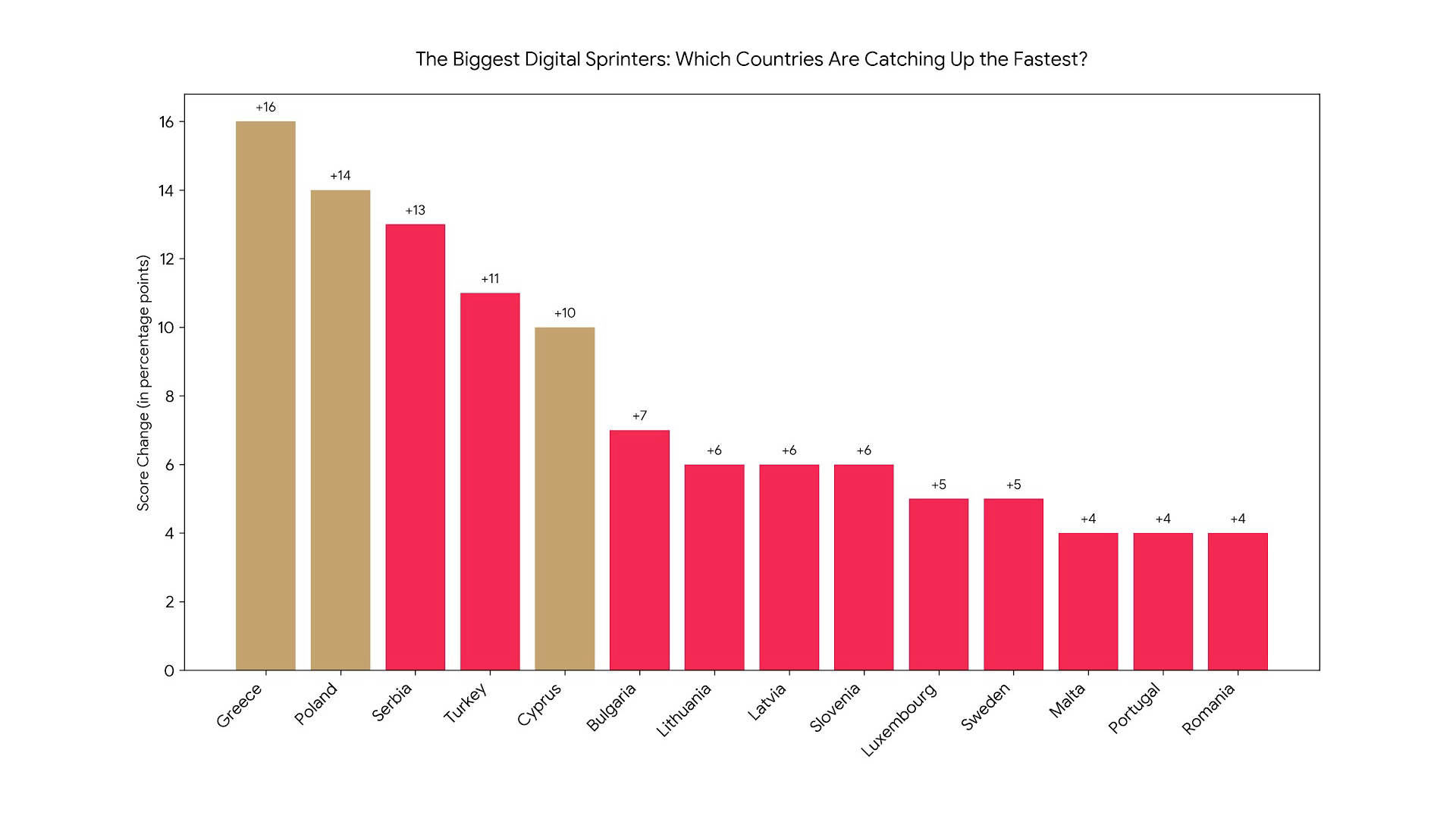
    A static ranking does not tell the whole story. The real value lies in analysing the dynamics of change. It is not the leaders that generate the greatest demand, but the countries that have made the biggest leap in rankings in recent years.

    Greece: the absolute leader in dynamism. In just four years, Greece has improved its ranking by 16 points – the biggest jump in the whole of Europe. The country, which until recently was seen as a digital marauder, is now pursuing an ambitious transformation programme, fuelled by significant funding from the RRF.

    Poland: With an increase of 14 points, Poland is the runner-up for growth in the EU. This proves that our domestic market is also undergoing intensive investment and is an extremely attractive field.

    Cyprus: with an impressive rise of 10 points, Cyprus is another market to watch. Like Greece, starting from a lower base, Cyprus is investing in the fundamentals of the digital state.

    Where does this remarkable dynamic come from? It is the result of a synergy of political will and a powerful financial injection from the EU’s Reconstruction and Resilience Facility (RRF). More importantly, these countries’ investments are not in niche improvements, but in fundamental, large-scale systems, such as the construction of central registries, the implementation of national e-service platforms or the creation of digital identity systems.

    For large IT integrators, these are ideal opportunities to win flagship contracts.

    Poland compared to Europe – the domestic market as a springboard for success

    Poland’s impressive rise in the eGovernment Benchmark ranking proves that great opportunities lie just beyond the threshold. Experience gained on home ground can become the most valuable capital in international expansion.

    Poland’s digital administration is a picture of contrasts. On the one hand, we are a European leader in certain areas, e.g. in terms of online access to medical data. On the other hand, there is still a large gap between central and local administration, and cross-border services need to be improved. These weaknesses are at the same time huge market niches.

    A key driver of the transformation in Poland is the National Recovery Plan (NERP). Out of a total pool of EUR 59.8 billion, as much as 21.3% (around EUR 12.7 billion) has been earmarked for digital purposes. This is a gigantic stream of money that will be invested in cyber security (EUR 532 million), digitisation of administration (EUR 100 million) or digital education (EUR 1.2 billion).

    Polish IT companies should use the domestic market as a testing ground. Every successful project carried out in Poland under the KPO becomes a powerful ‘export ticket’. A Polish company that successfully implements a KPO-funded project gains invaluable know-how.

    It can then offer the same proven solution to a Greek ministry or a Cypriot government agency, arguing that it understands perfectly the specifics of RRF-funded projects. This is a powerful competitive advantage.

    From analysis to contract

    The theoretical analysis materialises in the form of specific public contracts, which can be found on the Tenders Electronic Daily (TED) portal – the official EU platform with free access to thousands of advertisements. Systematic monitoring of the portal is not only a way to find orders, but also a form of market intelligence.

    Here are examples that support these claims:

    • Greece – AI-based innovation: the Greek Ministry of Digitalisation has launched a tender with an estimated value of €19.1 million for the implementation of AI-based solutions in public administration. This is perfect evidence of a ‘technological leap’ – a country catching up with the most advanced technologies right away.
    • Cyprus – Building Data Foundations: A health insurance organisation in Cyprus is looking for a contractor to create, implement and maintain a data warehouse. This is an example of a foundational project that demonstrates the huge demand for building key elements of the data infrastructure.
    • Poland – Cyber Security at Local Level: The tender launched by the Municipality of Lagiewniki to upgrade its cyber security illustrates a market niche at the local government level. Hundreds of similar, smaller tenders create a huge, fragmented market, ideal for medium-sized IT companies.

    Armed with experience and high-calibre specialists, Polish technology companies today have a historic opportunity to become not just contractors, but key architects of this change, building their position on the international stage for years to come.

  • Cloud in the public sector: modernisation opportunity or procedural maze?

    Cloud in the public sector: modernisation opportunity or procedural maze?

    Public administration is increasingly feeling the pressure of digitalisation. Citizens who use intuitive banking applications, e-commerce services or streaming platforms on a daily basis expect a similar level of convenience and quality from the state.

    Cloud computing appears to be the obvious solution here – a dynamic, scalable and flexible tool that allows institutions to innovate faster. The problem is that administrative realities rarely keep up with the possibilities of technology.

    Implementing cloud services in the public sector is not just a technological issue. It is first and foremost an organisational and legal transformation that determines whether the potential of the cloud will be realised or whether it will be stuck in a maze of procedures.

    The gap between technology and procedure

    The dynamic development of the cloud means that its implementation offers administrations a chance to leapfrog efficiency. In theory – because in practice, public procurement is still designed according to the logic of building physical infrastructure: server rooms, cables, local systems.

    Meanwhile, the cloud requires a completely different approach – the ability to buy a service rather than hardware. This means flexible contracts, a different billing and accountability model. Unfortunately, many IT units in government operate in structures inherited from the era of local data centres.

    Their resources are limited and the competences of the staff are mainly aimed at maintaining older systems.

    The result? An ever-widening gap between what technology enables and what the administrative system is able to effectively contract and implement.

    The cloud as an opportunity for systemic change

    Why is this so important? Because cloud deployment in the public sector is not about savings or migrating data to another infrastructure. It is the foundation for modernising the state.

    The cloud allows public institutions to respond more quickly to citizens’ needs, test new solutions and even integrate further technologies – from artificial intelligence to predictive analytics – without having to build everything from scratch.

    In short: an administration that can use the cloud can become more agile, transparent and accessible.

    But for this to happen, a change in thinking is needed – from procedures focused on equipment and price, to an approach that focuses on quality of service, safety and long-term value.

    Why classic tender criteria don’t work

    In the private sector, cloud deployment is often a strategic decision – a provider is chosen, terms and conditions are negotiated, added value is assessed. In the public sector, there are rigid tendering procedures. The problem is that these were designed for traditional infrastructure projects.

    Price still dominates as the main criterion. In the case of cloud services, this can lead to a paradox: the cheapest solution wins, but it is not necessarily secure, scalable or compliant with regulations. And if we add to this the lack of competence in IT units, which are then supposed to supervise such a contract, the result is frustration on the part of both the administration and the providers.

    It is therefore necessary to re-evaluate the logic of tenders: rewarding flexibility, compliance with standards, interoperability and quality of service. Price should be one element, but not the only criterion.

    Five key conditions for successful contracting of cloud services

    To break the deadlock and make the public sector realistically benefit from the potential of the cloud, a systemic approach is required. Five elements are key here:

    1 Purpose definition – the subject matter of the contract must be described functionally, in an open and flexible way. This avoids the institution being tied to a particular technology or solution that will quickly become obsolete.

    2 Selection procedure – not all cloud services can be fitted into classic procurement procedures. The choice of path has a huge impact on the feasibility of implementation and subsequent flexible operation.

    3 Technical and legal requirements – interoperability, security, compliance with standards (e.g. data protection) are fundamental. These are not details, but criteria that determine the effectiveness and security of the entire implementation.

    4 Bid evaluation criteria – price should not be the main factor. More weight should be given to auditability, quality, scalability and the provider’s ability to ensure continuity of service.

    5 Management and monitoring – signing a contract is only the beginning. SLAs, incident management procedures, technical oversight and a competent contract manager are crucial. Without these, even the cheapest service quickly becomes a costly problem.

    Lessons for the public sector and IT suppliers

    The introduction of these rules is not a cosmetic change, but a necessity. For the administration, it means a chance to really modernise and provide services at the level that citizens expect. For the IT market, a change in the balance of power.

    Technology companies that prioritise quality, security and the ability to handle complex contracts can gain an advantage over suppliers who only play with price.

    What’s more, flexible cloud contracting can open up space for innovative startups that would have no chance to compete in the classic tender model.

    In short: an administration that learns to use modern procurement tools can become not a brake but a catalyst for innovation across the ecosystem.

    The cloud in the public sector is not a technological fad, but a condition for modernising the state.

    However, the success of implementations does not depend on the providers themselves, but on the ability of governments to contract services in a way that is consistent with their nature – flexible, qualitative and focused on long-term outcomes.

    In other words: the future of digital administration starts not in the server room, but in the tendering process.


  • Cloud in public administration: adoption is growing, strategy and security are limping along

    Cloud in public administration: adoption is growing, strategy and security are limping along

    More than 70 per cent of Polish public administration units are already using cloud solutions, according to the latest report on the state of cloud computing implementations in the public sector. Local authorities are more open in this respect than central administration, which is still rather cautious about the cloud. However, there are some worrying conclusions from the report regarding the quality and awareness of implementations: the vast majority of public institutions using the cloud rely on the services of a single provider, which raises concerns about vendor lock-in, i.e. dependence on a single technology partner. Moreover, experts point to the lack of long-term cloud strategies in administrations.

    The report was prepared jointly by experts from the Cyfrowa Polska Association and Andersen Tax & Legal law firm. – We analysed in detail the criteria for selecting suppliers by public administration bodies and the cost structure of storing data in the cloud. All this was done to diagnose the current level of cloudisation of the Polish public administration and to identify the most important challenges standing in the way of implementing cloud technology in the public sector , says Mikołaj Śniatała, an expert at Andersen Tax & Legal law firm.

    According to the report, although the scale of technology adoption in public institutions is growing, serious gaps in planning, security and management of cloud environments in these units are visible. Cyfrowa Polska’s experts point to a widespread lack of a transparent cloud implementation strategy – the majority of administration units do not plan migration, do not analyse risks, nor do they research new solutions. Nor do they plan to change providers or diversify services. According to experts, this lack of strategy limits the flexibility and resilience of the system. – Digitisation of the public sector in Poland, despite visible progress, still too often boils down to individual implementations of cloud services. Such activities, although valuable in themselves, are not part of a coherent strategy. As a result, there is no holistic approach to monitoring costs and measuring the effectiveness of implemented solutions, which significantly hinders the assessment of their real impact, says Michał Kanownik, President of Cyfrowa Polska.

    Vendor lock-in a real threat

    One of the most important findings of the report is the scale of the Polish administration’s dependence on a single provider. 78% of all units using the cloud use solutions from only one company. This indicates the risk of so-called vendor lock-in, i.e. a permanent relationship with one technological entity. What is more, as many as 7 out of 10 institutions, when selecting cloud services, are guided by existing licence agreements and not by an assessment of security, innovation or cost-effectiveness.

    Meanwhile, according to the experts’ assessment in the report, in the case of cloud services it is essential to ensure that there is no dependence on a single provider. – In particular, it is important that the contractual terms defining the rights and obligations of both contractual parties include the procedure for migration and exit from the cloud, believes Michał Kanownik.

    The issue of cyber security is also extremely important, the report highlights. Only 7% of public entities surveyed by Cyfrowa Polska and Andersen Tax & Legal considered security as the main criterion for choosing a cloud service provider. This may raise legitimate concerns – especially in the context of storing sensitive data processed by public institutions.

    Untapped potential of national solutions

    Experts who participated in the preparation of the study also point to the underutilised potential of homegrown cloud solutions, especially the limitations of projects such as the Government Cloud Computing (RCO) or the Cloud Service Assurance System (ZUCH). According to the report, their low adoption by government entities is due to a lack of trust, institutional illegibility, poor technical offerings and lack of implementation support. In practice, the public sector does not see ZUCH as a viable alternative to global providers.
    The observation of the abnormally low popularity of these providers is also confirmed by the Supreme Chamber of Control, which, in its post-audit statement of 16 March 2025, indicated that between 2020 and 2022, there were only nine entities in the ZUCH database that became active in the system, adds Mikołaj Śniatała of Andersen Tax & Legal.

    Poland in the cloud, or Cloud-First policy

    According to Michał Kanownik, the solution to some of these problems could be the introduction of a Cloud-First policy in Poland, encouraging administration to prioritise the use of cloud solutions with a clear definition of principles, standards and requirements for suppliers. – Such a policy would set the directions of development, increase the predictability of IT projects in administration and facilitate cooperation with the technology sector, the president of Cyfrowa Polska points out.

    As part of the promotion of the Cloud-First policy, the government would issue recommendations on the use of the cloud. According to experts from Cyfrowa Polska, defining the rules and conditions that will have to be met by service providers would streamline the acquisition of cloud solutions by government entities. Public entities and external providers would have to know the boundary conditions and requirements for the products and services to be implemented. At the same time, IT teams within the administration would be able to plan and develop future solutions effectively and in advance, the report explained.

    – The study we have just published shows a lack of a coherent strategy, a low level of attention to security and a lack of diversification of providers in the field of cloud solutions. This is why, together with experts from various backgrounds, we are calling for the development of a coherent national cloud development policy, increased competence in administration and the creation of conditions for greater competition on the cloud computing services market, concludes Michał Kanownik.

    Responses to questions concerning, among other things, the type of data stored in the cloud, the administration’s preferred providers, factors influencing their choice and the cost of using cloud services were collected from 82 public administrations between January and May 2025.