Tag: Channel partner

  • How Zebra Technologies has been building a global partner ecosystem for a decade

    How Zebra Technologies has been building a global partner ecosystem for a decade

    In the technology industry, ten years is a whole era. Zebra Technologies is just celebrating the anniversary of its PartnerConnect programme, which provides a good opportunity to look at how the business collaboration model has evolved in the digital age. What started in 2016 as an attempt to integrate dispersed partners is today a powerful network of more than 10,000 players worldwide, from resellers to innovative software developers.

    From the beginning, the programme has relied on a channel-first strategy, i.e. growth through the success of its partners. Throughout this decade, Zebra has not only delivered hardware, but built the framework for the entire ecosystem, introducing specialisations in areas such as RFID, vision systems and AI-based automation. The success of this strategy is confirmed not only by the numbers, but also by industry accolades.

    Today, in IT, a product alone, even the best, is not enough. Real value is created where technology meets industry-specific expertise – whether in logistics or healthcare. Zebra understood that it could not solve every customer problem on the front line alone. Instead, it created a platform that allows partners to overbuild their own high-margin services on the foundation of their technology.

    Greg Williams, VP Channel EMEA w Zebra Technologies Corporation

    “Partners play a key role in how we solve problems and deliver value to our customers by offering solutions that digitise, automate and deploy intelligence into frontline operations,” says Greg Williams, VP Channel EMEA at Zebra Technologies Corporation. “The PartnerConnect programme reinforces our channel-first strategy and the development of an ecosystem that meets the needs of today’s customers and AI-driven transformation.”

    When choosing technology providers, it is worth paying attention to whether they offer only tools or an entire environment to support data development and integration. It seems reasonable to look for partners that invest in long-term relationships and specialisations, as these are the ones that guarantee that the implemented solution will not get old after one season. It is also worth considering a greater focus on solutions that provide real-time data insights, as these, combined with the right software, build a real competitive advantage in the modern market. A good direction is to bet on ecosystems that promote the exchange of competencies – working with a specialised integrator often yields better results than trying to implement universal solutions on your own.

  • IT partner in 2026: Why is the partner channel generating $2 trillion in SME sector spend?

    IT partner in 2026: Why is the partner channel generating $2 trillion in SME sector spend?

    Paradoxically, it is not algorithms but trusted human capital that is becoming the most valuable asset of smaller business. The SME sector is increasingly shifting its budgets towards specialised partners, looking to them not only as suppliers, but above all as architects of survival. In 2026, as much as 79% of IT spending in the SME sector flows through the hands of commercial partners. In regions such as EMEA or Latin America, this figure is even higher than 80%.

    This is no coincidence, but proof that relationship and local trust are becoming the hardest currency in business.

    Partner as ‘external brain’ of the operation

    For a small or medium-sized company, technology is rarely an end in itself – it is a tool for survival and growth. At the current rate of innovation, managing the technology stack alone is becoming an insurmountable barrier for SMEs. The difference between the market average (66.7% spend by partners) and the SME sector (79%) shows that the smaller the scale of the business, the greater the need for a trusted guide.

    The IT partner in 2026 has become the de facto ‘external technology director’ . Companies with between 100 and 499 employees, which account for as much as 42% of spend in their segment, are not looking for products on the shelves of digital giants. They are looking for someone who will take responsibility for consultancy, implementation and, most importantly, ongoing operational support.

    The end of the dictatorship of “boxed” solutions

    The SME market in 2026 has developed a defence mechanism against technological chaos. Although this sector’s spending is growing more slowly than the broader enterprise market, its structure is becoming increasingly consolidated around external advisors. While the largest corporations are pumping billions directly into hyperscale data centres, smaller companies have almost completely handed over the reins to local partners.

    This change is not a coincidence, but a pragmatic calculation. The medium-sized company is not looking for access to raw computing power, but a ready continuity of processes. In EMEA, where partners control as much as 82% of spending, technology has become a service whose stability must be vouched for by a specific individual, not the anonymous rules and regulations of a global provider

    Managed services: A new standard for security and peace of mind

    Omdia’s data analysis sheds light on a fascinating trend: the dynamic growth of managed services, which is expected to reach $251 billion at 9.7% growth. This signals a profound mental shift in business. Entrepreneurs have realised that a one-off implementation is only the beginning.

    Technology in the hands of smaller companies has become a test of character and trust. While the market giants are tempted by direct access to powerful infrastructure, the SME sector in 2026 is massively opting for the intermediation of local partners, seeing them not only as suppliers, but above all as guarantors of operational peace of mind. The eighty per cent dominance of the partner model is clear evidence that it is the personal relationship that is becoming the most effective fuse for business growth.

    Cloud and connectivity – foundations built by intermediaries

    Although cloud computing is associated with giants such as AWS, Microsoft and Google, partners are the ones ‘bringing it under the roof’ of medium-sized companies. The predicted 22.3% growth in cloud infrastructure services is largely due to integrators who can carry out a secure migration without paralysing the customer’s current operations.

    A similar mechanism is observed in the area of Unified Communications (UC). Since 9 out of 10 UC platforms are purchased through partners, this means that the key for the business is not the chat application itself, but its integration with sales processes, customer service and ERP systems. The partner is the architect here, making the individual building blocks from different suppliers start to form a coherent whole.

    cloud

    Regional dependency

    Geographical data confirms that reliance on the partner channel is a global trend and resilient to cultural differences. From Asia (81%) to Latin America (86%), the SME sector needs local support. Even in North America, where direct sales models are historically the strongest, up to 73% of budgets go through partners.

    The battle for the SME market is not taking place in the data centres of the hyperscalers, but in the relationships built by thousands of local IT companies. They are the ‘last mile’ of digitalisation, without which the global technology revolution would be bogged down by configuration problems and lack of technical support.

    Pragmatism instead of fascination

    An interesting phenomenon is the evolution of approaches to artificial intelligence. Although half of SME companies are already using AI tools, the time for hobbyist testing of chatbots is over. In 2026, AI has become an invisible component of analytics and compliance, and its implementation depends almost entirely on the competence of the IT partner. It is up to them to decide whether the technology will save money or merely increase the client’s technology debt.

    The real strength of the partner channel lies in its flexibility. While global providers standardise their offering to the limit, the IT partner adapts it to local legal and operational realities. It is this ‘last mile’ of implementation that generates the lion’s share of the $2 trillion that the SME sector puts on the table.

    The renaissance of relationships

    The addressable market for partners serving SMEs is expected to be worth as much as $1.87 trillion in 2026. This is evidence of a renaissance in professional advisory services, making it clear that the role of the partner as a trusted advisor is becoming more important than ever. Channel partners have won this battle because they are the only ones offering something that cannot be bought in a subscription model: personal accountability for the business outcome. For the SME sector, which cannot afford downtime and failed experiments, the professional IT partner has become the most important fuse for growth.

    Finally, it is worth adding that, according to Omdia data, the SME sector, with a budget of $2.38 trillion, will capture nearly 40% of the IT pie in 2026, creating a powerful space for partners to build business value.

  • Asbis closes a difficult year on a strong note. Slovakia and new iPhones drive the rebound

    Asbis closes a difficult year on a strong note. Slovakia and new iPhones drive the rebound

    Despite a year full of geopolitical and economic challenges, Asbis ended 2024 with a result that may herald a change in market sentiment. The mWIG40 index-listed IT equipment distributor generated estimated consolidated revenues of USD 383 million in December. This represents a year-on-year increase of 17 per cent and represents the company’s best monthly sales performance in the past year.

    The key to December’s success, however, was not even growth in all markets, but the completion of specific major projects. Slovakia stood out in particular, where Asbis almost doubled sales thanks to the finalisation of significant contracts. Poland and the United Arab Emirates were equally solid, with double-digit growth, confirming their role as stable pillars in the group’s portfolio.

    From a technological perspective, however, the most interesting signal is coming from Kazakhstan. After months of stagnation, this market has started to show positive trends, which CEO Serhei Kostevitch links directly to the launch of new Apple smartphone models. This may suggest that demand for consumer electronics in the EMEA region is beginning to recover, driven by hardware innovation.

    For investors, the December report proves that Asbis’ geographic diversification strategy is still working, cushioning local downturns with prosperity in other regions. Although the whole of 2024 required management to ‘put out fires’, the end of the year provides a solid foundation for an optimistic entry into 2025.

  • Arrow Electronics IT distribution leader: 4 awards from CONTEXT

    Arrow Electronics IT distribution leader: 4 awards from CONTEXT

    Arrow Electronics, a global IT solutions provider, has announced it has won four prestigious awards in the CONTEXT ChannelWatch Distributor of the Year Awards 2025, confirming its position as a leader in the IT distribution industry.

    In this year’s edition, the company was honoured with the titles:

    • Best Value Added Distributor (VAD)
    • Best Cloud Distributor
    • Distributor with Best Customer Service (award for the first time),
    • Most Innovative Distributor (award for the first time).

    These accolades underline Arrow’s consistent commitment to providing innovative, valuable and customer-focused solutions to partners across Europe.

    Digital transformation and the role of Arrow

    Arrow’s success in 2025 is in line with the dynamic development of the IT market, shaped by digital transformation, the growing role of artificial intelligence in business and the increased demand for cloud solutions, cyber security and modern IT infrastructure.

    “We are extremely proud of this award, which reflects the hard work, innovation and commitment of the entire Arrow team,” said Nick Bannister, President of Arrow’s Enterprise Computing Solutions Business in EMEA (pictured). – “It’s also a testament to the trust of our partners, to whom we consistently deliver cutting-edge technology, superior service and future-focused strategies. These awards motivate us to continue to develop value, innovation and long-term relationships across Europe.”

    Appreciated innovation and customer service

    Arrow won awards in the Best Customer Service and Most Innovative Distributor categories for the first time, highlighting its drive to anticipate customer needs and introduce initiatives that redefine the IT channel landscape.

    This is also the second year in a row that Arrow has been awarded Best Value Added Distributor and Best Cloud Distributor, reflecting its consistent excellence in strategic consulting, technical expertise and transformational cloud solutions.

    “The awarding of four CONTEXT ChannelWatch awards to Arrow – Best Value Added Distributor, Best Cloud Distributor, Best Customer Service Distributor and Most Innovative Distributor – highlights Arrow’s unique ability to deliver value, drive innovation and help resellers succeed. From supporting digital transformation with secure and scalable cloud solutions, to setting new standards in customer service and pioneering the use of artificial intelligence, Arrow has proven to be a visionary leader and trusted partner in the IT channel. These awards recognise its commitment to excellence and its pivotal role in shaping the future of the industry,” said Howard Davies, CEO and co-founder of CONTEXT.

    About the ChannelWatch study

    The CONTEXT ChannelWatch report is the world’s largest online survey of resellers. More than 7,000 companies participate each year, providing valuable insights into purchasing decisions, business plans and market trends. The awards confirm Arrow’s position as a leading integrator of cloud and AI solutions and the first choice partner in the IT channel.

  • ISO 27001 certification in the supply chain: Trust or verify?

    ISO 27001 certification in the supply chain: Trust or verify?

    Imagine the scenario: after a long process, you select a key technology partner. An offer lands on the table, with a proudly presented ISO 27001 certificate. You feel relieved – your data, processes and reputation will be in good, verified hands.

    What if this certificate is just a facade, issued without a solid audit and verification? In today’s digital ecosystem, trust is currency, but its blind acceptance can lead to disaster.

    What is ISO 27001 in theory?

    Before we dive into the world of ‘paper tigers’, let’s recall the basics. ISO/IEC 27001 is an internationally recognised standard for Information Security Management Systems (ISMS).

    In practice, it is a comprehensive recipe for how a company should methodically approach the protection of its information assets. The aim is to ensure the three pillars of security: confidentiality, so that only authorised persons have access to data; integrity, ensuring that data is accurate and complete; and availability, which ensures that authorised users have access to information when they need it.

    It is crucial to understand that ISO 27001 is not a one-off IT project, but an ongoing management process, deeply embedded in the culture of the entire organisation. Being certified sends a clear signal to the market: “We take security seriously”. So much theory. Practice, however, can be much more complicated.

    Real danger: Certification without accreditation

    The problem arises when non-accredited certificates enter the scene. These are often quicker and cheaper to obtain, tempting many companies. However, their evidential value is close to zero.

    Accreditation is a formal confirmation that the certification body itself operates in accordance with international standards and is regularly audited by independent bodies. Without this ‘protective umbrella’, the certificate becomes a mere diploma that offers no real guarantee of a sound audit.

    Working with a partner with such an unverified document can mean that behind the pretty logo are superficial risk assessments that do not take into account the real risks. This often goes hand in hand with chaos in access rights, especially those with administrator rights.

    What’s more, contingency plans may be outdated and backup tests irregular, which in practice is complemented by inadequate or even non-existent documentation of security processes. Such a partner becomes a weak link in the supply chain, opening a potential gateway to incidents for which you may ultimately be responsible.

    Practical guide: “Check!”

    The possession of a certificate by a partner does not exempt it from due diligence. Fortunately, checking its authenticity is not complicated. Verification should start by checking the certificate number in international public databases, such as the IAF CertSearch global registry.

    Next, it is worth going into the details of the document itself, paying particular attention not only to the expiry date, but above all to the key element, which is the scope of the certification. You need to ensure that it covers exactly the services, processes and locations you intend to use.

    A certificate for an office in Warsaw does not guarantee data security in a hosting centre in another city. Finally, do not forget to ask a simple question: “By whom is the body that issued the certificate accredited?”. Any credible company should give a clear answer without hesitation.

    Trust under control is the new norm

    In an era of increasing cyber threats and new regulations such as the NIS2 directive, which places great emphasis on the security of the entire supply chain, we cannot afford to be superficial.

    ISO 27001 certification is a powerful tool for building trust, but only if there is a viable, verified and continuously improved process behind it. The next time a partner’s certificate is on the table, ask yourself a fundamental question: do you trust or verify? The answer could determine the security of your business.

  • Digital arms race in Europe: where can a Polish integrator look for orders in the public sector?

    Digital arms race in Europe: where can a Polish integrator look for orders in the public sector?

    The European public sector is experiencing a transformation on an unprecedented scale. Acting as a global stress test, the pandemic exposed decades of neglect and became a powerful catalyst for change. Today, driven by a stream of funding from EU programmes, digitalisation has ceased to be an option and has become a strategic imperative.

    For Polish IT companies, this opens up a historic opportunity for expansion and lucrative contracts. This is not just another wave of modernisation – it is a real, centrally-funded digital arms race.

    The compass setting the course for these changes is the Digital Decade 2030 programme. In it, the European Commission has set ambitious targets: by the end of the decade, 100% of key public services are to be available online and every EU citizen should have access to a digital identity (e-ID).

    The engine for these investments is the Recovery and Resilience Facility (RRF). Across the Union, we are talking about tens of billions of euros allocated directly to digitisation projects in administration, e-health or e-justice.

    In this dynamic landscape, digital lead markets such as Estonia and Malta would seem to be the intuitive direction. However, the greatest potential for new, large-scale projects lies elsewhere – in countries that can be described as ‘ambitious contenders’.

    These are countries which, starting from a lower base, are dynamically catching up thanks to political determination and funds from the RRF. This is where the Polish integrator has the opportunity to become not just a supplier, but a strategic partner in the national digital transformation.

    Digital Europe map: leaders, stragglers and rising stars

    In order to accurately identify the most promising markets, it is necessary to understand how the digital maturity of government is measured. A key tool is the annual eGovernment Benchmark report, which assesses public services in 35 European countries from the perspective of ‘life events’ such as starting a business or losing a job. It analyses services in terms of their user orientation, transparency, use of key technologies (such as e-ID) and cross-border accessibility.

    The latest 2024 report draws a fascinating picture. The average score for the EU27 countries is 76 out of 100, indicating steady progress. However, the analysis divides the markets into three segments:

    • Digital Leaders (Malta, Estonia, Luxembourg): Extremely mature and saturated markets. Competition is huge here and opportunities lie in highly specialised niche solutions, e.g. using AI or blockchain.
    • Solid Players (Finland, Denmark, Lithuania): Countries with a high level of digitalisation, but still with room for optimisation. Tenders here can be for upgrading existing platforms or improving cross-border services.
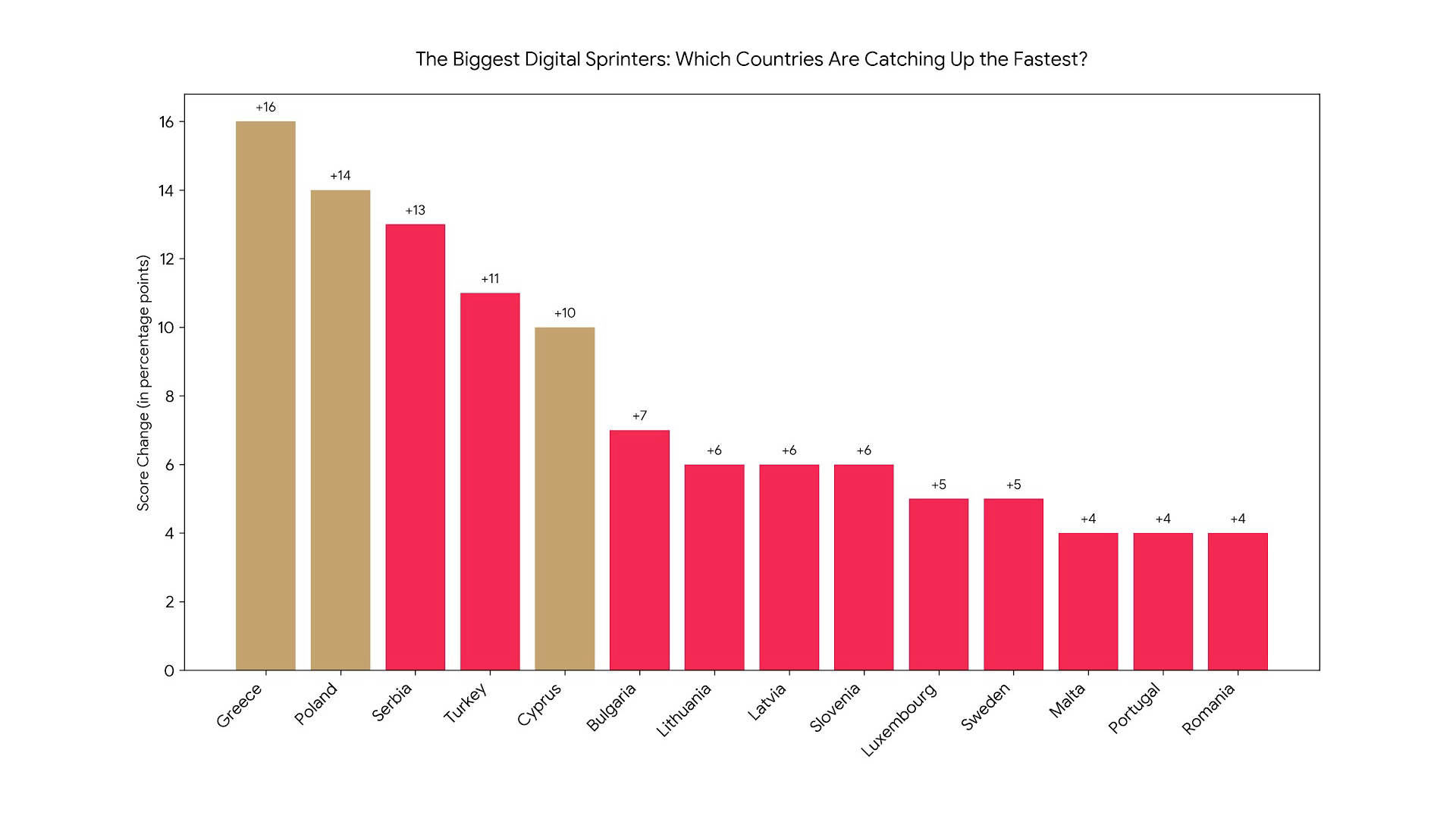
    • Ambitious Pretenders (Greece, Poland, Cyprus): This is the most interesting group from the perspective of seeking new large contracts. They are recording the highest growth rates and EU funds are driving large-scale transformation projects there.

    Analysis of the data leads to a fundamental conclusion: there is a clear correlation between a high score in the Key Enablers category and overall digital maturity. Countries at the top of the ranking, such as Malta and Estonia, have advanced and widely used digital identity systems.

    Without secure and convenient e-ID, administrations can only offer simple information services. Therefore, countries with digitisation ambitions but a low score in this category will have to invest in building or upgrading their identity systems first.

    For the Polish integrator, this is a clear signal that tenders for e-ID, e-signature and e-credentialing systems will be an absolute priority in the ‘contender’ markets.

    Beyond the ranking – identification of markets with the highest growth potential

    A static ranking does not tell the whole story. The real value lies in analysing the dynamics of change. It is not the leaders that generate the greatest demand, but the countries that have made the biggest leap in rankings in recent years.

    Greece: the absolute leader in dynamism. In just four years, Greece has improved its ranking by 16 points – the biggest jump in the whole of Europe. The country, which until recently was seen as a digital marauder, is now pursuing an ambitious transformation programme, fuelled by significant funding from the RRF.

    Poland: With an increase of 14 points, Poland is the runner-up for growth in the EU. This proves that our domestic market is also undergoing intensive investment and is an extremely attractive field.

    Cyprus: with an impressive rise of 10 points, Cyprus is another market to watch. Like Greece, starting from a lower base, Cyprus is investing in the fundamentals of the digital state.

    Where does this remarkable dynamic come from? It is the result of a synergy of political will and a powerful financial injection from the EU’s Reconstruction and Resilience Facility (RRF). More importantly, these countries’ investments are not in niche improvements, but in fundamental, large-scale systems, such as the construction of central registries, the implementation of national e-service platforms or the creation of digital identity systems.

    For large IT integrators, these are ideal opportunities to win flagship contracts.

    Poland compared to Europe – the domestic market as a springboard for success

    Poland’s impressive rise in the eGovernment Benchmark ranking proves that great opportunities lie just beyond the threshold. Experience gained on home ground can become the most valuable capital in international expansion.

    Poland’s digital administration is a picture of contrasts. On the one hand, we are a European leader in certain areas, e.g. in terms of online access to medical data. On the other hand, there is still a large gap between central and local administration, and cross-border services need to be improved. These weaknesses are at the same time huge market niches.

    A key driver of the transformation in Poland is the National Recovery Plan (NERP). Out of a total pool of EUR 59.8 billion, as much as 21.3% (around EUR 12.7 billion) has been earmarked for digital purposes. This is a gigantic stream of money that will be invested in cyber security (EUR 532 million), digitisation of administration (EUR 100 million) or digital education (EUR 1.2 billion).

    Polish IT companies should use the domestic market as a testing ground. Every successful project carried out in Poland under the KPO becomes a powerful ‘export ticket’. A Polish company that successfully implements a KPO-funded project gains invaluable know-how.

    It can then offer the same proven solution to a Greek ministry or a Cypriot government agency, arguing that it understands perfectly the specifics of RRF-funded projects. This is a powerful competitive advantage.

    From analysis to contract

    The theoretical analysis materialises in the form of specific public contracts, which can be found on the Tenders Electronic Daily (TED) portal – the official EU platform with free access to thousands of advertisements. Systematic monitoring of the portal is not only a way to find orders, but also a form of market intelligence.

    Here are examples that support these claims:

    • Greece – AI-based innovation: the Greek Ministry of Digitalisation has launched a tender with an estimated value of €19.1 million for the implementation of AI-based solutions in public administration. This is perfect evidence of a ‘technological leap’ – a country catching up with the most advanced technologies right away.
    • Cyprus – Building Data Foundations: A health insurance organisation in Cyprus is looking for a contractor to create, implement and maintain a data warehouse. This is an example of a foundational project that demonstrates the huge demand for building key elements of the data infrastructure.
    • Poland – Cyber Security at Local Level: The tender launched by the Municipality of Lagiewniki to upgrade its cyber security illustrates a market niche at the local government level. Hundreds of similar, smaller tenders create a huge, fragmented market, ideal for medium-sized IT companies.

    Armed with experience and high-calibre specialists, Polish technology companies today have a historic opportunity to become not just contractors, but key architects of this change, building their position on the international stage for years to come.

  • Vendor or advisor? The IT partner and its role in 2025

    Vendor or advisor? The IT partner and its role in 2025

    Not so long ago, good functionality and an attractive price were enough to close sales in the IT channel. Today, this no longer works. Customers are better informed, analyse the available options more often, involve more people in the purchasing process and make decisions more carefully. In this set-up, resellers need to go beyond the pattern of presenting the product and sending offers. Effectiveness now depends on the partner’s ability to guide the customer through the decision-making process – not just the sales process.

    Customer-side decisions are increasingly complex

    In B2B IT sales, it is increasingly rare to deal with a single decision maker. The process often involves several departments – IT, finance, security, operations and also compliance. Each participant has different expectations, different levels of knowledge and different evaluation criteria.

    This not only results in a longer procurement process, but also a greater risk of deadlock. Instead of a quick decision, organisations struggle with lack of consensus, unclear project scope and fear of risk. A partner that limits itself to providing a bid is reduced to the role of contractor – and loses influence over the final selection.

    The customer does not need a product salesman

    Much of the buying process is carried out by customers themselves – analysing data, comparing solutions and consulting other companies. When it comes to contacting a reseller, customers are already at an advanced stage of thinking about implementation, although they are often not yet clear on exactly what they want to buy and why.

    At this point, the client is not expecting another technical specification or product brochure. He needs help in understanding how a particular solution fits into his situation, what results it will deliver and how to minimise the risks associated with implementation. It is this stage that determines whether the partner becomes an advisor – or just one of many options being compared.

    The role of the decision advisor – how to put it into practice?

    Resellers who successfully adapt to the new reality start by talking about the customer’s context: their challenges, internal barriers and business goals. Only then do they move on to technology. This order allows them to better tailor their offering, but above all – to justify its value.

    Another element is support in the preparation of internal decisions on the client side. Resellers can help with ROI analysis, preparing materials for the CFO, assessing risks from a security or regulatory compliance perspective. These are real purchasing barriers that often block a project – and which a partner can help break down.

    So it’s not about selling a solution. It is about facilitating the customer’s decision to implement – and giving them the arguments that will convince the rest of the organisation.

    Value instead of discount, process instead of pressure

    Partners who support the decision-making process are less likely to have to compete on price. A customer who feels looked after and understands the value proposition is less sensitive to discounting. What’s more – a better-guided process translates into higher sales effectiveness, a shorter decision cycle and greater customer loyalty.

    This is a fundamental change. Not so long ago, sales in the IT channel were based mainly on product availability and the strength of the relationship. Today, what matters is the ability to guide the customer through a difficult, multi-stage decision-making process. In this context, consultancy competences – knowledge of purchasing processes, communication with different groups of decision-makers, the ability to translate technology into the language of effects – become crucial.

    New partner advantage: decision support

    In a world where technology is becoming increasingly standardised and offerings are difficult to differentiate at the level of specification, the advantage is not gained by whoever has the best product, but by whoever helps the customer best make sense of its implementation.

    It’s a change that requires investment – in people, in pre-sales tools, in training in communication and needs analysis. But it’s also a direction that offers more stable margins, longer relationships and a higher quality of collaboration.

    A partner who wants to sell effectively today should not only be able to explain ‘what’ he or she is selling – but above all: why the customer should make a decision right now, with him or her and in this direction.

  • When to say no to a customer? Partner channel and leadership courage

    When to say no to a customer? Partner channel and leadership courage

    In IT channels, for years there was a simple rule: the customer is always right and the partner always says yes. Discount? Yes. Short deadline? Yes. An implementation that no one has done before? Also yes – as long as you win the tender and maintain the relationship.

    Today, this model is no longer working. The more partners want to be advisors and not just doers, the more often they have to learn to say ‘no’. And to do so in a way that does not break contact – but builds trust.

    The partner industry has grown on relationships over the years. Large implementations have been won with loyalty, flexibility and a willingness to make concessions. This is natural – the customer pays, so demands. And a partner who fails to meet expectations is easily out of the game.

    The problem is that many of these ‘expectations’ today are not only unrealistic, but also dangerous: to profitability, to the team, to reputation. Agreeing to everything ends up overloading projects, losing control of the scope, and often losing trust – because the client sees the partner agreeing to everything, but not defending anything.

    Systemic factors are also often behind over-compliance:

    – pressure from vendors to close quarterly targets,

    – no competitive advantage (everyone has products),

    – too much dependence on a single client.

    As a result, the leaders of partner companies are themselves trapped: they choose a short-term ‘yes’, even though they know that a professional ‘no’ should follow.

    In the enterprise environment, especially in IT channels, saying no is often treated as a risk: the customer will get offended, the project will be lost, the vendor will ask “what’s going on?”. Meanwhile, a well-communicated ‘no’ can be the very thing that builds a partner’s position.

    Because ‘no’ does not necessarily mean conflict. It can mean:

    – We have understood the expectations, but we believe that this solution will not work,

    – this range is not realistic at the time,

    – the discount offer does not correspond to the value of our service.

    Leaders who can say ‘no’ with justification show not only courage but competence. They don’t behave like salesmen – they behave like advisers. And contrary to fears, clients appreciate this. Because no one wants a partner who agrees to everything – and then backs out of it.

    It is not about assertiveness for the sake of principle. It’s about situations where agreeing would do more harm than refusing. Such as:

    • Demanding implementation in an unrealistic timeframe, with no buffer for testing and acceptance – which usually ends in a rollback and loss of trust.
    • Requests to cut costs at the expense of quality, e.g. without adequate resources, documentation or a training phase.
    • Forcing discounts without changing the scope – hitting profitability and team motivation.
    • Suggestions that do not comply with regulations (RODO, ISO, security standards), but “because the board wants it that way”.

    In such situations, leaders act differently from salespeople. Instead of running away from confrontation, they name the risks, explain the consequences and – crucially – offer alternatives. This is not shutting down the conversation, but moving it to the level of decisions, not demands.

    Refusal is not just about defending the company’s interests. It is also part of building a relationship based on balance. A partner who has an opinion and is able to defend it becomes more than just a supplier to the customer – it becomes a trusted advisor.

    This translates into tangible benefits:

    • Better projects – because they are carried out under realistic conditions, with a clear scope.
    • Stronger negotiating position – both vis-à-vis the customer and the vendor.
    • Stronger teams – because people see that the leader is not sacrificing their time and quality of work to get a contract ‘by force’.

    The partner channel has to play a different role than it did a decade ago. It is no longer enough to ‘sell and implement’. The customer expects decisions, not just execution. And this means that IT company leaders must have the courage to say ‘no’ – not from a position of strength, but from a position of responsibility.

    Refusal, well-grounded and constructive, does not destroy a relationship. On the contrary, it builds its deeper foundation. At a time when trust and credibility are as important as technology, the ability to say ‘no’ is becoming one of a leader’s most important tools.

  • The holy grail for IT partners: Which IT services offer the highest margins with the highest demand in 2025?

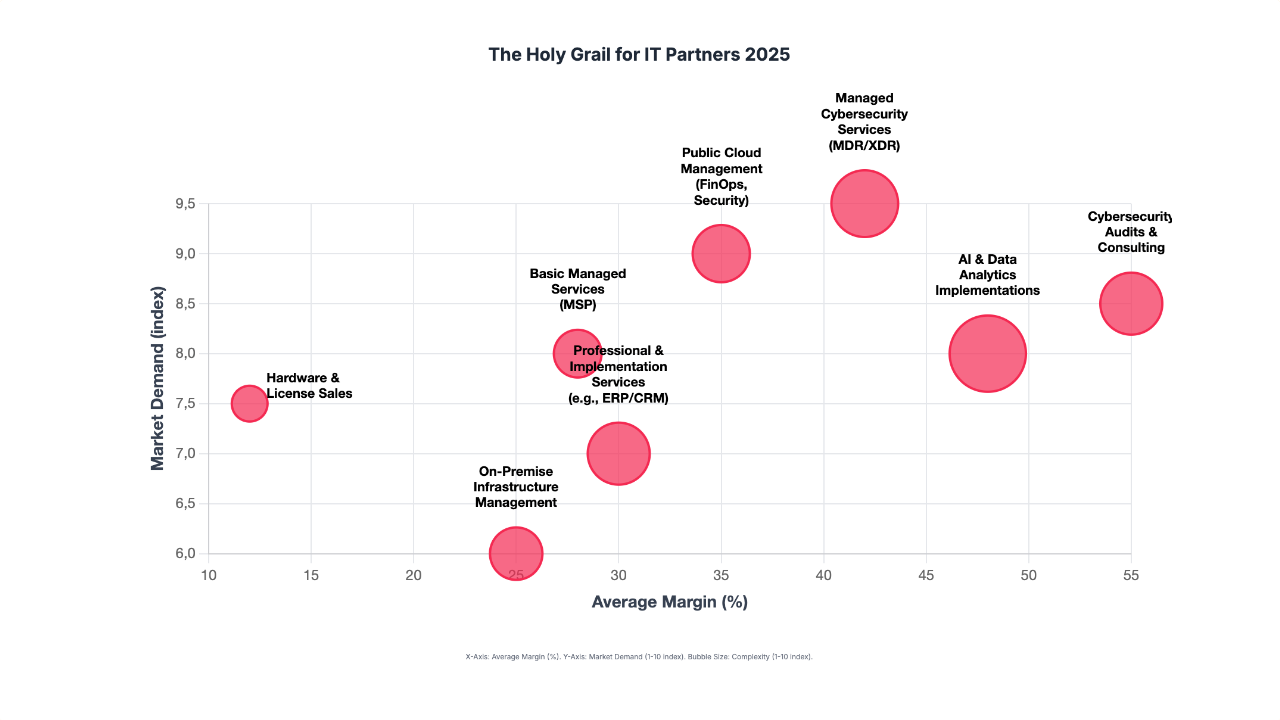
    The holy grail for IT partners: Which IT services offer the highest margins with the highest demand in 2025?

    The year 2024 has gone down in technology history as an era of bold experimentation, driven by a wave of generative artificial intelligence. Companies around the world immersed themselves in the possibilities of AI, launching countless pilot projects. However, 2025 brings a fundamental shift.

    Enthusiasm, which analysts at Channelnomics described as “unprecedented” , is giving way to the hard reality of business. The time for monetisation and return on investment has arrived. Customers are no longer asking “will AI?”, but “how will AI translate into our profit?”.

    For IT partners, this transformation opens up a new era of opportunity. They are becoming the key conduits for companies that must navigate an increasingly complex technology landscape. Success in 2025 will depend on the ability to respond to three powerful forces shaping the market: the shift towards profitable artificial intelligence, the imperative of cyber security as the foundation of every operation, and the maturity of the cloud, which is generating demand for new, high-margin optimisation services.

    Leading analyst firms agree on the scale of the coming growth. Forecasts of global IT spending in 2025 point to a market worth more than $5 trillion.

    This solid growth of a few per cent is almost entirely driven by two phenomena: the mass adoption of artificial intelligence and the need to upgrade existing systems.

    The IT services segment will remain the largest part of the market, with a projected value of $1.69 trillion, but data centre systems and software will see the greatest growth as a direct result of investment in AI.

    Against this background, Poland is emerging as a regional leader. The value of the Polish IT services market is forecast to reach USD 10.44 billion in 2025, with GDP growth expected to reach an impressive 4.1%. The strength of the Polish market is driven by a globally recognised pool of technology talent, making our country a leading location for nearshoring and outsourcing.

    However, this position is a double-edged sword for local IT partners. Huge demand creates a gigantic market, but it also means competition with global players.

    In this reality, competing on price alone is becoming a strategy without a future. Advantage must be based on talent, value and specialisation.

    The market analysis clearly identifies three areas where demand, the need for specialisation and margin potential converge, creating ideal conditions for building competitive advantage.

    The AI revolution – from experiment to profit

    The year 2025 marks the end of the era of free lunches in the AI world. Customers who have invested in pilot projects now expect tangible business results. This creates a huge opportunity for partners who can speak the language of ROI.

    The biggest barriers to AI adoption lie not in the technology, but in lack of competence (42% of companies), insufficient data quality (42%) and lack of a solid business case (42%). It is in these areas that an AI partner can offer the most value.

    Instead of generic implementations, the most profitable services focus on solving complex problems. AI governance (AI Governance) and ensuring models are explainable are becoming key for firms in regulated sectors, with 44% of organisations planning to invest in them. Instead of offering one-size-fits-all chatbots, partners should focus on creating industry-specific solutions that drive AI adoption in finance, retail or media.

    The ability to navigate costs also becomes crucial. The cost of an averagely complex AI project can range from $60,000 to more than $250,000, and a partner who can guide the client through the entire process, from concept to implementation, gains strategic advisor status.

    2. Cyber security: from reactor to proactive guardian

    The cyber security market is booming, with a projected annual growth rate of 14.6%. This growth is driven by the increasing complexity of threats, including AI-assisted attacks, and the increasingly severe financial consequences of successful intrusions, with the average cost already reaching $4.88 million.

    These services are high-margin, and consulting in this area can yield margins of 20-40% . This is because their value is directly linked to protection against catastrophic risk.

    The real growth and margin lies in the move away from standard, saturated services to advanced managed solutions. We are talking about the evolution from Endpoint Detection and Response (EDR) systems to Managed Detection and Response (MDR) and Extended Detection and Response (XDR).

    These solutions integrate signals from across the customer’s IT environment and provide 24/7 monitoring and expert response. It is no coincidence that 97% of the world’s top-earning managed service providers (MSPs) offer managed security services.

    The democratisation of advanced security operations (SOC) through AI is also a powerful new trend. AI assistants for analysts allow even smaller teams to operate with the efficiency of experienced experts, paving the way for offering a highly effective and profitable SOC-as-a-Service.

    3 The economics of the cloud, or the imperative of optimisation

    As companies move more and more operations to the cloud, a new fundamental challenge is emerging. For 82% of organisations, managing cloud spend is now the number one concern. It is estimated that up to a third of this spend is wasted due to ineffective configuration or lack of oversight.

    This is a huge, easily quantified business pain for which IT partners can offer an effective remedy.

    The immediate answer is FinOps, a new operational discipline that brings together finance, engineering and business to bring financial accountability to cloud consumption. The market for FinOps tools and services is growing at more than 11% per year.

    This is a high-value consulting practice that can help clients reduce cloud costs by 20-30%. Instead of one-off audits, partners can offer a continuous FinOps-as-a-Service, creating a recurring, high-margin revenue stream.

    An additional opportunity is the complexity of multi-cloud environments, which up to 92% of companies are implementing . Partners that can offer a unified management plane for AWS, Azure and GCP environments become invaluable to customers.

    Global trends provide the map, but success depends on skilfully navigating the local context. For Polish IT partners, 2025 is a time of strategic decisions. It is necessary to move away from a model of competing mainly on costs to building deep specialisation.

    Rather than being an ‘everything provider’, aim to be the best in a selected, high-margin niche, such as implementing regulatory compliance (e.g. DORA), implementing GenAI in a specific industry or consulting FinOps.

    The biggest barrier for clients is the lack of talent, so a partner’s most valuable asset is its team of experts . The investment in competence, certification and retraining of talented developers towards AI/ML engineering is the most important investment in future profitability.

    Equally important is a change in the way business discussions are conducted. The discussion must shift from the level of technological features to that of business outcomes. It is necessary to learn to quantify the value of the services provided, speaking the language of risk reduction, operational savings and return on investment .

    The market analysis for 2025 leads to one conclusion: “The Golden Grail is not a single service, but a strategically balanced portfolio. The partner of the future is one that is specialised, agile and obsessed with delivering tangible value to customers.

    A historic opportunity is opening up for Polish companies in the IT sector. Its geographical location, access to outstanding talent and dynamic economy create ideal conditions for a leap forward in global competitiveness.

    The key will be to have the courage to invest in the most difficult but also the most promising areas of the market and become an indispensable guide for their customers in the smart technology era.


  • The IT industry is narrowing the circle of trust. Partnership not for everyone

    The IT industry is narrowing the circle of trust. Partnership not for everyone

    The IT industry is transforming, especially in the sales channel. Over the years, many IT manufacturers have relied on a broad presence in the channel – the more partners, the greater the growth potential. Today, this approach is losing relevance. More and more vendors are deliberately reducing the number of active partners, focusing their activities on a select group of resellers and integrators who have a real impact on sales.

    Instead of scaling the number of accounts, vendors prefer to deepen relationships with those who already have access to strategic customers and competence in delivering complex solutions. Such selectivity means higher demands, but also a greater willingness to invest on the vendor side – from joint sales planning to priority access to presales and MDF resources.

    Some global vendors, such as Dell Technologies and HPE, have already signalled that the priority is on the quality of partnerships, not their number. In 2024, this trend has also clearly accelerated among software vendors, especially in the subscription model, where customer retention has become as important as acquisition.

    What was once the norm – i.e. open registrations, low entry thresholds and minimal expectations of activity – is increasingly giving way to a ‘closed club’. For many partners, this means they need to redefine their position in their relationship with vendors.

    The focus on fewer partners entails a new logic of cooperation. Vendors are no longer just looking for a distribution channel – they expect active participation in the sales process and customer development. Increasingly, the relationship resembles a joint go-to-market rather than the classic ‘manufacturer-reseller’ model.

    In practice, this means deeper commitment on both sides: joint pipeline planning, shared sales targets and regular performance reviews. For partners, it also means greater transparency – manufacturers expect insight into CRM data, detailed forecasts and clearly defined project contributions.

    In return, they offer more than just a discount. Access to technical teams, priority in lead allocation and priority in implementing new solutions are becoming the new currency in channel relationships. Vendors – especially those operating on an as-a-service model – want to be assured that the partner will not only sell the solution, but also help retain the customer throughout the contract lifecycle.

    This shift towards ‘value-added engagement’ can be seen particularly in the cloud and security sector, where sales rarely end with a single deployment. Partners who can deliver not only the product, but also ongoing support, are becoming a natural extension of manufacturer teams.

    Domino effect in the canal

    Producer selectivity is not without its impact on the rest of the channel. Smaller and medium-sized partners – hitherto operating on a transactional model – are increasingly finding that access to technical support, leads or marketing resources is becoming limited. Vendors are shifting resources to where they see greater return potential.

    As a result, for many ‘mid-tier’ partner companies, collaboration with the manufacturer becomes more one-sided: less communication, less attention, fewer opportunities for joint initiatives. Partners still have access to basic tools – portals, e-learning programmes, documentation – but the personalised approach that used to be standard is missing.

    This gap is being attempted to be filled by distributors. They offer their own development programmes, pre-sales as a service, flexible financing models or dedicated engineering resources. In practice, they are now taking over part of the role previously played by vendors vis-à-vis smaller partners – especially in the SME segment and local integrators.

    This also marks a shift in power dynamics: partners who have hitherto built their position directly with the manufacturer are increasingly having to accept indirect relationships – with less influence over strategy and access to key information. For many, this is the beginning of having to make a choice – either to increase scale and competence or to redefine their business model.

    Is it worth the effort?

    For partners who are not among the ‘preferred’, the question becomes: is it worth investing in a relationship with a vendor who is shifting resources elsewhere? Increasingly, the answer is yes – provided they can demonstrate value beyond the sale itself.

    Manufacturers are increasingly rewarding partners who show initiative – not waiting for leads, but generating demand themselves, sharing the pipeline and taking risks in pilot projects. It is also becoming crucial to have certified competences – not only technical, but also business competences, such as the ability to conduct consultative sales or service integration.

    Less obvious strengths are also at stake: access to niche vertical markets, a strong local brand or an efficient implementation process. Vendors are looking for partners who don’t just ‘sell the product’, but can build it into the customer’s real-world environment – and do so quickly, predictably and with minimal risk.

    For many partners, this means transforming from an infrastructure provider to a technical and business advisor. It is a difficult process, but in the long term – the only way to maintain direct access to manufacturer support and stay in the game for larger projects.

    The IT industry and the 2025 outlook: will only the elite remain?

    If the current direction continues, in 2025 the IT sales channel could become more polarised than ever before. At the top – a narrow group of strategic partners, tightly integrated into the manufacturer’s operations. Below – a broad base of smaller companies, operating in a transactional mode, supported mainly by distribution or self-service portals.

    This raises the question of long-term sustainability. Focusing on ‘top performers’ brings faster growth and better cost control, but also risks losing flexibility. Especially in local markets, where relationships and regional presence still matter, too narrow a network of partners can limit scalability.

    Some vendors are trying to balance – offering different partnership paths, depending on their business model. Others put it all on the line, hoping that the rest of the market will be taken up by an ecosystem of services, cloud platforms or value-added distribution anyway.

    For the partners themselves, this is a moment of strategic decisions. Maintain the current model and accept a second-tier role – or invest in competences, specialisations and relationships that can bring them closer to the forefront. The new normal in the IT industry does not mean the end of the channel. But it definitely changes the rules of the game.