Tag: Startups

  • PLN 40 million for startup acceleration: Startup Booster Poland call is launched

    PLN 40 million for startup acceleration: Startup Booster Poland call is launched

    The Polish Agency for Enterprise Development (PARP) is making a significant move towards professionalising the domestic innovation ecosystem by launching a call for applications in the Startup Booster Poland – Tech Impact programme. With a total budget of PLN 40 million, funded by the European Funds for the Modern Economy (FENG), the initiative is focused on identifying specialised operators who will take on the burden of guiding young companies through the most risky stage of their development. Organisations such as technology transfer centres, technology parks or incubators can apply for funding of between PLN 15 and 20 million. The deadline for applications is 17 July, and what is at stake is not only capital, but above all a change in the survival statistics of young companies.

    The current landscape of the Polish SME sector, which accounts for almost half of the country’s GDP, shows a clear gap in the resilience of the youngest players. Only 68 per cent of startups continue to operate after the first year, while for two-year-old companies the figure rises sharply to 91 per cent. This data sheds new light on PARP’s strategy – the Tech Impact programme is not just another grant mechanism, but an attempt to systemically secure the ‘valley of death’. The focus on *impact* projects, i.e. solutions to the social and environmental challenges of the UN’s Agenda 2030, suggests that the Polish administration is beginning to see sustainability as a real competitive advantage, not just a regulatory requirement.

    In view of these developments, it is worth noting the need for future operators to build interdisciplinary mentoring teams. Successful acceleration in the area of Tech Impact today requires a combination of hard business competencies and expertise in ESG reporting or environmental certification. It also seems reasonable for operators applying for operator status to integrate their activities with private investors already at the application stage, which will allow startups to make a smoother transition from the incubation phase to market funding rounds.

    Greater intensification of educational activities aimed at traditional business should also be considered; after all, the role of the operator is only successful when the innovative solution finds a viable customer or strategic partner. Building such bridges between science, startups and mature industry may prove to be a key factor that will determine the sustainability of the effects of this programme in the long term business perspective.

    Innovation actors with relevant experience in the implementation of acceleration programmes, in particular, can apply for funding:

    • technology transfer centres,
    • innovation centres
    • technology incubators
    • academic business incubators,
    • technology parks.

    How to apply? Applications for the operators of the FENG Startup Booster Poland – Tech Impact programme are accepted until 17 July via the LSI platform: https://lsi.parp.gov.pl.

    More information about the call can be found on the PARP website.

  • IT market in CEE: Poland vs. Czech Republic, Hungary, Romania. Analysis

    IT market in CEE: Poland vs. Czech Republic, Hungary, Romania. Analysis

    Central and Eastern Europe (CEE) has long ceased to be seen as an ’emerging’ technology market. Today, it is a globally established, dynamic and competitive centre of innovation, whose IT services and R&D market is growing four to five times faster than the global average.

    At the heart of this technological renaissance are four key players, a kind of ‘Visegrad+ Technology’: Poland, the Czech Republic, Hungary and Romania. Each of these countries brings a unique profile to the regional jigsaw: Poland appears as a regional hegemon in terms of scale, the Czech Republic as a stable industrial and technological centre, Hungary as a magnet for foreign direct investment and specialised expertise, and Romania as a ‘digital contender’ with the highest growth rate.

    CEE technology arena

    To understand the dynamics of competition in the region, it is first necessary to assess the fundamental economic context, comparing the scale, structure and importance of IT markets in each of the four countries. It is these indicators that determine who are the biggest players and where the epicentre of growth lies.

    Scale and dynamics of the market: measuring the forces

    Market size is a fundamental indicator of strength. In this respect, Poland is the undisputed leader in the region, although different sources give slightly different estimates, reflecting the complexity and dynamics of the sector. According to PMR data, the value of the Polish IT market in 2023 was PLN 66.3 billion (approx. EUR 15.4 billion), with a forecast of growth to PLN 74 billion (approx. EUR 17.2 billion) by 2025. IDC Poland analysts, on the other hand, estimate this value even higher – at PLN 80.3 billion (approx. EUR 18.6 billion) in 2023. Regardless of the methodology adopted, the scale of the Polish market significantly exceeds its neighbours.

    The Czech ICT (information and communication technology) market presents the picture of a mature and stable powerhouse. Its revenues are forecast to reach EUR 24.3 billion by 2026, with a steady annual growth rate of 2.1%. This indicates a less volatile, well-established market. The Hungarian ICT market is more difficult to assess conclusively due to disparate data. Mordor Intelligence estimates its value at an impressive USD 35.17 billion in 2025, with a projected annual growth rate (CAGR) of 11.41% until 2030. Other sources quote a more conservative figure of €5bn for 2024. This discrepancy suggests that the higher estimate covers a wide range of telecoms services and hardware sales, driven by large corporations. The Hungarian e-commerce segment alone reached HUF 1,920 billion (approximately EUR 4.9 billion) in 2024.

    Romania presents the most dynamic picture. Its digital economy is expected to reach a value of EUR 52 billion by 2030. The IT services export market, valued at EUR 24.9 billion in 2023, is expected to grow to EUR 44.8 billion by 2028, representing an impressive CAGR of 9.1%. This is the fastest growth trajectory in the group analysed, positioning Romania as a top contender for regional momentum.

    This dichotomy between scale and speed of growth creates a strategic tension. Poland, as the largest market, offers stability, a mature and diverse ecosystem, which is attractive to large corporations looking for space for R&D centres. On the other hand, Romania, with its near double-digit growth, is a magnet for venture capital funds and companies looking for rapid expansion, willing to accept the risks associated with a less mature market. The choice between these countries is therefore not a simple decision, but depends on the investor’s appetite for risk and its growth strategy.

    The powerhouse that drives GDP: More than the service sector

    The importance of the IT sector for national economies is best reflected in its share of Gross Domestic Product. In Poland, it is an impressive 8%, reflecting the deep integration of technology into the overall economy and its key role as a driving force. Romania also boasts a high figure at 6.6%. Surprisingly, Hungary has the lowest share at 4.3%. Although precise data for the Czech Republic is lacking for IT alone, the context is the powerful automotive industry, generating 10% of GDP, indicating strong links between the technology sector and industry.

    These figures, juxtaposed with overall wealth levels, show that technology is a key tool for convergence. Poland and Romania, with GDP per capita (in purchasing power parity) at 79% of the EU average, are chasing the Czech Republic (92%). The IT sector is undoubtedly one of the main accelerators of this process.

    Market Architecture: What’s hiding under the hood?

    The internal structure of the IT markets in each country reveals their unique specialisations and strategic directions.

    Poland: We are seeing a clear bifurcation of the market. The hardware segment is stabilising after a pandemic boom, while software and services are going from strength to strength, reaching a value of PLN 30.5bn (€7.1bn) in 2023. Cloud services are a key driver, with the market growing by 25% year-on-year to reach US$2bn.

    Czech Republic: The market is strongly determined by a powerful industrial base, especially the automotive and electrical engineering sectors. This generates a huge demand for embedded systems, industrial automation and advanced enterprise IT solutions. The country is also a hub for international R&D centres such as Microsoft, IBM and Oracle.

    Hungary: the market is characterised by an exceptionally high level of high-tech adoption by businesses. The cloud adoption rate is 37.1% (slightly below the EU average) and data analytics as high as 53.2%, which is well above the EU average (33.2%). This indicates a mature and demanding corporate customer base. The largest segment of the ICT market is telecommunications services, accounting for more than 41% of the total.

    Romania: the market is largely export-oriented, especially in the area of software development services. Despite the government’s strong emphasis on the digitalisation of small and medium-sized enterprises, its level (27%) still lags far behind the EU average (57.7%), which paradoxically creates a huge potential for growth in the internal market.

    An analysis of the structure of markets reveals an interesting phenomenon in Hungary. On the one hand, companies there show above-average maturity in the adoption of advanced technologies such as data analytics.

    On the other hand, the contribution of the overall IT sector to GDP is the lowest in the group. This apparent contradiction suggests that technological advancement is concentrated in a narrow group of large, often foreign corporations (e.g. from the automotive sector), rather than being a widespread phenomenon driven by a broad domestic IT industry.

    This indicates a ‘top-heavy’ market with potentially fewer opportunities for local SMEs compared to Poland, where the domestic IT sector is a much larger economic force.

    The human capital equation: talent, skills and remuneration

    In an industry dominated by a ‘war for talent’, it is human capital that is the most valuable asset and the ultimate determinant of competitiveness. The analysis moves from macroeconomic numbers to the practical realities of building and maintaining technology teams.

    Talent resource: A deep but challenging resource

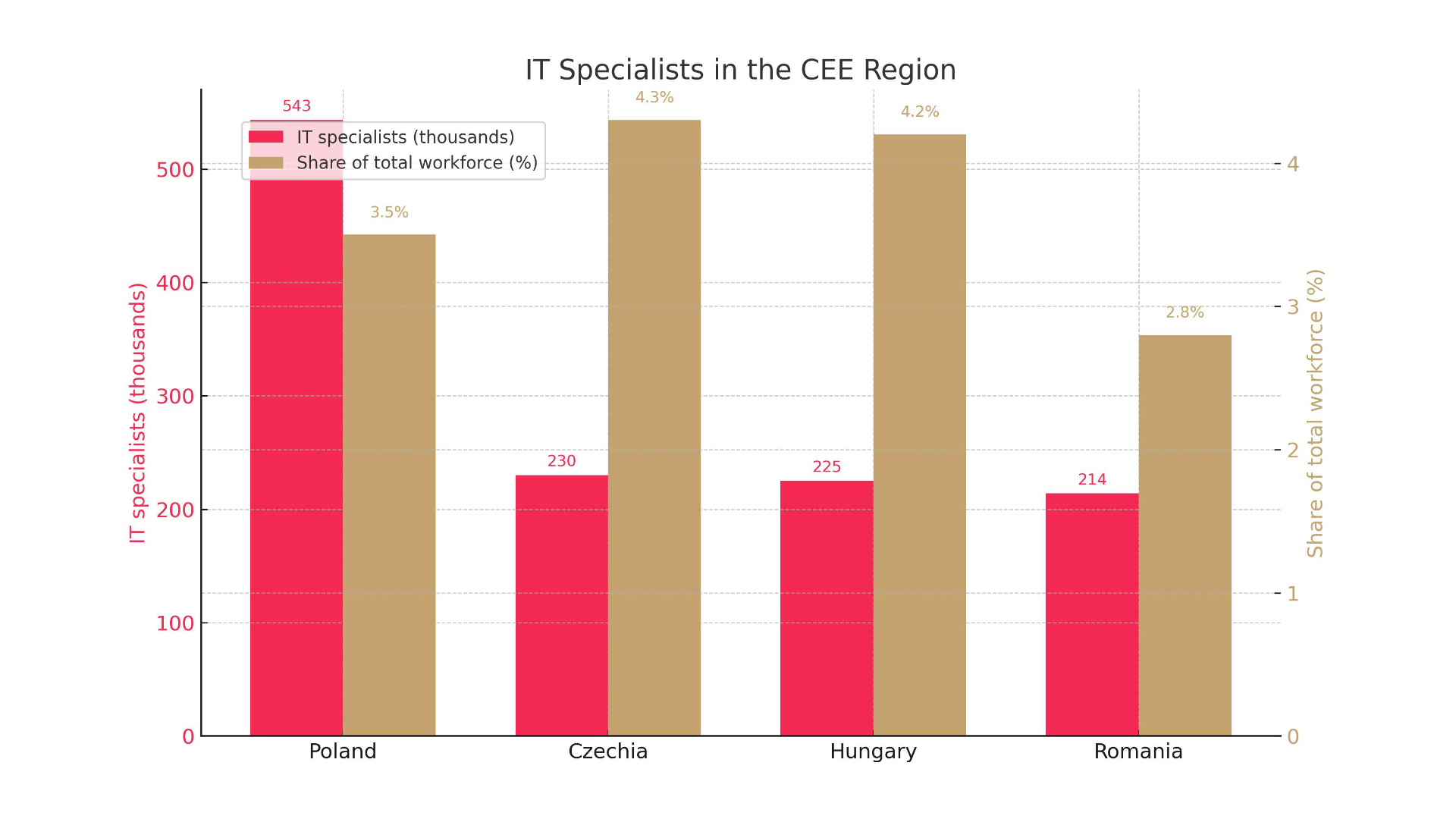
    Poland: a giant with a skills gap: Poland has by far the largest talent pool, estimated at between 493,000 and over 586,000 professionals. This is a powerful asset, but the country is struggling with a significant skills gap. IT professionals account for 3.5% of the total workforce, which is lower than the EU average (4.5%). It is estimated that Poland lacks as many as 147,000 experts to reach the EU average.

    Czech Republic: Hub of specialists: the Czech Republic has a solid base of nearly 230,000 ICT experts, representing 4.3% of the workforce – a figure close to the EU average. Renowned technical universities provide a steady flow of graduates, although they have to compete for talent with the powerful industrial sector.

    Hungary: Stability and qualifications: In Hungary, the share of ICT professionals in employment is 4.2%, also close to the EU average. However, the annual growth rate of these professionals (2.4%) is slower than in the EU (4.3%) , suggesting a stable but less rapidly growing talent pool.

    Romania: The density paradox: Romania has a large and highly valued talent pool of between 202,000 and 226,000 professionals. The country boasts the highest number of certified IT professionals per capita in Europe. Paradoxically, their share of the total workforce is the lowest in the group at just 2.8%. In addition, Romania faces a ‘brain drain’ problem, which poses a serious challenge to keeping top talent in the country.

    This talent flow dynamic is fundamental to long-term development. The phenomenon of ‘brain drain’ in Romania stands in contrast to the ‘brain inflow’ in Poland, which is becoming an attractive place to work for professionals from other countries, including Ukraine.

    An economy that loses talent often exports junior and mid-level professionals, which undermines its ability to create complex, high-margin products locally. In contrast, a country attracting talent can accelerate its march up the value chain by importing experienced experts.

    This indicates that the Polish ecosystem may mature faster, while the Romanian ecosystem, if not reversed, may remain more focused on the provision of outsourcing services.

    Map of Wages: Clash of the four capitals

    Salaries are a key competitive factor in the talent market. A comparison of rates in the region’s main technology hubs reveals significant differences.

    Warsaw bonus: Polish salaries are among the highest in the region. A senior programmer on a B2B contract in Kraków or Warsaw can expect a salary in excess of PLN 26,000 net per month (around EUR 6,000). Even on an employment contract, senior salaries exceed PLN 12,000 net (around EUR 2,800).

    Prague competitiveness: Czech salaries are also very high. The typical range for IT professionals is between CZK 43,130 (approximately EUR 1,730) and CZK 122,874 (approximately EUR 4,930) per month. The best-paid roles, such as Data Scientist, can bring in an annual income of CZK 1.2 million (approximately EUR 48,150). The average annual salary for a software engineer is around EUR 55,600.

    Budapest’s value proposition: Hungarian salaries offer a better cost/quality ratio. The average salary for an IT specialist is around EUR 1,800 per month , while a software engineer in Budapest earns an average of EUR 40,400 per year. This makes Hungary much more affordable to build a team than Poland or the Czech Republic.

    Rising costs in Bucharest: Romanian wages are rising fast, but still offer a cost advantage. The average salary in the technology industry is EUR 3,402 net per month. The general range for IT is between RON 4,647 (approximately EUR 930) and RON 16,879 (approximately EUR 3,390) per month. However, these rates are further bumped up by the total exemption from income tax up to a certain threshold, which significantly increases the net salary.

    The prevalence and high rates of B2B contracts in Poland are not just a billing method, but symptomatic of a mature, highly competitive senior talent market. This model gives maximum flexibility and earning potential to the best professionals, but at the same time creates instability for employers and leads to a more transactional relationship with employees.

    In contrast, the dominance of traditional employment contracts in Hungary and the Czech Republic (83.5% and 67% in IT respectively) suggests a more stable, corporate labour market. This means that companies in Poland need to adopt a different HR strategy, focusing on offering attractive projects and top salaries, while in the Czech Republic and Hungary more emphasis can be placed on long-term career paths and company culture.

    A list of coveted expertise: Who’s on top?

    Across the region, there is a huge demand for specialists in areas such as artificial intelligence and machine learning (AI/ML), data analytics (Data & BI), cyber security and DevOps. It is these roles that are the highest paid.

    However, each country also has its niches in which it has achieved a leadership position. Poland is a global powerhouse in the production of computer games (gamedev), with giants such as CD Projekt RED at the forefront. The industry generates more than EUR 500 million in revenue, creating an ecosystem of talent in game design, programming and graphics that is unique in the region.

    Romania is rapidly developing its own gamedev scene, attracting global players such as Amazon Games, which has opened a new studio in Bucharest. The country is also strong in the Fintech sector, with the capital generating 77% of the industry’s turnover in the country.

    The Czech technology scene fits perfectly with the needs of its industry base, targeting areas such as cyber security (Avast originated from here) and enterprise software. Hungary, on the other hand, with its high adoption rate of cloud and data analytics by corporations, generates a strong demand for data architects, cloud engineers and enterprise systems specialists such as SAP.

    The innovation frontier: start-ups, outsourcing and investment

    The future of any technology market depends on its ability to innovate, attract capital and integrate into the global ecosystem. This section examines the dynamics that are shaping tomorrow’s technology scene in Central and Eastern Europe.

    The vibrant Venturelands: The startup race

    Poland: Leader in terms of volume: Poland boasts the largest startup ecosystem in the group, with more than 1,251 companies. Warsaw is the dominant hub. The ecosystem is mature enough to have released nearly a third of all unicorns (companies with a valuation of more than USD 1 billion) in the CEE region. Funding, however, remains a challenge, with as many as 56% of startups reporting difficulties in obtaining it.

    Czech Republic: An effective rival: Despite its smaller scale, the Czech ecosystem is highly rated, ranking 3rd in Eastern Europe, ahead of Poland. It is famous for startups in the areas of SaaS, Fintech and Healthtech and is the cradle of global success stories such as Avast and unicorns such as Rohlik and Productboard. A key challenge is the perceived lack of a sufficient number of high-quality projects by investors.

    Hungary: a stagnant giant? Hungary has established companies such as Prezi and LogMeIn, but has struggled to maintain momentum in recent years. Total investment has stagnated at around EUR 54 million. Recently, however, there has been an upturn in the segment of early-stage AI-based startups, which could herald a rebound.

    Romania: The unicorn factory: The Romanian ecosystem has been defined by the spectacular success of UiPath, the global leader in process automation (South Africa). This event has put the country on the map for international investors. The AI scene is particularly active, with large funding rounds for companies such as FintechOS. The ecosystem is heavily concentrated in Bucharest.

    The success of UiPath has had a profound secondary impact on the entire Romanian ecosystem. Not only has it created a generation of experienced, wealthy angel investors and serial entrepreneurs (the so-called ‘UiPath mafia’), but it has also acted as a global proof of principle, reducing the perceived risk of investing in Romania in the eyes of international VC funds. This explains the impressive funding rounds for companies such as FintechOS and the general revival around the Romanian scene, which might otherwise seem disproportionate to the size of the market. This ‘unicorn effect’ is a powerful accelerator that allows the ecosystem to perform well above its nominal weight.

    Global background: Strategic partner, not cheap labour

    The entire CEE region is a leading global destination for IT outsourcing. Clients are increasingly shifting their focus from cost optimisation to access to high-end skills, innovation and cultural proximity. The regional talent pool exceeds 1.75 million engineers.

    A stable business environment is a key asset. In the Doing Business 2020 ranking, Poland (40th), the Czech Republic (41st), Hungary (52nd) and Romania (55th) offer predictable conditions, an advantage over other global outsourcing hubs.

    Poland is often recognised as a leader in IT competitiveness in the region thanks to its huge talent pool, business climate and strong exports. It is a major hub for the R&D centres of global giants such as Google and Microsoft.

    The Czech Republic ranks among the top five countries in terms of the attractiveness of outsourcing, renowned for its high quality services and data security.

    Hungary and Romania are attracting investors with their correspondingly low 9 per cent corporate income tax and tax exemptions for programmers, which, combined with a large talent pool, creates a powerful value proposition.

    The strong presence of international R&D centres and outsourcing companies in Poland and the Czech Republic is not just a service industry; it is a key incubator for the country’s startup ecosystem. These centres train local talent to global standards, introduce them to global business practices and create a network of professionals who eventually leave to start their own product companies. A programmer working for five years in Google ‘s Warsaw office learns product management, scaling and international sales at a level not available in most local companies. Such a specialist, armed with unique skills, contacts and an understanding of the needs of the global market, is much more likely to succeed. In this way, the outsourcing sector is not a separate entity, but a fundamental pillar that feeds and accelerates the development of the domestic product and startup economy.

    The role of the state: Catalysts for growth

    The governments of all four countries actively support the technology sector through a variety of initiatives, including tax incentives, funding programmes and startup visas. Key policies, such as Romania’s income tax exemption for software developers or Hungary’s low CIT rate , are important competitive advantages. Poland and the Czech Republic are effectively using EU funds and national development agencies (such as PFR Ventures and CzechInvest) to fuel their innovation ecosystems.

    Verdict: Poland’s position and the way forward

    A synthesis of the data presented makes it possible to formulate a clear verdict on Poland’s position compared to regional rivals and to outline strategic perspectives for the entire region.

    Regional SWOT analysis: Comparative scorecard

    Poland:

    • Strengths: Largest market and talent pool, diverse ecosystem (gamedev, enterprise), strong startup scene.
    • Weaknesses: Significant talent gap, increasing wage pressure, high competition.
    • Opportunities: Inflow of talent from abroad, opportunity to move up the value chain to more complex products.
    • Threats: Loss of cost competitiveness to Romania/Hungary, market saturation in some areas.

    Czech Republic:

    • Strengths: Stable, mature market, highly qualified professionals, strong integration with industry, excellent business environment.
    • Weaknesses: Smaller talent pool, slower growth, higher costs than some neighbours.
    • Opportunities: Leverage the industrial base for innovation within Industry 4.0, become a hub for high-margin R&D centres.
    • Threats: Competition for talent with powerful manufacturing sector, risk of stagnation.

    Hungary:

    • Strengths: Favourable tax environment, high adoption of advanced technologies in companies, strong value proposition.
    • Weaknesses: Stagnation in startup funding, slower growth of talent pool, less dynamic ecosystem.
    • Opportunities: Potential to become a specialised hub for AI and data science solutions for corporations, attracting cost-oriented FDI.
    • Threats: Lagging behind regional leaders in startup innovation, political uncertainty affecting investor confidence.

    Romania:

    • Strengths: Top growth rate, high talent density, significant cost advantages, ‘unicorn effect’ after UiPath success.
    • Weaknesses: Brain drain, less developed domestic market, infrastructure gaps outside major hubs.
    • Opportunities: huge potential in the digitalisation of the country’s SMEs, becoming the gamedev hub of South East Europe.
    • Threats: Talent retention, risk of overheating the economy, dependence on export markets.

    Poland’s position in the CEE arena: Heavyweight champion under pressure

    Poland remains the undisputed leader of the CEE technology scene in terms of scale, talent numbers and diversity of the ecosystem. The size of its market and depth of specialisation, especially in gamedev and enterprise software, are unrivalled.

    However, leadership comes at a price. Poland faces challenges typical of a mature market: intense wage competition that undermines its cost advantage, and a critical skills gap that could stifle future growth. Poland is no longer the ‘low-cost’ option; it is the ‘scale’ option.

    While Poland is leading the way, the competition is not sleeping. Romania challenges it in terms of growth and dynamism, the Czech Republic in terms of stability and specialised quality, and Hungary in terms of cost efficiency for corporate investments.

    Collective strength: The future is regional

    The future of the CEE technology scene will not depend on which country ‘wins’, but on how the region as a whole handles the transformation from a cost-driven outsourcing destination to a value-driven innovation partner. Poland, as the largest player, has a key role to play in leading this change, but its success is inextricably linked to the health and dynamism of its neighbours.

  • Managing innovation in the shadow of doubt. The art of turning cool criticism into market success

    Managing innovation in the shadow of doubt. The art of turning cool criticism into market success

    Just recall the image of a typical board meeting or pitching session in front of an investment fund. A revolutionary idea for an innovative system architecture or a cutting-edge digital product lands on the table. After a moment of tense silence, the iconic cold statement is made, suggesting that the project is too risky and that the business model will most simply not scale. In a technology industry that has lived for years in a paradigm of continuous validation, agile methodologies and seeking immediate acceptance for every iteration of a product, a lack of enthusiasm from the environment is sometimes interpreted as the ultimate failure. Meanwhile, a clash with the wall of scepticism can prove to be the most life-giving moment in the innovation lifecycle. This phenomenon, while intuitively familiar to many business pioneers, has just found indisputable confirmation in rigorous scientific research.

    It is not uncommon for today’s technology ecosystems and startup environments to fall into the trap of so-called echo chambers. Being in an environment that uncritically applauds new initiatives builds a false sense of market security. Such dynamics can lull vigilance and make entire R&D departments lazy. Business psychology, however, points to a completely different, much more powerful driving mechanism. The rejection of an innovative concept, in which the creators have invested time and intellect, is sometimes perceived at a deep level almost as a personal attack. Contrary to appearances, a confrontation of this kind rarely leads to a final capitulation. Much more often it becomes an inflammatory spark, awakening a perverse need to prove the world wrong.

    “Being in an environment that uncritically applauds new initiatives builds a false sense of market security.”

    The intuitive belief in the power of being underestimated has been put on solid ground by the work of a team from North Carolina State University. Researcher Tim Michaelis and his colleagues set out to investigate a mechanism aptly named the ‘underdog effect’, or underdog syndrome. The analysis of this phenomenon was based on three independent, complementary research phases. In the first phase, the researchers conducted in-depth interviews with a group of more than four hundred and twenty entrepreneurs. Nearly three hundred and twenty of them heard an explicit prediction of failure early in their business. The conclusions from these interviews proved exceptionally clear, demonstrating that those who were predicted business failure showed noticeably higher levels of commitment to their visions. The chilling scepticism acted like a defibrillator on their determination.

    The second stage of the research, involving a group of almost five hundred and eighty participants, provided a glimpse into the mechanics of motivation itself. The experiment proved that the mere recall of a moment when someone expressed doubt about the success of a project led to an immediate and measurable increase in willingness to work. This clearly shows that the memory of the criticism experienced is not just a temporary impulse, but is a long-term source of market determination. The final proof was provided by a longitudinal study in which the actions of more than four hundred company creators were monitored for three months at regular intervals. This approach made it possible to observe how the underdog effect evolves over time. The researchers’ conclusion leaves no illusions – this psychological mechanism directly translates into work intensity, exceptional focus on operational goals and a real, tangible grounding of the company in the market.

    The above findings resonate perfectly with the day-to-day reality of the IT industry, where great ambition and merciless technological verification constantly clash. The mechanism of wanting to be proven right can effectively eliminate the phenomenon of procrastination among software architects, engineers or product managers. The frustration caused by the lack of faith of the environment forces one to enter a state of deep concentration on the so-called delivery of results. Project teams, who have had to fight for survival and justify the raison d’être of their vision from the very start, naturally build resilience. This early fortitude becomes an invaluable asset in later phases of development, for example when dealing with critical incidents in production environments or in the face of unexpected industry turbulence.

    However, it should be made clear that the glorification of the underdog syndrome carries certain analytical risks. For there is an extremely fine line between bold visionaryism and harmful blindness to macroeconomic realities. Every organisation faces the challenge of avoiding the trap in which absolutely every dissenting voice begins to be treated solely as an unfounded attack, and ignoring comments becomes an end in itself. The ability to calibrate the business compass proves to be an absolutely strategic competence in this context. On the one hand, it is worth drawing strength from general doubt, which is an unparalleled stimulant for hard work. On the other hand, however, under no circumstances should one close one’s ears to constructive criticism regarding errors in the business logic architecture, shortcomings in the user experience or gaps in the financial forecasts. The conscious implementation of substantive comments, manifested, for example, in the form of an agile pivot, ultimately separates the successful strategists from the incorrigible fantasists. Professor Michaelis’s team, moreover, is itself pointing in this direction as a target for future research, planning the search for the ideal balance point between market wind in the sails and the invigorating resistance of matter.

    “Scepticism, properly balanced and devoid of personal envy, becomes high-octane fuel.”

    The conclusions of the analyses cited above shed a refreshing new light on innovation management and building mature technology teams. From the perspective of modern business entities, it is worth realising that the complete absence of opposition when designing debuting solutions is rarely a reason for optimism. In healthy organisational structures, the presence of individuals acting as devil’s advocates – questioning the status quo and testing the logic of new concepts – is a downright desirable phenomenon. Scepticism, properly balanced and devoid of personal envy, becomes high-octane fuel. Indeed, the lack of popular acclaim does not signal a retreat, but constitutes a free dose of the most condensed business energy, capable of producing new-generation market leaders.

  • Wonderful raises $100m. AI platform from Index Ventures enters Polish market

    Wonderful raises $100m. AI platform from Index Ventures enters Polish market

    The enterprise AI agent market is gaining a new, heavily funded player. Wonderful, a startup founded just in early 2025, has announced the raising of a $100 million Series A round. The funding, led by Index Ventures with participation from Insight Partners and IVP, comes just four months after an impressive $34 million seed round. This dizzying speed of funding signals that investors see more than just another AI platform.

    In a world saturated with generic models, Wonderful is positioning itself as a company solving the ‘last mile’ problem. CEO Bar Winkler admits that the potential of technology alone is not enough, and that the real challenge remains “implementation in large-scale production”. The company is combining its AI platform with what it calls “best-in-class deployment”, focusing on customer service agents via voice, chat and email, but with a key focus on deep integration with enterprise systems.

    This strategy involves rapid geographical expansion, including a recent entry into Poland. As Marcin Motel, General Manager for Poland, points out, it is not about simple translation. The company is investing in local implementation teams and ‘AI that speaks Polish’, understanding the cultural context and industry specifics. It is this adaptability that is supposed to be a competitive advantage in a market where many companies are still struggling to scale digital customer service.

    Wonderful declares that its agents already manage tens of thousands of complex interactions a day, from billing disputes to diagnosing problems, achieving a resolution rate of more than 80% without human intervention. Investors such as Hannah Seal of Index Ventures point out that the market does not want ‘generic agents’, but solutions that work in any language and in any market.

    Although the company is starting with customer service, the funds raised are expected to drive expansion into new areas such as employee training, internal IT support and compliance verification. Wonderful’s business model is based on the premise that in the age of AI, the real value is not the algorithm itself, but its reliable implementation, tailored to business realities.

  • Following drone attacks on airports, demand for defence is growing. Quantum Systems attracts capital

    Following drone attacks on airports, demand for defence is growing. Quantum Systems attracts capital

    German drone manufacturer Quantum Systems is gearing up for a €150 million funding round which, according to Manager Magazin magazine sources, could raise the company’s valuation to €3 billion. This is a threefold increase compared to the last valuation and a clear signal of how fast the market for unmanned defence systems is growing in Europe.

    Quantum Systems, founded in 2015, has gone from a niche manufacturer to a key player in the military and infrastructure drone segment. The company’s latest model, the ‘Jaeger’, designed to intercept hostile drones, gained attention after a series of incidents at airports in Germany and the UK. Growing concerns about the security of critical infrastructure are making anti-drone technology a priority for state services – especially after the German government’s declaration to grant police the right to shoot down unauthorised UAVs.

    According to market insiders, Quantum Systems is targeting revenues of €300 million in 2025 and more than €500 million a year later. The company has made no secret of its expansion ambitions – it plans acquisitions of startups and technology providers to strengthen its competences in AI, flight autonomy and electronic defence.

    Europe, hitherto dependent on suppliers from the US and Israel, is trying to build its own technological base in the drone field. Investors see Quantum Systems as a potential ‘European Palantir’ for the airspace – a company combining hardware, software and data analytics.

    Another, larger capital round is announced for 2026, which could raise the valuation to €5bn. If current growth rates continue, Quantum Systems will become one of Europe’s most valuable defence-technology startups – at a time when the continent is urgently seeking security autonomy.

  • Europe’s answer to hyperscalers? Nscale to supply 200,000 Nvidia chips to Microsoft

    Europe’s answer to hyperscalers? Nscale to supply 200,000 Nvidia chips to Microsoft

    UK start-up Nscale, which specialises in infrastructure for artificial intelligence, has signed an extended deal with Microsoft. As part of the collaboration, the company will supply around 200,000 Nvidia chips to data centres in the US and Europe – one of the largest contracts of its kind announced publicly. According to the Financial Times, the deal could be worth up to $14bn, although Nscale does not comment on financial details.

    It is a move that is part of the global race for computing power, which today defines the real position of AI players. Microsoft – a key investor in OpenAI – is intensively expanding its own infrastructure to become independent of external providers and secure resources for years to come. For Nscale, in turn, this is an opportunity to join the exclusive group of Big Tech infrastructure partners.

    Deliveries will begin in 2025 and will include new data centres in Texas and Portugal, among others. Dell Technologies will also be involved in the contract, suggesting that Nscale will act as an AI infrastructure integrator rather than just a hardware supplier. This follows an earlier project in Norway, where a joint venture between Nscale and Aker is preparing an AI campus with 52,000 Nvidia GPUs for Microsoft.

    Nscale, which in September raised $1.1bn in funding from Aker and Nokia, among others, has consistently positioned itself as the European answer to US-based hyperscalers. The ambition is clear: to build a continental AI infrastructure at scale to rival AWS and Google Cloud.

    In the background, the strategic question remains – will Europe manage to maintain control of key AI resources if the US giants remain the main beneficiaries? The Microsoft contract strengthens Nscale, but at the same time shows how strong the AI market’s dependence on capital and demand from the US is

  • AI bubble? Investors warn despite record funding for startups

    AI bubble? Investors warn despite record funding for startups

    Record amounts of venture capital funding are flowing into AI startups, but leading global investors are beginning to publicly warn of disconnected valuations. There is growing concern that the early-stage AI sector is becoming overheated, with fear of falling behind (FOMO) replacing rational calculation.

    According to PitchBook data, AI startups raised $73.1 billion globally in the first quarter of 2025 alone, accounting for nearly 58% of all VC funding. Such a huge result was driven by giant rounds like the one for OpenAI worth $40 billion. Investors are racing to gain a foothold in the technology race of the decade.

    However, at the recent Milken Institute Asia Summit 2025 in Singapore, managers from Singapore’s sovereign fund GIC and the TPG fund expressed scepticism. They pointed out that the ‘AI’ label alone today allows companies without significant revenues to achieve astronomical valuations that are multiples of their current financial performance.

    The problem is that market expectations may be well ahead of the technology’s real capabilities. The current boom in AI capital spending may effectively mask potential weaknesses in the global economy, creating the illusion of a general boom.

    While no one is denying the potential of AI, and some companies in this sector are able to reach $100 million in revenue in just a few months, the valuations of others are astonishing. There are early-stage startups with per-employee valuations ranging from $400 million to as much as $1.2 billion. According to experts, such figures are “breathtaking” and raise fundamental questions about whether the current investment frenzy is creating a speculative bubble that will soon burst.

  • The digital euro is getting closer. ECB bets on AI from Portuguese startup Feedzai

    The digital euro is getting closer. ECB bets on AI from Portuguese startup Feedzai

    The European Central Bank has taken a key step towards the realisation of the digital euro by selecting Portuguese startup Feedzai as the main provider of an AI-based fraud detection system.

    Under the framework agreement, Feedzai, together with PwC, is to develop a transaction risk model for the digital euro – analysing deviations from the normal pattern of customer behaviour, payment history and interactions. This system is to support payment service providers in deciding whether to approve remittances in digital wallets.

    The contract is for four years with an option to extend to 15 years. The initial value stands at €79.1m, with a maximum budget limit of €237.3m. In the same framework contract process, the ECB awarded contracts for other key components of the digital euro – from offline solutions to data exchange mechanisms – with values ranging from €27.6 million to €220.7 million.

    It is worth noting that the framework agreements do not provide for disbursements until the project actually starts, allowing the ECB the flexibility to adjust the scope in light of legislative changes. The start of the de facto phase depends on the adoption of the Digital Euro Regulation by the EU institutions – a decision expected in mid-2026. The digital euro is scheduled to take off in 2029.

    Feedzai, a Coimbra-based company, already operates $8 trillion worth of payment systems annually for clients such as Portugal’s Novobanco and Abu Dhabi’s Wio Bank. At the same time, it has announced a $75 million funding round, bringing it to a valuation of $2 billion.

    This move by the ECB is part of a broader political and technological project: building European sovereignty in digital payments and reducing dependence on US-based payment systems. – While the project remains highly dependent on the regulatory and implementation framework, the choice of Feedzai itself reflects the Eurozone’s ambition to make the digital euro not only a means of payment, but also the central security infrastructure for a new generation of payments.

  • Snowflake launches programme for AI startups

    Snowflake launches programme for AI startups

    Snowflake is stepping up its efforts in the artificial intelligence space , targeting start-ups directly. The company has announced the launch of the Snowflake for Startups programme, which aims to make it easier for young technology companies to build and scale advanced AI applications. It is a strategic move to strengthen the Snowflake ecosystem and attract a new wave of innovators before they tie up with competing cloud platforms.

    Lowering the entry threshold

    A major problem for many AI start-ups is the need to build and secure complex infrastructure, which consumes time and capital that could be spent on product development. Snowflake addresses this problem by offering access to the same off-the-shelf, enterprise-grade infrastructure on which its own services, such as Cortex AI, are based.

    In practice, this means that start-ups can skip the foundation-building stage and immediately focus on developing their models and applications in a secure, managed environment. They get access to computing power and popular LLM models, allowing them to deploy solutions and reach customers faster.

    Four pillars of support

    The Snowflake initiative is based on four key elements beyond the technology itself:

    1 Go-To-Market strategy: start-ups are given the opportunity to distribute their applications and solutions through the Snowflake Marketplace, giving them access to a base of more than 12,000 potential corporate customers. This is a powerful tool to quickly build market traction.

    2. cooperation with Venture Capital: the company is strengthening its cooperation with leading VC funds such as Greylock Partners, Redpoint Ventures and Altimeter. Portfolio companies of these funds receive preferential terms, including free loans for Snowflake’s services. In turn, Snowflake Ventures, the company’s investment arm, plans to increase the pace of its own investments by more than 30% this year.

    3 Acceleration and Advice: the Snowflake Startup Accelerator programme provides participants with technical support, platform credits and market strategy advice. The initiative is growing in interest, recording over 300% growth in applications this year.

    4 Physical Space: The SVAI Hub, a coworking and event centre, is being built in Menlo Park in Silicon Valley. It is intended to serve as a meeting place, making it easier for start-ups to build relationships with the Snowflake team, VC funds and other key AI players.

    Snowflake’s efforts are a textbook example of building a competitive advantage by creating a strong ecosystem. At a time when AWS, Google Cloud and Microsoft Azure are also heavily courting AI start-ups, offering a comprehensive package – from infrastructure to funding to sales support – is key. For Snowflake, this is an investment in the future: start-ups that succeed on their platform will become big, loyal customers in the future. The programme is therefore not so much an act of philanthropy as a deliberate business strategy to establish the company as a focal point for the next generation of data-driven and artificial intelligence solutions.

  • A revolution in SOC? Israeli startup Vega has $65m for new security analytics

    A revolution in SOC? Israeli startup Vega has $65m for new security analytics

    Israeli cyber security startup Vega has raised $65 million in a combined seed and Series A round, reaching a valuation of $400 million. The funding was led by Accel Fund, with participation from Cyberstarts, Redpoint and CRV.

    Such a high valuation for a company that has been on the market for only 18 months shows the great confidence investors have in its technology and team.

    Founded by graduates of the 8200 military intelligence unit, Vega is entering the crowded but still challenging security operations (SecOps) market.

    The company aims to solve one of the key problems facing security operations centres (SOCs) today: the overload of data and alerts generated by existing systems such as SIEM. Vega’s technology aims to change the way organisations perform incident analysis, which is expected to reduce response times and increase analyst efficiency.

    The funds raised will be used to intensify research and development and for dynamic expansion in the company’s main target market, the US.

    Representatives of the startup report early interest from large US companies in the retail and finance sectors.

  • Nothing with $200m to develop AI. Valuation rises to $1.3bn

    Nothing with $200m to develop AI. Valuation rises to $1.3bn

    London-based startup Nothing, led by Carl Peia, has raised $200 million in a new funding round. Led by the Tiger Global fund, the company’s valuation has risen to $1.3 billion. The funds are to be used for a key goal: deep integration of artificial intelligence into its devices.

    Founded in 2020 by the OnePlus co-founder, the company has quickly made its mark on the market. Since the debut of its first smartphone in 2022, Nothing has launched successive generations of phones and popular wireless handsets.

    To date, the company has shipped millions of devices, with cumulative revenues exceeding $1 billion. The last significant funding round of nearly $100 million closed in 2023.

    The new investment is not only fuel for further growth, but above all a strategic shift towards AI. In line with the company’s vision, artificial intelligence, in order to reach its full potential, requires a fundamental rethinking of the interaction with hardware.

    Nothing intends to start with smartphones and audio accessories, creating a cohesive ecosystem in which AI will be an integral part of the software and not just an additional feature. In the long term, the company’s operating system would also drive other device categories.

    The move is a bold attempt to stand out in a market dominated by the duopoly of Apple and Samsung. While a handful of European players such as Fairphone and HMD Global are looking for their niches, Nothing is betting on software innovation as a key element in the battle for customers.

    Existing shareholders including GV (Google Ventures), EQT and Highland Europe also participated in the round, signalling their confidence in the brand’s long-term strategy. The capital raised will be crucial to translate the ambitious AI plans into viable features that will convince consumers.

  • The UK Venture Capital market is slowing down. Investors focus on quality, not quantity

    The UK Venture Capital market is slowing down. Investors focus on quality, not quantity

    The UK venture capital market experienced a noticeable slowdown in the first seven months of 2025. Analyst data shows a decline in deal volume of around 14% and a reduction in total deal value of 11% year-on-year.

    This cooling off is not an isolated phenomenon, however, but rather a reflection of a global trend in which investors are moving away from rapid growth strategies to a more disciplined approach.

    The main reason for this change is the continuing macroeconomic difficulties, which have prompted funds to recalibrate their strategies.

    Rather than dispersing capital in numerous early-stage projects, investors are focusing on companies with solid foundations and a clearly defined path to profitability.

    This turn towards quality is a sign of a maturing market, not a collapse. Similar caution is being observed in other key markets, including China.

    Despite the slowdown, the UK maintains a strong position in the global innovation ecosystem, ranking among the top five VC markets in terms of number and value of deals. During the period under review, UK firms accounted for around 7% of all global deals and raised nearly 4% of the total value of global funding.

    The high-tech and healthcare sectors remain the driving force.

    This is borne out by the significant funding rounds that have managed to close in 2025. Isomorphic Labs tops the list with a $600 million round, closely followed by Verdiva Bio ($411 million) and PS Miner ($350 million).

    Other large deals, such as those for Rapyd (USD 300 million), CMR Surgical (USD 200 million) and Synthesia (USD 180 million), show that capital continues to flow to the most promising companies.

    The current phase is therefore not a retreat, but a recalibration of capital discipline. The long-term outlook for the UK VC ecosystem remains robust.

    As economic conditions stabilise, sectors such as deep tech and life sciences, which offer real value, will be in the best position to attract sustained investment.