Tag: Samsung

  • Samsung workers strike. CEO warns of crisis

    Samsung workers strike. CEO warns of crisis

    Samsung Electronics board chairman Shin Je-yoon has issued an internal memo to employees, calling for an amicable resolution to the wage dispute. The upcoming 18-day union strike, scheduled for 21 May, is aimed at winning higher bonuses based on profits from the AI memory segment. Management warns that operational paralysis at South Korea’s largest manufacturer by revenue will hit investors, trigger an outflow of foreign capital and weaken the domestic currency. However, the key risk remains a loss of confidence from global customers and a flight to competitors at a critical market juncture.

    The escalation of this conflict reflects a deeper, structural problem in the technology sector, where workers are increasingly demanding a direct share of the profits generated by the artificial intelligence revolution. Lessons learnt from the current impasse indicate that a possible production outage will not be limited to Samsung’s internal losses. An interruption in the supply of HBM and DRAM components will immediately destabilise global supply chains, impacting the margins and schedules of leading Silicon Valley giants and delaying the deployment of AI infrastructure around the world.

    In the current situation, it is worth noting the need to revise existing incentive models to respond more flexibly to profit spikes in the most stressed divisions. It would be advisable to develop mechanisms for transparent dialogue about remuneration structure before negotiations enter a phase that makes compromise impossible. From the perspective of long-term competitiveness, it seems a sensible step to balance wage pressures with maintaining investment capacity in R&D. Ultimately, the priority remains to protect operational continuity, as this determines market position in the absolute technology race.

  • Samsung goes all the way and wants to block trade union strikes

    Samsung goes all the way and wants to block trade union strikes

    Samsung Electronics, the cornerstone of the global semiconductor market, has embarked on a new path of confrontation with its workers. The giant has asked the court to block the actions of its unions, which the company describes as illegal. The move is an attempt to secure production continuity at a time when global demand for artificial intelligence chips is reaching critical levels.

    The crux of the dispute centres around the 18-day strike planned for May and the methods of pressure used by the social side. While the unions accuse management of ‘declaring war’ and violating the constitutional right to protest, Samsung’s management argues that their legal intervention does not strike at the very idea of a strike, but is intended to prevent radical forms of expression, such as the occupation of production lines. For a company that has just reported an eightfold increase in operating profit to 57.2 trillion won, every day of downtime at the Pyeongtaek complex means losses running into billions of dollars.

    The workers’ frustration is deeply rooted in economic and image reasons. The market success of rival SK Hynix and the growing disparity in bonus schemes has led the workforce to demand the removal of salary caps and a closer link between bonuses and real company profits. Samsung’s record financial performance has become the unionists’ strongest argument in the negotiations, giving them the feeling that the company has capital that it is unwilling to share fairly.

    From a business perspective, the escalation of this conflict comes at the worst possible time. The global data centre infrastructure, driven by the AI arms race, is extremely sensitive to any fluctuation in the supply of DRAM and NAND. The possible paralysis of half the capacity in Pyeongtaek would instantly translate into bottlenecks, hitting sectors from automotive to consumer electronics.

    Samsung needs to act to avoid downtime and maintain growth levels, but pulling up the strings on the conflict with its employees seems a short-sighted move, given that tensions have been ongoing for several months. The company does not seem to have any idea how to resolve the conflict beyond maintaining the status quo, and the consequences, such as the occupation of production lines, could realistically affect the business. It could come to the point where the Korean giant not only has to go along with the unions, but also gifts a market ace to its competitors by being forced to halt production.

  • The race for AI dominance. Samsung makes up ground on rivals

    The race for AI dominance. Samsung makes up ground on rivals

    A year ago, Samsung Electronics management had to explain densely to shareholders about its delays in the race for dominance in the artificial intelligence sector. Today, the mood in Suwon is quite the opposite. The Korean giant’s shares have risen by an impressive 62 per cent since January, with the company proudly announcing its entry into an “unprecedented super-cycle” driven by giant investments in AI infrastructure.

    The key to this turnaround appeared to be a closer relationship with Nvidia. Jensen Huang’s recent praise of Samsung’s HBM4 memory and the announcement of a strategic partnership with the Korean foundry confirms that the company is successfully bridging the gap with its main rival, SK Hynix.

    With the wind in its sails, Samsung is seeking to hedge against the semiconductor market’s historic pain point of rapid cyclicality. Co-CEO Jun Young-hyun, who oversees the chip division, is implementing a new fundamental contracting strategy.

    Instead of relying on traditional quarterly or annual contracts, the company is actively negotiating long-term contracts of three to five years with key customers. This is a pragmatic business move to ‘concrete’ the current high margins and ensure revenue stability in the face of market concerns about a possible AI bubble.

    However, the semiconductor division’s winning streak comes at a price for the wider technology ecosystem. Rising prices and a limited supply of memory, absorbed en masse by server rooms, are beginning to pose a serious bottleneck for hardware manufacturers.

    Jun openly acknowledges that this cost-burdening trend, combined with macroeconomic uncertainty and potential customs turmoil, poses a real risk to profitability and supply in the PC and smartphone markets. Infrastructure development is also being dragged down by global power problems in new data centres.

    However, before the macroeconomic challenges can fully kick in, the Korean giant has to deal with tensions in its own backyard. In the shadow of record stock market profits, staff frustration is growing. Unions are threatening strikes in May, singling out management for wage disparity with market competitors, stemming from lean years in the past.

    While Jun is reassuring that a return to high yields will unlock premiums and quickly settle the dispute, the spectre of production disruption in the midst of a demand eldorado remains a significant warning sign for investors.

  • NAND memory prices to rise 200 per cent – Samsung and AI are changing the market

    NAND memory prices to rise 200 per cent – Samsung and AI are changing the market

    Samsung is sending a clear signal: the era of cheap data space is coming to an end. According to recent reports, the chip giant plans to double the price of NAND dice in the second quarter of 2026. This is another such drastic increase this year, meaning that on a scale of just twelve months, these components will become 200 per cent more expensive. For the tech sector, this is a jolt that will change the mathematics of manufacturing everything from smartphones to servers.

    The reason for this phenomenon lies in the architecture of modern artificial intelligence. Until now, investor attention has been focused on HBM memory, the ultra-fast RAM required for GPUs. However, powerful AI systems, such as the Llama models from Meta, need not only to ‘think’ fast, but also to retrieve data instantly. Classic hard drives have proved too slow to keep up with the speed of modern computing clusters. As a result, technology giants have begun buying up NAND resources en masse to build SSD arrays capable of powering AI infrastructure.

    The memory market is a de facto oligopoly, with Samsung and SK Hynix setting the tone. When one player raises prices, the rest usually follow suit, consuming the margins of the smaller players. Laptop and phone manufacturers will face a difficult choice: either pass the costs on to end customers or apply digital ‘belt-tightening’ by offering devices with smaller disk capacities as standard.

    However, the biggest victim of this change will not be Silicon Valley corporations, which can afford any price in the AI arms race. The SME sector will be hit hardest. While Meta or Google are securing supplies for their data centres, local companies building their own workstations or server rooms will pay twice as much for the same hardware as they did a year ago. In 2026, NAND memory has gone from being a cheap bulk commodity to a strategic resource whose price now reflects the ambitions of the world’s richest players.

  • AI investments under question: Why is the stock market losing billions?

    AI investments under question: Why is the stock market losing billions?

    In just a few weeks, an astronomical sum of $1.3 trillion evaporated from the valuations of major tech giants. This phenomenon, although rapid, was not the work of an unfortunate coincidence or a temporary panic of trading algorithms. Rather, it represented a harsh market verdict delivered over a business model based largely on narrative rather than on the foundation of cash flow generation. Unconditional faith in the promises of artificial intelligence has come to an end, giving way to an era of rigorous viability verification.

    For the past few years, the technology sector has been fed visions of an almost eschatological nature, in which artificial intelligence was to become the panacea for all efficiency ills. However, January 2026 brought a radical change in optics. Investors, hitherto inclined to give preference to far-reaching goals, turned their attention to current financial transparency. The gap between the enthusiastic declarations made in international economic forums and the hard operational reality became too clear to be ignored any longer. The symbol of this tumble became Microsoft, whose capitalisation shrank by $613 billion, which, when juxtaposed with historical daily declines of 12%, showed the scale of the fragility of modern valuations.

    The reason for this lies in the deep disconnect between the perceived usefulness of the technology by its creators and its real-world adoption at the consumer and corporate level. While leaders in Redmond or Seattle talk about changing the world, the average enterprise is still searching for answers on how generative models are going to realistically translate into operating margins. This gap in understanding led to a speculative bubble that burst when the market began to demand evidence of returns on gigantic capital expenditures.

    In doing so, it is worth noting an interesting paradox that sheds new light on the structure of the current crisis. While developers of software and language models are losing value, the beneficiaries of the situation remain those operating in the realm of physical infrastructure. Companies such as Taiwan Semiconductor Manufacturing Co or Samsung Electronics are experiencing growth, suggesting that capital is not fleeing the technology sector altogether, but is making a strategic rotation. Investors have begun to favour component suppliers whose returns are tangible and immediate, at the expense of visionaries whose success depends on the future, still uncertain monetisation of services. In this context, the success of a traditional giant like Walmart, which has significantly increased its market value through the point-to-point implementation of solutions in logistics, becomes a signpost for modern business strategy. Success is not achieved by whoever has the most powerful technology, but by whoever can harness it most effectively to generate savings in the real value chain.

    One of the most worrying aspects of the current situation is the phenomenon of the so-called capital expenditure trap. Projects of almost cyclopic scale, such as the OpenAI Stargate initiative valued at $500 billion, have turned into mechanisms for consuming capital on an industrial scale. A fundamental strategic dilemma is emerging here for technology and finance executives. Expenditure on AI infrastructure is growing exponentially, while the lifecycle of purchased hardware is shortening dramatically. There is a real risk that state-of-the-art accelerators and memory systems will lose their moral and technical value faster than they manage to make a profit covering the cost of their purchase. The situation is exacerbated by a component availability crisis, with delayed deliveries arriving in data centres at a time when the next, more efficient generation of silicon is already on the horizon.

    The current market correction is a lesson in humility towards the laws of economics. It demonstrates that, in the long term, technology cannot escape the need to demonstrate its cost-effectiveness. The strategic tension IT decision-makers now find themselves in requires a move away from aggressive, often unreflective pursuit of novelty towards sustainability. Rather than building monumental, untested systems, it makes sense to focus on financial transparency and precise definition of operational goals. The market no longer rewards mere presence in the AI arms race; it now rewards the ability to win individual performance battles.

    A key lesson from recent developments is the understanding that artificial intelligence is undergoing a process of normalisation. It is ceasing to be treated as a magical tool with infinite potential, and is beginning to be seen as a costly asset that must be managed with the same discipline as a fleet of machines or a transport fleet. This is not the end of the revolution, but the moment of its transition into a mature phase, where the advantage is determined not by the amount of capital invested, but by the precision of its allocation.

    Big Tech’s billion-dollar loss in 2026 does not necessarily signify the twilight of innovation, but is rather a necessary course correction. For the business world, it signals that the time of speculative euphoria is over and that the future belongs to those entities that can combine technological savvy with iron business logic. The biggest challenge of the coming months will therefore not only be the fight for access to the fastest processors, but above all the fight to regain the confidence of investors by showing real, tangible results from the transformations underway. In a world where trillions of dollars can disappear in a few trading sessions, the most valuable currency becomes credibility and the ability to generate profit here and now.

  • Samsung regains momentum in race for Nvidia orders

    Samsung regains momentum in race for Nvidia orders

    For the past quarters, Samsung Electronics has been in a rare technological position for itself – in the role of a contender chasing a runaway lead. While SK Hynix and Micron have successfully monetised surging demand for high-bandwidth memory (HBM), the Suwon-based giant has struggled with certification barriers and operational inertia. Thursday’s announcement that it has begun shipping HBM4 samples to key partners, however, marks a clear caesura: Samsung is officially ending its period of defensiveness and entering the battle for supremacy in Nvidia’s accelerator ecosystem.

    Technological response to the data bottleneck

    The key argument in Samsung’s new offensive is raw performance, which hits directly at the most critical point in today’s data centres – the communication bandwidth between the processor and memory. The new generation of HBM4 chips boasts a sustained data transfer rate of 11.7 Gbps, a 22 per cent improvement over the HBM3E standard. In peak load scenarios, these units are capable of reaching 13 Gbps. From a business perspective, these parameters are not just a technological show-off; they are a viable tool for reducing large-scale language model (LLM) training times and optimising the operational costs of the computing infrastructure.

    A game of trust and market redefinition

    The declaration by Song Jai-hyuk, chief technology officer of the semiconductor division, of ‘very satisfactory’ customer feedback is a signal of profound strategic significance. It suggests that Samsung has done its homework from previous generations and regained the confidence of AI market leaders, who have so far diversified their risk by relying mainly on supply from SK Hynix. The stock market’s reaction – a 6.4 per cent increase in share price – confirms that investors see the potential for this action to break the status quo.

    However, the competitive landscape remains extremely challenging. SK Hynix, promising to maintain its “overwhelming” market dominance, and Micron, reporting mass production, are not about to give up the field without a fight. Samsung, aware of the pace of this evolution, is already announcing samples of HBM4E chips for the second half of the year in an attempt to impose its own innovation dynamics on the market.

    For the broader technology sector, Samsung’s return to full operation means a stabilisation of supply chains and a welcome pluralisation of the market. The shift from a duopolistic model to fierce competition among the three powers could catalyse further declines in the unit price of computing power, ultimately accelerating the democratisation of advanced AI solutions in global business.

  • The end of the monopoly in AI? Samsung enters the HBM4 game and challenges SK Hynix

    The end of the monopoly in AI? Samsung enters the HBM4 game and challenges SK Hynix

    For the past quarters, Samsung Electronics has been in the unusual position of chasing. While SK Hynix has dominated the supply of high-bandwidth memory (HBM) to AI sector leader Nvidia, the Suwon-based giant has struggled to certify its latest solutions. According to the latest reports, this defensive phase is now coming to an end. Samsung is preparing to start production of HBM4 chips as early as next month, heading the first batches straight to Nvidia’s and AMD’s data centres.

    This breakthrough, signalled by industry sources, suggests that Samsung has successfully passed the rigorous qualification tests that were previously an insurmountable barrier. For the semiconductor market, this is a signal of fundamental importance. The entry of a third player with full production capacity could stabilise supply chains that have so far been a bottleneck for the global expansion of artificial intelligence infrastructure.

    From a business perspective, the move has two dimensions. Firstly, for Nvidia, diversifying its HBM4 suppliers – a key component of next-generation GPUs – means more bargaining power and less operational risk. Secondly, for Samsung itself, it is an opportunity to regain margins that have suffered as a result of the slowdown in the traditional DRAM market. Success in the HBM4 segment is not just a matter of prestige, but a prerequisite for maintaining dominance in the era of high performance computing.

    Analysts point out that, although the exact scale of orders remains confidential, Samsung’s determination to start shipments as early as February demonstrates the high maturity of their technology processes. The rivalry with SK Hynix and Micron is thus entering a decisive phase, in which the winner will no longer be determined solely by chip design, but above all by the efficiency of mass production. In a world where demand for AI computing power seems insatiable, Samsung has just reminded the market that it does not intend to give up the field without a fight.

  • The new infrastructure cost structure: Why CAPEX budgets need to take into account sustained HBM price increases

    The new infrastructure cost structure: Why CAPEX budgets need to take into account sustained HBM price increases

    The sharp increase in global semiconductor revenues by 21 per cent to $793 billion in 2025 is a signal to policymakers far more important than a simple cyclical recovery. The data confirms a fundamental reallocation of capital in the IT sector. Infrastructure budgets are no longer the domain of general computing, shifting aggressively towards specialised AI acceleration. For CFOs and CIOs, this means the end of waiting for component prices to fall – high infrastructure costs are the new structural norm, not a temporary anomaly.

    A key finding from the analysis of the revenue structure is the growing role of critical components. AI-related semiconductors already account for almost a third of total sales, and the bottleneck has shifted from processors to memory. High-bandwidth memory (HBM) has generated more than $30 billion in revenue, taking 23 per cent of the DRAM market. For supply chain strategists, this is a clear wake-up call: the availability of AI servers in the coming quarters will be dictated not so much by computing power as by the availability of HBM memory dice, of which SK Hynix and Samsung are the main beneficiaries.

    Equally important for long-term planning is the unprecedented consolidation of market power in the hands of a single supplier. Nvidia, with revenues of $125.7 billion, has become the de facto monopoly of the computing standard, distancing Samsung by $53 billion. This raises a significant risk of vendor lock-in for companies building their own data centres. On the other hand, Intel’s dramatic drop in market share to just 6 per cent is forcing organisations to re-evaluate their technology partnerships and retention strategies for legacy systems based on x86 architecture, which is losing its market leadership status.

    Gartner’s forecasts, suggesting an increase in AI infrastructure investment to $1,300 billion by 2026 and the dominance of AI chips in sales by 2029, point in the right direction. Organisations that fail to factor the growing cost share of specialised silicon into their CAPEX models risk underestimating digital transformation budgets on an unprecedented scale.

  • 30 hours of battery life and AI features. Samsung Galaxy Book6 enters the game in the Enterprise segment

    30 hours of battery life and AI features. Samsung Galaxy Book6 enters the game in the Enterprise segment

    Samsung continues its offensive in the premium laptop segment with the announcement of the launch of the Galaxy Book6 family. The new line-up, which includes Ultra, Pro and an entry-level variant, marks a significant turning point in the Korean giant’s portfolio due to the computing technology used.

    At the heart of the devices are Intel Core Ultra Series 3 processors, based on the highly anticipated Intel 18A technology process. The move is expected to give the new devices a performance edge over their predecessors, particularly in terms of energy efficiency.

    For the IT sales channel, the specifications of the flagship Galaxy Book6 Ultra will be key. Samsung has equipped it with next-generation graphics chips – Nvidia GeForce RTX 5070 or 5060 – which positions the hardware as a workstation for creative professionals.

    RAM configurations range from 13 GB to 32 GB, which is sufficient for most business applications, although in the high-end segment the competition already offers sometimes higher limits.

    From the perspective of the mobile user, energy optimisation promises to be the most interesting. Samsung declares that, thanks to Intel’s new architecture, the Ultra and Pro models are able to run for up to 30 hours in video playback mode.

    This represents a five-hour increase in operating time over the previous generation. This is complemented by fast-charging technology, allowing the battery to reach 63 per cent capacity in just 30 minutes.

    The manufacturer is strongly integrating the hardware with the Galaxy AI suite, taking advantage of the presence of NPUs on Intel chips for tasks such as real-time translation, intelligent background clipping and note summarisation.

    Content is presented on Dynamic AMOLED 2X panels with a peak brightness of 1,000 nits, featuring anti-reflective coating and Corning Gorilla Glass DXC.

    Samsung has also announced an Enterprise Edition variant, dedicated to managed IT environments, signalling a desire to fight for the enterprise customer. Pricing for the devices has not yet been disclosed, making it difficult to fully assess the competitiveness of the new series at this stage.

  • Breakthrough in the shadow of AI: Samsung and the promise of ultra-efficient NAND memory

    Breakthrough in the shadow of AI: Samsung and the promise of ultra-efficient NAND memory

    The explosion of generative artificial intelligence has forced the technology industry to rapidly revise its approach to energy efficiency. Responding to the growing demand of data centres that are choking on excess information processing, Samsung’s research department has unveiled a technology that could drastically change the economics of storage. The new generation of NAND flash memory promises to reduce energy consumption during read and write operations by up to 96 per cent compared to current market standards.

    The Korean giant’s engineers have moved away from traditional oxide semiconductors to ferroelectric transistors. Although this technology has so far been overlooked in high-power circuits due to its high threshold voltage, Samsung has managed to turn this apparent disadvantage into a key architectural advantage. In modern 3D NAND structures, where cells are connected in series, precise control of leakage currents is critical to chip stability. The new solution effectively blocks the flow of current below a certain threshold, eliminating energy losses that have previously increased exponentially as more layers of memory are added.

    The implications of this discovery go beyond the chip architecture itself. With the current race for the number of layers in storage, ferroelectrics could become the standard to further scale capacity without crippling power costs. Although the technology will first go into server and enterprise applications, in the long term it will also define the mobile and wearables market. However, cautious optimism should be exercised – the mass production schedule remains in the realm of corporate plans for the time being, and consumer deployments will still have to wait for the market.

  • Three screens versus Chinese pressure. Samsung opens a new front in the battle for the premium market

    Three screens versus Chinese pressure. Samsung opens a new front in the battle for the premium market

    Samsung Electronics is opening a new chapter in the history of mobile devices with the unveiling of the Galaxy Z TriFold on Tuesday. This move is not just the launch of yet another gadget, but a clear attempt to defend the territory against growing pressure from Chinese competitors who are becoming increasingly bold in the premium segment. The Korean giant aims to strengthen its position as an innovation leader, even if market analysts remain sceptical about the mass potential of the new device category in the near future.

    Priced at around 3.59 million won (close to US$2440), the smartphone offers an impressive 10-inch viewing space when unfolded, achieved through three panels. This is a screen almost a quarter larger than that of the Galaxy Z Fold 7. Despite incorporating the largest battery in the brand’s flagship history and super-fast charging technology, experts suggest that the high price and manufacturing challenges will effectively lock this model into a market niche. Ryu Young-ho, senior analyst at NH Investment & Securities, assesses straightforwardly that the TriFold is primarily a technology showcase rather than a product geared towards generating sales volume. Unlike the now mature seventh generation of standard ‘folders’, the TriFold is a first-generation product that may still be struggling with childhood issues such as the durability of the mechanisms.

    The distribution strategy confirms the manufacturer’s cautious approach. The device will make its debut in its home market on 12 December, to hit China, Singapore, Taiwan and the United Arab Emirates later this year. Interestingly, the US launch is not scheduled until the first quarter of next year. Samsung needs to act fast, as Huawei unveiled its tri-fold solution back in September and the industry is speculating about Apple entering the segment next year.

    According to Counterpoint Research, the foldable smartphone market is extremely volatile. Samsung’s share in this sector jumped from 9 per cent to 64 per cent in the third quarter, reflecting the cyclical nature of product launches. Despite this, ‘foldables’ still represent only a margin of the overall market – less than 2 per cent this year. A real acceleration and annual growth rates of 30 per cent are only forecast for 2026-2027, when the technology matures and Cupertino-based competitors finally enter the game.

  • Changing of the guard: Apple ends Samsung’s long-standing dominance

    Changing of the guard: Apple ends Samsung’s long-standing dominance

    The multi-year race for smartphone sales volume is approaching a turning point. According to the latest forecasts from analyst firm Counterpoint Research, Apple is on course to finally dethrone Samsung in 2025, taking the position of year-round market leader. Although the Korean giant continues to post increases, Cupertino’s momentum is proving to be unmatched by its competitors this year.

    Analysts estimate that Apple will close the year with sales around 10 per cent higher than last year. In comparison, Samsung can expect growth of 4.6 per cent. Yang Wang of Counterpoint points out that a key driver of this acceleration is the market success of the iPhone 17 series, debuting in September. The device replacement cycle is not insignificant – consumers who bought electronics in large numbers at the start of the pandemic are just now deciding to upgrade their hardware, which naturally drives sales of the latest generations.

    However, Apple’s strength is not solely based on new unit sales. Analysts point to the powerful ecosystem effect built by the secondary market. Between 2023 and mid-2025, as many as 358 million used iPhones went into secondary circulation. This is a strategic resource – these users represent a base that is likely to reach for new models with the bitten apple logo in the coming years. Through this mechanism, Counterpoint predicts that Apple can maintain its volume leadership until at least 2029.

    The observed change in leadership also signals a broader transformation in the market structure itself. For years, Samsung has won with its broad portfolio and dominance of the budget segment. Now, however, market researchers are seeing a clear consumer shift towards more expensive premium devices that are used for longer. This trend, combined with the fact that manufacturers have stopped publishing accurate sales figures, means that the battle for dominance is shifting from quantity to value and customer loyalty – a field in which the US corporation has felt most secure for years.

  • Samsung dictates prices. DDR5 memories to become up to 60 per cent more expensive due to AI boom

    Samsung dictates prices. DDR5 memories to become up to 60 per cent more expensive due to AI boom

    Samsung Electronics, the world’s largest manufacturer of memory chips, is sharply raising prices for key components used in data centres. According to sources familiar with the matter, the prices of some DDR5 memory modules, which are essential for AI infrastructure, rose by as much as 60% in November compared to September. The move signals growing pressure on the global supply chain and heralds higher costs for the technology industry as a whole.

    Samsung’s decision to increase so dramatically was preceded by an unusual delay in formally announcing contract prices in October. Rising prices for server chips, such as DDR5 modules, pose a serious challenge to technology giants investing billions in data centres.

    Knock-on effects in the supply chain

    The effects of shortages are already being felt throughout the market. Many of the largest server manufacturers are accepting the fact that they will not receive enough product and are paying significant price premiums. Concrete figures show the scale of the problem: the contract price of a 32 GB DDR5 module has risen from USD 149 in September to USD 239 today. Similar increases, in the order of 50%, have affected 16 GB and 128 GB modules.

    However, the problem goes beyond the server rooms. Chinese smartphone manufacturer Xiaomi recently warned that rising memory prices are driving up the cost of producing phones. What’s more, China’s leading foundry SMIC reported that its customers are holding back orders for other types of chips because they are unable to secure the necessary memory modules to complete their products.

    Samsung’s strategic win

    While the market is struggling, for Samsung the shortage is a strategic blessing. The company, which until recently lagged behind rivals such as SK Hynix and Micron in the advanced AI chip segment (such as HBM), is now catching up thanks to its dominant position in the traditional DDR5 memory market. Analysts point out that this gives Samsung much more negotiating power.

    Market forecasts suggest that this is only the beginning. Analysts at TrendForce expect Samsung to raise quarterly contract prices between October and December by 40-50%, well above the expected market average of 30%. The strength of demand is so strong that customers are already entering into long-term supply contracts for 2026 and 2027 in an attempt to hedge against further increases.


  • Samsung hits record high on the stock market – is the AI chip boom sustainable?

    Samsung hits record high on the stock market – is the AI chip boom sustainable?

    Samsung Electronics shares rose to a record high of 96,900 won on Thursday, piercing the 2021 peak and ending the session up more than 0.9 per cent. The company’s share price has risen nearly 80% since the start of the year, making it one of the main beneficiaries of the global euphoria around semiconductors and artificial intelligence.

    Investors are responding primarily to the growing demand for HBM (High Bandwidth Memory), key to the development of AI models. Samsung, alongside SK Hynix and Micron, is one of the few manufacturers capable of mass producing these chips. However, questions can be heard in the background: can the memory market keep up the pace of the AI boom, or is this just another cyclical wave like those of 2017-2018?

    Analysts point out that the current boom is different from previous ones – this time demand is being driven by hyperscalers and AI accelerator manufacturers such as Nvidia, rather than the smartphone or PC market. At the same time, Samsung is announcing aggressive investments in new production lines and development of HBM4 chips, hoping to gain a technological edge ahead of the competition.

    However, the memory market remains capricious. DRAM and NAND prices have rebounded after a two-year slump, but profit margins remain dependent on the Big Tech investment cycle. Any delay in AI projects or slowdown in data centre spending can quickly cool enthusiasm.

    For now, Samsung is benefiting from the global narrative: semiconductors are the new oil of the AI era. The record ratings are a signal of the market’s faith in this slogan. The real test is yet to come – when, instead of speculation, there will be hard pressure on performance and the ability to deliver to the most demanding AI customers.

  • AI raises memory prices: Samsung with best result in 3 years

    AI raises memory prices: Samsung with best result in 3 years

    Samsung Electronics announces its biggest quarterly profit in more than three years. This signals that the DRAM and NAND memory market is regaining momentum – although paradoxically not thanks to the most advanced AI chips, but conventional memory, whose global shortages are driving up prices. According to the company’s estimates, operating profit for the third quarter reached 12.1 trillion won (approximately US$8.5 billion), 32% higher than a year earlier. This is Samsung’s best result in 13 quarters – and a strong rebound after a period of price collapse in the chip industry.

    However, this rebound has its heroes – and they are not the HBM chips that are generating the most excitement in the AI sector today. As analysts at NH Investment & Securities point out, classic memory chips, used in AI servers and data centres, have played a key role. Their prices – according to TrendForce – rose by up to 171% year-on-year in the third quarter. The reason? Manufacturers focused on HBM and reduced production of standard dice, extending the supply shortage.

    This paradoxical trend has been compounded by a global acceleration of investment in AI infrastructure: hyperscalers like Microsoft, Google and Meta are building GPU farms on a massive scale, but still need huge volumes of classic DRAM and NAND for servers, caching layers and operating systems. Samsung – the largest supplier of these components – has capitalised on its volume strength.

    Despite this, competition is increasingly ruthless. SK Hynix has snatched the DRAM market leadership from the Koreans, becoming a key supplier of HBM memory to Nvidia. Micron is also consolidating its position in the AI segment. Samsung is lagging behind in premium segments, and its exposure to the Chinese market – subject to export restrictions on advanced chips – is limiting sales opportunities.

    Investors, however, are responding enthusiastically. The company’s shares have risen 79% since the beginning of the year, reaching their highest level since 2021. The market is betting that Samsung will gradually close the technology gap, particularly with its next-generation HBM4 memory, which the company is working on intensively with key customers in the US, according to Morgan Stanley. Commercial deployment is scheduled for 2026.

    However, the market remains marked by geopolitical risks. Potential US tariffs, an escalating trade war with China and Chinese export controls on rare earths could again disrupt supply chains. Today, Samsung benefits from shortages – tomorrow it could face oversupply if the AI market slows down or regulatory pressures emerge.

    Samsung therefore faces a rare dilemma: record results are a fact, but its foundation – conventional memory – remains a low-tech prestige segment. Is this a temporary surge or the beginning of a new equilibrium in the AI era?

    The answer will come when the market verifies who will deliver the next generation of memory for GPT-6 models, not smartphones. Samsung will show detailed results on 30 October. The key question is no longer ‘if’, but ‘how fast’ it will approach Nvidia and SK Hynix in the crucial AI race.

  • The smartphone market is back on a growth path – and it’s thanks to AI and the premium segment

    The smartphone market is back on a growth path – and it’s thanks to AI and the premium segment

    Global smartphone shipments rose 2.6% in the third quarter to 322.7 million units, according to the latest data from IDC. This is the second consecutive quarter of rebound after years of stagnation, suggesting that consumers are once again beginning to consider the smartphone as a key personal device rather than just a utility tool.

    Despite high inflation and cost pressures, demand for premium devices – especially those offering AI-based features – remains remarkably resilient. The industry is benefiting from aggressive replacement programmes and favourable financing models that lower the barrier to entry. “The decision to upgrade becomes almost automatic for many customers,” IDC points out.

    The market leader remains Samsung, which shipped 61.4 million devices, driven by the success of the Galaxy Z Fold 7 and Flip 7 series. This was the company’s best third quarter ever in the foldable segment – a niche that is beginning to move beyond early enthusiasts. Apple, with 58.6 million units and almost 3 per cent growth, built on record demand for its new iPhone 17 line, where the marketing emphasis has been on AI capabilities and longer system support.

    Both manufacturers are increasingly positioning the smartphone as a personal AI hub – a device that will process the user’s data locally without dependence on the cloud. This shifts the competition from the number of cameras and processor power to the quality of smart features: voice assistants, automatic photo editing or personalised recommendations.

    IDC predicts that the end of the year will continue the positive trend, driven by Christmas promotions and the debuts of more ‘on-device’ AI-equipped models. The most interesting battle, however, is not over hardware, but over the new ecosystem of services built around the smart phone – because it will determine who will actually monetise the industry’s return to growth.i

    Brand3Q25 deliveries3Q25 market share3Q24 deliveries3Q24 market shareyear-on-year change
    1. Samsung61.419.0%57.718.4%6.3%
    2. Apple58.618.2%57.018.1%2.9%
    3. Xiaomi43.513.5%42.813.6%1.8%
    4 Transition29.29.0%25.78.2%13.6%
    5. vivo28.88.9%27.08.6%6.9%
    Others101.231.4%104.533.2%-3.2%
    Total322.7100,00%314.6100%2.6%
  • 5 smartphone technologies that have changed the world in the last decade

    5 smartphone technologies that have changed the world in the last decade

    In just one decade, the smartphone has undergone a transformation from a useful gadget to the almost invisible centre of our lives, eliminating everyday frustrations along the way that we have managed to forget. This is the story of the key innovations that made technology finally fade into the background, becoming a seamless extension of ourselves.

    The end of the password era: How biometrics gave us back time and peace of mind

    It all started with a single touch. Apple ‘s introduction of the Touch ID reader in the iPhone 5s in 2013 was more than a technological innovation. It fundamentally changed our relationship with digital security. A cumbersome action became an instant, subconscious gesture. This moment sparked the mass acceptance of biometrics, which has become the new standard at an incredible rate. By 2022, as many as 81% of all smartphones were equipped with it, and consumers considered it more secure than traditional passwords.

    The evolution was rapid. In 2017, Apple unveiled Face ID, offering even smoother facial scan authentication. At the same time, Android device manufacturers, aiming for perfectly bezel-less screens, faced a dilemma: where to put the reader? The solution came in 2018, when Vivo unveiled the world’s first phone with a fingerprint reader embedded in the display. However, the real power of biometrics did not lie in mere convenience. It became the key foundation for a revolution that was lurking just around the corner – mobile payments. Without fast and trusted one-touch authentication, the idea of paying with your phone would never have taken off.

    Wallets in reverse: The quiet triumph of contactless payments

    Mobile payments is the story of how a small NFC chip and clever software made the leather wallet a relic of the past. Apple Pay, introduced in 2014, was perfectly timed. Its success was the result of a confluence of three key factors: technological readiness (NFC-enabled phones), regulatory impetus (the mandatory switch to EMV chip cards in the US forced shops to upgrade terminals) and the promise of unparalleled convenience and security.

    The scale of this change is staggering. The global mobile payments market, valued at $3.84 trillion in 2024, is forecast to grow to more than $26 trillion by 2032. For retailers, the benefits were immediate. By simplifying the payment process to a single tap, they have reduced the main cause of shopping cart abandonment, reporting an increase in conversions on mobile devices of up to 58%.

    Pocket studio: The invisible genius of computational photography

    A smartphone, by virtue of its size, will never be able to accommodate the optics of a professional camera. And yet the pictures we take are getting better and better. This is thanks to a silent hero – computational photography. The software in our phones has learned to bend the laws of physics, and the effects of this revolution have been devastating for the traditional market. Between 2010 and 2023, global camera shipments fell by an incredible 94%.

    Computational photography has automated techniques that once required knowledge and equipment. Portrait mode, using artificial intelligence, digitally blurs the background, mimicking the effect of expensive lenses. HDR combines several photos with different exposures into one perfectly balanced image. The real breakthrough, however, was Google’s Night Sight mode, introduced in 2018, which assembles multiple frames into one bright and sharp image, working wonders in almost total darkness. A year later, the Huawei P30 Pro, with its Periscope lens, enabled powerful optical zoom without thickening the body. In this way, the smartphone not only replaced the compact camera; it democratised photography, giving millions of people the tools to create high-quality content and driving the visual nature of the modern internet.

    The screen that came to life: From liquidity to the folding revolution

    For years, screens were all about size and resolution. The last decade has brought innovations that have changed how we experience interacting with the display, and even the shape of the display itself. The first, subtle change was to raise the refresh rate. Pioneered by the Razer Phone in 2017, the 120Hz standard made scrolling and animations incredibly smooth. It’s one of those innovations you don’t appreciate until you’re back to the old 60 Hz standard – then everything seems to ‘stutter’.

    The second change was much bolder. The idea of a foldable screen, present in concepts for years, finally became a reality with the launch of the Samsung Galaxy Fold in 2019. Although still a niche market, it is growing rapidly, with forecasts predicting it to be worth more than $63 billion by 2029. Foldable smartphones are a radical attempt to break the glass panel paradigm that has dominated recent years.

    InnovationPioneering technology/deviceThe year of the breakthrough
    Mass BiometricsApple Touch ID (iPhone 5s)2013
    NFC Mobile PaymentsApple Pay2014
    High refresh rate screenRazer Phone (120 Hz)2017
    3D facial biometryApple Face ID (iPhone X)2017
    On-screen fingerprint readerVivo X20 Plus UD2018
    AI Night PhotographyGoogle Night Sight (Pixel 3)2018
    Periscope lensHuawei P30 Pro2019
    Foldable screenSamsung Galaxy Fold2019

    The invisible foundations of progress

    All these breakthroughs would not have been possible without the quiet revolutions in the background. The arms race in fast charging technology, spearheaded by standards such as Qualcomm’s Quick Charge, reduced charging times from hours to minutes, finally freeing us from ‘battery anxiety’. At the same time, the advent of 5G networks, with its ultra-low latency, has opened the door to cloud-based game streaming and reliable video calls on the move, solving the ‘connectivity anxiety’ problem.

    Looking back, the overarching innovation goal of the last decade was to make technology invisible. Biometrics, mobile payments, computational photography and fast charging have systematically removed the barriers between us and the digital world. The greatest inventions were the ones we stopped thinking about, allowing technology to finally fade into the background of our lives.

  • Samsung must pay $445m for 5G and Wi-Fi patent infringement

    Samsung must pay $445m for 5G and Wi-Fi patent infringement

    Samsung is once again facing a massive financial blow in a court in Marshall, Texas – a locale that for years has been regarded as the epicentre of the loudest patent battles in the US. A federal jury found that the Korean giant had infringed four patents belonging to US company Collision Communications, awarding it damages of $445.5 million.

    The dispute involved key technologies related to the 4G, 5G and Wi-Fi standards, used in Samsung’s Galaxy range of smartphones, laptops and other devices, among others. Collision, a small New Hampshire-based company, argued that the patented solutions were based on research originally conducted by defence contractor BAE Systems and were designed to improve wireless performance. Samsung countered by claiming that the patents at issue were invalid.

    Texas, and the Marshall court in particular, has a long history of disputes involving global electronics manufacturers. Samsung has had to contend with multimillion-dollar claims here on several occasions in recent years – the industry has for years referred to the region as a ‘rocket docket’ due to the fast pace of proceedings and its favour towards patent owners.

    The ruling could have wider implications for the technology industry, where pressure is growing around intellectual property in the 5G and AI space. Increasingly, smaller players – often research spin-offs – are suing global manufacturers, hoping to share in the profits from the mass commercialisation of their solutions.

    Collision and Samsung have not yet issued official comments. The case may go to appeal, but it already shows that patent wars remain one of the invisible but costly fronts of technological competition.

  • Qualcomm in London court. Lawsuit over ‘hidden tax’ in price of Apple and Samsung smartphones

    Qualcomm in London court. Lawsuit over ‘hidden tax’ in price of Apple and Samsung smartphones

    Qualcomm is facing a duel – a trial that could redefine the relationship between smartphone manufacturers and chip suppliers is set to begin at London’s Competition Tribunal in October. UK consumer organisation Which? accuses the company of abusing its dominant position by forcing smartphone manufacturers – including Apple and Samsung – to pay exorbitant royalties regardless of the use of Qualcomm chips. The claims amount to £480 million (approximately US$646.8 million) and are expected to affect nearly 29 million consumers who have bought iPhones or Samsung phones since 2015.

    Which? argues that the practice of ‘no license, no chips’ acts as a hidden tax: royalties are collectively passed on to users, regardless of Qualcomm’s actual technological contribution to a particular device. Qualcomm maintains that the licensing of standard-essential patents (SEPs) is in line with market norms, and the lawsuit misrepresents the relationship between chip sales and patent royalties.

    Although it is a state class action, the key question will not be directly the amount of damages – that can be determined later – but the admissibility of the class action and the link between Qualcomm’s policies and consumer harm. The court’s interest has already been aroused by the very manner in which the expert reports were prepared: the new president of the Court has criticised the excessiveness of the evidence and the subjectivity of the industry’s pre-trial analysis.

    This is not the first time Qualcomm has come under fire for antitrust allegations. In the US, in a dispute with the Federal Trade Commission (FTC), an appeals court overturned an earlier ruling that the ‘no licence, no chips’ policy violated antitrust law. In California, a consumer lawsuit from 2023 was dismissed.

    For the technology industry – especially low-cost smartphone manufacturers – the London judgment could set a precedent. If the Court upholds Which? arguments, it will open the floodgates for similar claims in other markets. If Qualcomm wins, however, it will have a strong argument for maintaining its licensing strategy.

  • Technology giants’ slip-ups. What can we learn from the biggest failures in the IT world?

    Technology giants’ slip-ups. What can we learn from the biggest failures in the IT world?

    In Silicon Valley, it is said that failure is not a shame, but a badge of honour; proof that one had the courage to take risks. It’s a convenient narrative, but there is a grain of truth behind it. Even the biggest players with almost unlimited budgets – Google, Microsoft or Samsung – have had their share of spectacular stumbles.

    Products that were supposed to revolutionise the market now rest in the technological graveyard. However, let’s forget about malice. Let’s look at these stories to extract universal and timeless business lessons.

    Google Glass – When technology overtakes society

    Do you remember 2012? Google presented the future to the world, and it came in the form of smart glasses. The Glass project, with its futuristic interface projected directly in front of the eye, created a wave of excitement.

    The journalists and developers who joined the $1,500 Explorer programme felt they were touching tomorrow. They could shoot video, take photos and navigate, looking at the world through the lens of data.

    However, the spell faded as quickly as it had appeared. Glass users became infamously known as ‘Glassholes’ because those around them felt permanently invigilated. Is my interlocutor recording me? Is he or she just taking my picture?

    The lack of a clear answer to these questions spawned an insurmountable barrier. What’s more, beyond the ‘wow’ effect, no one really knew what the device was to be used for on a day-to-day basis.

    It was a solution in search of a problem – expensive, weird-looking and socially troublesome.

    Business moral: Innovation must be socially acceptable. The most advanced technology will fail if it ignores the cultural context, social norms and real user needs.

    The lesson with Google Glass is simple: it is not enough to ask “can we build this?”, the key question is “should we and does anyone need it?”.

    Windows Phone – Building a great product in a market vacuum

    Microsoft was late to the smartphone revolution, but when it finally got into the game, it did so with aplomb. Windows Phone was a system that delighted critics. Its ’tile’ based interface, known as Metro UI, was fresh, elegant and ran incredibly smoothly even on weaker devices.

    To pose a real challenge to the Apple and Google duopoly, the Redmond giant even took over Nokia’s legendary mobile division. It had a great system and excellent hardware on its hands. What could go wrong?

    Everything that was around. The Windows Phone debacle is a textbook example of the problem known as the ‘app gap’. Users didn’t want a system that didn’t have Snapchat, the latest games or banking apps.

    Developers, in turn, did not want to develop software for a platform with a marginal market share. This vicious circle proved deadly. Microsoft built a beautiful and capable car, but forgot about roads, petrol stations and garages.

    Business moral: The product itself, even the best, is not enough. In today’s world, the king is the ecosystem. Users don’t buy the device or system itself – they buy access to millions of apps, services and communities. Without the support of third-party developers and a strong network effect, even the biggest player is doomed to fail.

    Samsung Galaxy Note 7 – When haste leads to spontaneous combustion

    In the second half of 2016, Samsung was on an upward wave. The Galaxy Note 7 was to be the masterpiece crowning its dominance of the Android market and the ultimate ‘iPhone killer’. The device received rave reviews for its symmetrical design, phenomenal screen and the best camera on the market. Sales kicked off. And then the phones started to flame out.

    Reports of exploding batteries, initially treated as isolated incidents, quickly turned into a global crisis. It turned out that, in the pursuit of the thinnest possible chassis and the desire to get ahead of Apple’s launch, engineers had packed the battery cells too aggressively, leaving no room for them to work naturally.

    Faulty design combined with insufficient quality assurance (QA) testing created a ticking bomb. A global recall and bans on bringing the product on board aircraft became an image nightmare.

    Business moral: Never sacrifice quality and safety on the altar of speed-to-market (Time-to-Market). Foundations are more important than fireworks. One critical mistake can not only destroy a brilliant product, but also cost a company billions of dollars and, more valuable, years of rebuilding customer trust.

    Golden lessons from the technology graveyard

    The stories of Google Glass, Windows Phone and Galaxy Note 7 are more than curiosities – they are case studies illustrating key dynamics governing the technology market. The Google Glass story shows how even the most advanced technology can fail if it ignores societal needs and norms.

    The case of Windows Phone, on the other hand, proves that in today’s world an isolated product, even a technically polished one, stands little chance against the power of a vibrant ecosystem.

    Finally, the Galaxy Note 7 fiasco is a clear example that rushing and compromising on quality leads to the loss of the most valuable capital – customer trust.

    These challenging failures are not a sign of weakness, but a natural part of the innovation process. The ability to learn from them and adapt is what ultimately creates more mature and successful products.
  • SSD manufacturers: Ranking and market share driven by AI

    SSD manufacturers: Ranking and market share driven by AI

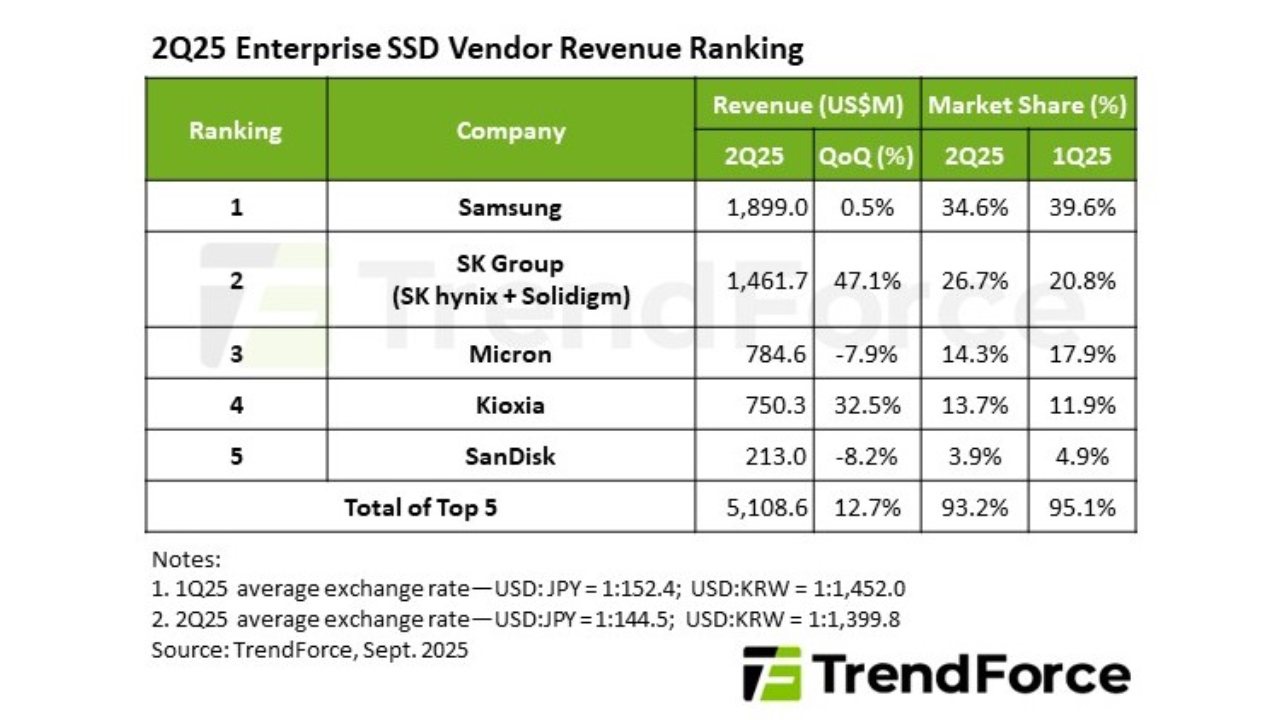
    The enterprise SSD sector is experiencing strong growth, driven by investments in infrastructure for artificial intelligence. Revenues for the top five players exceeded $5.1bn, growing 12.7% quarter-on-quarter.

    However, behind the optimistic data lie serious challenges in the supply chain that determine who wins and who gets left behind.

    The main driver of the market is the growing appetite for computing power, stimulated by the upcoming release of the Blackwell platform from NVIDA and the continued expansion of server rooms by North American cloud service providers (CSPs).

    New AI systems require ultra-fast and high-capacity storage media capable of handling gigantic language models without lag, which directly translates into a surge in enterprise SSD orders.

    Nevertheless, the market has collided with a supply barrier. Manufacturers are facing shortages of legacy DDR4 memory, used in SSD controllers, and extended lead times for chip substrates.

    These bottlenecks in production mean that not everyone is able to take full advantage of market prosperity. The ability to effectively manage inventory and plan production has become a key factor in determining financial performance.

    The leader remains Samsung, whose revenues remained stable at $1.9 billion.

    With a wide presence in the North American market and less susceptibility to DDR4 availability issues, the company has been able to capture a significant proportion of urgent orders, consolidating its dominance.

    The biggest winner of the quarter, however, was the SK Group (SK hynix and Solidigm). Reporting revenue growth of an impressive 47.1 per cent to $1.46 billion, the company broke its historic record. This success was driven by growing demand for high-capacity drives from key US cloud customers.

    In third place was Micron, with revenues of $784.6m, down 7.9%. The company is experiencing some delays in the validation process of its latest high-capacity media, which could limit its growth potential in the second half of the year.

    An excellent result was achieved by Kioxia, increasing revenues by 32.5% to $750 million. The Japanese manufacturer’s competitive advantage turned out to be its so-called hybrid binding technology, which is key to accelerating AI applications.

    Rounding out the pack is Western Digital, whose enterprise SSD division (included in the report as SanDisk) generated $213 million in revenue (down 8.2%).

    Despite growing shipments, the company’s limited presence in the AI server segment has left it behind its competitors.

    Analysts point out that the future of the market will be defined by three trends: the rapid pace of innovation forced by AI, increasing pressure from Chinese manufacturers and the need to balance new and older manufacturing technologies.

    Supply-demand mismatches may become the new normal and profitability will depend on precision in planning and agility in the supply chain.

    Trend Force, SSD
    Source: Trend Force