Tag: FinOps

  • The hangover from euphoria, or how AI agents can blow through a year’s budget in a few hours

    The hangover from euphoria, or how AI agents can blow through a year’s budget in a few hours

    Not so long ago, artificial intelligence was supposed to be the ‘ultimate solution’ to productivity problems – a digital alchemist turning empty process flows into pure efficiency gold. The ball was in full swing and the champagne was pouring from the presentations of the models promised by suppliers.

    Today, however, instead of more breakthroughs in machine reasoning, something far less spectacular is whispered about in the corridors of business conferences: the happiness bill. For it turns out that the ticket of admission to the world of AI was not a one-off fee, but a dynamic, hard-to-tame subscription for the future, the cost of which can rise exponentially overnight.

    What we are witnessing is the birth of ‘token fever’. It’s a state where the enthusiasm of engineers collides with the dismay of CFOs. For decades, we have been accustomed to the SaaS model – predictable, fixed licence fees that were easy to budget for. Generative AI has shattered this order, introducing a ‘probabilistic’ model. Here, a mistake in one agent’s logic or an overly effusive prompt can burn up financial resources faster than traditional cloud infrastructure consumes electricity.

    Uber and a mistake worth billions

    If the tech industry was looking for the ‘canary in the coal mine’, it found it in San Francisco in April 2026. At the IA HumanX conference, Praveen Neppalli Naga, Uber’s CTO, gave a speech that sobered even the biggest optimists. The giant, which had invested an astronomical $3.4 billion in research and development in 2025, faced a wall: its annual budget for artificial intelligence had evaporated in just four months.

    It wasn’t a matter of one misguided investment decision, but a side effect of an engineering fantasy with no brakes. Uber, aiming for aggressive technology adoption, encouraged its developers to use agents like Claude Code en masse. The result? 11% of back-end code was already being generated by artificial intelligence, but the price for this ‘efficiency’ proved deadly. Without proper performance filters and oversight of token consumption, AI ceased to be a lever for savings and became an out-of-control spending engine.

    The case of Uber is a classic example of a ‘tsunami of tokens’. Autonomous agents, entering infinite iteration loops with no clear limits, can burn a fortune in the time it takes to drink an espresso. It’s a painful lesson for any CIO: innovation without financial architecture is just a very expensive hobby. Naga admitted that the company had to go back to the design table to completely redefine its strategy. Any company that deploys AI today without a rigorous profitability analysis risks having its success measured not by margin growth, but by the speed with which it exhausts its own resources.

    Goodbye SaaS, hello volatility

    We are bidding farewell to an era where the IT budget was like a fixed Netflix subscription – predictable, secure and giving a false sense of control. For years, the SaaS model accustomed us to per-user licensing, where the only risk was a surplus of accounts that no one used. Generative AI brutally ends this period of ‘licensing peace of mind’ by introducing a billing model that is more akin to electricity bills during an energy crisis than traditional software.

    The shift from fixed costs to variable costs is a fundamental paradigm shift. In 2024, IT departments were buying AI access in a lump sum. Today, in 2026, vendors such as OpenAI and Anthropic have eliminated unlimited Enterprise plans, introducing dynamic billing for token consumption. The reason is mundane: AI agents have destroyed the distribution curve on which the old business was based. The subscription model only worked when the ‘lec’ users subsidised the ‘intensive’ ones. One, when we started employing autonomous agents, the differences became absurd. Analyses show cases where a user paying $100 a month generated costs of $5,600 in a single billing cycle. A subsidy ratio of 25 to 1 is a straightforward path to supplier bankruptcy, hence the sharp turn towards ‘use-pay’ billing.

    This makes IT spending probabilistic. This radically differentiates AI from the traditional cloud. A forgotten server in AWS generates a fixed, linear cost. A poorly designed prompt or agent without iteration limits, on the other hand, can go into a loop and generate millions of useless tokens in seconds. In this new world, a programmer’s logical error doesn’t end up ‘crashing’ the application – it ends up draining the company account at the speed of light. This means an immediate redesign of IT finance and the abandonment of rigid budget frameworks in favour of flexible management of the ‘economics of inference’.

    Tsunami of tokens – a new unit of risk

    In the modern CIO’s dictionary, a new, much more predatory term has emerged alongside ‘technical debt’: the ‘token tsunami’. This is a phenomenon in which autonomous agents, rather than freeing up staff time, fall into loops of endless iterations, burning up budgets with the intensity of a steel mill. The problem is that a bot, unlike a human, never feels fatigue or shame for duplicating mistakes – it simply consumes resources until it encounters a hard limit or empties its account.

    The scale of the problem is such that even the biggest players have had to revise their dogmas. Gartner is sounding the alarm: by the end of 2027, up to 40% of agent-based AI projects will be cancelled. The reason? Not a lack of vision, but brutal mathematics – rising costs while lacking precise tools to measure real business value.

    Here is where the biggest paradox of 2026 manifests itself: the unit price per token is steadily falling, but the total bill is rising. Indeed, AI agents consume between 5 and even 30 times more units per task than a standard chatbot. This is a classic trap of scale – an efficiency that becomes economically inefficient by its sheer volume. If your AI strategy is based solely on the hope that ‘models will be cheaper’, you’re just building a castle in the sand that the coming tsunami will wash away in one billing cycle. Without rigorous control over what machines process and why, modern IT becomes hostage to its own unbridled computing power.

    AI FinOps – the new alchemy of IT finance

    If you thought Cloud FinOps was challenging, get ready for a no-holds-barred ride. Traditional cloud optimisation was about simple craftsmanship: shutting down unused servers and keeping an eye on instance reservations. AI FinOps is a completely different discipline – it’s probabilistic rather than deterministic resource management. Here, the unit of expenditure is no longer processor man-hours, but the cost of a useful response relative to the cost of an erroneous or ‘hallucinated’ response.

    In 2026, as many as 98% of FinOps teams consider spending on AI as their number one priority. The reason is simple: in the traditional cloud, a technical error rarely leads to an exponential increase in cost. In the world of AI agents, misconfigured prompt logic can burn through budgets faster than you can refresh your dashboard. This is forcing IT leaders to define a new metric – the economics of inference. We no longer count how much a model costs us, but how much the operational success gained from its work costs us.

    And that means rewriting dashboards from scratch. Classic management frameworks such as ITIL 4 or COBIT, while providing a solid base, today require immediate extensions to include prompt lifecycle management or agent iteration limits. AI FinOps is not just about Excel tables; it is a new management philosophy where an engineer must think like an economist and a financier must understand LLM architecture. Without this synergy, buying tokens is akin to pouring rocket fuel into a hole in the tank – the effect is spectacular, but extremely short-lived and frighteningly expensive.

    How not to burn through a decade of innovation

    The time window for non-punitive errors has just slammed shut. To avoid a ‘token tsunami’, organisations need to move from a phase of joyful adaptation to a phase of rigorous architecture. The first and most pressing step is to conduct a token consumption audit – not a general one, but a precise one, broken down by specific teams and use cases. When a query to a model can cost as much as a good cup of coffee, we need to know who is ordering a double espresso without a clear business need.

    The key to financial survival is the implementation of three technical foundations:

    • RAG (Retrieval-Augmented Generation): Providing the model with only the data it actually needs, drastically reducing the token ‘diet’.
    • Specialist models: Abandoning the ‘all-knowing’ giants in favour of smaller, cheaper and finely-trained models for repetitive tasks.
    • Corporate charter for the bot: Establish rigid iteration limits and budgets per agent. This is a matter of elementary financial hygiene.

    We also need to review how our people work with the technology. Identifying the ‘Centaurs’ (experts empowering their AI skills) and eliminating the ‘Automators’ (unreflectively delegating work to a machine) will allow a real increase in ROI. The most expensive and fastest way to waste an innovation budget is to buy millions of tokens just to have teams working exactly as they will in 2022, only with an on-screen chat interface.


     

  • The paradox of on-demand technology: cloud and AI innovation paid for by rising costs and chaos

    The paradox of on-demand technology: cloud and AI innovation paid for by rising costs and chaos

    Companies around the world are aggressively investing in on-demand technologies such as the public cloud, software as a service (SaaS) and generative artificial intelligence. The aim is to accelerate innovation and maintain competitive advantage.

    But a new global report from Capgemini Research Institute, based on a survey of 1,000 managers from organisations with revenues of more than US$1bn, reveals a hard truth: rising costs, complexity and lack of oversight are beginning to threaten the viability of these critical investments.

    A surge in investment and expectations

    The transformation towards consumer models is a reality. According to the report, the share of on-demand technology in IT budgets is set to increase from the current 29% to 41% over the next year.

    For the majority of business leaders (77%), the scalability and performance of the cloud is the foundation for growth, enabling faster time to market. Nevertheless, behind this enthusiasm lie significant operational and financial challenges.

    The hidden costs of digital transformation

    The Capgemini study identifies key problem areas that undermine the benefits of flexible technology models.

    • Uncontrolled cost growth: As many as 82% of executives surveyed report significant increases in spending on cloud, SaaS and Gen AI. The problem is not only price increases, but also notorious budget overruns. 76% of organisations spent more on the public cloud than they anticipated (by an average of 10%), and similar problems affected budgets for Gen AI (68%) and SaaS (52%). The main reasons were inefficient use of resources and decentralised, uncontrolled purchasing.
    • IT in the shadows and security risks: Purchasing decisions are increasingly being made outside IT departments. Business units already account for 59% of spend on generative AI and 48% on SaaS. What’s more, an estimated 12% of all software-as-a-service spending remains completely outside any form of governance. Almost all managers (98%) admit that they make technology purchases bypassing the IT department, leading to inefficiencies, duplication of tools and the creation of security vulnerabilities.
    • Disappointing return on investment: Despite the huge financial outlay, the real benefits often remain below expectations. Only 29% of companies achieved the anticipated cost savings from SaaS implementations. Similarly, only 33% achieved the desired quality of cloud services and 38% saw the expected acceleration of innovation through generative artificial intelligence.

    FinOps: a theoretical solution, immature in practice

    The answer to cloud cost management chaos is supposed to be the discipline of FinOps. And while 76% of organisations have or plan to implement dedicated teams in this area, their approach is still in its infancy.

    Most companies focus on basic cost monitoring tools, but only 37% regularly analyse this data and take optimisation measures based on it.

    Most symptomatically, only 2% of FinOps teams manage cloud, SaaS and Gen AI costs in an integrated way. This shows that FinOps is still seen as an operational tool, rather than a strategic function influencing business decisions.

    Sustainability: the forgotten dimension of optimisation

    Inefficient management of on-demand technologies also has an environmental dimension. More than half of companies (53%) agree that sub-optimal use of resources leads to excessive energy consumption and increased carbon emissions.

    Despite this awareness, only 36% have a strategy that integrates sustainability goals with financial operations. Optimising resources, switching off unused instances or designing energy-efficient architectures are actions that can bring both financial and environmental benefits.

    The paradox of on-demand technology is that tools created to increase agility and efficiency, without proper oversight, become a source of chaos and unpredictable costs. The data clearly shows that the way to realise their full potential is through mature, integrated financial, security and sustainability management.

  • How do you effectively manage AI costs in the cloud? The answer is FinOps

    How do you effectively manage AI costs in the cloud? The answer is FinOps

    There is a new gold rush in the world of technology, and its name is Artificial Intelligence. Every organisation, from a startup to a global corporation, wants to implement its predictive models, intelligent chatbots and recommendation systems.

    The public cloud, with its promise of infinite scalability and flexibility, seems the ideal place to realise these ambitions. AI is the ticket to innovation and gaining competitive advantage. Enthusiasm reigns and the possibilities seem endless. And then comes the bill.

    Suddenly, the promise of a revolution turns into a headache for IT and finance departments. It turns out that training advanced models and handling millions of queries in real time generates costs that can surprise even the most experienced managers.

    This scenario is becoming increasingly common. For artificial intelligence to become a true friend of business and not a financial nightmare, it needs a strategic partner. That partner is FinOps – the culture and practice of cloud-aware financial management that reconciles innovation with profitability.

    Appetite grows, and with it the bills

    AI has long ceased to be the domain of experiments in laboratories. It is a powerful business tool in which companies are investing huge resources. It is no surprise that more than 40 per cent of IT budgets are now being spent on expanding cloud capabilities, mainly to handle AI workloads.

    Technology leaders are well aware of the challenge ahead, with almost as many (40%) specifically citing artificial intelligence as one of the main factors that will drive up IT costs over the next three years.

    The problem is that AI costs are not linear. They consist of powerful and expensive graphics processing units (GPUs), the transfer and storage of gigantic data sets and the constant running of models in production mode. This complexity overlaps with the already existing problem of controlling expenditure in the cloud.

    With almost all (94%) IT leaders admitting they face challenges in optimising cloud costs, and nearly half (44%) of organisations having limited visibility into their spend, adding resource-intensive AI to the equation is a simple recipe for financial disaster.

    Unforeseen cost spikes are becoming the norm rather than the exception.

    To the rescue of FinOps: The cost charmer in the age of AI

    This is when FinOps enters the scene. It’s much more than just cost monitoring tools. It is a cultural shift that builds bridges between technology, finance and business teams. It aims to instil shared responsibility for spending in the cloud, where every engineer and developer understands the financial implications of their decisions.

    In the context of artificial intelligence, the role of FinOps becomes crucial and covers three main areas:

    • Forecasting: Rather than acting blindly, FinOps practices allow you to estimate the costs of AI projects before they even take off. This enables informed decisions to be made about whether a project makes business sense.
    • Continuous optimisation: FinOps teams act as personal trainers for the cloud infrastructure. They identify unused or oversized resources, help select the right machine instances and take care of cost “hygiene” on a daily basis.
    • Allocating and measuring value: FinOps allows every dollar spent on the cloud to be precisely allocated to a specific product, project or department. This allows the business to finally answer the fundamental question: is our investment in AI actually paying off?

    The technological ‘power couple’ in practice

    What does AI and FinOps collaboration look like in action? Let’s imagine a few scenarios. A data science team wants to train a new complex model. Instead of running the most expensive GPU instances on-demand, thanks to FinOps they can schedule this process for overnight hours, using much cheaper spot instances.

    Another example is a model that supports recommendations in an online shop. Instead of maintaining full computing power 24/7, the systems automatically scale during peak hours and almost shut down at night, generating huge savings.

    The most important aspect, however, is to link costs to real business value. With FinOps, a company can see that although the new recommendation model costs 20% more, it has simultaneously increased conversions by 35%. This turns the discussion about costs into a conversation about a strategic, measurable investment.

    Sustainable innovation

    Investing in AI without a solid FinOps foundation is like sailing on a rough ocean without a map and compass – an exciting but extremely risky expedition. Combining the power of AI with informed financial management is today’s new standard for creating sustainable and profitable innovations.

    It is through this approach that artificial intelligence can fully realise its promise and become a reliable best friend in the development of any organisation.

  • From chaos to control: how a FinOps partner builds value and reduces cloud costs

    From chaos to control: how a FinOps partner builds value and reduces cloud costs

    The public cloud was supposed to be a revolution in IT economics. The promise of flexibility, on-demand scalability and a pay-as-you-go model painted a vision of a world where companies only pay for what they need. However, the reality turned out to be much more complicated and, for many organisations, much more expensive.

    Today, for an increasing number of IT and finance directors, the public cloud, rather than being a tool for optimisation, has become synonymous with an uncontrolled budget drain. The figures are alarming.

    According to Flexera’s ‘State of the Cloud’ report, wasteful spending on the public cloud reaches an average of 32%. Globally, this translates into an astronomical amount of more than $225 billion lost in 2024 alone.

    The problem is so acute that managing cloud spend is, for the second year running, the top challenge for companies worldwide, even overtaking security issues.

    The ‘gold rush’ phase and the mass migration to the cloud is over.

    Now the IT industry faces a much tougher challenge: achieving operational excellence and implementing financial governance in this new dynamic environment.

    Anatomy of lost control: why are cloud bills rising?

    In order to effectively manage costs, it is first necessary to understand the fundamental causes of their escalation. This is a confluence of technological, organisational and cultural factors, which together create the ideal conditions for the emergence of ‘cloud debt’.

    • Lack of visibility (The Visibility Gap) is the most fundamental problem. Organisations cannot optimise what they cannot see. As much as 54% of waste in the cloud is directly attributable to a lack of insight into cost structure. Traditional finance departments are presented with a single, aggregate bill that, without specialised tools, is impossible to accurately allocate to specific teams or projects. This leads to companies employing ‘blind’ management strategies, with no idea who is generating the expenditure and why.
    • Cloud Sprawl (Disorder and Resource Proliferation) is another scourge. The ease with which new resources can be deployed without proper oversight is becoming its biggest drawback. This phenomenon, compounded by ‘Shadow IT’ (deploying services without the knowledge of central IT), leads to a chaotic growth of instances and services. In a world where any developer can run a powerful infrastructure, purchasing power has been decentralised, but financial accountability rarely follows.
    • The ‘Lift-and-Shift’ migration trap is often a financial Trojan horse. Moving existing applications from your own data centre to the cloud unchanged is quick, but proves costly in the long run. Applications designed for a static on-premise environment are unable to take advantage of the flexibility of the cloud. They run 24/7, generating costs even when they are idle, which is a simple way to overpay. Thus, companies are moving not only their applications but also old inefficiencies to the cloud.

    A direct consequence of these problems is overprovisioning, i.e. allocating far more resources (computing power, memory) than is actually needed. For fear of performance problems, developers often choose instances ‘over-provisioning’, which is a major source of waste.

    FinOps and the role of the partner: the answer to cost chaos

    In response to the growing financial chaos, a new discipline has been born: FinOps. It is a holistic operational practice and cultural shift that aims to fundamentally change the way an organisation thinks about technology spend.

    The main goal of FinOps is not to save money at all costs, but to maximise the business value from every penny spent in the cloud. It is about finding a smart balance between cost, speed of innovation and quality of service.

    FinOps breaks down traditional silos, creating a bridge between engineering, finance and business teams. However, implementing a successful FinOps practice is a complex undertaking. It requires a unique combination of technical, financial and soft skills.

    Few companies have this set-up within their own ranks, with as many as 64% of organisations reporting staff shortages in the cloud area.

    In this context, the specialised IT partner becomes a strategic consultant and value architect. His or her role is to bridge this competence gap and accelerate the customer journey through the successive stages of FinOps maturity, which can be described in three phases:

    1. Inform: The partner implements tools and processes to ensure full cost transparency. Key here is the establishment of a consistent resource tagging policy that allows every dollar of expenditure to be accurately allocated to the appropriate team or project.
    2. Optimize: Armed with data, the partner moves into action. He or she brings ready-made strategies such as identifying and eliminating waste, ‘rightsizing’ (matching instance size to load) and intelligent commitment management (Reserved Instances/Savings Plans). Effective action in this phase can result in savings of 20-40%.
    3. Operate: This is the most important phase where the partner helps to embed FinOps practices into the day-to-day operations of the organisation, building the client’s internal capacity to manage costs sustainably on its own.

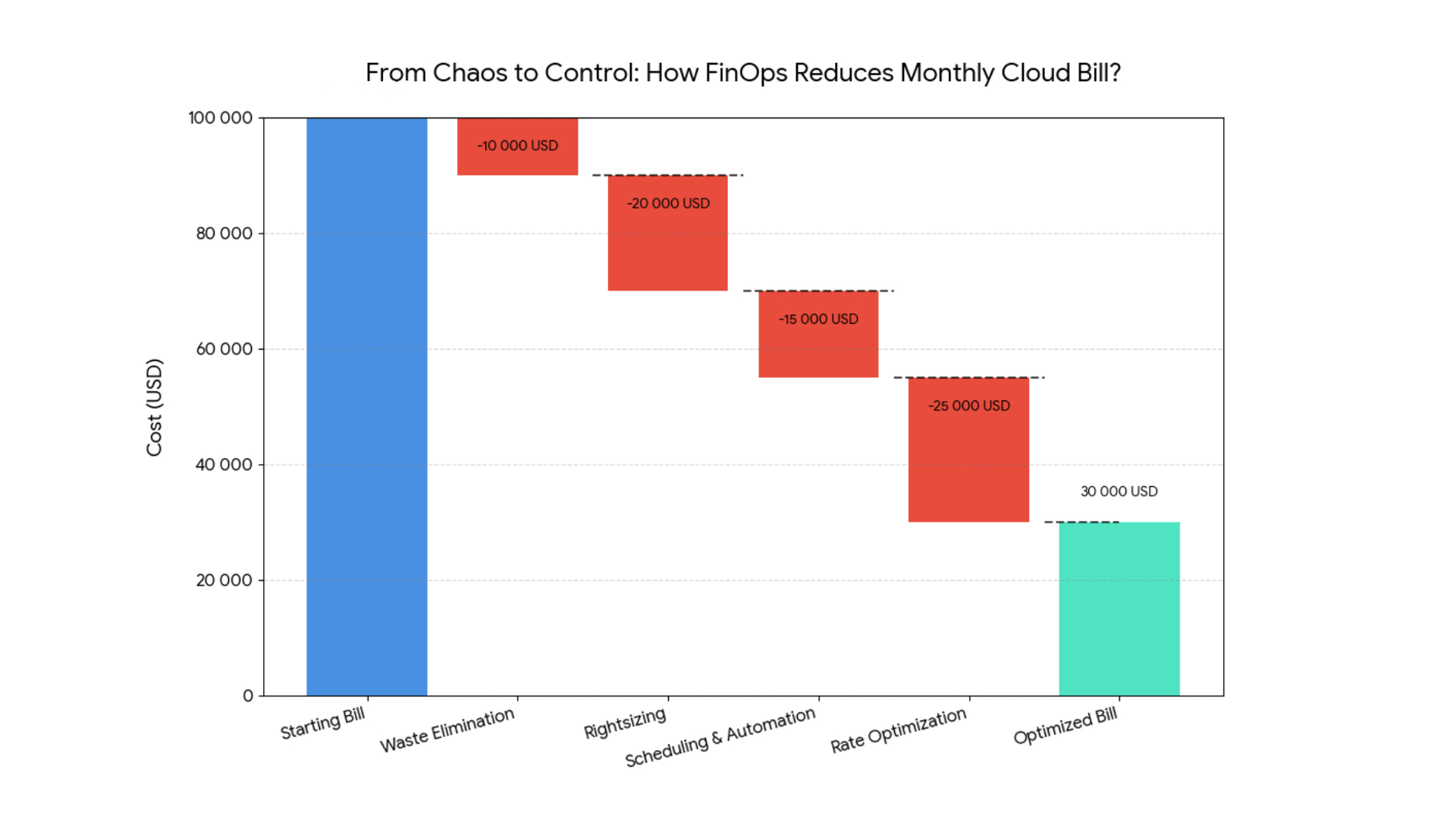
    Optimisation plan in practice: from chaos to control

    Working with a FinOps partner translates into a concrete, structured action plan that takes the organisation from chaos to predictability.

    Step 1: Visibility and Waste Elimination (Quick Wins)

    The process starts with cleaning up the environment. The partner implements consistent resource tagging and scans the environment for ‘zombie resources’ – unused disks, obsolete snapshots or idle load balancers that continue to generate costs. Their elimination results in immediate savings of 5-15% of the total bill.

    Step 2: Optimising Efficiency Gains

    The partner then focuses on efficiency. Rightsizing is key here. By analysing historical data, it identifies oversized resources and recommends reducing them, which can reduce costs by up to 40%. In parallel, automation is implemented that shuts down development and test environments out of hours, which can reduce their cost by up to 60-66%.

    Step 3: Rate Optimisation

    Once the resources are used efficiently, it is time to optimise the price. For workloads of a stable nature, the partner recommends purchasing discount instruments such as Reserved Instances (RI) or Savings Plans (SP). Committing to one or three years of computing power can give discounts of up to 75%. For interrupt-resistant tasks, spot instances are implemented, which offer discounts of up to 90%.

    Step 4: Architectural Optimisation (Strategic Value)

    This is the most advanced stage. The partner, in collaboration with the client’s architects, analyses the applications transferred by the lift-and-shift method. It identifies those whose refactoring towards modern, cloud-based architectures (e.g. serverless, microservices) will yield the greatest return on investment. Although refactoring requires an initial outlay, in the long term it leads to a drastic reduction in operating costs and unlocks the true economic potential of the cloud.

    An investment in FinOps is an investment in the future

    The journey to the cloud that began with the promise of savings has, for many companies, turned into a struggle to control costs. The problem of wastage of more than 30% is not an anomaly, but the new, painful norm.

    Cloud cost management is no longer a one-off IT project. It has become an ongoing, strategic business function. The answer to this challenge is FinOps – a cultural shift that brings financial accountability to the heart of technology operations.

    However, the road to FinOps maturity is long and requires unique, interdisciplinary competences. For most organisations, working with a specialised IT partner is becoming not a luxury, but a strategic accelerator.

    An experienced partner brings knowledge, tools and proven methodologies that enable companies to achieve a measurable return on their cloud investments faster.

    The ultimate goal is sustainable transformation – transforming the cloud from an unpredictable cost centre to an efficient engine that drives innovation and generates real business value.